



Community hub
Recent from talks
Contribute something
Nothing was collected or created yet.
Vietnamese đồng
View on Wikipedia
| Đồng Việt Nam (Vietnamese) | |||||
|---|---|---|---|---|---|
| |||||
| ISO 4217 | |||||
| Code | VND (numeric: 704) 1989–1990: VNC | ||||
| Unit | |||||
| Plural | The language(s) of this currency do(es) not have a morphological plural distinction. | ||||
| Symbol | ₫/đ | ||||
| Denominations | |||||
| Subunit | |||||
| 1⁄10 | hào (chữ Hán: 毫) | ||||
| 1⁄100 | xu (from French sou) both subunits are obsolete due to inflation and have been unused in Vietnam for several decades | ||||
| Banknotes | |||||
| Freq. used | 1,000₫, 2,000₫, 5,000₫, 10,000₫, 20,000₫, 50,000₫, 100,000₫, 200,000₫, 500,000₫ | ||||
| Rarely used | 50₫ (commemorative), 100₫ (commemorative), 100₫, 200₫, 500₫, 500,000₫ (commemorative) | ||||
| Demographics | |||||
| User(s) |  Vietnam Vietnam | ||||
| Issuance | |||||
| Central bank | State Bank of Vietnam | ||||
| Website | www.sbv.gov.vn | ||||
| Valuation | |||||
| Inflation |  2.7% (2019)[1] 2.7% (2019)[1] | ||||


The dong (Vietnamese: đồng; /dɒŋ/; Vietnamese: [ˀɗɜwŋ͡m˨˩]; sign: ₫ or informally đ and sometimes Đ in Vietnamese;[2] code: VND) is the currency of Vietnam, in use since 3 May 1978.[3][4] It is issued by the State Bank of Vietnam.[5] The dong was also the currency of the predecessor states of North Vietnam and South Vietnam, having replaced the previously used French Indochinese piastre.[6][7]
Formerly, it was subdivided into 10 hao (hào), which were further subdivided into 10 xu, neither of which are now used due to inflation. The Vietnamese dong has increasingly moved towards exclusively using banknotes, with lower denominations printed on paper and denominations over 10,000 dong, worth about 40¢ dollar or euro, printed on polymer. As of 2022, no coins are used. Generally, Vietnam is moving towards digital payments.[8][9][10] The 500,000-dong note (VND) is the highest-denomination banknote in circulation in Vietnam.[11] The note is dark blue in color and has been in circulation since 2003.[12][13][14][15]
As of September 2025, the Vietnamese dong is the third-lowest valued currency unit (behind the Iranian rial and the Lebanese pound), with one United States dollar equaling 26,387 dong.[16]
Etymology
[edit]The word đồng is the Sino-Vietnamese word for copper. (Chữ Hán: 銅)
History
[edit]French Indochina
[edit]The piastre (known in Vietnam as "silver"), was the currency of French Indochina between 1885 and 1952.
North Vietnam
[edit]In 1946, the Viet Minh government (later to become the government of North Vietnam) introduced its own currency, the dong, to replace the French Indochinese piastre at par. Two revaluations followed, in 1951 and 1959; the first was at a rate of 100:1, the second at a rate of 1,000:1.
South Vietnam
[edit]
Notes dually denominated in piastres and dong were issued in 1953 for the State of Vietnam, which evolved into South Vietnam in 1954. On 22 September 1975, after the fall of Saigon, the currency in South Vietnam was changed to a "liberation dong" worth 500 old Southern dong.
United Vietnam and inflation
[edit]After Vietnam was reunified, the dong was also unified on 3 May 1978. One new dong equalled one Northern dong or 0.8 Southern "liberation" dong.
On 14 September 1985, the dong was revalued again, with one new dong worth 10 old dong. At that time, Vietnamese economists believed that revaluing the currency would increase its value, but it turned out to have the opposite effect: savings of many people were wiped out, the currency experienced unprecedentedly heavy inflation that peaked at 700% in September 1986 and prices skyrocketed. For example, in 1986, the price of agricultural products increased by 2000% compared to ten years before. Aiming to solve this problem, the government banned all forms of non-state-owned internal trade, which they believed to be capitalistic, resulting in an economic crisis so severe that Tố Hữu referred to it as a "vertical downturn".[citation needed] Despite the inflation rates having stabilized as part of the Đổi Mới reforms, especially during the 1990s and early 2000s, the effects of the crisis still last in the value of the dong, one of the lowest in the world today.[17]
Coins
[edit]First dong
[edit]In 1978, aluminum coins dated 1976 were introduced in denominations of 1, 2 and 5 hao, as well as 1 dong. The coins were minted by the Berlin Mint in the German Democratic Republic and bear the state crest on the obverse and denomination on the reverse. Due to the chronic inflation experienced by Vietnam during the 1980s and 1990s, these coins lost all their relevant value and no coins were circulated for many years after this series.
| Image | Value | Technical parameters | Description | Date of | ||||||||
|---|---|---|---|---|---|---|---|---|---|---|---|---|
| Diameter | Thickness | Mass | Composition | Edge | Obverse | Reverse | First Minting | Issue | Issue Suspended | Withdrawal | ||
| 1 hao | Unknown | Aluminum | Reeded | Coat of arms | Denomination | 1976 | 2 May 1978 | 14 September 1985 | ||||
| 2 hao | ||||||||||||
| 5 hao | ||||||||||||
| 1 dong | ||||||||||||
| These images are to scale at 2.5 pixels per millimetre. For table standards, see the coin specification table. | ||||||||||||
Second dong
[edit]Commemorative issues
[edit]Commemorative coins in copper, brass, copper-nickel, silver, and gold have been issued since 1986, but none of these have ever been used in circulation.
2003 issue
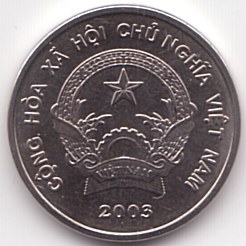
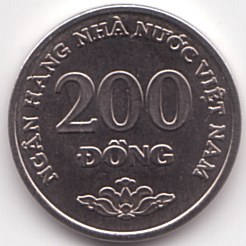
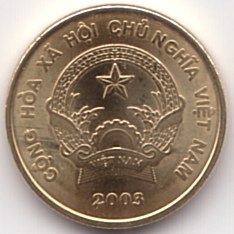
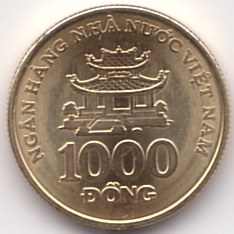
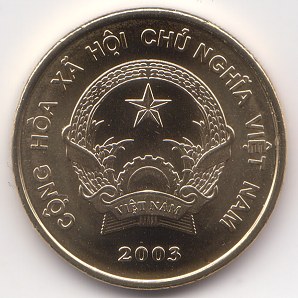
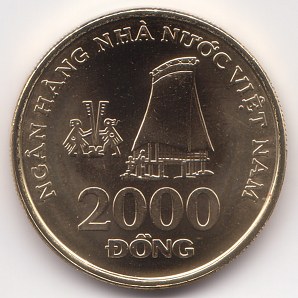
[edit]The State Bank of Vietnam resumed issuing coins on 17 December 2003.[18] The new coins, minted by the Mint of Finland, were in denominations of 200, 500, 1,000, 2,000, and 5,000 dong in either nickel-clad steel or brass-clad steel. Prior to its reintroduction, Vietnamese consumers had to exchange banknotes for tokens with a clerk before purchasing goods from vending machines. This was also to help the state ease the cost of producing large quantities of small denomination banknotes, which tended to wear easily. Many residents expressed excitement at seeing coins reappear after many years, as well as concern for the limited usefulness of the 200 dong coins due to ongoing inflationary pressures.[19]
Since the launch of the 2003 coin series, the State Bank has had some difficulties with making the acceptance of coins universal despite the partial discontinuation of smaller notes, to the point of some banks refusing coin cash deposits or the cashing in of large numbers of coins. This has prompted laws requiring private and municipal banks to transact and offer services for coins and the full discontinuation of small denomination and cotton-based notes. Also, the coins did not gain popularity from the Vietnamese people.[20] Eventually, State Bank of Vietnam withdrew its distribution in April 2011.[21][22]
| Image | Value | Technical Parameters | Description | Date of | ||||||||
|---|---|---|---|---|---|---|---|---|---|---|---|---|
| Diameter | Thickness | Mass | Composition | Edge | Obverse | Reverse | First Minting | Issue | Issue Suspended | Withdrawal | ||
| [23][24] | 200 dong | 20 mm | 1.45 mm | 3.2 g | Nickel-plated steel | Plain | Coat of arms | Denomination | 2003 | 17 December 2003 | April 2011 | Very rare, partly withdrawn out of circulation |
| 500 dong | 22 mm | 1.75 mm | 4.5 g | Nickel-plated steel | Segmented (3 groups) | 1 April 2004 | ||||||
| [25][26] | 1,000 dong | 19 mm | 1.95 mm | 3.8 g | Brass-plated steel | Reeded | Coat of arms | Water Temple, Đô Temple | 2003 | 17 December 2003 | April 2011 | Very rare, partly withdrawn out of circulation |
| [27][28] | 2,000 dong | 23.5 mm | 1.8 mm | 5.1 g | Brass-plated steel | Segmented (6 groups) | Highland Stilt house in Tay Nguyen | 1 April 2004 | ||||
| 5,000 dong | 25.5 mm | 2.2 mm | 7.7 g | Brass (Cu92Al6Ni2) | Micro-scalloped | Một Cột Pagoda (One Pillar Pagoda) | 17 December 2003 | |||||
| These images are to scale at 2.5 pixels per millimetre. For table standards, see the coin specification table. | ||||||||||||
Banknotes
[edit]First dong
[edit]In 1978, the State Bank of Vietnam (Ngân hàng Nhà nước Việt Nam) introduced notes in denominations of 5 hao, 1, 5, 10, 20, and 50 dong dated 1976. In 1980, 2 and 10 dong notes were added, followed by 30 and 100 dong notes in 1981. These notes were discontinued in 1985 as they gradually lost value due to inflation and economic instability.
| Image | Value | Dimensions | Main Color | Description | Date of | ||||
|---|---|---|---|---|---|---|---|---|---|
| Obverse | Reverse | Printing | Issue | Issue Suspended | Withdrawal | ||||
| 5 hao | 107 × 53 mm | Purple-Brown | Coat of Arms | Coconut palm | 1976 | 2 May 1978 | 14 September 1985 | ||
| 1 dong | 115 × 57 mm | Brown | Thai Nguyen Iron and Steel Corporation | ||||||
| 2 dong | 115 × 58 mm | Purple | River Scene | 1980 | 1980 | ||||
| 5 dong | 123 × 61 mm | Green | Fishery | 1976 | 2 May 1978 | ||||
| 10 dong | 131 × 63 mm | Purple-Blue | Elephant, logging | ||||||
| 131 × 65 mm | Purple | Ho Chi Minh house | 1980 | 1980 | |||||
| 20 dong | 141 × 70 mm | Blue | Ho Chi Minh | Tractors, hydroelectric dam | 1976 | 2 May 1978 | |||
| 30 dong | 143 × 71 mm | Red-Brown | Freighters; "Dragon's House" (Nha Rong), Ho Chi Minh museum, Saigon | 1981 | 1981 | ||||
| 50 dong | 151 × 75 mm | Red | Hong Gai open pit mining | 1976 | 2 May 1978 | ||||
| 100 dong | 158 × 80 mm | Brown-Yellow | Ha Long Bay | 1980 | 1980 | ||||
| These images are to scale at 0.7 pixel per millimetre (18 pixel per inch). For table standards, see the banknote specification table. | |||||||||
Second dong
[edit]In 1985, notes were introduced in denominations of 5 hao, 1, 2, 5, 10, 20, 30, 50, 100, and 500 dong. As inflation became endemic, these first banknotes were followed by 200, 1,000, 2,000, and 5,000 dong notes in 1987, by 10,000 and 50,000 dong notes in 1990, by a 20,000 dong note in 1991, a 100,000 dong note in 1994, a 500,000 dong note in 2003, and a 200,000 dong note in 2006. Banknotes with denominations of 5,000 dong and under have been discontinued from production, but as of 2015 are still in wide circulation.[29]
Five banknote series have appeared. Except for the current series, dated 2003, all were confusing to the user, lacking unified themes and coordination in their designs. The first table below shows the latest banknotes, of 100 dong or higher, prior to the current series.
On 7 June 2007, the government ordered cessation of the issuance of the cotton 50,000 and 100,000 dong notes.[citation needed] They were taken out of circulation by 1 September 2007. State Bank of Vietnam 10,000 and 20,000 dong cotton notes are no longer in circulation as of 1 January 2013.[30]
| Image | Value | Dimensions | Main Color | Description | Date of | ||||
|---|---|---|---|---|---|---|---|---|---|
| Obverse | Reverse | printing | issue | issue suspended | withdrawal | ||||
| 5 hao | 100 × 50 mm | Pink | Flag Tower of Hanoi | Denomination | 1985 | 14 September 1985 | Unknown | ||
| 1 dong | 114 × 57 mm | Blue-Green | Hòn Phụ Tử (Father and Son islet) | ||||||
| 2 dong | 110 × 56 mm | Purple | Boats | ||||||
| 5 dong | 128 × 64 mm | Green | Boats in Hue | ||||||
| 10 dong | Red | Ngoc Son Temple | |||||||
| 20 dong | Purple | Ho Chi Minh | One Pillar pagoda | ||||||
| 30 dong | 150 × 75 mm | Blue | Ben Thanh Market | ||||||
| 50 dong | Green | Thac Ba hydro power plant | |||||||
| 149 × 75 mm | Pink | Thang Long bridge | 1987 | ||||||
| 100 dong | 158 × 78 mm | Brown | Rice planting | 14 September 1985 | |||||
| 500 dong | Red | Bim Son cement plant | |||||||
| These images are to scale at 0.7 pixel per millimetre (18 pixel per inch). For table standards, see the banknote specification table. | |||||||||
Third dong
[edit]| Image | Value | Dimensions | Main Color | Description | Date of | ||||
|---|---|---|---|---|---|---|---|---|---|
| Obverse | Reverse | Printing | Issue | Issue Suspended | Withdrawal | ||||
| 100 dong | 120 × 60 mm | Green | Coat of Arms | Phổ Minh Temple | 1991 | 2 May 1992 | 1994 | Current, but rarely used | |
| 200 dong | 130 × 65 mm | Orange | Ho Chi Minh | Agricultural production | 1987 | 30 September 1987 | 2015 | ||
| 500 dong | Pink | Port Haiphong[31] | 1988 | 15 August 1989 | |||||
| 1,000 dong | 134 × 65 mm | Brown-Green | Coal Mining | 1987 | 2 March 1988 | 20 October 1989 | |||
| 2,000 dong | Brown-Pink | Thai Nguyen Iron and Steel Corporation | |||||||
| 1,000 dong | Green | Lumber production | 1988 | 20 October 1989 | 2015 | Current | |||
| 2,000 dong | Pink | Textile factory | |||||||
| 5,000 dong | Blue | Offshore platform | 1987 | 2 March 1988 | 15 January 1993 | ||||
| Trị An hydropower plant | 1991 | 15 January 1993 | 2015 | Current | |||||
| 10,000 dong | 140 × 68 mm | Red | Hạ Long Bay | 1990 | 2 May 1992 | 1994 | 1 January 2013 | ||
| 1993 | 15 October 1994 | 2006 | |||||||
| 20,000 dong | Blue | Canned food factory | 1991 | 2 March 1993 | |||||
| 50,000 dong | Green | Nhà Rồng Port | 1990 | 1994 | 1 September 2007 | ||||
| 1994 | 15 October 1994 | 2003 | |||||||
| 100,000 dong | 145 × 71 mm | Brown | Ho Chi Minh's ethnic house | 1 September 2000 | 2004 | ||||
| These images are to scale at 0.7 pixel per millimetre (18 pixel per inch). For table standards, see the banknote specification table. | |||||||||
The one-hundred-dong bill technically remains in circulation, however due to its low value (roughly US$0.004) it is rarely ever used for transactions. The bill is largely seen as a collectible or an oddity, with it often selling for many times its original face value.[32][33]
In 2003 Vietnam began replacing its cotton banknotes with plastic polymer banknotes, claiming that this would reduce the cost of printing.[34] Many newspapers in the country criticized these changes, citing mistakes in printing and alleging that the son of the governor of the State Bank of the Vietnam benefited from printing contracts.[34] The government clamped down on these criticisms by banning two newspapers from publishing for a month and considering other sanctions against other newspapers.[34] Even though the 2003 series banknotes listed in the table below have now completely replaced the old notes of the same denominations, as of 2019 the cotton fibre banknotes of 200, 500, 1,000, 2,000, and 5,000 dong still remain in wide circulation and are universally accepted.[citation needed]
| Image | Value | Dimensions | Main Color | Description | Date of | |||||
|---|---|---|---|---|---|---|---|---|---|---|
| Obverse | Reverse | Obverse | Reverse | Printing | Issue | Issue Suspended | Withdrawal | |||

|

|
10,000 dong | 132 × 60 mm | Yellow | Ho Chi Minh | Bạch Hổ oil field | The first two digits of the serial number give the last two digits of the year of issue. | 30 August 2006 | Current | |

|

|
20,000 dong | 136 × 65 mm | Blue | Covered bridge in Hội An | 17 May 2006 | ||||
| 50,000 dong | 140 × 65 mm | Pink | Huế | 17 December 2003 | ||||||
| 100,000 dong | 144 × 65 mm | Green | Temple of Literature | 1 September 2004 | ||||||
| 200,000 dong | 148 × 65 mm | Red | Hạ Long Bay | 30 August 2006 | ||||||
| 500,000 dong | 152 × 65 mm | Cyan | Ho Chi Minh's birthplace in Kim Liên | 17 December 2003 | ||||||
| These images are to scale at 0.7 pixel per millimetre (18 pixel per inch). For table standards, see the banknote specification table. | ||||||||||
A commemorative polymer 50 dong banknote dedicated to the fiftieth anniversary of the State Bank of Vietnam was issued in 2001, but its face value is so tiny that it clearly was meant only for collectors. The note is available in three forms, by itself, in a presentation folder or in a presentation folder in an envelope. In 2016, a 100 dong banknote was issued on cotton-based paper to commemorate the 65th anniversary of central banking.
| Image | Value | Dimensions | Main Color | Materials | Description | Date of | ||||
|---|---|---|---|---|---|---|---|---|---|---|
| Obverse | Reverse | Printing | Issue | |||||||
| 50 dong | 165 × 82 mm | Pink | Polymer | Ho Chi Minh | State Bank of Vietnam | 2001 | May 2001 | |||
| 100 dong | 163 × 82 mm | Red | Paper | 2016 | 6 May 2016 | |||||
| These images are to scale at 0.7 pixel per millimetre (18 pixel per inch). For table standards, see the banknote specification table. | ||||||||||
Bearer's checks 1992–2002
[edit]To support the growing industrial need for large money transactions, the State Bank issued "Bearer's Checks" or "State Bank Settlement Checks" (Ngân Phiếu Thanh Toán) in denominations from 100,000 to 5,000,000 dong.[36] To prevent counterfeiting, these notes had many degrees of protection, their designs were changed every five to six months, and they had expiration dates five or six months after the date of issue. The checks worked until the banking system was upgraded to handle electronic transfers of large amounts of đồng, making most large transactions unnecessary.
Currency devaluation
[edit]In November 2009, the Vietnamese government decided to devalue the Vietnamese dong by 5% and at the same time raise interest rates to 8%. This was seen as a move that could destabilize the financial markets in Asia, as economies in the region were competing for an advantage over the European and American markets.[37]
On 11 February 2010, the State Bank of Vietnam (SBV) adjusted the interbank exchange rate between the Vietnamese dong (VND) and the US dollar (USD) to 18,544 VND/USD, a devaluation of 3.25% from the previous rate of 17,941 VND/USD.[38] 17 August 2010, The SBV further devalued the VND by 2.04% to 18,932 VND/USD, an increase of 388 dong from the previous rate.[38][39]
On 11 February 2011, the SBV announced a decision to increase the interbank exchange rate between USD and VND from 18,932 VND to 20,693 VND (a 9.3% increase).[40][41][42][43] Along with that, the SBV also narrowed the applicable range for the exchange rates of commercial banks from ±3% to ±1%.[44] However, by 19 February 2011, the USD exchange rate on the black market was 22,300 VND.[citation needed]
2022 to 2024
[edit]In response to increasing pressure on the Vietnamese dong as a result of high inflation in the US, on 17 October 2022, the decision was made to increase the dong's trading band from 3 to 5 percent. As a result, from 16 October to 24 October the currency lost 2.98 percent of its value falling from 24,135 to 24,845 Vietnamese dong to the dollar.[45] This decline has continued into 2024 with the dong losing about 4.5 percent of its value between 1 January 2024, and the end of July.[46]
Exchange rate
[edit]| Current VND exchange rates | |
|---|---|
| From Google Finance: | AUD CAD CHF CNY EUR GBP HKD JPY USD INR KRW |
| From Yahoo! Finance: | AUD CAD CHF CNY EUR GBP HKD JPY USD INR KRW |
| From XE.com: | AUD CAD CHF CNY EUR GBP HKD JPY USD INR KRW |
| From OANDA: | AUD CAD CHF CNY EUR GBP HKD JPY USD INR KRW |
After the revaluation of the Zimbabwean dollar on 1 August 2006,[47] the dong became the least valued currency unit for months. Around 21 March 2007, the revalued Zimbabwean dollar regained least valued currency status (in terms of black market exchange rate), and on 7 September 2007 in terms of official exchange rate. After the use of the Zimbabwean dollar ceased on 12 April 2009,[48] the dong was the second least valued currency unit after the Iranian rial as of 28 November 2014. Since 19 June 2014, the Vietnamese dong has been devalued a total of five times in an effort to help spur exports and to ensure the stability of the currency.[49]
| Year | USD Exchange Rate |
|---|---|
| 1960 | 97 |
| 1970 | 410 |
| 1980 | 2,050 |
| 1990 | 6,500 |
| 2000 | 14,428 |
| 2010 | 19,495 |
| 2020 | 23,173 |
| 2022 | 22,862 |
| 2024 | 25,287 |
| August 2024 | 25,135 |
| January 2025 | 25,270 |
| June 2025 | 26,095 |
Sources: tradingeconomics.com,[full citation needed] imf.org[full citation needed]
See also
[edit].svg)


References
[edit]- ^ "Vietnam and the IMF". Archived from the original on 26 April 2020. Retrieved 16 April 2020.
- ^ The State Bank of Vietnam suggests other languages use the ISO code "SBV - Tasks and Mandates of SBV". Archived from the original on 9 September 2022. Retrieved 9 September 2022.
- ^ World Currency Yearbook. International Currency Analysis, Incorporated. 1990. ISBN 978-0-9648104-0-2. Archived from the original on 4 January 2024. Retrieved 26 December 2023.
- ^ Kinh tế Việt Nam 1955-2000: tính toán mới, phân tích mới (in Vietnamese). Nhà xuất bản Thống Kê. 2000. Archived from the original on 4 January 2024. Retrieved 26 December 2023.
- ^ "TIỀN ĐANG LƯU HÀNH". Archived from the original on 21 December 2023. Retrieved 21 December 2023.
- ^ "History of the Joint Chiefs of Staff" (PDF). Archived (PDF) from the original on 6 March 2023. Retrieved 21 December 2023.
- ^ "Tiền và hoạt động tiền tệ tại Việt Nam trước năm 1945". Archived from the original on 21 December 2023. Retrieved 21 December 2023.
- ^ Hàng, Thời Báo Ngân (28 April 2021). "Lịch sử đồng tiền Việt Nam - Quá trình hình thành và phát triển". Thời Báo Ngân Hàng (in Vietnamese). Archived from the original on 21 December 2023. Retrieved 21 December 2023.
- ^ VTV, BAO DIEN TU (4 May 2021). "Lịch sử đồng tiền Việt Nam". BAO DIEN TU VTV (in Vietnamese). Archived from the original on 21 December 2023. Retrieved 21 December 2023.
- ^ Khánh, Vĩnh (12 June 2022). "Tiền tệ Việt Nam thời Pháp thuộc". Báo Kinh tế đô thị - Đọc tin tức thời sự kinh tế 24h mới nhất (in Vietnamese). Archived from the original on 21 December 2023. Retrieved 21 December 2023.
- ^ "Các Mệnh Giá Tiền Việt Nam Đang Được Lưu Hành Mới 2024 – Liệu Tiền Xu Còn Được Lưu Hành Hay Không?". Hằng tín việt nam (in Vietnamese). Retrieved 15 September 2025.
{{cite web}}: CS1 maint: url-status (link) - ^ NLD.COM.VN. "17-12, phát hành tiền giấy 500.000 đồng và 50.000 đồng mới". Báo Người Lao Động Online (in Vietnamese). Archived from the original on 21 December 2023. Retrieved 21 December 2023.
- ^ VnExpress. "Việt Nam sắp có tiền nhựa và tiền xu". vnexpress.net (in Vietnamese). Archived from the original on 24 September 2022. Retrieved 21 December 2023.
- ^ Nam, Nguyen. "Tỷ giá euro". Chợ Giá - Giá Mới Mỗi Ngày (in Vietnamese). Archived from the original on 21 December 2023. Retrieved 21 December 2023.
- ^ ONLINE, TUOI TRE (27 November 2003). "Từ 17-12-2003: VN có thêm 5 loại tiền mặt mới". TUOI TRE ONLINE (in Vietnamese). Archived from the original on 3 June 2022. Retrieved 21 December 2023.
- ^ VietnamFinance (2 May 2016). "Bản đồ tiền tệ: giá trị Việt Nam đồng thấp thứ 2 thế giới". VietnamFinance (in Vietnamese). Archived from the original on 21 December 2023. Retrieved 21 December 2023.
- ^ Cima, Ronald J., ed. (1989) [December 1987]. Vietnam : A Country Study (PDF). Area Handbook Series. 101 Independence Ave, SE Washington, DC 20540. p. 179. Archived (PDF) from the original on 14 April 2024. Retrieved 7 January 2014 – via Library of Congress.
The ill-conceived monetary-reform plan introduced in late 1985 set in motion unprecedented inflation. Hanoi replaced the old D10 note with a new Dl note and devalued the dong's foreign exchange rate from Dl .20 to US$1 to D15 to US$1. A leak about the planned currency change and the unavailability of new notes of small denominations, however, defeated the goal of contracting the money supply by eliminating illegal cash holdings. As a result, inflation increased from about 50 percent in late 1985 to 700 percent by September 1986. ... To curb inflation, the government directed its efforts at lowering prices by imposing state regulations. Price subsidies were reintroduced, and, in the face of widespread shortages and hoarding, the rationing of essential goods also was reinstituted.
{{cite book}}: CS1 maint: location (link) CS1 maint: location missing publisher (link) - ^ a b c d State Bank of Vietnam. "Technical characteristics of Vietnamese currency" (in Vietnamese). Archived from the original on 22 July 2006. Retrieved 9 August 2006.
- ^ "Curious Vietnamese sneak a peek at no-tear notes, coins". 19 December 2003. Archived from the original on 1 June 2004.
- ^ "Tại sao tiền xu không được ưa chuộng?". Vietstock. Archived from the original on 13 April 2021. Retrieved 12 May 2013.
- ^ "Nên thu hồi tiền xu khi giá trị thanh toán không còn". Người Đưa Tin. 27 December 2012. Archived from the original on 23 May 2022. Retrieved 27 December 2012.
- ^ Vietnam Coins 2003 Archived 26 December 2023 at the Wayback Machine Coins and Banknotes of Vietnam and French Indochina
- ^ "collection/vncoins/vn-20003-o". art-hanoi.com. Archived from the original on 2 November 2013. Retrieved 3 April 2014.
- ^ "collection/vncoins/vn-20003-r". art-hanoi.com. Archived from the original on 2 November 2013. Retrieved 25 January 2014.
- ^ "collection/vncoins/vn-1k03-o". art-hanoi.com. Archived from the original on 2 November 2013. Retrieved 3 April 2014.
- ^ "collection/vncoins/vn-1k03-r". art-hanoi.com. Archived from the original on 2 November 2013. Retrieved 25 January 2014.
- ^ "collection/vncoins/vn-2k03-o". art-hanoi.com. Archived from the original on 2 November 2013. Retrieved 3 April 2014.
- ^ "collection/vncoins/vn-2k03-r". art-hanoi.com. Archived from the original on 2 November 2013. Retrieved 25 January 2014.
- ^ "500,000 Vietnamese Dong: The Story of a Historic Banknote". www.banknoteworld.com. Archived from the original on 25 March 2017. Retrieved 24 March 2017.
- ^ "Wayback Machine has not archived that URL". Retrieved 31 March 2023.[dead link]
- ^ "TIỀN ĐANG LƯU HÀNH, Ngân hàng nhà nước Việt Nam". sbv.gov.vn.
- ^ "Tiền 100 đồng bán với giá cao gấp nhiều lần - VnExpress". VnExpress. 3 December 2017. Retrieved 6 July 2018.
- ^ "Muốn có tiền giấy 100 đồng phải chịu phí đổi cao gấp hàng trăm lần". Zing. 2 December 2017. Retrieved 7 July 2018.
- ^ a b c BBC (21 October 2006). "Vietnam censorship concern grows". BBC News. Archived from the original on 14 April 2016. Retrieved 21 October 2006.
- ^ Ngân Hàng Nhà Nước Việt Nam Thông Báo Phát Hành Tiền Mới Vào Lưu Thông Archived 27 September 2006 at the Wayback Machine
- ^ Ngan Phieu (Bearer's Checks) 1992-2002 Archived 2 February 2009 at the Wayback Machine Coins and banknotes of Vietnam and French Indochina
- ^ "VN phá giá tiền gây căng thẳng ở châu Á". BBC News Tiếng Việt (in Vietnamese). 27 November 2009. Retrieved 19 April 2024.
- ^ a b "Tỷ giá 2010: Những "điệu nhảy" chóng mặt!". VietNamNet News (in Vietnamese). Retrieved 19 April 2024.
- ^ "Các điều chỉnh về ngoại hối của ngân hàng nhà nước". Ngân hàng Nhà nước Việt Nam (in Vietnamese). Retrieved 19 April 2024.
- ^ Oanh, Kiều (11 February 2011). "Dư luận quốc tế về việc Việt Nam điều chỉnh tỷ giá". Nhịp sống kinh tế Việt Nam & Thế giới (in Vietnamese). Retrieved 19 April 2024.
- ^ "Ngân hàng Nhà nước tăng tỷ giá giữa USD với VND". beta.baokhanhhoa.vn (in Vietnamese). Retrieved 19 April 2024.
- ^ "Vanilla Prepaid" (in Vietnamese). Retrieved 19 April 2024.
- ^ "Tỷ giá VND/USD tăng 9,3%". Báo điện tử Tiền Phong (in Vietnamese). 12 February 2011. Retrieved 19 April 2024.
- ^ "BBC Vietnamese - Việt Nam - Tiền đồng mất giá thêm 8,5%". www.bbc.com (in Vietnamese). Retrieved 19 April 2024.
- ^ Barnes, Mark (30 April 2024). "The Vietnamese Dong's Wild Ride: Unpacked 2024". the-shiv. Retrieved 26 August 2024.
- ^ the-shiv (24 July 2024). "What Does a Devalued Yen Mean for Vietnam?". the-shiv. Retrieved 26 August 2024.
- ^ "Zimbabwe money loses three zeros". BBC News. 31 July 2006. Archived from the original on 13 August 2017. Retrieved 1 August 2006.
- ^ "Zimbabwe Suspends Use of Own Currency | News". Voice of America. 12 April 2009. Archived from the original on 29 June 2011. Retrieved 7 January 2010.
- ^ "Vietnamese Dong Devaluations 2014-2016". globalcurrencyreset.net. 23 May 2016. Archived from the original on 17 June 2016. Retrieved 23 May 2016.
- Krause, Chester L.; Clifford Mishler (1991). Standard Catalog of World Coins: 1801–1991 (18th ed.). Krause Publications. ISBN 0873411501.
- Pick, Albert (1994). Bruce, Colin R. II; Shafer, Neil (eds.). Standard Catalog of World Paper Money: General Issues (7th ed.). Krause Publications. ISBN 0-87341-207-9.
External links
[edit]
- Coins and Banknotes of Vietnam and French Indochina
- The ultimate guide to Vietnamese currency - Scooter Saigon Tours
| Preceded by: North Vietnamese dong Location: North Vietnam Reason: currency unification Ratio: at par |
Currency of Vietnam 1978 – 1985 Note: banknotes are dated 1976 |
Succeeded by: Second dong Reason: inflation Ratio: 1 second dong = 10 first dong |
| Preceded by: South Vietnamese liberation dong Location: South Vietnam Reason: currency unification Ratio: 1 new dong = 0.8 liberation dong | ||
| Preceded by: No universal currency Reason: Vietnamese invasion of Cambodia Note: It is unclear whether the North, the South dong, or nothing at all was used after the invasion in January 1980 and before the issuance of a united dong in May |
Currency of Cambodia 1978 – 1980 Concurrent with: Thai baht and some other foreign currencies, to some extent |
Succeeded by: Cambodian riel Reason: reintroduction of a national currency Ratio: 1 riel = 3 dong = 0.25 US dollar = 1 kg rice |
| Preceded by: First dong Reason: inflation Ratio: 1 second dong = 10 first dong |
Currency of Vietnam 1985 – |
Succeeded by: Current |
| Circulating | |
|---|---|
| Obsolete and historical | |
| Generic placeholder | |








Vietnamese currency | ||
|---|---|---|
| Imperial Vietnam |  _Art-Hanoi_02.jpg) _02.jpg) | |
| Colonial Vietnam | ||
| Democratic Republic | ||
| South Vietnam | ||
| Socialist Republic | ||
| Exonumia | ||
See also: Economy of Vietnam | ||