



Community hub
Recent from talks
Contribute something
Nothing was collected or created yet.
Vacuous truth
View on Wikipedia | This article's lead section may be too long. (September 2025) |
In mathematics and logic, a vacuous truth is a conditional or universal statement (specifically a universal statement that can be converted to a conditional statement) that is true because the antecedent cannot be satisfied.[1] It is sometimes said that a statement is vacuously true because it does not really say anything.[2] For example, the statement "all cell phones in the room are turned off" (alternatively said "for all x in this room, if x is a cellphone then x is turned off") will be true when no cell phones are present in the room. In this case, the statement "all cell phones in the room are turned on" would also be vacuously true, as would the conjunction of the two: "all cell phones in the room are turned on and all cell phones in the room are turned off", which would otherwise be incoherent and false.
More formally, a relatively well-defined usage refers to a conditional statement (or a universal conditional statement) with a false antecedent.[1][3][2][4] One example of such a statement is "if Tokyo is in Spain, then the Eiffel Tower is in Bolivia".
Such statements are considered vacuous truths because the fact that the antecedent is false prevents using the statement to infer anything about the truth value of the consequent. In essence, a conditional statement, that is based on the material conditional, is true when the antecedent ("Tokyo is in Spain" in the example) is false regardless of whether the conclusion or consequent ("the Eiffel Tower is in Bolivia" in the example) is true or false because the material conditional is defined in that way.
Examples common to everyday speech include conditional phrases used as idioms of improbability like "when hell freezes over ..." and "when pigs can fly ...", indicating that not before the given (impossible) condition is met will the speaker accept some respective (typically false or absurd) proposition.
In pure mathematics, vacuously true statements are not generally of interest by themselves, but they frequently arise as the base case of proofs by mathematical induction.[5] This notion has relevance in pure mathematics, as well as in any other field that uses classical logic.
Outside of mathematics, statements in the form of a vacuous truth, while logically valid, can nevertheless be misleading. Such statements make reasonable assertions about qualified objects which do not actually exist. For example, a child might truthfully tell their parent "I ate every vegetable on my plate", when there were no vegetables on the child's plate to begin with. In this case, the parent can believe that the child has actually eaten some vegetables, even though that is not true.
Scope of the concept
[edit]A statement is "vacuously true" if it resembles a material conditional statement , where the antecedent is known to be false.[1][3][2]


Vacuously true statements that can be reduced (with suitable transformations) to this basic form (material conditional) include the following universally quantified statements:
- , where it is the case that .[4]
- , where the set is empty.
- This logical form can be converted to the material conditional form in order to easily identify the antecedent. For the above example "all cell phones in the room are turned off", it can be formally written as where is the set of all cell phones in the room and is " is turned off". This can be written to a material conditional statement where is the set of all things in the room (including cell phones if they exist in the room), the antecedent is " is a cell phone", and the consequent is " is turned off".
- , where the symbol is restricted to a type that has no representatives.


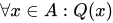


Vacuous truths most commonly appear in classical logic with two truth values. However, vacuous truths can also appear in, for example, intuitionistic logic, in the same situations as given above. Indeed, if is false, then will yield a vacuous truth in any logic that uses the material conditional;[6] if is a necessary falsehood, then it will also yield a vacuous truth under the strict conditional.
Other non-classical logics, such as relevance logic, may attempt to avoid vacuous truths by using alternative conditionals (such as the case of the counterfactual conditional).
In computer programming
[edit]Many programming environments have a mechanism for querying if every item in a collection of items satisfies some predicate. It is common for such a query to always evaluate as true for an empty collection. For example:
- In JavaScript, the array method
everyexecutes a provided callback function once for each element present in the array, only stopping (if and when) it finds an element where the callback function returns false. Notably, calling theeverymethod on an empty array will return true for any condition.[7] - In Python, the built in
all()function returnsTrueonly when all of the elements of an iterable (in this example, a list) areTrueor the iterable is empty:all([1,1])==True; all([1,1,0])==False; all([])==True.[8] A less ambiguous way to express this is to sayall()returns True when none of the elements areFalse. - In Rust, the
Iterator::allfunction accepts an iterator and a predicate and returnstrueonly when the predicate returnstruefor all items produced by the iterator, or if the iterator produces no items.[9] - In SQL, the function, the function
ANY_VALUEcan differ depending on the RDBMS's behaviour relating NULLs to vacuous truth. Some RDBMS might returnnulleven if there are non-nullvalues.[10] Some DBMS might not allow for its use infilter(...)orover(.. )clauses. - In Kotlin, the collection method
allreturnstruewhen the collection is empty. - In C#, the Linq method
Allreturnstruewhen the collection is empty. - In C++, the
std::all_offunction template returnstruefor an empty collection.[11] - In Agda, an empty type (for example,
⊥, which is defined with no constructors) is 'false' at the type level, following the Curry–Howard correspondence. A parameter of such a type can be matched against an 'absurd' pattern and an equation containing such a pattern has no right hand side. The principle of ex falso quodlibet can be defined this way as a functionefq : ∀ {n} {a : Set n} → ⊥ → a. The functionefqis then a proof of the vacuously true proposition⊥ → afor every proposition (i.e. type)a. For example, it is a proof of⊥ → ⊥.
Examples
[edit]These examples, one from mathematics and one from natural language, illustrate the concept of vacuous truths:
- "For any integer x, if x > 5 then x > 3."[12] – This statement is true non-vacuously (since some integers are indeed greater than 5), but some of its implications are only vacuously true: for example, when x is the integer 2, the statement implies the vacuous truth that "if 2 > 5 then 2 > 3".
- "All my children are goats" is a vacuous truth when spoken by someone without children. Similarly, "None of my children is a goat" would also be a vacuous truth when spoken by the same person.
See also
[edit]- Definite description
- De Morgan's laws – specifically the law that a universal statement is true just in case no counterexample exists:
- Empty sum and empty product
- Empty function
- Paradoxes of material implication, especially the principle of explosion
- Presupposition, double question
- State of affairs (philosophy)
- Tautology (logic) – another type of true statement that also fails to convey any substantive information
- Triviality (mathematics) and degeneracy (mathematics)

References
[edit]- ^ a b c "Vacuously true". web.cse.ohio-state.edu. Archived from the original on 18 November 2023. Retrieved 15 December 2019.
- ^ a b c "Vacuously true - CS2800 wiki". courses.cs.cornell.edu. Archived from the original on 21 June 2023. Retrieved 15 December 2019.
- ^ a b "Definition:Vacuous Truth – ProofWiki". proofwiki.org. Retrieved 2019-12-15.
- ^ a b Edwards, C. H. (January 18, 1998). "Vacuously True" (PDF). swarthmore.edu. Archived from the original (PDF) on 28 April 2021. Retrieved 14 December 2019.
- ^ Baldwin, Douglas L.; Scragg, Greg W. (2011), Algorithms and Data Structures: The Science of Computing, Cengage Learning, p. 261, ISBN 978-1-285-22512-8
- ^ Johansson's minimal logic is an exception, because the proof needs the principle of explosion.
- ^ "Array.prototype.every() – JavaScript". MDN Web Docs. Mozilla Foundation. 27 November 2023.
- ^ "Built-in Functions". Python 3.10.2 documentation.
- ^ "Iterator in std::iter". Rust Documentation.
- ^ "The ANY_VALUE(...) Aggregate Function". Modern SQL. Retrieved 2024-11-27.
- ^ "std::all_of, std::any_of, std::none_of". Cpprefeference. 19 March 2024. Archived from the original on 1 December 2024. Retrieved 9 December 2024.
- ^ "logic – What precisely is a vacuous truth?". Mathematics Stack Exchange.
Bibliography
[edit]- Blackburn, Simon (1994). "vacuous", The Oxford Dictionary of Philosophy. Oxford: Oxford University Press, p. 388.
- David H. Sanford (1999). "implication". The Cambridge Dictionary of Philosophy, 2nd. ed., p. 420.
- Beer, Ilan; Ben-David, Shoham; Eisner, Cindy; Rodeh, Yoav (1997). "Efficient Detection of Vacuity in ACTL Formulas". Computer Aided Verification: 9th International Conference, CAV'97 Haifa, Israel, June 22–25, 1997, Proceedings. Lecture Notes in Computer Science. Vol. 1254. pp. 279–290. doi:10.1007/3-540-63166-6_28. ISBN 978-3-540-63166-8.
External links
[edit]Vacuous truth
View on GrokipediaCore Concepts
Definition
In classical logic, a universal statement of the form is true if the domain is empty, as there are no elements in for which fails to hold.[5] Similarly, an implication or conditional statement "If , then " (denoted ) is true whenever the antecedent is false, irrespective of the truth value of .[6] This phenomenon, known as vacuous truth, arises because the statement cannot be falsified due to the absence of relevant instances: no counterexamples exist to violate the condition.[7] A key example is the empty set , where any universal claim over holds true by default, such as "all elements of are even numbers," since no elements are present to contradict it.[8] Vacuous truths differ from contingent truths, which hold only under specific empirical or circumstantial conditions and could be false in other scenarios; in contrast, vacuous truths are necessarily true solely by virtue of their logical form and the lack of potential counterexamples.[9]Logical Basis
In classical propositional logic, the material implication, denoted , is defined by its truth table, which specifies that the implication is true whenever the antecedent is false, irrespective of the truth value of the consequent . This behavior ensures that implications with false antecedents hold vacuously, as there are no instances where is true but is false to falsify the statement. The full truth table is as follows:| True | True | True |
| True | False | False |
| False | True | True |
| False | False | True |
Historical Context
Ancient and Medieval Origins
In Aristotle's syllogistic logic, developed in the Prior Analytics, categorical propositions involving empty terms—those categories without existing referents—are subject to debate regarding existential import. Under the traditional interpretation, universal affirmatives carry existential import, meaning they presuppose the existence of the subject term; thus, propositions like "all goat-stags are horned" (with "goat-stag" denoting nothing) would be false due to the absence of instances.[13] Some modern interpretations argue Aristotle did not assume existential import, treating such propositions as lacking truth conditions or non-informative without invalidating the deductive form.[14][15] Aristotle's focus on structural relations in syllogistic figures like Barbara or Celarent highlights formal validity, but the empirical content is affected by referential voids. Building on Aristotelian foundations, the medieval Islamic philosopher Avicenna (Ibn Sina) explored conditional propositions in works such as al-Qiyas (The Book of Demonstration), arguing that conditionals with impossible antecedents are true because no possible scenario can falsify them, as the antecedent's impossibility precludes any counterinstance.[16] This position, rooted in Avicenna's distinction between implicative and factual conditionals, holds that such propositions succeed vacuously in the sense of luzūm (necessary implication), where the antecedent's non-occurrence ensures the conditional's immunity to disconfirmation. Avicenna's analysis thus anticipates later vacuous truths by emphasizing logical necessity over empirical verification in hypothetical reasoning. In the Latin scholastic tradition, William of Ockham further refined these ideas through his supposition theory in the Summa Logicae, positing that terms without personal supposition—lacking reference to existing things—can render universal affirmative propositions true when the subject is empty, as no false instances arise to contradict them.[17] Ockham's modes of supposition, including determinate and confused varieties, account for this by linking term reference to truth conditions via descent rules; in empty cases, the failure of descent to particulars still preserves the proposition's validity, aligning with a non-existential interpretation of universals.[18] This framework, which bridges signification and propositional truth, provided a semantic basis for handling referential voids without requiring existential import.Modern Developments
The formalization of vacuous truth in modern logic began with the development of predicate logic by Gottlob Frege and Bertrand Russell in the late 19th and early 20th centuries. Frege's Begriffsschrift (1879) introduced universal quantification as holding true whenever no instance falsifies the predicate, but his system presupposes a non-empty domain and does not explicitly consider vacuous cases over empty domains. Russell extended this in his theory of descriptions and predicate logic, particularly in "On Denoting" (1905), where non-referring definite descriptions lead to false statements (e.g., "The present king of France is bald" is false due to failed existence). However, Russell's framework accepts vacuous truth for universal statements over null classes, such as "all elements of the empty class satisfy any property," ensuring logical consistency by treating such universals as true rather than undefined. This approach resolved paradoxes in denoting phrases and aligned with the extensional semantics of early analytic philosophy. In set theory, the Zermelo-Fraenkel axioms (ZF), formalized by Ernst Zermelo in 1908 and refined by Abraham Fraenkel in the 1920s, explicitly incorporate vacuous truth through the treatment of the empty set . The axioms ensure that exists and satisfies universal predicates vacuously, as in , since no element exists to violate , making the statement true by default; this underpins subset relations and separation, where every set has as a subset without contradiction.[19] Zermelo's original formulation emphasized the empty set's role in building the cumulative hierarchy, avoiding inconsistencies in infinitary constructions by relying on such vacuous validations. A key advancement in the 1920s came from David Hilbert and Paul Bernays' work on proof theory in Grundlagen der Mathematik (volumes I and II, 1934–1939, building on 1920s lectures), which integrated vacuous cases into formal derivations, including infinitary logic extensions like the -rule. Their system handles empty domains in consistency proofs by treating universal generalizations over voids as derivable without additional premises, facilitating metamathematical analysis of infinite structures.[20] By the 1930s, vacuous truth shifted from controversy in early analytic philosophy—where figures like Russell debated its intuitiveness against Aristotelian import—to widespread acceptance in standard model theory, largely through Alfred Tarski's semantic framework in "The Concept of Truth in Formalized Languages" (1933). Tarski's models define truth for quantified sentences over any domain, including empty ones, where universals hold vacuously, establishing a rigorous basis for logical consequence that resolved prior ambiguities and influenced post-war formal semantics. This evolution solidified vacuous truth as a cornerstone of classical logic, enabling consistent handling of empty structures in both philosophy and mathematics.Examples
Mathematical Illustrations
One prominent illustration of vacuous truth in set theory arises with the empty set, denoted ∅. The statement "all elements of ∅ are even numbers," formalized as ∀x (x ∈ ∅ → x is even), holds true because there are no elements in ∅ to satisfy the antecedent x ∈ ∅, rendering the implication vacuously true regardless of the consequent. This example demonstrates how universal quantification over an empty domain yields truth in classical logic, as the premise fails for all potential x.[21] Another mathematical scenario involves domains defined by impossible conditions, such as the set of positive integers less than 1, which is empty. The assertion "all positive integers less than 1 are even," expressed as ∀n ∈ ℕ⁺ (n < 1 → n is even), is vacuously true since no positive integer satisfies n < 1, leaving the implication without a counterexample.[22] This highlights vacuous truth in number theory, where the restricted domain ensures the universal claim cannot be falsified. In geometry, consider statements about impossible figures within Euclidean space. The proposition "all triangles in a Euclidean plane with four sides are equilateral" is vacuously true, as no such triangles exist—the definition of a triangle precludes four sides—thus the antecedent never holds, satisfying the implication for all cases. This example underscores how vacuous truth applies to geometric universals over empty classes of objects.[23] In graph theory, the empty graph, which has no vertices or edges, provides a clear case. The statement "every vertex in an empty graph has degree 0" is vacuously true, since there are no vertices to check, making the universal quantification ∀v (v is a vertex → deg(v) = 0) hold without violation. This illustrates vacuous truth in structural properties of graphs, where the absence of elements preserves the claim.[24]Everyday Language Cases
Vacuous truth frequently arises in natural language through universal generalizations and conditionals where the relevant class or antecedent is empty, often creating an intuitive sense of falsehood or irrelevance despite formal logical validity. This tension between logical rigor and everyday intuition is a key feature of how vacuous truth operates in colloquial speech.[25] A standard illustration is the statement "All my children are asleep," uttered by a childless speaker. In classical logic, this is vacuously true because there are no children to whom the property of being asleep fails to apply, satisfying the universal quantifier over an empty domain. However, natural language carries a presupposition of the existence of children, rendering the statement odd or misleading in conversation; as philosopher P.F. Strawson argued, such cases involve presupposition failure rather than straightforward truth or falsity.[26] Another example appears in policy statements, such as "No student who misses class without excuse will pass." If no students miss class without excuse, the statement is vacuously true, as there are no counterexamples in the restricted domain. This logical outcome can feel unsatisfying in everyday contexts, where the speaker might intend to assert a rule only when applicable cases exist, highlighting the gap between formal semantics and pragmatic expectations. English conditionals like "If you finish your homework, you can play" introduce ambiguity when the antecedent cannot occur, such as if no homework is assigned. Logically, the implication holds vacuously since the premise is false, but natural language users may interpret it as inapplicable or trivially satisfied, underscoring how vacuous cases challenge intuitive understandings of causality and permission. Vacuous truth is particularly common in legal and contractual language, where clauses often apply to hypothetical or non-existent scenarios, such as penalties for breaches that never materialize. These formulations ensure comprehensive coverage without requiring actual instances, though they can lead to debates over intent and applicability in practice.[27]Applications
In Mathematics
In set theory, the axiom of subsets establishes that the empty set ∅ is a subset of every set S, a relation denoted by ∅ ⊆ S, which holds vacuously because there are no elements in ∅ to violate the condition that every element of ∅ must belong to S. This vacuous truth is foundational to Zermelo-Fraenkel set theory, ensuring consistency in the treatment of the empty set without requiring additional axioms for special cases. Without this principle, foundational structures like the cumulative hierarchy of sets would encounter paradoxes when handling empty collections. Vacuous truth also plays a crucial role in mathematical induction, particularly in the base case when the initial set is empty. For instance, in recursive definitions over natural numbers starting from 0, the base case for n=0 often involves proving a property over an empty predecessor set, which is true by vacuity since no elements exist to falsify the statement. This allows induction to proceed seamlessly, underpinning proofs in areas like combinatorics and algebra where empty cases arise naturally. In number theory, vacuous truths support theorems by handling statements about non-existent objects without contradiction. Consider the claim that all even primes greater than 2 are odd; since no such primes exist (as 2 is the only even prime), the universal quantifier over an empty set renders the statement true vacuously, aiding in broader results like the fundamental theorem of arithmetic by avoiding exceptions for absent cases. Furthermore, vacuous truth prevents inconsistencies in algebraic identities involving empty collections, such as the empty product formula, where the product over the empty set is defined as 1, the multiplicative identity. This convention, , ensures that formulas like the product of divisors or factorial extensions (e.g., 0! = 1) remain consistent, avoiding undefined behaviors in otherwise uniform mathematical structures.In Computer Programming
In functional programming languages, vacuous truth manifests in operations that universally quantify over iterables, such as checking if all elements satisfy a condition. For instance, Python's built-inall() function returns True when applied to an empty iterable, as there are no elements to falsify the universal claim.[28] Similarly, in JavaScript, the Array.prototype.every() method returns true for an empty array, reflecting the logical principle that all (zero) elements satisfy any predicate vacuously.[29]
In database query languages like SQL, vacuous truth appears in quantified predicates over empty result sets. The ALL operator in a quantified comparison predicate evaluates to True if the subquery returns no rows, meaning the condition holds for every (non-existent) row in the empty relation.[30] For example, a query such as SELECT * FROM employees WHERE salary > ALL (SELECT bonus FROM empty_table); succeeds vacuously if empty_table has no rows, as the universal comparison is satisfied without counterexamples. This behavior aligns with relational algebra, where universal quantification over an empty relation is true. The same principle applies in PostgreSQL, where ALL predicates return true for empty subqueries.[31]
In type theory-based languages, empty types embody vacuous truth by making dependent propositions hold without evidence. Agda's empty type ⊥ (bottom) has no constructors, representing falsehood; thus, any dependent type Π (x : ⊥) → P x is inhabited vacuously, as there are no values of ⊥ to satisfy, rendering the universal claim true.[32] In Rust, the never type ! serves as an empty type with no values, allowing it to subtype any type and enabling vacuous proofs in generic code, such as functions that "return" ! implying impossible branches hold any postcondition without execution.[33]
A common pitfall arises in loops or iterations over empty collections, where the body executes zero times, causing conditional assertions to pass vacuously and potentially masking logical errors. For example, in Python, a loop like for x in []: assert is_positive(x) succeeds without raising an exception, even if is_positive would fail on actual elements, leading developers to overlook cases with no data.[34] This can result in incorrect assumptions about data validation in production code, emphasizing the need to explicitly handle empty inputs separately from universal checks.