



Community hub
Recent from talks
Contribute something
Nothing was collected or created yet.
Well-defined expression
View on WikipediaIn mathematics, a well-defined expression or unambiguous expression is an expression whose definition assigns it a unique interpretation or value. Otherwise, the expression is said to be not well defined, ill defined or ambiguous.[1] A function is well defined if it gives the same result when the representation of the input is changed without changing the value of the input. For instance, if takes real numbers as input, and if does not equal then is not well defined (and thus not a function).[2] The term well-defined can also be used to indicate that a logical expression is unambiguous or uncontradictory.


A function that is not well defined is not the same as a function that is undefined. For example, if , then even though is undefined, this does not mean that the function is not well defined; rather, 0 is not in the domain of .


Example
[edit]Let be sets, let and "define" as if and if .


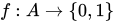


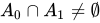
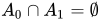
Then is well defined if . For example, if and , then would be well defined and equal to .


However, if , then would not be well defined because is "ambiguous" for . For example, if and , then would have to be both 0 and 1, which makes it ambiguous. As a result, the latter is not well defined and thus not a function.


"Definition" as anticipation of definition
[edit]In order to avoid the quotation marks around "define" in the previous simple example, the "definition" of could be broken down into two logical steps:
- The definition of the binary relation. In the example:
- The assertion. The binary relation is a function; in the example:



While the definition in step 1 is formulated with the freedom of any definition and is certainly effective (without the need to classify it as "well defined"), the assertion in step 2 has to be proven. That is, is a function if and only if , in which case – as a function – is well defined.
On the other hand, if , then for an , we would have that and , which makes the binary relation not functional (as defined in Binary relation#Special types of binary relations) and thus not well defined as a function. Colloquially, the "function" is also called ambiguous at point (although there is per definitionem never an "ambiguous function"), and the original "definition" is pointless.
Despite these subtle logical problems, it is quite common to use the term definition (without apostrophes) for "definitions" of this kind, for three reasons:


- It provides a handy shorthand of the two-step approach.
- The relevant mathematical reasoning (i.e., step 2) is the same in both cases.
- In mathematical texts, the assertion is "up to 100%" true.
Independence of representative
[edit]Questions regarding the well-definedness of a function often arise when the defining equation of a function refers not only to the arguments themselves, but also to elements of the arguments, serving as representatives. This is sometimes unavoidable when the arguments are cosets and when the equation refers to coset representatives. The result of a function application must then not depend on the choice of representative.
Functions with one argument
[edit]For example, consider the following function:
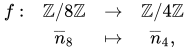
where and are the integers modulo m and denotes the congruence class of n mod m.



N.B.: is a reference to the element , and is the argument of .


The function is well defined, because:

As a counter example, the converse definition:
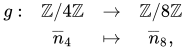
does not lead to a well-defined function, since e.g. equals in , but the first would be mapped by to , while the second would be mapped to , and and are unequal in .


Operations
[edit]In particular, the term well-defined is used with respect to (binary) operations on cosets. In this case, one can view the operation as a function of two variables, and the property of being well-defined is the same as that for a function. For example, addition on the integers modulo some n can be defined naturally in terms of integer addition.
![{\displaystyle [a]\oplus [b]=[a+b]}](https://wikimedia.org/api/rest_v1/media/math/render/svg/3795c6b625447d3607a3979a49f10328aeaaf25f)
The fact that this is well-defined follows from the fact that we can write any representative of as , where is an integer. Therefore,
![{\displaystyle [a]}](https://wikimedia.org/api/rest_v1/media/math/render/svg/ea82bc70a8e322f13a3c4e5b9d5d69e8ef097ad8)


![{\displaystyle [a]\oplus [b]=[a+kn]\oplus [b]=[(a+kn)+b]=[(a+b)+kn]=[a+b];}](https://wikimedia.org/api/rest_v1/media/math/render/svg/ad0e16a047b326bd1daa86fc21b84ef986f3d7a5)
similar holds for any representative of , thereby making the same, irrespective of the choice of representative.
![{\displaystyle [b]}](https://wikimedia.org/api/rest_v1/media/math/render/svg/e016d81a1b29bb79b275e446042b925b7dd6b6d7)
![{\displaystyle [a+b]}](https://wikimedia.org/api/rest_v1/media/math/render/svg/f4b7d37d08b05354ad6b15e9f9f1cbc82190c607)
Well-defined notation
[edit]For real numbers, the product is unambiguous because ; hence the notation is said to be well defined.[1] This property, also known as associativity of multiplication, guarantees the result does not depend on the sequence of multiplications; therefore, a specification of the sequence can be omitted. The subtraction operation is non-associative; despite that, there is a convention that is shorthand for , thus it is considered "well-defined". On the other hand, Division is non-associative, and in the case of , parenthesization conventions are not well established; therefore, this expression is often considered ill-defined.


Unlike with functions, notational ambiguities can be overcome by means of additional definitions (e.g., rules of precedence, associativity of the operator). For example, in the programming language C, the operator - for subtraction is left-to-right-associative, which means that a-b-c is defined as (a-b)-c, and the operator = for assignment is right-to-left-associative, which means that a=b=c is defined as a=(b=c).[3] In the programming language APL there is only one rule: from right to left – but parentheses first.
Other uses of the term
[edit]A solution to a partial differential equation is said to be well-defined if it is continuously determined by boundary conditions as those boundary conditions are changed.[1]
See also
[edit]References
[edit]Notes
[edit]- ^ a b c Weisstein, Eric W. "Well-Defined". From MathWorld – A Wolfram Web Resource. Retrieved 2 January 2013.
- ^ Joseph J. Rotman, The Theory of Groups: an Introduction, p. 287 "... a function is "single-valued," or, as we prefer to say ... a function is well defined.", Allyn and Bacon, 1965.
- ^ "Operator Precedence and Associativity in C". GeeksforGeeks. 2014-02-07. Retrieved 2019-10-18.
Sources
[edit]- Contemporary Abstract Algebra, Joseph A. Gallian, 6th Edition, Houghlin Mifflin, 2006, ISBN 0-618-51471-6.
- Algebra: Chapter 0, Paolo Aluffi, ISBN 978-0821847817. Page 16.
- Abstract Algebra, Dummit and Foote, 3rd edition, ISBN 978-0471433347. Page 1.
Well-defined expression
View on GrokipediaDefinition and Fundamentals
Formal Definition
In mathematics, particularly within set theory and abstract algebra, the concept of a well-defined expression arises in the context of structures built from equivalence relations. An equivalence relation on a set is a binary relation that is reflexive ( for all ), symmetric (if then ), and transitive (if and then ).[4] Such a relation partitions into disjoint subsets called equivalence classes, and the quotient set is the set of all these equivalence classes, denoted .[4] A primary setting for well-defined expressions is when defining functions or operations on quotient sets, where inputs are equivalence classes rather than individual elements, ensuring unambiguity across representatives.[3] Formally, a function is well-defined if, for any with , it holds that . Equivalently, for a function , it induces a well-defined function on the quotient if whenever .[3] This condition guarantees that the output depends only on the equivalence class, not on the choice of representative, thereby preserving the structure's integrity in abstract algebraic constructions.[3]Role in Mathematical Proofs
Verifying the well-definedness of an expression or operation is a preliminary step in mathematical proofs, particularly in algebraic constructions, to ensure that the object being defined is unambiguous and independent of representational choices before advancing to substantive properties. This anticipation prevents circular reasoning, as subsequent analyses—such as establishing that a function on a quotient structure preserves the intended algebraic relations—rely on the prior confirmation that the function or operation yields consistent outputs regardless of how elements are expressed. For instance, in defining operations on quotient groups or rings, well-definedness must be established to guarantee that the structure is viable for further proof development.[2][5] The logical progression in such proofs typically begins with demonstrating independence from representatives, often via equivalence relations that partition the domain into classes, ensuring the expression is constant on each class. Only after this foundational check can one proceed to verify advanced properties, such as injectivity, surjectivity, or preservation of operations in homomorphisms, as these require the underlying map to be a legitimate function. This stepwise approach maintains the integrity of the proof, avoiding invalid conclusions from ill-posed definitions.[2][6] Historically, the emphasis on well-definedness emerged in 19th-century algebra to rigorize abstract constructions, notably in Richard Dedekind's development of ideal theory around 1871, where he defined ideals as closed systems within algebraic number fields to ensure consistent norms and avoid circular dependencies in factorization proofs. Dedekind's method grounded ideals in concrete congruences and residue classes, providing a template for modern algebraic rigor that influenced subsequent theorem-building in ring theory.[7]Key Examples
Basic Set-Based Example
A foundational example of a well-defined expression arises when defining functions on sets partitioned by an equivalence relation. Consider the set with subsets and , which we intend to treat as equivalence classes under a relation ~ that partitions S into these disjoint subsets, such as relating elements within each subset via an arbitrary but consistent rule (e.g., pairing based on a specified property). Without specifying the equivalence classes explicitly, a proposed function given by might seem applicable, but its extension to the quotient set requires the classes to be disjoint and the function to yield consistent outputs across representatives.[3] However, if the equivalence relation instead identifies elements across the subsets—such as ~ where 1 ~ 3 and 2 ~ 4, forming classes {{grok:render&&&type=render_inline_citation&&&citation_id=1&&&citation_type=wikipedia}} = \{1, 3\} and {{grok:render&&&type=render_inline_citation&&&citation_id=2&&&citation_type=wikipedia}} = \{2, 4\}—the proposed becomes ill-defined. For the class [8], selecting representative 1 gives f({{grok:render&&&type=render_inline_citation&&&citation_id=1&&&citation_type=wikipedia}}) = 1^2 = 1, while selecting 3 gives f({{grok:render&&&type=render_inline_citation&&&citation_id=1&&&citation_type=wikipedia}}) = 3^2 = 9; since , the output varies by choice, violating consistency. Similarly, for [9], but , again inconsistent. This inconsistency arises because the squaring operation does not preserve the equivalence, leading to ambiguity in the expression's value for each class.[3] To achieve well-definedness, the function must be reformulated to depend solely on properties invariant under the equivalence relation, operating directly on the classes rather than individual representatives. For instance, define , where is the smallest element in the class; then f({{grok:render&&&type=render_inline_citation&&&citation_id=1&&&citation_type=wikipedia}}) = (\min \{1, 3\})^2 = 1^2 = 1 and f({{grok:render&&&type=render_inline_citation&&&citation_id=2&&&citation_type=wikipedia}}) = (\min \{2, 4\})^2 = 2^2 = 4, yielding unique outputs independent of representative choice. This resolution ensures the expression is unambiguous, highlighting how equivalence relations facilitate consistent definitions on partitioned sets.[3]Quotient Structure Example
A prominent example of a well-defined expression arises in the context of quotient groups of integers under addition, specifically the canonical projection between and . Consider the function defined by , where denotes the equivalence class of modulo . To establish that is well-defined, suppose , meaning or . Since , it follows that , so and thus . This ensures the output depends only on the equivalence class in the domain, independent of the representative chosen.[2] In contrast, the reverse mapping often fails to be well-defined. Attempt to define by . For the class {{grok:render&&&type=render_inline_citation&&&citation_id=0&&&citation_type=wikipedia}}_4, the representative yields g({{grok:render&&&type=render_inline_citation&&&citation_id=0&&&citation_type=wikipedia}}_4) = {{grok:render&&&type=render_inline_citation&&&citation_id=0&&&citation_type=wikipedia}}_8, but the representative (since ) yields g({{grok:render&&&type=render_inline_citation&&&citation_id=0&&&citation_type=wikipedia}}_4) = {{grok:render&&&type=render_inline_citation&&&citation_id=4&&&citation_type=wikipedia}}_8. Since {{grok:render&&&type=render_inline_citation&&&citation_id=0&&&citation_type=wikipedia}}_8 \neq {{grok:render&&&type=render_inline_citation&&&citation_id=4&&&citation_type=wikipedia}}_8 in , the value of g({{grok:render&&&type=render_inline_citation&&&citation_id=0&&&citation_type=wikipedia}}_4) depends on the choice of representative, rendering ill-defined.[3] This counterexample illustrates a key insight: well-definedness for such reduction maps holds when the modulus of the codomain divides that of the domain (as ), but fails otherwise (as ), ensuring the equivalence relation of the domain is compatible with that of the codomain.[2]Independence from Representatives
Unary Functions
In the context of quotient sets, a unary function , where is an equivalence relation on a set , is well-defined if its value depends only on the equivalence class and not on the choice of representative. Formally, this requires that whenever , then ; equivalently, using coset notation, whenever , ensuring is independent of the particular .[10][11] To verify well-definedness, one assumes (meaning belongs to the kernel of the relation or the defining subgroup, depending on the structure) and demonstrates using the properties of the equivalence relation or the underlying algebraic structure. For instance, in quotient groups where , the inversion map is checked by supposing , so for some ; then , and since is normal, , implying .[12][10] Unary operations commonly arise in quotient groups and rings, such as additive inversion in the integers modulo , . Here, the equivalence classes are cosets , and the unary inverse function is defined by , which is well-defined because if , then , preserving the coset structure. This ensures the quotient forms an abelian group under addition.[10]Binary Operations
In the context of quotient sets, a binary operation on is well-defined if it maps pairs of equivalence classes to a unique equivalence class, independent of the choice of representatives. Specifically, for an operation defined by , where denotes the original binary operation on , it must hold that if and , then . This criterion ensures that the result does not vary with different representatives from the same classes, preserving the structure of the quotient.[13][14] A canonical example is the addition operation on the quotient set , the integers modulo , where equivalence classes are defined by congruence modulo : . To verify well-definedness, suppose and , meaning divides and divides . Then divides , so , and thus . This property stems from the additive structure of integers, confirming that addition respects the equivalence relation.[14][15] Binary operations can fail to be well-defined if they do not respect the equivalence relation, often due to the underlying structure lacking necessary compatibility, such as non-homomorphic mappings. For instance, attempting to define a multiplication on cosets of a non-normal subgroup in a group may yield inconsistent results across representatives, as the coset product would depend on the choice, violating the required invariance.[13]Notation and Conventions
Clarity in Notation
Clarity in mathematical notation for multi-operand expressions hinges on the associativity of the underlying binary operation, ensuring that the expression yields a unique value regardless of parenthesization. For an operation , the expression is conventionally evaluated from left to right as , but associativity guarantees that this equals , making the notation unambiguous and well-defined.[16] Without associativity, different groupings could produce inconsistent results, rendering the expression ill-defined./01:_Basic_Definitions_and_Results/1.01:_Definitions_and_examples) Addition and multiplication follow the historical convention of left-associativity, a standard adopted in mathematical practice to facilitate straightforward evaluation of chains of operations without requiring explicit parentheses.[17] This convention traces back to early developments in algebraic notation, where consistent left-to-right processing aligned with the intuitive grouping in written expressions.[18] For example, the expression is parsed as , producing a single, determinate sum./02:_Groups/2.01:_Binary_Operations) Verification of well-defined notation involves confirming that the expression's value remains invariant under all valid parsings, a condition met when the operation's associativity holds.[16] This approach ensures computational consistency in extended products or sums, such as defining the -fold operation iteratively without ambiguity./01:_Basic_Definitions_and_Results/1.01:_Definitions_and_examples)Common Ambiguities to Avoid
In mathematical notation, expressions involving non-associative operations can lead to ambiguities if the intended grouping is not specified. For instance, subtraction is not associative, meaning that the expression does not inherently specify whether to compute or .[19] The standard convention in mathematics and most programming languages treats such operations as left-associative, evaluating from left to right as .[20] This yields distinct results in numerical examples: for , the left-associative interpretation gives , whereas the right-associative alternative computes .[19] Another common pitfall arises in quotient structures, where functions on cosets are denoted as but may mislead if the independence from the choice of representative is not explicitly verified or stated.[21] Without confirming that whenever , the notation implies a well-defined operation that might not hold, potentially leading to inconsistent results.[13] To avoid this, mathematicians recommend explicitly referencing the coset structure and proving well-definedness before using such notation.[22] Best practices for preventing these ambiguities include using parentheses to enforce grouping in non-associative expressions, such as writing when the left-associative default is not intended, or stating conventions explicitly at the outset of a proof or definition.[20] Associativity serves as a prerequisite for omitting such clarifications in cleaner notation, as associative operations allow unambiguous multi-operand expressions without specified order.[19]Broader Applications
In Algebraic Structures
In the context of group theory, well-defined expressions are essential for constructing homomorphisms between quotient groups that preserve the algebraic structure. A homomorphism , where is a normal subgroup of , is well-defined if it maps cosets consistently, ensuring for all . This requires verifying that the map is independent of the choice of representative in each coset, which holds precisely when is normal, as the coset operation is itself well-defined under normality.[12] A canonical example is the projection , defined by , which sends integers to their residue classes modulo . This map is well-defined because if , then , so , and it preserves addition since . Such projections form surjective homomorphisms with kernel , enabling the study of cyclic groups via quotients.[12] In ring theory, well-defined expressions extend to quotient rings , where is an ideal, requiring both addition and multiplication on cosets to be independent of representatives. Multiplication is well-defined if and imply , which follows from the ideal property that absorbs multiplication by elements of . For polynomial rings, consider , where multiplication must satisfy ; this holds because if , then . A specific case is , isomorphic to the complex numbers, where cosets are of the form and multiplication uses .[23] This concept extends to modules over a ring , where quotient modules (with a submodule of ) require well-defined scalar actions . The action is well-defined because if , then , and since is a submodule, , implying . This ensures inherits the module structure, allowing actions that are independent of representatives and facilitating homological algebra applications like exact sequences.[24]In Differential Equations
In the context of partial differential equations (PDEs), a solution is considered well-defined if the associated boundary value or initial value problem is well-posed in the sense of Hadamard, meaning it admits at least one solution that is unique and depends continuously on the initial or boundary data, thereby ensuring consistency with the specified conditions.[25] This framework guarantees that small perturbations in the data lead to small changes in the solution, providing stability essential for both theoretical analysis and practical applications.[25] A prominent example is the heat equation, where uniqueness of solutions on bounded domains with appropriate initial and boundary conditions is established through the maximum principle, which bounds the solution by the maximum values on the initial data and boundaries, preventing extraneous solutions.[26] This principle implies that any two solutions differing only in their interior values must coincide, as their difference would violate the non-negativity or boundedness enforced by the parabolic nature of the equation.[26] However, ambiguities arise when the domain is unbounded, as in the Laplace equation, where the Dirichlet problem may admit multiple solutions without additional conditions at infinity, such as decay or boundedness requirements, rendering the problem ill-defined.[27] For instance, on the upper half-plane, harmonic functions can be constructed that match prescribed boundary data but differ by unbounded additives at infinity, violating uniqueness.[27] In modern numerical methods, well-defined discretizations of PDEs, particularly finite difference schemes, are crucial to avoid inconsistencies; these schemes must be consistent with the continuous problem and stable to ensure convergence to the true solution, as per the Lax equivalence theorem for linear well-posed PDEs.[28] This prevents artifacts like oscillations or divergence in approximations, maintaining the integrity of boundary and initial condition enforcement across the discrete grid.[28]References
- An expression is called "well-defined" (or "unambiguous") if its definition assigns it a unique interpretation or value.
- Taking differences in an anti-derivative cancels the effect of the undetermined additive constant, so the expression F(b) − F(a) is a well-defined value.