Hubbry Logo
Vaginal fornixVaginal fornixMain
Open search
Vaginal fornix
Community hub
Vaginal fornix
logo
8 pages, 0 posts
0 subscribers
Be the first to start a discussion here.
Vaginal fornix
Vaginal fornix
from Wikipedia
Vaginal fornix
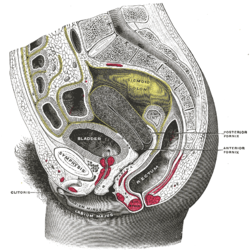
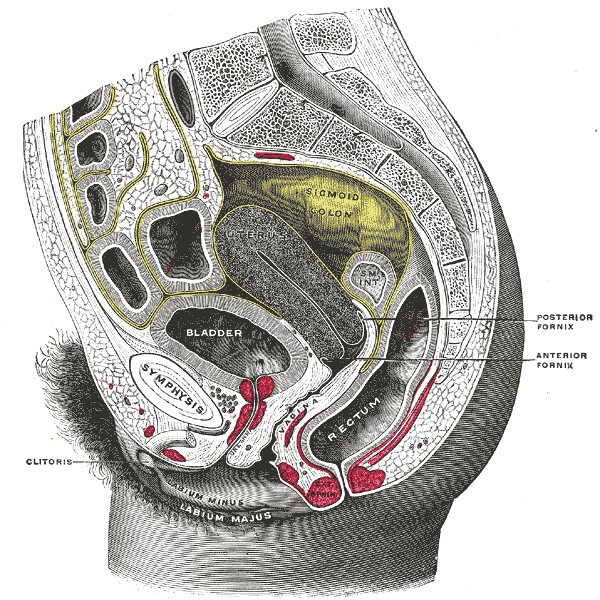
Sagittal section of the lower part of a female trunk, right segment
(SM. INT. = small intestine)
Details
Identifiers
Latinfornix vaginae
TA98A09.1.04.002
TA23524
FMA19985
Anatomical terminology

The fornices of the vagina (sg.: fornix of the vagina or fornix vaginae) are the superior portions of the vagina, extending into the recesses created by the vaginal portion of cervix. There is an anterior fornix and a posterior fornix. The word fornix is Latin for 'arch'.

Sexuality

[edit]

During sexual intercourse in the missionary position, the tip of the penis may reach the anterior fornix, while in the rear-entry position it may reach the posterior fornix.[1]

The anterior fornix is also called the a-spot, an analogue to the g-spot (Gräfenberg spot), which is closer to the vaginal opening, and also on the anterior side of the vagina.[2]

References

[edit]
[edit]
Revisions and contributorsEdit on WikipediaRead on Wikipedia
from Grokipedia
The vaginal fornix is the superior portion of the vaginal canal that forms a series of recesses around the protruding cervix uteri, consisting of an anterior fornix, a larger posterior fornix, and two smaller lateral fornices. This structure arises from the reflection of the vaginal walls over the vaginal portion of the cervix, creating blind-ended spaces that represent the deepest part of the vagina. Anatomically, the posterior fornix is the most spacious recess, situated behind the cervix and adjacent to the rectouterine pouch (pouch of Douglas), while the anterior fornix lies in front of the cervix near the vesicouterine pouch and is typically shallower due to the proximity of the urinary bladder. The lateral fornices flank the sides of the cervix, connecting the anterior and posterior regions and providing flexibility to the vaginal vault. Lined by stratified squamous epithelium, the fornices are hormonally responsive, undergoing changes in thickness and lubrication influenced by estrogen levels throughout the menstrual cycle. Clinically, the vaginal fornix serves as a key site during sexual intercourse, where semen is often deposited, particularly in the posterior fornix, facilitating potential fertilization. It is also significant in gynecological examinations, as the fornices allow access for visualizing the cervix and sampling for conditions like infections or cervical cancer screening. Pathologies such as forniceal cysts, perforations, or involvement in pelvic inflammatory disease can occur here, potentially leading to complications like evisceration or adhesions.

Anatomy

Structure and location

The vaginal fornix comprises the superior recessed portions of the vagina that form a continuous vault surrounding the protruding vaginal portion of the cervix, delineating an anterior fornix, a posterior fornix, and two lateral fornices. This configuration arises from the reflection and folding of the vaginal walls around the cervix, creating these distinct recesses. The posterior fornix is the deepest and most capacious among them, accommodating greater volume due to its anatomical positioning. In terms of dimensions, the average distance from the vaginal orifice to the tip of the anterior fornix measures 57 ± 5 mm, while the distance to the posterior fornix is longer at 74 ± 4 mm. Total vaginal length, often assessed from the hymen to the posterior fornix, averages approximately 7.5 cm in reproductive-age women, with variability influenced by factors such as parity and age. These measurements reflect the fornix's role in extending the vaginal canal superiorly within the pelvis. Histologically, the vaginal fornix is lined by nonkeratinized stratified squamous epithelium, which is continuous with the vaginal mucosa and lacks underlying glands. Transverse folds known as rugae, formed by the mucosal layer, extend into the fornices, enhancing distensibility and surface area. The structure is situated at the apex of the vagina in the female pelvis, encircling the cervix in proximity to surrounding pelvic organs.

Relations to adjacent structures

The vaginal fornix forms a vault-like enclosure around the vaginal portion of the cervix, creating a continuous recess that surrounds the cervix except at its point of attachment to the vaginal wall. This arrangement positions the fornices as superior extensions of the vaginal canal, intimately related to surrounding pelvic structures. The anterior fornix is bounded superiorly by the posterior wall of the urinary bladder and the vesicovaginal pouch, a potential space between the bladder and vagina. It lies in close proximity to the urethra anteriorly, facilitating the spatial relationship between the reproductive and urinary systems in the pelvis. In contrast, the posterior fornix communicates directly with the rectouterine pouch, also known as the pouch of Douglas, which is the deepest peritoneal recess in the female pelvis. It is bounded by the anterior wall of the rectum, separating the vaginal vault from the rectosigmoid colon. The lateral fornices are situated adjacent to the ureters and uterine arteries on each side, with the ureters passing anteromedially in close proximity to these recesses before entering the bladder. They also lie near the levator ani muscles, which form part of the pelvic floor supporting these structures.

Function

Reproductive role

The posterior vaginal fornix functions as a natural reservoir for semen deposited during ejaculation, enabling sperm to pool near the external cervical os and enhancing their proximity to the uterus for improved reproductive access. This positioning allows for rapid uptake of sperm into the reproductive tract, with studies showing transport to the uterus occurring within minutes post-deposition during the follicular phase. In interaction with cervical mucus, semen mixes with mucus adjacent to the external os, aiding sperm migration particularly during fertile periods when mucus exhibits favorable properties for transport. This proximity facilitates the mixing of ejaculate with mucus, creating a conducive environment where sperm can navigate cervical channels more effectively. The combined seminal and mucoid pool acts as an initial conduit, promoting progression toward the upper genital tract. During labor, the vaginal fornices expand to accommodate progressive cervical dilation and fetal descent through the birth canal. The posterior fornix, in particular, stretches significantly—often varying in depth and elasticity—to provide additional space for the presenting fetal part, thereby facilitating smoother progression and distributing mechanical stress across vaginal tissues.

Role in sexual activity

During sexual arousal and intercourse, the vaginal fornices, especially the posterior and lateral ones, are stimulated by deep penile penetration, which contacts the upper vaginal vault and activates sensory nerve endings to contribute to heightened pleasure and orgasmic responses. The anterior vaginal wall, encompassing the anterior fornix, serves as a key genital sensory activation site, where tactile pressure deforms mechanoreceptors like Ruffini endings, transmitting signals via the pelvic nerve to the spinal cord and brain for arousal escalation. The anterior fornix, often termed the A-spot or anterior fornix erogenous zone (AFE zone), is recognized for eliciting intense sexual pleasure and increased vaginal lubrication upon stimulation, as identified in research by Malaysian physician Chua Chee Ann in 1997, where repeated stroking for 10-15 minutes led to rapid arousal and orgasm in participants. Similarly, the posterior fornix, sometimes referred to as the P-spot, is associated with profound sensations during deep stimulation through activation of nearby nerve pathways. Sensitivity in the fornices varies with hormonal fluctuations; elevated estrogen levels during arousal promote vascular engorgement and transudation of fluid into the vaginal walls and fornices, amplifying lubrication and tactile responsiveness, while postmenopausal declines in estrogen can reduce this engorgement and sensitivity.

Clinical significance

Examination and imaging

The vaginal fornix is primarily assessed during routine pelvic examinations, which involve the use of a speculum to gently separate the vaginal walls and expose the fornices, enabling direct visualization of the cervix, the surrounding vaginal vault, and any abnormalities in the forniceal regions. This step allows for inspection of the anterior, posterior, and lateral fornices for signs of discharge, lesions, or inflammation while the speculum is in place. Following speculum removal, a bimanual palpation is performed by inserting one or two gloved fingers into the vagina—often directed into the posterior or lateral fornix—to evaluate the depth, mobility, and tenderness of the fornices, as well as their relation to the uterus and adnexa via concurrent abdominal palpation. Imaging techniques provide non-invasive visualization of the vaginal fornix, particularly for assessing its dimensions and spatial relationships to adjacent pelvic structures. Transvaginal ultrasound, performed with a probe inserted into the anterior or posterior fornix, facilitates precise measurements of fornix depth and vaginal wall thickness (typically at 2 cm from the posterior fornix) and evaluates forniceal involvement in pelvic fluid collections or organ relations. Magnetic resonance imaging (MRI) offers superior soft tissue contrast for detailed depiction of the fornix in cases of suspected congenital anomalies, such as vaginal aplasia or dysgenesis, by delineating the forniceal architecture and its continuity with the cervix and uterus without radiation exposure. Colposcopy enhances fornix examination by using a magnifying colposcope to inspect the cervical-vaginal junction and adjacent fornices after acetic acid application, aiding in the detection of epithelial abnormalities, vascular changes, or lesions at the squamocolumnar junction extending into the fornices. The procedure involves speculum placement for optimal exposure of the fornices, allowing magnified illumination (up to 40x) to identify subtle irregularities that may indicate precancerous or inflammatory conditions at the forniceal margins. The evolution of vaginal fornix examination traces from manual bimanual techniques popularized in the mid-19th century by J. Marion Sims, who refined speculum use for gynecologic inspections, to contemporary endoscopic methods. Hysteroscopy, introduced diagnostically in 1869 by Giuseppe Pantaleoni, accesses the uterine cavity via the cervical os after traversing the vaginal fornix—typically the posterior fornix for entry—enabling direct endoscopic visualization and intervention while minimizing trauma. This progression reflects advancements from purely tactile assessments in early gynecology to integrated imaging and endoscopy for precise fornix evaluation.

Associated conditions

The vaginal fornix can be involved in various infections, particularly in pelvic inflammatory disease (PID), where pus from a tubo-ovarian abscess may accumulate in the posterior fornix due to its proximity to the pouch of Douglas, presenting as a fluctuating tender swelling. Cervicitis, often caused by sexually transmitted infections such as chlamydia or gonorrhea, can extend inflammation and purulent discharge to the fornices, leading to mucopurulent vaginal discharge and cervical friability. Benign cysts, such as Gartner duct cysts, can develop in the lateral or posterior fornices from embryonic remnants; they are usually asymptomatic but may cause discomfort or require surgical excision if large. Trauma to the vaginal fornix commonly occurs during childbirth or gynecological instrumentation, resulting in tears that may lead to hematomas, perforations, or complications such as rectovaginal fistulas, where an abnormal connection forms between the rectum and the posterior fornix. Adhesions may also form from healing or associated inflammation. Congenital anomalies affecting the vaginal fornix include transverse or longitudinal vaginal septa, which disrupt normal fornix formation by creating incomplete canalization of the vaginal plate during embryologic development. In Mayer-Rokitansky-Küster-Hauser syndrome, agenesis of the upper vagina and uterus results in absence or rudimentary development of the fornices. Post-surgical complications involving the fornix include shortening of the vaginal vault after hysterectomy, which reduces vaginal length and is associated with dyspareunia due to decreased capacity for penetration. Vaginal vault dehiscence can lead to evisceration, a serious emergency. Endometriosis may present with deep infiltrative implants in the posterior fornix, causing tender nodules and chronic pelvic pain. Malignancies of the vaginal fornix are rare but include primary squamous cell carcinoma originating from the fornix epithelium, often linked to human papillomavirus infection and presenting as invasive lesions in the upper vagina.

References

Add your contribution
Related Hubs
User Avatar
No comments yet.