Hubbry Logo
Vaginal support structuresVaginal support structuresMain
Open search
Vaginal support structures
Community hub
Vaginal support structures
logo
8 pages, 0 posts
0 subscribers
Be the first to start a discussion here.
Vaginal support structures
from Wikipedia

The vaginal support structures are those muscles, bones, ligaments, tendons, membranes and fascia, of the pelvic floor that maintain the position of the vagina within the pelvic cavity and allow the normal functioning of the vagina and other reproductive structures in the female. Defects or injuries to these support structures in the pelvic floor leads to pelvic organ prolapse. Anatomical and congenital variations of vaginal support structures can predispose a woman to further dysfunction and prolapse later in life.[1] The urethra is part of the anterior wall of the vagina and damage to the support structures there can lead to incontinence and urinary retention.[2]

Pelvic bones

[edit]

The support for the vagina is provided by muscles, membranes, tendons and ligaments. These structures are attached to the hip bones. These bones are the pubis, ilium and ischium. The interior surface of these pelvic bones and their projections and contours are used as attachment sites for the fascia, muscles, tendons and ligaments that support the vagina. These bones are then fuse and attach to the sacrum behind the vagina and anteriorly at the pubic symphysis.[3] Supporting ligaments include the sacrospinous and sacrotuberous ligaments. The sacrospinous ligament is unusual in that it is thin and triangular.[3][4]

Pelvic diaphragm

[edit]

The muscular pelvic diaphragm is composed of the bilateral levator ani and coccygeus muscles and these attach to the inner pelvic surface. The iliococcygeus and pubococcygeus make up the levator ani muscle. The muscles pass behind the rectum. The levator ani surrounds the opening which the urethra, rectum and vagina pass. The pubococcygeus muscle is subdivided into the pubourethralis, pubovaginal muscle and the puborectalis muscle. The names describe the attachments of the muscles to the urethra, vagina, anus, and rectum. The names are also called the pubourethralis, pubovaginalis, puboanalis, and puborectalis muscles and sometimes the pubovisceralis since it attaches to the viscera.[3]

Urogenital diaphragm (perineal membrane)

[edit]

The urogenital diaphragm, or perineal membrane, is present over the anterior pelvic outlet below the pelvic diaphragm.[5] The exact structure description is controversial. Despite the controversy, MRI imaging studies support the existence of the structure.[3][6]

Superficial and inferior muscles of the perineum (urogenital diaphragm):

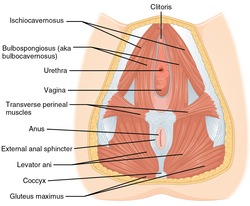
The perineum attaches across the gap between the inferior pubic rami bilaterally and the perineal body. This grouping of muscles constricts to close the urogenital openings. The perineum supports and functions as a sphincter at the opening of the vagina. Other structures exist below the perineum that support the anus.[3][6]

Perineal body

[edit]
The bulbospongiosus muscle is highlighted in red.

The perineal body is a pyramidal structure of muscle and connective tissue and part of it is located between the anus and vagina. It is a tendon that is formed at the point where the bulbospongiosus muscle, superficial transverse perineal muscle,[7] and external anal sphincter muscle converge to form this major supportive structure of the pelvis and vagina.[8][9][10] Below this, muscles and their fascia converge and become part of the perineal body. The lower vagina is attached to the perineal body by attachments from the pubococcygeus, perineal muscles, and the anal sphincter. The perineal body is made up of smooth muscle, elastic connective tissue fibers, and nerve endings. Above the perineal body are the vagina and the uterus. Damage and resulting weakness of the perineal body changes the length of the vagina and predisposes it to rectocele and enterocele.[3][6]

Endopelvic fascia and connective tissue

[edit]
The internal surface of the ilium showing where the muscles supporting the vagina insert and terminate

The vagina is attached to the pelvic walls by endopelvic fascia. The peritoneum is the external layer of skin that covers the fascia. This tissue provides additional support to the pelvic floor. The endopelvic fascia is one continuous sheet of tissue and varies in thickness. It permits some shifting of the pelvic structures. The fascia contains elastic collagen fibers in a 'mesh-like' structure. The fascia also contains fibroblasts, smooth muscle, and vascular vessels. The cardinal ligament supports the apex of the vagina and derives some of its strength from vascular tissue. The endopelvic fascia attaches to the lateral pelvic wall via the arcus tendineus.[3]

Anterior vaginal support

[edit]

Not all agree to the amount of supportive tissue or fascia exists in the anterior vaginal wall. The major point of contention is whether the vaginal fascial layer exists. Some texts do not describe a fascial layer. Other sources state that the fascia is present under the urethra which is embedded in the anterior vaginal wall.[3] Despite disagreement, the urethra is embedded in the anterior vaginal wall.[3]

Lateral and mid support structures

[edit]

The midsection of the vagina is supported by its lateral attachments to the arcus tendineus. Some describe the pubocervical fascia as extending from the pubic symphysis to the anterior vaginal wall and cervix. Anatomists do not agree on its existence.[3][11]


Complications

[edit]

Vaginal support structures can be damaged or weakened during childbirth or pelvic surgery. Other conditions that repeatedly strain or increase pressure in the pelvic area can also compromise support. Examples are:[12]

See also

[edit]

References

[edit]
[edit]
Revisions and contributorsEdit on WikipediaRead on Wikipedia
from Grokipedia
Vaginal support structures encompass the ligaments, fasciae, and muscles that anchor and suspend the within the , preventing descent and maintaining its functional alignment with adjacent organs. These structures form a dynamic system that supports the vaginal canal along its length, divided into three levels as conceptualized by DeLancey: Level I at the apex, Level II in the mid-vagina, and Level III at the distal portion. This framework highlights how connective tissues and muscular components interact to provide both passive suspension and active contraction, essential for continence, evacuation, and . At Level I, the uppermost third of the and receive apical support primarily from the uterosacral ligaments (USLs) and cardinal ligaments (CLs), which originate from the and pelvic sidewall, respectively, and insert into the vaginal apex. The USLs, measuring approximately 8.7–10 cm in length, contain , , autonomic nerves, and vessels, extending from the S2–S4 sacral region to the posterior and . In vivo, the USLs span about 9–10 cm and contribute to the visceral , supporting the pelvic visceral while enclosing the . The CLs, also known as Mackenrodt's ligaments, provide lateral reinforcement through their vascular and neural components, with the cranial portion carrying branches of the and the caudal portion housing nerve fibers. Level II supports the mid-vagina via the paravaginal attachments, including the pubocervical fascia (PCF) anteriorly and rectovaginal fascia posteriorly, which connect the vaginal walls to the pelvic sidewall at the arcus tendineus fasciae pelvis (ATFP). These fascial layers, enveloped by the endopelvic fascia, suspend the mid-vaginal segment laterally to the levator ani muscles, transmitting forces to maintain urethral and rectal positioning. The PCF specifically supports the bladder base and attaches to the CLs and cervix, while the ATFP serves as a fibrous anchor from the pubic bone to the ischial spine. In Level III, the distal vagina fuses with the perineal membrane and urogenital diaphragm, anchored by the pubourethral ligament (PUL) anteriorly and attachments to the perineal body (PB) posteriorly. The PUL, about 4 cm long, links the mid-urethra to the pubococcygeus muscle and distal vagina, providing forward tension. The PB, suspended by deep transversus perinei ligaments (also ~4 cm), integrates the posterior vaginal wall with the rectum and anal sphincter, facilitating closure mechanisms. Underlying these levels, the levator ani muscle complex—comprising the pubococcygeus, puborectalis, and iliococcygeus—forms the muscular foundation, contracting to elevate and compress the dynamically. The pubococcygeus attaches directly to the distal and PUL, while the levator plate (formed by pubococcygeus and iliococcygeus) stretches the posteriorly against intra-abdominal pressure. Damage to these structures, often from or aging, can lead to , underscoring their role in pelvic stability.

Introduction

Definition and importance

Vaginal support structures encompass the anatomical components, including bones, muscles, ligaments, and , that collectively suspend and stabilize the and adjacent pelvic organs, such as the , , and , against the forces of and intra-abdominal pressure. These structures form a dynamic system that maintains the position of pelvic organs during daily activities, ensuring proper alignment and function. The importance of these support structures lies in their role in preventing (POP), a condition where pelvic organs descend into or beyond the vaginal canal due to weakened supports. They also provide essential stability during by accommodating fetal passage while minimizing long-term damage, contribute to urinary and fecal continence by supporting the and anorectal structures, and facilitate through maintenance of vaginal integrity and muscle tone. Failure of these mechanisms can lead to POP and related disorders, which affect in up to 50% of parous women, often resulting in symptoms like pelvic pressure, incontinence, and discomfort that necessitate medical intervention. Historically, early descriptions of pelvic , including vaginal supports, emerged in the through the work of anatomists like Friedrich Henle, who detailed key connective tissue elements in systematic anatomical treatises. Understanding evolved in the late with contributions from surgical and imaging advancements, such as John DeLancey's framework organizing supports into three levels for apical, mid-vaginal, and distal regions, enabling precise diagnosis and treatment of support defects. Modern insights, derived from techniques like three-dimensional , have further clarified the interplay of these structures under stress.

DeLancey's levels of support

The three-level model of vaginal support was developed by John O.L. DeLancey in the early through detailed cadaveric dissections of 61 female and serial cross-sections of 13 additional specimens, providing a hierarchical framework for classifying the anatomical supports that maintain vaginal position and prevent . This model divides the into three distinct zones based on their supportive attachments: Level I encompasses the apical or upper third of the , suspended by vertical fibers of the paracolpium that extend to the pelvic walls via continuations of and uterosacral ligaments; Level II involves the mid-, where the paracolpium provides lateral attachments to the arcus tendineus pelvis and the overlying the muscles; and Level III covers the distal or lower third of the , which fuses directly with the , muscles, and perineal body. Central to DeLancey's model are the principles of interdependence among the levels and the integration of fascial and muscular components to achieve dynamic stability. The supports function hierarchically, such that failure at a higher level (e.g., Level I) can overload and compromise lower levels, leading to progressive descent of pelvic organs, while the model emphasizes how fascial condensations (paracolpium) work in concert with contractions to distribute forces during activities like Valsalva maneuvers. The model's validity has been corroborated by subsequent imaging and surgical studies, including (MRI) that visualizes defects at each level in patients with , revealing distinct patterns such as detachment of apical supports in Level I failures or lateral breaks in Level II attachments. Laparoscopic observations during reconstructions further confirm these levels by demonstrating space dissections that expose the paracolpial attachments and their role in isolated or combined sites.

Anatomical Foundations

Pelvic bones

The pelvic bones constitute the rigid skeletal framework that encloses and supports the pelvic viscera, including the . Each , or innominate bone, is formed by the fusion of three ossicles—the superior ilium, the posteroinferior , and the anteroinferior pubis—during late adolescence, with the paired s articulating anteriorly at the and posteriorly with the via sacroiliac joints. The , a triangular of five fused vertebrae, and the , comprising four fused rudimentary vertebrae, complete the posterior aspect of the . The , delineated by the arcuate line of the ilium, the pectineal line of the pubis, and the , separates the shallow false above—which extends laterally from the iliac fossae into the —from the true below, a deeper bony basin housing reproductive and urinary organs. The represents the superior aperture of the true at this brim, while the outlet forms the inferior opening, bounded anteriorly by the , laterally by the ischiopubic rami and ischial tuberosities, and posteriorly by the and sacrotuberous ligaments. This basin-shaped architecture contains and orients soft pelvic tissues, transmitting the weight of the upper body to the lower limbs while providing attachment sites for ligaments and muscles that reinforce vaginal support. The anchors ligaments such as the superior pubic ligament superiorly and the stronger arcuate pubic ligament inferiorly, along with muscle origins like the pubococcygeus. Similarly, the ischial spines serve as key attachments for the sacrospinous ligament and the iliococcygeus muscle, stabilizing the posterior . These points enable the pelvic bones to limit vaginal descent under intra-abdominal pressure, such as during , by anchoring supportive structures to prevent . The pelvic bones thus form the superior enclosure upon which the rests as the floor of the cavity. Variations in pelvic morphology, particularly inlet shape, affect support capacity and obstetric outcomes. The Caldwell-Moloy classification identifies the gynecoid type as the female form, with a transversely oval where the transverse exceeds the anteroposterior by a small margin, occurring in about 41% of women and optimizing space for fetal passage during vaginal birth. Conversely, the android is heart-shaped with a narrower anteroposterior dimension and posteriorly converging sides, seen in roughly 33% of cases and more typical in males, potentially compromising vaginal support and increasing dystocia risk by restricting engagement.

Pelvic diaphragm

The pelvic diaphragm forms the primary muscular layer of the , serving as a dynamic hammock-like structure that supports the pelvic viscera and maintains the integrity of the . It consists of the muscle complex and the coccygeus muscle, which together span the and attach to the pelvic bones for foundational stability. The complex comprises three main components: the pubococcygeus, which originates from the posterior pubic body and anterior arcus tendineus levator ani and inserts into the anococcygeal , , and perineal body; the iliococcygeus, arising from the posterior arcus tendineus levator ani and with insertions on the anococcygeal body and ; and the puborectalis, which originates from the pubic and contributes to the sling around the anorectum, inserting into the anococcygeal raphe. The coccygeus muscle originates from the and sacrospinous , inserting on the lateral and , and lies posterior to the iliococcygeus. These muscles insert collectively on the pelvic sidewalls via fascial attachments, the anococcygeal , and the pubic , creating a funnel-shaped barrier that separates the from the . Functionally, the pelvic diaphragm provides both active and passive support to the and other pelvic organs. Contraction of the elevates the , narrowing and closing the urogenital hiatus to prevent visceral descent during activities like coughing or lifting. Additionally, the baseline tone of these muscles offers passive resistance against intra-abdominal pressure, maintaining continence and organ position at rest. Innervation of the pelvic diaphragm primarily arises from the (S2-S4) for the pubococcygeus and puborectalis components, with the iliococcygeus and coccygeus receiving direct branches from the (S3-S4); a separate to the also contributes. Blood supply derives from branches of the , including the inferior gluteal and . Denervation of the , often involving injury, is associated with muscle weakness, particularly following vaginal —where up to one-third of women experience temporary —and in aging, where the exhibits minimal atrophy (approximately 4% decrease in cross-sectional area), though other degenerative changes contribute to laxity. However, in parous women, childbirth-related injuries exacerbate age-related degenerative changes, such as , leading to greater laxity.

Urogenital diaphragm and perineal body

The , commonly referred to as the , is a fibromuscular sheet that spans the anterior portion of the urogenital hiatus, bridging the gap between the bilateral inferior pubic rami and the perineal body. It consists of a complex three-dimensional structure divided into dorsal and ventral regions, with the dorsal portion forming bilateral transverse fibrous sheets that attach the lateral vaginal walls and perineal body to the ischiopubic rami, lacking striated muscle fibers. The ventral portion comprises a solid mass of tissue embedding the compressor urethrae and urethrovaginal sphincter muscles, which are continuous with the arcus tendineus fasciae . Laterally, it attaches firmly to the ischiopubic rami, while medially it fuses with the walls of the and ; cranially, the muscles adhere to its superior surface, and caudally, it connects with the and . This membrane encloses the deep transverse perineal muscle and contributes to the external urethral sphincter, providing a supportive layer beneath the pelvic diaphragm. The perineal body is a fibromuscular midline structure located between the and the vaginal introitus, typically measuring 3-4 cm in craniocaudal length and presenting as a wedge-shaped mass in females. It forms through the confluence of fibromuscular fibers from the anterolaterally, the superficial laterally, and the posterolaterally, along with contributions from the deep transverse perineal muscle and . This central tendon point also incorporates from the longitudinal anal muscle and septa, creating a pyramidal anchor for perineal muscles and . Together, the and perineal body stabilize the distal and by closing the urogenital hiatus and providing a sphincter-like to the vaginal outlet. The perineal body acts as a fixed central point that resists widening of the hiatus during increases in intra-abdominal pressure, such as straining, thereby maintaining integrity and preventing perineal descent. These superficial structures offer additional distal support superficial to the deeper pelvic diaphragm, enhancing overall vaginal positioning.

Connective Tissue Supports

Endopelvic fascia

The endopelvic fascia is a thin layer of fibro-areolar that forms a continuous envelope around the pelvic viscera, continuous with the parietal fascia lining the pelvic walls. It consists primarily of fibers embedded in a hydrated , along with fibroblasts, myofibroblasts, adipocytes, , and sparse fibers, which contribute to its adaptability. This fascia organizes into specific condensations, such as the pubocervical fascia anteriorly, the rectovaginal posteriorly, and the paracolpium laterally, which provide targeted structural reinforcement. These elements create a supportive network that transmits forces from the pelvic organs to the surrounding pelvic walls. The endopelvic fascia exhibits viscoelastic properties, balancing elasticity from abundant elastic fibers with tensile strength derived from its dense collagenous composition, allowing it to stretch under mechanical stress while maintaining structural . Its elasticity enables resilience and , particularly important during dynamic activities, with estimated to allow approximately 1 mm of downward stretch per 15 cm H₂O increase in intra-abdominal pressure. Smooth muscle components, though minimal and primarily concentrated near the , enhance its adaptability to hormonal influences like and relaxin. During vaginal , the fascia is vulnerable to disruption through or tears, which can compromise its supportive function. In terms of distribution, the endopelvic fascia surrounds key pelvic organs including the , , , and , forming a loose connective sheath that integrates with the broader fascial system. Laterally, it extends via condensations like the paracolpium to attach to the arcus tendineus fasciae pelvis, a tendinous arch running from the pubic to the ischial spine, thereby anchoring the organs to the pelvic sidewalls. This arrangement facilitates interaction with the , particularly the muscles, to provide overall suspension and stability to the pelvic contents.

Key ligaments and attachments

The key ligaments supporting the and related pelvic organs arise as condensations of the endopelvic , providing anchorage to the pelvic sidewalls and . The cardinal ligaments, also known as Mackenrodt's ligaments, are paired structures consisting of a thickening of the parametrium and pelvic at the base of the broad ligament. They extend laterally from the and upper to the pelvic sidewall near the ischial spines, forming fan-like attachments that incorporate , fibrous tissue, and neurovascular elements. These ligaments contain the and vein, which traverse them en route to the . The uterosacral ligaments are paired fibromuscular bands that originate from the posterior aspect of the and the sacrouterine fold of the . They course posteriorly and superiorly to insert onto the of the at the level of the second through fourth sacral vertebrae (S2-S4), with variable attachments to the third and sometimes fourth segments. These ligaments contribute to the formation of the (pouch of Douglas) by delineating its anterior and lateral boundaries. The arcus tendineus fasciae pelvis, often referred to as the white line of the pelvis, is a linear fibrous thickening of the superior overlying the . Approximately 10 cm in length, it spans from the anteriorly—attaching to the inferior pubic ramus near the —to the posteriorly, serving as a key insertion point for the endopelvic . Anteriorly, the pubovesical represents a medial extension or condensation of this fascial structure, connecting the neck to the and providing stabilization to the anterior pelvic viscera.

Functional Vaginal Supports

Level I: Apical support

Level I apical support, as defined in DeLancey's model of pelvic organ support, refers to the suspensory mechanism that maintains the position of the vaginal apex, including the and upper third of the , preventing its descent into the vaginal canal. This level is distinct from lower vaginal supports, focusing on vertical suspension to the pelvic . The primary structures providing this support are the uterosacral ligaments (USLs) and cardinal ligaments (CLs), which form the cardinal-uterosacral ligament complex. The USLs originate from the S2–S4 region of the , often blending with the sacrospinous ligament, and insert into the posterior aspect of the and upper , while the CLs originate from the pelvic sidewall, including attachments to the obturator internus at the level of the ischial spines, and insert into the lateral and upper . Together, these ligaments create a tensile network that suspends the vaginal apex superiorly and laterally, resisting intra-abdominal pressure and gravitational forces. The paracolpium, the most medial portion of the endopelvic enveloping these ligaments, facilitates this attachment and transmits supportive forces. Failure of Level I support occurs when these ligaments weaken or stretch, often due to trauma, aging, or surgical disruption, leading to apical descent, enterocele (herniation of small bowel into the rectovaginal space), or following . This apical deficiency can unmask or exacerbate other by altering load distribution on the . Clinically, apical support is assessed using the Quantification (POP-Q) system, where point C measures the descent of the or relative to the , with stages ranging from 0 (normal) to IV (complete eversion); simulated apical suspension during exam helps isolate its contribution to overall . Additionally, the muscle provides indirect reinforcement through its , which integrates with the endopelvic to stabilize the upper vaginal attachments, though primary suspension relies on the ligaments.

Level II: Anterior and lateral support

Level II support refers to the structural attachments that suspend the midportion of the vagina to the pelvic sidewalls and anterior pelvic structures, providing stability to the anterior vaginal wall and urethra. These supports are crucial for maintaining the position of the bladder base and urethra during increases in intra-abdominal pressure. The anterior component of Level II support is provided by the pubocervical fascia, a condensation of endopelvic fascia that connects the anterior vaginal wall to the pubic symphysis superiorly and the arcus tendineus fascia pelvis (ATFP) laterally. This fascial layer forms a hammock-like structure that extends from the pubic bone to the lateral pelvic sidewalls, effectively suspending the bladder and proximal urethra. Laterally, paravaginal attachments reinforce this support by linking the vaginal walls directly to the pelvic sidewalls through the endopelvic fascia, which adheres to the muscles and the fascia overlying the . These attachments run along the ATFP, a fibrous band stretching from the to the , preventing lateral displacement or detachment of the mid-vaginal walls. Defects in these paravaginal connections often begin near the and can lead to medial shifting of the vaginal wall away from its normal lateral fixation points. Functionally, Level II supports resist downward transmission of intra-abdominal pressure to the and , thereby preserving continence and preventing anterior compartment descent. Failure in the anterior pubocervical typically results in a central , characterized by bulging of the into the vaginal lumen due to fascial weakening or stretching. In contrast, disruption of the lateral paravaginal attachments causes paravaginal , where the anterior vaginal wall herniates laterally toward the obturator , often presenting with unilateral symptoms and observed in up to 89% of women with anterior prolapse in clinical studies.

Level III: Distal support

Level III support refers to the anatomical reinforcements that maintain the position of the distal , approximately the lower 2-3 cm proximal to the hymenal ring, and the vaginal introitus, ensuring the integrity of the urogenital outlet. This level involves direct fusion of the vaginal walls to surrounding structures without intervening paracolpium, contrasting with the fascial suspensions higher in the . The primary anterior and lateral structures include the , which fuses the anterior and lateral vaginal walls to the inferior pubic rami, providing firm attachment and structural stability to the distal and . The , forming a component of the , bridges the gap between the pubic rami and the perineal body, effectively closing the urogenital hiatus to prevent excessive widening during straining or activity. Posteriorly, the and perineal body contribute to support; the , which is thickest in the distal region, reinforces the posterior vaginal wall and allows independent mobility between the and when intact. The perineal body serves as a central fibromuscular anchor point, where attachments from the bulbospongiosus, superficial transverse perineal, and muscles converge, stabilizing distal vaginal attachments and integrating urogenital and anorectal functions. Functionally, these structures maintain continence by supporting urethral closure and preventing descent, with the facilitating periurethral muscle compression during continence mechanisms. During vaginal , the perineal body and membrane exhibit elasticity, distending to accommodate passage while recoiling post-delivery to restore support; however, this stretchability predisposes to tears or weakening, which can compromise post-partum recovery and lead to issues like if the or perineal body is disrupted.

Clinical Aspects

Pathophysiology of failure

The failure of vaginal support structures, which underpin pelvic organ stability, arises from a combination of mechanical overload and degenerative changes in muscles, , and ligaments. This weakening disrupts the normal suspension and closure of the vaginal canal, allowing pelvic organs to descend under gravitational and pressure forces. Central to this process is the interplay between the muscles, endopelvic , and key ligaments, where initial injuries or chronic insults lead to progressive impairment. Childbirth represents a primary cause of support failure, particularly through trauma to the levator ani muscles during vaginal delivery. Levator avulsion, a detachment of these muscles from their pubic attachments, occurs in 13-36% of vaginal deliveries and significantly compromises the pelvic floor's integrity, enlarging the urogenital hiatus and predisposing to long-term dysfunction. Aging contributes via collagen remodeling, with a progressive loss of type I collagen and an altered type I/III ratio that reduces tissue tensile strength; prevalence of prolapse increases by approximately 40% per decade after age 40. Connective tissue disorders, such as Ehlers-Danlos syndrome, exacerbate this by inherent defects in collagen synthesis and increased matrix metalloproteinase activity, leading to accelerated degradation of supportive fascia and ligaments. Biomechanically, failure occurs when elevated intra-abdominal —generated by activities like coughing, lifting, or straining—overwhelms compromised structures, causing excessive strain on the endopelvic and muscles. This widens the urogenital hiatus, creating a "" effect that funnels downward forces onto the vaginal walls. According to DeLancey's model of support levels, defects often progress sequentially from Level III (distal vaginal attachments) to Level II (mid-vaginal paravaginal supports) and ultimately Level I (apical suspension), amplifying organ descent. Additional risk factors amplify these mechanisms. Multiparity accumulates trauma from repeated deliveries, heightening avulsion risk. induces decline, which diminishes fascia elasticity and promotes . elevates risk by 32-69% through sustained intra-abdominal and adipose-related affecting connective tissues. Chronic constipation contributes via repetitive straining, mirroring the effects of . impairs synthesis and induces , further increasing mechanical stress on weakened supports.

Common complications

Pelvic organ prolapse (POP) represents the primary complication arising from failure of vaginal support structures, where pelvic organs descend into or beyond the vaginal canal due to weakened ligaments, , and muscles. This condition manifests in various forms, including (anterior vaginal wall prolapse involving the ), rectocele (posterior vaginal wall prolapse involving the ), and enterocele (apical prolapse involving herniation of the ). is the most common subtype, affecting 9-34% of women on clinical examination, while rectocele occurs in 3-37% and enterocele in less than 10%. POP is objectively graded using the International Continence Society's Pelvic Organ Prolapse Quantification (POP-Q) system, which measures descent relative to the al ring and categorizes severity into stages 0 (no ) through 4 (complete eversion). Stage 0 indicates no descent, stage 1 involves more than 1 cm above the hymen, stage 2 extends to 1 cm above or below, stage 3 shows descent greater than 1 cm below but not fully everted, and stage 4 represents complete . This standardized system facilitates and tracking of progression, with most cases falling into stages 1-2 and symptomatic disease more common in stages 3-4. Common associated issues include (stress or urge types due to urethral kinking), or from rectal entrapment, and such as or reduced stemming from anatomical distortion and pain. In severe cases, particularly advanced enterocele or , bowel obstruction may occur if prolapsed tissues compress intestinal loops, leading to , , and potential incarceration. Epidemiologically, POP affects 30-50% of women over 50 years, with increasing post-menopause due to decline exacerbating tissue weakness; symptomatic rates are lower at 3-6%, but objective findings on exam reach 40-50%. Projections indicate a 50% increase in women affected by POP by 2050 due to population aging.

References

Add your contribution
Related Hubs
User Avatar
No comments yet.