



Community hub
Recent from talks
Knowledge base stats:
Talk channels stats:
Members stats:
Female reproductive system
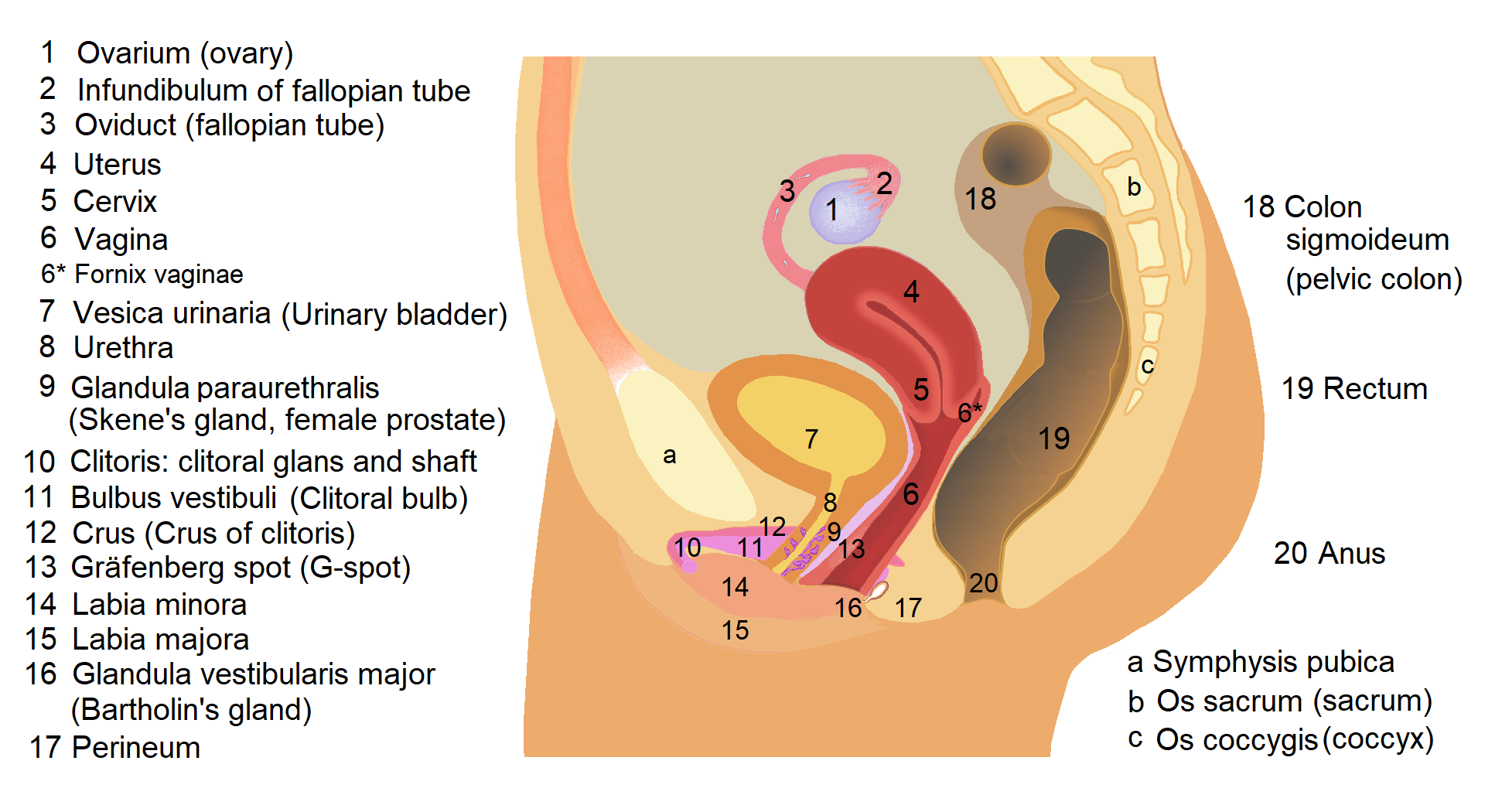
The human female reproductive system is made up of the internal and external sex organs that function in the reproduction of new offspring. The reproductive system is immature at birth and develops at puberty to be able to release matured ova from the ovaries, facilitate their fertilization, and create a protective environment for the developing fetus during pregnancy. The female reproductive tract is made of several connected internal sex organs—the vagina, uterus, and fallopian tubes—and is prone to infections. The vagina allows for sexual intercourse and childbirth, and is connected to the uterus at the cervix. The uterus (or womb) accommodates the embryo by developing the uterine lining.
The uterus also produces secretions which help the transit of sperm to the fallopian tubes, where sperm fertilize the ova. During the menstrual cycle, the ovaries release an ovum, which transits through the fallopian tube into the uterus. If an egg cell meets with sperm on its way to the uterus, a single sperm cell can enter and merge with it, creating a zygote. If no fertilization occurs, menstruation is the process by which the uterine lining is shed as blood, mucus, and tissue.
Fertilization usually occurs in the fallopian tubes and marks the beginning of embryogenesis. The zygote will then divide over enough generations of cells to form a blastocyst, which implants itself in the wall of the uterus. This begins the period of gestation and the embryo will continue to develop until full-term. When the fetus has developed enough to survive outside the uterus, the cervix dilates, and contractions of the uterus propel it through the birth canal (the vagina), where it becomes a newborn. The breasts are part of the reproductive system although mammary glands were only essential to nourishing infants until the modern advent of infant formula.
Later in life, a woman goes through menopause and menstruation halts. The ovaries stop releasing eggs and the uterus stops preparing for pregnancy.
The external sex organs are also known as the genitals, and these are the organs of the vulva, including the labia, clitoris, and vestibule. The corresponding equivalent among males is the male reproductive system.
The vulva is of all of the external parts and tissues and includes the following:
The vagina is a fibromuscular (made up of fibrous and muscular tissue) canal leading from the outside of the body to the cervix of the uterus. It is also referred to as the birth canal in the context of pregnancy. The vagina accommodates a penis during sexual intercourse. Semen containing spermatozoa is ejaculated from the penis at orgasm, into the vagina potentially enabling fertilization of the egg cell (ovum) to take place.
The cervix is the neck of the uterus, the lower, narrow portion where it joins with the upper part of the vagina. It is cylindrical or conical in shape and protrudes through the upper anterior vaginal wall. Approximately half its length is visible, the remainder lies above the vagina beyond view. The vagina has a thick layer outside and it is the opening where the fetus emerges during delivery.
Hub AI
Female reproductive system AI simulator
(@Female reproductive system_simulator)
Female reproductive system
The human female reproductive system is made up of the internal and external sex organs that function in the reproduction of new offspring. The reproductive system is immature at birth and develops at puberty to be able to release matured ova from the ovaries, facilitate their fertilization, and create a protective environment for the developing fetus during pregnancy. The female reproductive tract is made of several connected internal sex organs—the vagina, uterus, and fallopian tubes—and is prone to infections. The vagina allows for sexual intercourse and childbirth, and is connected to the uterus at the cervix. The uterus (or womb) accommodates the embryo by developing the uterine lining.
The uterus also produces secretions which help the transit of sperm to the fallopian tubes, where sperm fertilize the ova. During the menstrual cycle, the ovaries release an ovum, which transits through the fallopian tube into the uterus. If an egg cell meets with sperm on its way to the uterus, a single sperm cell can enter and merge with it, creating a zygote. If no fertilization occurs, menstruation is the process by which the uterine lining is shed as blood, mucus, and tissue.
Fertilization usually occurs in the fallopian tubes and marks the beginning of embryogenesis. The zygote will then divide over enough generations of cells to form a blastocyst, which implants itself in the wall of the uterus. This begins the period of gestation and the embryo will continue to develop until full-term. When the fetus has developed enough to survive outside the uterus, the cervix dilates, and contractions of the uterus propel it through the birth canal (the vagina), where it becomes a newborn. The breasts are part of the reproductive system although mammary glands were only essential to nourishing infants until the modern advent of infant formula.
Later in life, a woman goes through menopause and menstruation halts. The ovaries stop releasing eggs and the uterus stops preparing for pregnancy.
The external sex organs are also known as the genitals, and these are the organs of the vulva, including the labia, clitoris, and vestibule. The corresponding equivalent among males is the male reproductive system.
The vulva is of all of the external parts and tissues and includes the following:
The vagina is a fibromuscular (made up of fibrous and muscular tissue) canal leading from the outside of the body to the cervix of the uterus. It is also referred to as the birth canal in the context of pregnancy. The vagina accommodates a penis during sexual intercourse. Semen containing spermatozoa is ejaculated from the penis at orgasm, into the vagina potentially enabling fertilization of the egg cell (ovum) to take place.
The cervix is the neck of the uterus, the lower, narrow portion where it joins with the upper part of the vagina. It is cylindrical or conical in shape and protrudes through the upper anterior vaginal wall. Approximately half its length is visible, the remainder lies above the vagina beyond view. The vagina has a thick layer outside and it is the opening where the fetus emerges during delivery.