Hubbry Logo
Vaikuntam Queue ComplexVaikuntam Queue ComplexMain
Open search
Vaikuntam Queue Complex
Community hub
Vaikuntam Queue Complex
logo
8 pages, 0 posts
0 subscribers
Be the first to start a discussion here.
Vaikuntam Queue Complex
from Wikipedia

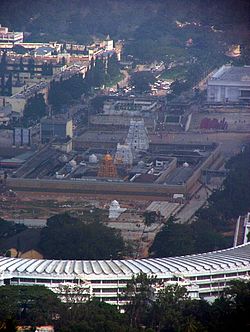
Tirumala Venkateswara Temple with the Vaikuntham Queue Complex in the foreground recognizable as the semicircular building

Vaikuntham Queue Complex is a facility used in Tirumala Venkateswara Temple, Tirumala by Tirumala Tirupati Devasthanams (TTD) for queue management. The complex serves as the entry point for all darshans and there are very few exceptions.

History

[edit]

The mid-1970s saw a sudden spike in the pilgrim inflow to the temple with rapid improvements in access to Tirupati and Tirumala. TTD added hundreds of cottages on the hills in Tirumala but could not address the crowd management fully. With the lack of infrastructure to hold pilgrims, the temple witnessed serpentine queues outside the temple and during peak season circling the 4 mada streets. TTD under the leadership of Sri P.V.R.K. Prasad (Executive Officer) and B.Nagi Reddy (Chairman, Board of Trustees) planned for a queue complex system that could hold 14,000 people as a solution for crowd management.[1] Work began in 1980 and was completed in 1983. The then Chief Minister N. T. Rama Rao inaugurated the facility in 1983.[2]

Modifications were made to the queue complex by additional rooms on the north western side of the temple in 1985 but those have been removed and replaced by a second queue complex in 2000 that is located down the road from the first queue complex.

At present, Queue complex-1 (old) caters to all Arjita Seva, Special Darshan (Paid Darshan), Cellar Ticket ticket holders. Pilgrims opting for Sarvadarshan (free entrance) are sent through Queue complex-2 (new).

Queue Complex

[edit]
Bridge connecting Queue complex to Temple. Temple is on the right side of the photo and the steps to reach the Queue complex (not seen here) is seen at the front left side of the photo

The Vaikuntham Queue complex is a semicircular building and opens into a garden maintained by TTD. The complex is situated on the southwest corner of the temple and is separated from the temple by the South Mada Street. The building has three levels in total and there are 19 halls in each level. Each hall has two doors - one for allowing pilgrims into the hall and the other for pilgrims to exit the hall and enter the corridor leading to the temple. The corridors connect to the southeast end of the temple by an overhead bridge. After the descent, the pilgrims turn around the corner and enter the temple through the main gopuram. To ensure pilgrims entering the temple for various activities are allowed at the same time, there are 2 queues and attendants inside the gopuram route the pilgrims appropriately.

Features

[edit]

Basic Facilities

[edit]

Inside the holding areas and rooms, TTD provides free food, fresh milk as well as medical aid facilities. Sanitary needs are also taken care of. Each compartment is provided with LED TV telecasting Sri Venkateswara Bhakti Channel(SVBC), a TTD-owned Devotional channel.

Security

[edit]

The entrance to the Vaikuntham Queue complex is staffed by Police, security and temple officials. For Arjita Seva ticket holders, the tickets are checked manually before allowing pilgrims inside the complex. Various sign boards indicate the location of the room where pilgrims need to report for their darshan or seva. Outside the room, the ticket is checked along with the fingerprints and (as necessary) face matches with the biometric data provided at the time of ticket purchase. Just before entering the temple, there is a baggage scanner to check bags carried inside the temple. Pilgrims are asked to exit the queue complex and deposit mobile phones and cameras, if present - a scenario that could delay darshan. Inside the queue complex as well as in the temple (leading right to the sanctum sanctorum), TTD has installed security cameras to oversee pilgrims' movements.

References

[edit]
Revisions and contributorsEdit on WikipediaRead on Wikipedia
from Grokipedia
The Vaikuntam Queue Complex (VQC) is a dedicated queuing facility at the (TTD) in , , , primarily used to manage the influx of devotees for Sarvadarsanam, the free general darshan of at the Sri Venkateswara Temple. It comprises two interconnected complexes featuring a series of spacious, airy halls that guide pilgrims orderly toward the temple sanctum, handling 60,000 to 80,000 visitors daily on normal days. The first complex, initiated in 1983 by then-Chief Minister , revolutionized crowd management with approximately 37 compartments capable of accommodating up to 17,000 pilgrims, while the second complex was later constructed to serve common pilgrims with a capacity of nearly 10,000. The complexes operate for 18 hours on regular days and up to 20 hours during peak periods, ensuring efficient flow through regulated queues monitored by TTD officers. Essential amenities include free Annaprasadam (meals), beverages like milk, coffee, and tea served every three hours, medical aid stations, well-maintained restrooms, purified drinking water, and CCTV-monitored areas broadcasting devotional programs and music to maintain a serene atmosphere. Separate entrances, such as VQC II for Sarvadarsanam and dedicated lines for VIP or donation-based darshans, help segregate crowds and minimize wait times. In response to surging pilgrim numbers—exacerbated by the introduction of online booking systems in the mid-2010s under —the TTD has explored a third queue complex to further enhance capacity and comfort. This infrastructure underscores the TTD's commitment to facilitating equitable access to one of the world's most visited religious sites, where darshan remains a profound spiritual experience for millions annually.

Overview

Location and Purpose

The Vaikuntam Queue Complex is located at the southwest corner of the Venkateswara Temple in , , , adjacent to the temple but separated by South Mada Street. Pilgrims access the temple from the complex via an overhead bridge spanning the street, ensuring a seamless transition while maintaining separation from vehicular traffic. Operated by the (TTD), the complex functions as the primary facility for managing pilgrim queues seeking darshan of Lord , channeling the flow of devotees through a series of inter-connected halls to promote orderly progression and minimize congestion at the temple's main entrance. This infrastructure addresses the logistical challenges posed by high-volume visitation, providing regulated waiting areas equipped with basic amenities to support extended stays during peak periods. The need for the complex arose in the mid-1970s amid a sharp rise in pilgrim inflows, triggered by TTD's enhancements to road access between and , which dramatically increased daily arrivals from thousands to tens of thousands. As a of the pilgrimage journey, the complexes together accommodate up to approximately 27,000 devotees, with the first complex (VQC1) holding about 17,000 across 37 compartments and the second (VQC2) nearly 10,000, enabling efficient and underscoring its vital role in sustaining the temple's operations amid growing devotional .

Architectural Design

The Vaikuntam Queue Complex is structured to optimize space utilization and promote efficient pilgrim flow toward the Temple. This design features multiple levels of inter-connected halls that guide devotees in a progressive manner, minimizing congestion at any single point. Each hall incorporates two doors—one for entry and one for exit—to enable smooth transitions between sections and support high-volume movement without bottlenecks. The layout culminates in a series of corridors that connect to the temple via an overhead bridge, providing a secure and streamlined pathway for pilgrims. Engineered for durability under intense footfall, the first complex's initial design accommodated up to 17,000 pilgrims, with provisions for enhanced interconnectivity among halls to adapt to varying crowd densities. This architecture prioritizes gradual progression, reducing the risk of overcrowding while maintaining structural integrity for daily operations.

History

Initial Construction

The planning phase for the Vaikuntam Queue Complex was initiated in the mid-1970s by Sri , the of the (TTD), and B. Nagi Reddy, the Chairman of the TTD Board of Trustees, to manage the surging pilgrim crowds at the Venkateswara Temple. These efforts were driven by rapid improvements in road access to during that period, which dramatically increased visitor numbers and resulted in unmanaged queues that often encircled the temple's four surrounding streets, posing significant challenges to pilgrim safety and comfort. Construction of the original complex began in 1980 under the oversight of TTD leadership and was completed in 1983, creating a semicircular structure designed to hold thousands of devotees in an organized manner. The facility, comprising approximately 37 compartments, was built to accommodate up to 17,000 pilgrims, providing covered waiting areas and basic amenities to streamline the darshan process. It was inaugurated by then in 1983, marking a key milestone in TTD's infrastructure development for .

Expansions and Modifications

Following its in 1983, the Vaikuntam Queue Complex underwent structural modifications in 1985, including the addition of extra rooms on the northwestern side to enhance pilgrim flow and accommodate growing crowds. These adjustments aimed to streamline movement within the original semicircular structure, addressing initial bottlenecks in queue progression toward the temple. However, these added rooms were later removed and replaced as part of ongoing adaptations to optimize space. To further manage escalating pilgrim numbers, the (TTD) constructed a second queue complex in 2000, located adjacent to the original facility and specifically designed for Sarvadarshan pilgrims seeking free entry. This addition, known as Vaikuntam Queue Complex II, features interconnected compartments that allow devotees to wait comfortably while progressing toward darshan, with a capacity of nearly 10,000 individuals. In contrast, the original Queue Complex I primarily handles paid and special darshan categories, creating a bifurcated system to segregate queue types and reduce congestion. These expansions were driven by the sustained surge in annual visitors to , which grew from approximately 700,000 in 1951 to over 15 million by 2001—a twentyfold increase reflecting the temple's rising global appeal. Daily footfall often exceeds 60,000 to 100,000 pilgrims, necessitating such upgrades to maintain orderly access without compromising devotee welfare.

Operations

Queue Management System

The Vaikuntam Queue Complex implements a procedural queue to direct and monitor the movement of pilgrims toward darshan at the Sri Temple in . Pilgrims enter via designated gates into the complex, which comprises a series of inter-connected halls that guide them in a progressive manner to the temple. The system is designed to handle 60,000 to 80,000 pilgrims daily on normal days, ensuring orderly flow through clean, spacious, and well-ventilated halls. In April 2025, the (TTD) launched a block-based queue at convergence points where external queues merge with the Vaikuntam Queue Complex, dividing the flow into 14 distinct blocks along routes such as ATC Tank Bund and Narayana Giri Gardens. Each block accommodates up to 400 pilgrims within secured, numbered compartments equipped with gates, facilitating better control and preventing overcrowding at entry points. This innovation builds on the complex's linear pathway, which prohibits to minimize congestion and promote efficient progression. Pilgrim movement concludes with an exit from the halls via an overhead bridge connecting to the temple's southeast entrance, allowing seamless transition after descent. Oversight is provided by TTD officers, vigilance staff, and assistant executive officers who regulate queues through direct supervision, public address systems for announcements, and real-time updates displayed on screens. Signage throughout the complex further aids navigation and maintains order. Average wait times fluctuate with crowd density, generally spanning 6 to 8 hours on typical days and extending to 20 hours during festivals or peak seasons. Different darshan categories can route pilgrims through specific paths within this framework.

Types of Darshan

The Vaikuntam Queue Complex manages multiple categories of darshan to accommodate diverse pilgrim groups, utilizing separate pathways for free and paid access to promote both accessibility and operational efficiency. Sarvadarshan provides free general darshan exclusively through Queue Complex-2, open to all pilgrims. Pilgrims can obtain free Sarva Darshan Tokens (SSD) at designated counters in or for time-slotted entry, helping to regulate queues and shorten waits, without requiring advance online booking. Devotees enter this dedicated section and navigate a series of inter-connected, spacious compartments equipped with basic amenities, where they await their turn for a glimpse of Lord ; this process typically accommodates 60,000 to 80,000 pilgrims daily on normal days, with wait times varying from 6 to 20 hours depending on crowd levels. Arjita Sevas and Special Darshan, as paid services, route pilgrims through Queue Complex-1 to ensure prioritized and expedited access. Arjita Sevas encompass various donation-based rituals offering enhanced proximity to the , such as Suprabhata Seva (early morning awakening), Thomala Seva (decoration with flowers), and Archana (personalized chanting of names), with costs starting from ₹25 per person for services like Archana and up to several thousand rupees depending on the seva type; tickets booked up to one month in advance. The Special Darshan, commonly known as Seegra Darshan or ₹300 Special Entry Darshan, allows quicker progression with wait times reduced to 2-3 hours, available via online booking and entry near the ATC parking area adjacent to Complex-1. These options include VIP Break Darshan for Srivani Trust donors contributing at least ₹10,000, enabling direct entry and minimal queuing for a one-time privilege. These distinctions—free pathways in Complex-2 versus paid and priority routes in Complex-1—balance equity for general pilgrims with for special groups, significantly reducing wait times for ticketed devotees while upholding universal access; special queues overall help manage peak crowds by segregating flows from entry to the temple's Pradakshinam area.

Facilities

Amenities for Pilgrims

The Vaikuntam Queue Complex provides essential amenities to support the comfort of pilgrims during extended waiting periods for darshan at the Tirumala Venkateswara Temple. Free distribution of food and beverages is a key service, with meals such as , pongal, or upma served as between 9:00 AM and 10:30 AM, followed by lunch and dinner consisting of chakkara pongal, curry, chutney, rice, sambar, rasam, and buttermilk from 10:30 AM to 4:00 PM and 5:00 PM to 10:30 PM, respectively. Beverages and snacks are distributed every three hours throughout the day in the compartments of Vaikuntam Queue Complex I and II, ensuring timely nourishment for waiting devotees. Additionally, approximately 10,000 liters of fresh are provided daily across the complex and related areas to cater to general needs, including infants and seniors. Medical aid is readily available through on-site and clinics designed to address basic concerns, particularly for elderly or ill pilgrims enduring long queues. A dedicated 24-hour operates exclusively within Vaikuntam Queue Complex I to offer immediate assistance to devotees waiting for hours. Free medical facilities extend to the broader complex, including first-aid centers in Vaikuntam Queue Complex II, supported by ' healthcare network for prompt treatment of minor ailments. Sanitation facilities, including restrooms, are integrated across the halls to maintain for the large influx of pilgrims. These amenities are regularly maintained to ensure cleanliness, with engineering efforts focused on updating like taps and toilets to prevent hygiene issues during peak times. To alleviate the tedium of waiting, options include LED televisions and a modern spiritual amphitheater broadcasting devotional content from the Sri Venkateswara Bhakti Channel (SVBC), a TTD-operated channel featuring programs, music, and temple updates. This setup, installed in 2014, aims to foster a devotional atmosphere within the compartments.

Security Arrangements

The security framework at the Vaikuntam Queue Complex relies on coordinated personnel deployment to ensure safety and order for millions of annual pilgrims. TTD vigilance officials oversee operations within the halls, enforcing protocols and monitoring compliance, while private security guards, including personnel stationed at key entry points, conduct routine patrols and assist in regulating access. Urban Police contingents are integrated into this setup, with deployments scaling up during high-traffic events like Vaikunta Ekadasi to manage potential disruptions. Screening processes at the complex entrances involve thorough checks to prevent prohibited items from entering. Pilgrims undergo manual pat-down searches conducted separately for men and women to detect items such as electronic gadgets, non-vegetarian food, liquor, and weapons, which are confiscated on site. Biometric verification, including facial recognition systems at points like Vaikuntam Queue Complex-2, confirms pilgrim identities against darshan tokens for authorized entry. These measures align briefly with queue flow to minimize delays while upholding vigilance. Surveillance infrastructure features hundreds of CCTV cameras strategically placed across the complex, including inside halls, Narayangiri sheds, and external queue lines, enabling continuous oversight of pilgrim movements. All feeds are linked to the TTD's Integrated Command Control Centre, where over 25 technical staff monitor live footage in real time to detect anomalies and support proactive interventions. Emergency protocols emphasize swift coordination among TTD security teams, police units, and the command centre to handle incidents like surges or breaches. This includes predefined response plans for evacuations, emergencies, and unauthorized access, drawing on real-time data to de-escalate situations and maintain order throughout the temple premises.

Recent Developments

Technological Integrations

In 2025, the (TTD) adopted an AI-based crowd management system at the Vaikuntam Queue Complex to enable real-time monitoring and predictive adjustments for crowd flow. This system, inaugurated on September 25, 2025, as India's first AI-integrated Command Control Centre, utilizes approximately 6,000 cameras for crowd mapping, 3D visualization of congestion, and prediction of Sarva Darshan wait times, allowing officials to dynamically optimize pilgrim movement and reduce bottlenecks. Integrated facial recognition technology further supports the identification of missing persons and enhances overall safety without disrupting queue progression. Located at Vaikuntam Queue Complex-I, the centre features live dashboards and drone surveillance to provide actionable insights, marking a significant shift toward data-driven operations for handling up to 100,000 daily pilgrims. In November 2025, TTD announced plans to strengthen the Integrated Command Control Centre (ICCC) for better crowd surveillance and management. This includes integrating CCTV feeds from the , Narayangiri sheds, and queue lines, with IT department support for system upgrades and enhancements to ICCC software by the Karya Foundation USA. Weekly review meetings will monitor progress to ensure real-time monitoring and data analysis for efficient queue management. The block-based queue system, launched in April 2025, reorganized the complex into 14 secure blocks to streamline pilgrim movement through digital tracking. Each block accommodates up to 400 devotees in numbered compartments equipped with gates for controlled entry, enabling scheduled group releases that minimize overcrowding and cut average wait times by optimizing flow from external holding areas to the main queues. This digital infrastructure integrates with TTD's monitoring tools to track block occupancy in real time, ensuring equitable access and preventing unauthorized bypassing while accommodating diverse darshan types. Digital ticketing has been integrated with TTD's official mobile apps and website, allowing pilgrims to obtain virtual queue tokens for slotted Sarva Darshan and Special Entry Darshan, which facilitates pre-arrival booking to avoid physical lines. This system, enhanced in 2025 for events like Vaikunta Ekadasi, releases tickets online starting at specified times—such as 11 a.m. for December quotas—using a secure portal where users select slots and receive e-tokens verifiable via photo ID at entry points. The virtual tokens link to the AI command centre's facial recognition for seamless verification, reducing manual checks and enabling biometric-assisted entry to expedite processing for booked pilgrims. Upgrades to Sri Venkateswara Bhakti Channel (SVBC) broadcasting in 2025 include enhanced systems across the Vaikuntam Queue Complex for real-time announcements and live updates on queue status, darshan timings, and facilities. These high-definition LED screens, installed in compartments and common areas, stream SVBC content including devotional programs and TTD alerts, ensuring pilgrims remain informed during extended waits and integrating with the AI system for dynamic content like predicted wait times. This audiovisual enhancement supports over 37 compartments, providing multilingual updates to improve the overall pilgrim experience without relying on manual announcements.

Planned Expansions

In July 2025, the (TTD) Board approved plans for the construction of a third Vaikuntam Queue Complex (VQC-III) to manage the escalating pilgrim influx and reduce overcrowding at the existing VQC-I and VQC-II facilities, particularly during high-density periods such as Brahmotsavams and Vaikunta Ekadasi. The initiative stems from the current complexes' capacity to handle 60,000 to 100,000 devotees daily, which proves insufficient during peak events, leading to extended wait times and discomfort for pilgrims. A sub-committee of experts was constituted to conduct a comprehensive , encompassing technical, financial, and administrative evaluations, with the process slated to commence shortly after the board's August 2025 meeting. The proposed VQC-III will feature spacious holding zones, well-ventilated waiting halls, integrated frisking and points, restrooms, facilities, aid stations, locker rooms, and enhanced for elderly and differently-abled pilgrims, complemented by cultural amenities such as devotional artwork, Vedic chanting zones, and sacred landscaping. These expansions are projected to accommodate future growth in pilgrim numbers post-2025, based on seasonal analyses for free darshan, special entry, and senior queues. is expected to proceed once a suitable site is identified and a detailed project report is finalized by the committee. Complementing the physical expansions, TTD's modernization initiatives include upgrades to the central reception office and main accommodation hub, alongside integration enhancements for the Kalyanakatta complex to streamline services and pilgrim amenities. Further AI-driven infrastructure goals encompass advanced for crowd forecasting, real-time monitoring, and expanded queue blocks to optimize flow and potentially reduce darshan wait times to two hours. These measures, supported by engagements with firms like , remain pending full board approval following procedural resolutions.

References

Add your contribution
Related Hubs
User Avatar
No comments yet.