Hubbry Logo
ValknutValknutMain
Open search
Valknut
Community hub
Valknut
logo
8 pages, 0 posts
0 subscribers
Be the first to start a discussion here.
Valknut
Valknut
from Wikipedia

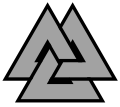
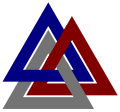
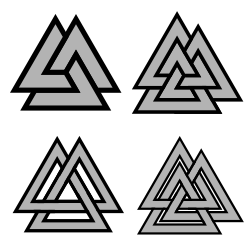
Valknut variations.
On the left unicursal trefoil forms; on the right tricursal linked triangle forms.

The valknut is a symbol consisting of three interlocked triangles forming subliminal triskelion at its center. It appears on a variety of objects from the archaeological record of the ancient Germanic peoples. The term valknut is a modern development; it is not known what term or terms were used to refer to the symbol historically.

Scholars have proposed a variety of explanations for the symbol, sometimes associating it with the god Odin, and it has been compared to the three-horned symbol found on the 9th-century Snoldelev Stone, to which it may be related.[1]

Archaeological record

[edit]
A section of the Stora Hammars I stone in Gotland, Sweden, depicts a valknut in a central and predominant position, appearing alongside figures interpreted as Odin with a characteristic spear shunting another figure into a burial mound while a raven is overhead and another man is hanged.

The valknut appears on a wide variety of objects found in areas inhabited by the Germanic peoples. The symbol is prominently featured on the Nene River Ring, an Anglo-Saxon gold finger ring dated to around the 8th to 9th centuries.[2] In 2024, an English shilling showing both the symbol and a person holding a cross was found near Norwich. It has been interpreted as a mixing of religious imagery, with the cross being a Christian symbol and the valknut being heathen. This is consistent with its dating to the 7th century CE, when Christianity was being adopted in England.[3]

A wooden bed in the Viking Age Oseberg Ship buried near Tønsberg, Norway, features a carving of the symbol on an ornately stylized bedpost and the Oseberg tapestry fragments, a partially preserved tapestry found within the ship burial, also features the symbol.[4]

Additionally, the valknut appears prominently on two picture stones from Gotland, Sweden: the Stora Hammars I stone and the Tängelgårda stone.

The historically attested instances of the symbol appear in two traditional, topologically distinct forms. The symbol appears in unicursal form, topologically a trefoil knot also seen in the triquetra. This unicursal form is found, for example, on the Tängelgårda stone. The symbol also appears in tricursal form, consisting of three linked triangles, topologically equivalent to the Borromean rings. This tricursal form can be seen on one of the Stora Hammars stones, as well as upon the Nene River Ring, and on the Oseberg ship bed post. Although other forms are topologically possible, these are the only attested forms found so far.

In Norwegian Bokmål, the term valknute is used for a polygon with a loop on each of its corners.[5] In the English language, the looped, four-cornered symbol is called Saint John's Arms.

Theories and interpretations

[edit]

Several explanations for the symbol have been proposed:

Hrungnir's heart

[edit]

Chapter 17 of the 13th century Prose Edda book Skáldskaparmál contains the following description of the heart of the jötunn Hrungnir: "Hrungnir had a heart that was famous. It was made of hard stone with three sharp-pointed corners just like the carved symbol hrungnishjarta [Hrungnir's heart]."[6] Comparisons have been made between this symbol description and the symbol known as the valknut.[1]

Odin and mental binds

[edit]
The Tängelgårda stone from Gotland, Sweden, features valknuts below a depiction of a horse.

Hilda Ellis Davidson theorizes a connection between the valknut, the god Odin, and "mental binds":

For instance, beside the figure of Odin on his horse shown on several memorial stones there is a kind of knot depicted, called the valknut, related to the triskele. This is thought to symbolize the power of the god to bind and unbind, mentioned in the poems and elsewhere. Odin had the power to lay bonds upon the mind, so that men became helpless in battle, and he could also loosen the tensions of fear and strain by his gifts of battle-madness, intoxication, and inspiration.[7]

Davidson says that similar symbols are found beside figures of wolves and ravens on "certain cremation urns" from Anglo-Saxon cemeteries in East Anglia.[7]

Other

[edit]

Because the symbol appears on picture stones with Odin and on burial gifts in the Oseberg ship burial, Rudolf Simek says that the symbol may have been associated with religious practices surrounding death.[1]

Topology

[edit]

The valknut is topologically equivalent to either the Borromean rings, the trefoil knot, or (in modern use only) a closed three-link chain, depending on the particular artistic depiction:

[edit]

The symbol is used for a variety of purposes in modern popular culture. The valknut symbol is used as a religious symbol by some adherents of Heathenry, a new religious movement inspired by historic Germanic paganism.[8]

In Europe, the Swedish forest products company Svenska Cellulosa Aktiebolaget uses a triquetra valknut as their logo, which can be commonly seen on many products produced by the company; the DFB has used a logo inspired by the unicursal form of the valknut for the Germany national football team since 1991.[9]

The symbol appears as the fretboard inlay on some of Arch Enemy/Carcass guitarist Michael Amott's signature Dean Guitars "Tyrant" models, and it is also used as a logo by American engineering firm RedViking.[10] In Civilization VI, the valknut is the national symbol of Norway, which in the game is led by Harald Hardrada and mostly representative of Vikings rather than the modern country.

Bogd Bank of Mongolia uses the same symbol as their main corporate logo.[11]

In modern Norway, the word "valknut" means "knot of those fallen in battle", connecting the symbol to the god Odin and representing the glory of death in battle.[12]

The valknut has seen some use by White supremacists.[13][14] The Anti-Defamation League notes that "nonracist pagans may also use this symbol, so one should carefully examine it in context rather than assume that a particular use of the symbol is racist."[13]

See also

[edit]
  • Mjölnir, a symbol representing the hammer of the god Thor, particularly popular during the Viking Age
  • Looped square, a symbol that produces a square with outward pointing loops at its corners
  • Triquetra, a symbol composed of three interlaced arcs
  • Triskelion, a type of hooked cross representing three bent human limbs

Citations

[edit]
  1. ^ a b c Simek (2007:163).
  2. ^ The British Museum Online. "finger-ring" Archived 21 January 2021 at the Wayback Machine
  3. ^ Marsden, Adrian (1 January 2025). "A new 7th century shilling from Norfolk". Searcher.
  4. ^ Davidson (1967:125).
  5. ^ Coat of arms for Lødingen Municipality, blazoned in the Norwegian Royal Decree of 11 May 1984, quoted in Hans Cappelen og Knut Johannessen: Norske kommunevåpen, Oslo 1987, page 197. The term is also used in Anders Bjønnes: Segltegninger fra hyllingene i Norge 1591 og 1610, Oslo 2010, pages 64–65.
  6. ^ Byock (2001:88).
  7. ^ a b Davidson (1990:147).
  8. ^ Harvey 2007: 59.
  9. ^ "index". DFB - Deutscher Fußball-Bund e.V. 19 March 2014. Archived from the original on 24 September 2008. Retrieved 25 May 2020.
  10. ^ RedViking home page Archived 22 December 2020 at the Wayback Machine.
  11. ^ "Богд Банк | Банкны тухай". Archived from the original on 24 August 2023. Retrieved 24 August 2023.
  12. ^ "Valknut | Description, Meaning, Norse Mythology, Odin, & Facts | Britannica". www.britannica.com. Retrieved 23 April 2024.
  13. ^ a b "Hate on Display - Hate Symbols Database: Valknot" Archived 16 January 2017 at the Wayback Machine. Anti-Defamation League.
  14. ^ "Face of Hate: Chris Allgier Explained". Southern Poverty Law Center. 26 August 2007. Archived from the original on 31 August 2007. Retrieved 27 December 2013.

References

[edit]
[edit]
Revisions and contributorsEdit on WikipediaRead on Wikipedia
from Grokipedia
The Valknut is a symbol composed of three interlocked triangles appearing on artifacts from the Viking Age, primarily Scandinavian runestones and grave goods dating to the 8th to 11th centuries CE. It is attested archaeologically on Gotland picture stones, such as those from Stora Hammars and Tängelgårda, where it features in scenes interpreted as sacrificial or funerary rituals. The term "valknut," a modern coinage from Norwegian combining valr ("the slain") and knut ("knot"), lacks any historical textual basis and was not used in the Norse period; the symbol's original designation, if it had one, remains unknown. Iconographic associations frequently place the Valknut near figures holding spears or accompanied by birds, motifs linked to the god in , suggesting interpretive connections to themes of death, binding of the soul, or the selection of slain warriors for , though no primary literary sources explicitly describe or name the symbol. Scholars debate its precise meaning, with some proposing it represents interconnected cycles of life, fate, or Hrungnir's heart from mythological tales, but these remain conjectural absent direct evidence. In contemporary contexts, the Valknut has been adopted in Norse reconstructionism and , while also appropriated by certain extremist groups, highlighting its ambiguous legacy beyond usage.

Description and Etymology

Geometric Structure

The Valknut consists of three interlocked triangles, typically equilateral, arranged such that their vertices point outward or form a central pattern. This configuration creates a symmetrical figure often interpreted as evoking cycles or bindings, though its precise geometric uniformity varies across depictions. Depictions fall into distinct forms: one with three discrete triangles overlapping without fused edges, resembling linked shapes, and a unicursal variant drawable via a single continuous line that traces all three triangles. The unicursal form emphasizes connectivity through a seamless path, while the separate-triangle version highlights individual yet interdependent elements. In knot theory, some renderings align with the Borromean rings, classified as link L6a4, where three components are mutually interlocked but separable pairwise, demonstrating Brunnian properties. Alternative topological equivalents include the (3_1) in unicursal tracings or a closed three-link chain (L6n1), reflecting the symbol's adaptability in both artistic and abstract mathematical contexts. These interpretations underscore the Valknut's non-rigid , as historical artifacts show inconsistencies rather than a standardized template.

Origin and Historicity of the Term

The term valknut (often rendered in faux-Old Norse as valknútr) is a modern originating in Norwegian scholarship, with no attestation in medieval Norse texts, sagas, , or other primary sources from the (circa 793–1066 CE). It lacks any historical precedent as a descriptor for the interlocked triangles symbol, which appears in archaeological contexts without nomenclature. The symbol's ancient users likely employed an unrecorded term, if any, rendering valknut a label rather than a faithful reconstruction. The word derives from the Norwegian compound valknute, historically denoting a distinct looped square knot (resembling the modern "Nordic star" or map marker symbol ⌘) used in textiles and , not the triangular form associated with Viking artifacts. Gutorm Gjessing first applied valknute (adapted as valknut) to the triangular in his 1943 paper "Hesten i førhistorisk kunst og kultus," published in the journal Viking, where he discussed prehistoric motifs including horse imagery and on Scandinavian artifacts. This application bridged unrelated knot traditions without linguistic or contextual justification, leading subsequent scholars to popularize it despite its arbitrary nature. Etymologically, val- is linked to valr ("the slain" or "battle-dead"), combined with knútr ("knot"), yielding a speculative interpretation as "knot of the slain," evocative of themes in like Odin's selection of warriors. However, this parsing is unverified for the symbol, as valknute's prefix may instead derive from a term for "rounded" or "choice," reflecting the original square 's form rather than connotations. The term's adoption reflects 20th-century romanticization of Norse heritage, prioritizing interpretive appeal over philological rigor, with no evidence tying it to pre-modern usage.

Archaeological Evidence

Primary Artifacts and Sites

![Sacrificial scene on Hammars][float-right] The primary archaeological attestations of the Valknut symbol occur on picture stones from the island of , , dating to the through the early (approximately 400–800 CE). These limestone monuments, often erected as memorials, feature carved scenes of mythological or warrior motifs alongside in some cases. One key artifact is the Stora Hammars I stone (designated G 490 in the Swedish runic corpus), found in Lärbro , , depicting a scene interpreted as a sacrifice or execution with the Valknut positioned near the central figures, possibly linking it to themes of death or divine intervention. The stone's imagery includes a tree-bound figure and armed warriors, suggesting associations with Odin-related cults, though direct causal links remain speculative without textual corroboration. The Tängelgarda I stone (G 1103), also from Lärbro parish on and dated to the CE, portrays a mounted scene with two instances of the Valknut appearing beneath the horse's legs, potentially symbolizing slain warriors or binding magic in a battle context. This artifact's early date places it predating the peak , indicating the motif's roots in pre-Viking Germanic traditions. Additional Gotland picture stones, such as those from the Hammars and Alskog areas, bear variants of the interlocked triangles, but their scarcity outside — with rare parallels in Danish wooden carvings or Anglo-Saxon —suggests a regionally concentrated usage rather than widespread pan-Germanic adoption. No Valknut motifs have been verifiably identified on mainland Scandinavian runestones or in major ship burials like Oseberg, underscoring its limited primary distribution.

Geographic and Temporal Distribution

The symbol appears in archaeological contexts primarily within and adjacent Germanic regions during the late through the , with dated examples ranging from the 7th to the 10th centuries CE. Its earliest confirmed depictions include a 7th-century from Tängelgårda on , , where the interlocking triangles appear twice beneath a mounted figure. By the , the symbol is evident on Gotland's picture stones, such as Stora Hammars I, which features it in a sacrificial scene alongside Odin-like figures and ravens. In , the Valknut is carved on wooden artifacts from the Oseberg ship burial near , dated to circa 834 CE, including a bedpost and a bucket lid fragment, within a high-status pagan context. Scandinavian finds cluster heavily in , particularly , reflecting regional memorial and funerary practices, while Norwegian evidence ties to elite burials. Danish sites yield limited direct attestations, with mentions in broader Germanic contexts but no prominently dated artifacts specified in excavation reports. Beyond , the symbol surfaces in Anglo-Saxon , as on a struck circa 640–660 CE near , , depicting it below a diademed figure holding a , indicating syncretic pagan-Christian use during conversion pressures. Another English example is the Nene River ring from , a Viking-era silver piece with the triangles alongside runic elements, recovered from a riverine deposit. These insular finds suggest dissemination via trade, migration, or shared Germanic heritage, though less frequent than continental Norse occurrences. No verified instances appear further afield in continental Europe or within this timeframe, confining the symbol's distribution to northern Germanic pagan spheres.

Recent Discoveries

In June 2025, a metal detectorist discovered a rare 7th-century Anglo-Saxon , known as a thrymsa, in a field near , , , marking the earliest known example of East Anglian coinage. The coin, weighing approximately 1.3 grams and minted around 630–670 CE, features on its reverse a figure interpreted as a dancing or holding a above a valknut symbol composed of three interlocked triangles. This juxtaposition suggests between emerging Christian and pre-Christian Norse pagan elements, as the valknut has long been linked to and themes of death and the in Scandinavian contexts. The find extends the known geographic and temporal range of the valknut, previously attested mainly on 8th–11th-century Swedish runestones and picture stones, into 7th-century Anglo-Saxon , predating most continental examples by decades or more. Experts note the coin's craftsmanship aligns with Merovingian influences from , potentially indicating trade or cultural exchange networks that carried the symbol eastward from Germanic tribes or westward via migration. While the valknut's precise function remains speculative, its placement beneath the cross may imply ritual subjugation of pagan motifs to Christian dominance, reflecting the era's religious transitions in . This discovery has prompted reevaluation of the valknut's origins, challenging assumptions of its exclusive late Viking Age Scandinavian provenance and highlighting potential Anglo-Frisian roots or earlier Proto-Norse dissemination. The coin, declared treasure under the UK's Treasure Act and acquired by a local museum, underscores ongoing metal-detecting surveys' role in uncovering transitional artifacts from the Migration Period to the early medieval era. No comparable valknut-bearing coins have surfaced since, though the find has spurred targeted geophysical surveys in similar riverine and coastal sites across eastern England.

Mythological Interpretations

The valknut's name, coined in modern Norwegian as "knot of the slain," derives from valr ("slain warriors" or "those fallen in battle") and knutr ("knot"), evoking ties to the war dead gathered by in . This , however, is a 19th-century scholarly without attestation in medieval Norse texts, where the symbol lacks a designated name or explicit mythological explanation. The association with the "slain" thus relies on retrospective linguistic analysis rather than direct literary evidence. Iconographic evidence links the valknut to through its proximity to figures interpreted as the god on artifacts. On the 7th- or 8th-century Tängelgärda stone from , , the symbol appears near a mounted with and , widely regarded by archaeologists as leading slain warriors, underscoring the god's role as for battle-fallen heroes. Similarly, the Stora Hammars I picture stone from the same region depicts the valknut alongside scenes of sacrifice and Odin-like motifs, suggesting a or funerary context tied to Odin's domain over death and the . Interpretations connecting the valknut to Odin's power over the slain propose it symbolizes the inescapable fate of warriors or the god's magical bindings (forbindings), as Odin was said to weave destinies and select the dead for eternal battle in Valhalla. Odin's self-sacrifice on Yggdrasil for rune-knowledge and his oversight of Valkyries in choosing the slain reinforce this, with the triadic form potentially mirroring the three Norns or Odin's gallows motif. Yet, scholars caution that such meanings are inferential, drawn from contextual imagery rather than corroborated by sagas or Eddas, which omit the symbol entirely. No primary sources confirm the valknut as an exclusive Odin emblem, and its recurrence in non-Odinic burial contexts implies broader connotations of mortality or oaths beyond a singular divine link.

Hrungnir's Heart Hypothesis

In the 's , describes the as possessing a heart "of hard stone and sharp-edged and three-cornered," with this shape giving rise to a symbol known as hrungnishjarta ("Hrungnir's heart"), which was later employed in magical contexts. This thirteenth-century account, drawing on earlier skaldic traditions, portrays the heart as triangular and angular, evoking durability and perhaps invulnerability, traits shattered when Thor hurls his hammer at during their . The hypothesis linking this symbol to the valknut emerges from the visual correspondence between Snorri's three-cornered description and the valknut's interlocking triangles, proposing that the archaeological motif—attested on artifacts like the picture stones—stylizes Hrungnir's petrified heart as a of giant strength or esoteric power. Advocates, including some folklorists, contend this predates the modern term "valknut" (coined in the nineteenth century from Norwegian valknute, lacking medieval attestation) and aligns with Norse motifs of bodily symbols in , such as hearts denoting or fate. For example, the symbol's rigid, geometric form mirrors stone's unyielding nature, potentially invoking Hrungnir's defiance against Thor, though no pre-Snorri texts explicitly connect it to the giant. Skeptics, however, emphasize the hypothesis's speculative nature, noting that Snorri's text references a "runic character" or token without depicting interlocked loops, which characterize most valknut instances and evoke binding or topological complexity rather than a literal heart. Archaeological evidence places valknut-like motifs in contexts tied to Odin, such as slain figures on the Hammars stones (c. 800–1000 CE), suggesting sacrificial or shamanic roles over a giant's anatomy. The link thus hinges on interpretive analogy, not direct provenance, and may reflect Snorri's euhemerizing tendencies to rationalize pagan symbols through mythic biography, potentially conflating disparate traditions without empirical corroboration from runestones or sagas.

Mental Bindings and Other Theories

Scholar Hilda Ellis Davidson proposed that the symbolizes 's capacity to impose mental binds on adversaries and release allies from psychological constraints during conflict. This interpretation connects the interlocking triangles to 's magical prowess in Norse lore, where he could dull enemies' resolve—inducing confusion or fearlessness in foes—and incite rage in his warriors by dispelling hesitation. Descriptions in sagas, such as Snorri Sturluson's Ynglinga Saga (c. 1225 CE), attribute to the ability to "quiet the courage" of opponents or enhance victory through incantations, aligning with the symbol's appearance alongside depictions on picture stones from the 8th-11th centuries CE. The theory posits the three triangles as metaphorical knots representing these dual powers: binding (binda) the mind to incapacitate and unbinding (leysa) to empower, echoing poetic Eddic references to 's (incantatory magic) that manipulates perception and will in battle. Archaeological instances, like the Valknut near speared figures on the Stora Hammars I stone (c. 800-1000 CE, , ), reinforce this link to as and war god, though direct textual attestation tying the symbol explicitly to "mental fetters" remains interpretive rather than explicit. Alternative mythological theories frame the Valknut as emblematic of the "knot of the slain," denoting warriors pledged to whose fates interlock in death and afterlife selection by . Some scholars suggest connections to seidr (shamanic sorcery) practices, viewing the triangles as evoking Odin's self-sacrifice on for rune-knowledge, symbolizing ecstatic binding to other realms. Less substantiated proposals include representations of the three weaving (fate) or the nine worlds of in triplicate form, but these derive from symbolic extrapolation without corroboration.

Skeptical and Empirical Critiques

The term "valknut," often interpreted as "knot of the slain," is a modern not attested in any texts or medieval Scandinavian sources; it derives from Norwegian compounds "valr" (slain) and "knute" (knot), with earliest scholarly uses traced to the by figures like Sophus Bugge and later formalized in a paper by Gutorm Gjessing. This absence undermines claims of a direct mythological pedigree, as no primary eddic or sagaic reference describes the symbol by this name or explicitly ties it to or warrior death cults. Empirical analysis of archaeological instances—primarily limited to fewer than a dozen Viking Age artifacts, such as the Gotland picture stones (e.g., Stora Hammars I and II, circa 7th-9th centuries CE)—reveals no inscriptions or contextual artifacts clarifying intent, rendering interpretations reliant on visual juxtaposition rather than textual or functional evidence. Associations with Odin stem from proximity to spear-wielding figures interpreted as the god on stones like Tängelgårda, but such iconographic correlations do not establish causation or exclusivity; similar interlocking motifs appear in non-Odinic contexts, suggesting possible decorative, apotropaic, or generic knotwork functions without specific sacral meaning. Variations in depiction, including non-interlocked triangles or trefoil forms, further question the symbol's uniformity as a deliberate "knot," challenging topological claims of inherent binding symbolism tied to Odinic mind-control myths like those in Hávamál. Hypotheses linking the valknut to Hrungnir's heart from Snorri Sturluson's (13th century) rely on a single metaphorical description of the giant's stone heart as triangle-shaped, but this post-dates the artifacts by centuries and lacks material corroboration, representing speculative etiological projection rather than empirical continuity. Broader critiques highlight how neopagan and popular sources amplify unverified Odin-slain connections, often prioritizing intuitive symbolism over the paucity of pre-modern , while academic caution—evident in debates over the symbol's open interpretability—stems from the field's inherent limitations in decoding non-literate . No peer-reviewed studies confirm causal links to , underscoring that purported meanings reflect modern reconstructive biases more than verifiable .

Mathematical and Topological Analysis

Knot-Like Properties

The valknut is topologically analyzed as a link rather than a single , with its interlocked triangular form corresponding to specific multi-component structures in . In one prevalent model, it aligns with the , denoted as the link L6a4, a comprising three unknotted circles. This configuration exhibits the property that no pairwise subset is linked—each pair has a of zero—yet the full assembly cannot be separated into independent components without breakage, illustrating a higher-order interdependence. This Brunnian nature underscores the valknut's knot-like inseparability, where the topological entanglement relies on all elements collectively; severing any yields two unlinked circles. The link is hyperbolic, admitting a complement with a hyperbolic volume of approximately 7.32772, computed via or similar tools for link complements. Such properties distinguish it from trivial links and highlight its non-splittable character under . Variant depictions interpret the valknut as a closed three-link , classified as L6n1, where three components interlock in a sequential manner, forming a non-trivial Hopf that resists disentanglement. Unlike the Borromean form, this model involves direct pairwise linking in a cycle, with total zero but evident . Both representations share the trait of being 6-crossing in minimal , with the valknut's planar projection serving as a that projects these 3D embeddings. Unicursal versions, drawable in a single stroke, may reduce to the (3_1) when considered as a single closed curve, possessing a crossing number of 3 and being the simplest chiral knot. The trefoil's knot group is the braid group B3 modulo its center, and it fails the unknotting test via invariants like the Arf invariant of 1, confirming non-triviality. However, historical artifacts favor multi-component links over single-knot tracings, aligning more closely with the Borromean or chain models for capturing the symbol's interlocking essence.

Unicursal Tracing and Invariants

The unicursal form of the valknut features a single continuous line forming three interlocked triangles, enabling it to be drawn in one stroke without lifting the instrument or retracing paths, corresponding to an Eulerian circuit in its underlying graph. This configuration appears on the Tängelgarda stone from , , dated to the CE. In contrast, the tricursal variant comprises three distinct closed loops, requiring separate tracings for each triangle. Historical artifacts display both forms, with the unicursal predating widespread tricursal depictions in iconography. Topologically, the unicursal valknut equates to the (denoted 3_1 in standard knot tables), a single-component with minimal crossing number of three. This type exhibits non-trivial invariants, including a group with x,yx2=y3\langle x, y \mid x^2 = y^3 \rangle and a non-zero Δ(t)=t2t+1\Delta(t) = t^2 - t + 1, distinguishing it from the . Such invariants remain unchanged under , confirming the valknut's embedding as a rather than a composite or unlink. The tricursal form, interpreted as three oriented circles, aligns with the link (L6a4), where pairwise linking numbers are zero—allowing any two rings to separate—but the triple linking invariant, such as the Milnor μ(112)\mu(112) number of ±1\pm 1, enforces overall inseparability. This distinction highlights how tracing method influences perceived : unicursal yields a knotted curve, while tricursal suggests a . Empirical analysis of rune stone projections supports these classifications, though planar depictions obscure full 3D embeddings.

Modern Revival and Usage

Neopagan and Heathenry Adoption

The Valknut has gained prominence in modern Heathenry, a reconstructionist religious movement reviving pre-Christian Germanic traditions, where it serves as a key emblem linked to and themes of death, sacrifice, and the . Adherents, particularly those emphasizing worship within Asatru kindreds, incorporate it into personal talismans, decorations, and , viewing the interlocking triangles as symbolizing the "knot of the slain" or the inescapable fates woven by the . This usage emerged in the late amid the broader Neopagan revival, with the symbol's appeal stemming from its archaeological presence on artifacts, despite the absence of any attested name or explicit mythological explanation for it. Interpretations among Heathens vary, often drawing on references to Odin's spear binding warriors or Hrungnir's heart motif, though scholars note these connections rely on speculative rather than primary textual evidence. Organizations like and have seen members employ the Valknut in rituals evoking Odinic mysteries, such as blots for the , but its deployment remains decentralized, reflecting Heathenry's emphasis on individual lorecraft over dogmatic uniformity. By the 1990s, commercial Neopagan vendors began mass-producing Valknut pendants, accelerating its visibility at gatherings like Midwest Thing or PantheaCon. The symbol's adoption has faced scrutiny due to parallel use by ethnonationalist and Odinist factions within folkish Heathenry, which prioritize ancestral exclusivity and have incorporated it alongside runes in iconography since the 1980s, sometimes overlapping with non-religious extremist icon sets identified by monitoring groups. Mainstream universalist Heathen bodies, such as those affiliated with the Inclusive Heathens network, have issued guidelines cautioning against its display in public contexts to mitigate misperceptions, arguing that modern associations dilute its reconstructed spiritual intent; nonetheless, surveys of practitioners indicate continued private reverence, with over 40% of Odin-focused respondents in a 2015 European Heathen census reporting Valknut usage in devotionals. This tension underscores broader debates in Neopaganism about reclaiming ambiguous historical motifs from fringe appropriations without conceding cultural ground. The Valknut has appeared sporadically in film and television, often as a visual nod to Norse heritage or esoteric symbolism in narratives involving conflict or the supernatural. In the 2020 thriller Becky, directed by Jonathan Milott and Cary Murnion, the symbol is engraved on a key to a remote cabin, serving as a plot device amid a home invasion scenario. Similarly, it features as a keyword-associated element in the Hong Kong action film Shock Wave 2 (2020), though its specific role remains ancillary to bomb-disposal themes. In professional wrestling, the symbol was incorporated into promotional imagery for All Elite Wrestling's Revolution event on March 7, 2021, aligning with the promotion's occasional use of mythological motifs. In music, particularly within and genres, the Valknut has been depicted in album artwork to convey themes of , warfare, and the . The Swedish band included a rendition of the symbol in the background design of their 2006 album With Oden on Our Side, which peaked at number 25 on the Heatseekers chart and emphasizes Norse pagan narratives. Other underground acts, such as the Spanish thrash metal project , have centered their branding around the symbol, as seen in their 2024 album Scream of Cthulhu, blending Norse iconography with . Video games featuring , like the God of War series (2018 onward), evoke related motifs but rarely depict the Valknut explicitly, with its use overshadowed by more prominent symbols such as or . Overall, such representations tend to prioritize aesthetic or atmospheric evocation over deep mythological fidelity, reflecting the symbol's niche appeal in .

Controversial Associations and Misappropriations

The Valknut has been appropriated by certain white supremacist and neo-Nazi groups, particularly those identifying with "Odinism" or folkish variants of Asatru that emphasize racial exclusivity, transforming it from a historical Norse motif into a marker of extremist ideology. The identifies the symbol as co-opted for racist purposes, noting its use among Odinists who interpret it as signifying willingness to die in battle for , often framed within a of white racial preservation. This misuse gained visibility during the 2017 in , where participants displayed the Valknut alongside other Norse symbols to evoke a mythic warrior ethos aligned with ethnonationalism. Instances of such associations have prompted scrutiny in contemporary contexts, including a June 2025 report on a U.S. Immigration and Customs Enforcement agent's visible Valknut tattoo, which raised concerns about potential white supremacist sympathies due to the symbol's documented adoption by far-right extremists. Academic analyses highlight how far-right actors selectively draw on Norse paganism, including the Valknut, to construct a transnational white identity, appearing in terrorist manifestos and online propaganda since at least the early 2010s. Despite its pre-Christian origins unrelated to modern racial ideologies, the symbol's entanglement with these groups has led advocacy organizations to classify it as a hate symbol when used in isolation or with contextual indicators of extremism, advising caution among non-extremist practitioners of Norse-inspired spirituality.

References

Add your contribution
Related Hubs
User Avatar
No comments yet.