


Community hub
Recent from talks
Contribute something
Nothing was collected or created yet.
Huginn and Muninn
View on Wikipedia

In Norse mythology, Huginn and Muninn (sometimes anglicized as Hugin and Munin; /ˈhuːɡɪn, ˈmuːnɪn/ or /ˈhjuːɡɪn, ˈmjuːnɪn/; roughly "mind and will" – see § Etymology) are a pair of ravens that serve under the god Odin, flying around the world (Midgard) and bringing him information. Huginn and Muninn are attested in the Poetic Edda, compiled in the 13th century from earlier traditional sources: the Prose Edda and Heimskringla; in the Third Grammatical Treatise, compiled in the 13th century by Óláfr Þórðarson; and in the poetry of skalds.
In the Poetic Edda, a disguised Odin expresses that he fears the ravens may not return from their daily flights. The Prose Edda explains that Odin is referred to as Hrafnaguð (O.N.: [ˈhrɑvnɑˌɡuð]; "raven-god") due to his association with Huginn and Muninn. In the Prose Edda and the Third Grammatical Treatise, the two ravens are described as perching on Odin's shoulders. Heimskringla details that Odin gave Huginn and Muninn the ability to speak.
Examples of artifacts that may depict Odin with one of the ravens include Migration Period golden bracteates, Vendel era helmet plates, a pair of identical Germanic Iron Age bird-shaped brooches, Viking Age objects depicting a moustached man wearing a helmet, and a portion of the 10th or 11th century Thorwald's Cross. Huginn and Muninn's role as Odin's messengers has been linked to shamanic practices, the Norse raven banner, general raven symbolism among the Germanic peoples, and the Norse concepts of the fylgja and the hamingja.
Etymology
[edit]On the surface, the names Huginn and Muninn represent Odin's sense and mind. Their names are definitive singular forms of words which encompass various related but abstract senses. As an example, the English word mind is based on the same root word as Muninn, but encompasses the sense of Huginn when used as a noun, yet with the sense of Muninn when used as a verb. The exact clear definitions and intentions behind these names are hard to extrapolate, but they were probably close to synonyms with several shared and bordering senses.[1]
Huginn is the definite accusative singular of Old Norse: hugr (see Hug (folklore); modern Danish: hug, hu; Icelandic: hugur; Norwegian: hug; Old Swedish: hugher, hogher; modern Swedish: håg). It encompasses the complex meaning of mind and sense, such as "thought, perception, comprehension, awareness, mood, sentiment, desire, choice etc".[2][3] Cognates include Middle English: hige (with variants: huȝe, huiȝe, hiȝe, huie, hiȝ, hie), Old English: hyge, hiġe; Old Saxon: hugi; Middle Dutch: hoghe; Dutch: heug; Gothic: hugs; Old High German: hugu, hugi; with the same meaning.[2][1]
Muninn is the definite accusative singular of Old Norse: munr (modern Danish: mon; Icelandic: munur; Norwegian: monn; Old Swedish: mon, mun; modern Swedish: mån). It encompasses the complex meaning of affection, intent and will, such as "care, urge, yern, strive, wonder, curiosity, interest, memory, prediction etc".[4][5][6][7][8][9][10] Cognates include Old English: myne; Gothic: muns; Middle High German: mun; with the same meaning, as well as English: mind and Old English: gemynd ("memory, mind").[2][7][1]
Attestations
[edit].jpg)
In the Poetic Edda poem Grímnismál, the god Odin (disguised as Grímnir) provides the young Agnarr with information about Odin's companions. He tells the prince about Odin's wolves Geri and Freki, and, in the next stanza of the poem, states that Huginn and Muninn fly daily across the entire world, Midgard. Grímnir says that he worries Huginn may not come back, yet more does he fear for Muninn:
- Benjamin Thorpe translation:
- Hugin and Munin fly each day
- over the spacious earth.
- I fear for Hugin, that he come not back,
- yet more anxious am I for Munin.[11]
- Henry Adams Bellows translation:
- O'er Mithgarth Hugin and Munin both
- Each day set forth to fly;
- For Hugin I fear lest he come not home,
- But for Munin my care is more.[12]
In the Prose Edda book Gylfaginning (chapter 38), the enthroned figure of High tells Gangleri (king Gylfi in disguise) that two ravens named Huginn and Muninn sit on Odin's shoulders. The ravens tell Odin everything they see and hear. Odin sends Huginn and Muninn out at dawn, and the birds fly all over the world before returning at dinner-time. As a result, Odin is kept informed of many events. High adds that it is from this association that Odin is referred to as "raven-god". The above-mentioned stanza from Grímnismál is then quoted.[13]
In the Prose Edda book Skáldskaparmál (chapter 60), Huginn and Muninn appear in a list of poetic names for ravens. In the same chapter, excerpts from a work by the skald Einarr Skúlason are provided. In these excerpts Muninn is referenced in a common noun for 'raven' and Huginn is referenced in a kenning for 'carrion'.[14]
In the Heimskringla book Ynglinga saga, a euhemerized account of the life of Odin is provided. Chapter 7 describes that Odin had two ravens, and upon these ravens he bestowed the gift of speech. These ravens flew all over the land and brought him information, causing Odin to become "very wise in his lore."[15]
In the Third Grammatical Treatise an anonymous verse is recorded that mentions the ravens flying from Odin's shoulders; Huginn seeking hanged men, and Muninn slain bodies. The verse reads:
Archaeological record
[edit].jpg)
.jpg)
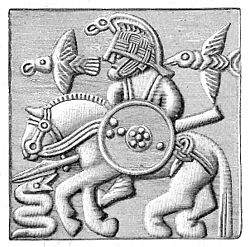
Migration Period (5th and 6th centuries CE) gold bracteates (types A, B, and C) feature a depiction of a human figure above a horse, holding a spear and flanked by one or more often two birds. The presence of the birds has led to the iconographic identification of the human figure as the god Odin, flanked by Huginn and Muninn. Like Snorri's Prose Edda description of the ravens, a bird is sometimes depicted at the ear of the human, or at the ear of the horse. Bracteates have been found in Denmark, Sweden, Norway and, in smaller numbers, England and areas south of Denmark.[17] Austrian Germanist Rudolf Simek states that these bracteates may depict Odin and his ravens healing a horse and may indicate that the birds were originally not simply his battlefield companions but also "Odin's helpers in his veterinary function."[18]
Vendel era helmet plates (from the 6th or 7th century) found in a grave in Sweden depict a helmeted figure holding a spear and a shield while riding a horse, flanked by two birds. The plate has been interpreted as Odin accompanied by two birds: his ravens.[19]
A pair of identical Germanic Iron Age bird-shaped brooches from Bejsebakke in northern Denmark may be depictions of Huginn and Muninn. The back of each bird features a mask motif, and the feet of the birds are shaped like the heads of animals. The feathers of the birds are also composed of animal heads. Together, the animal heads on the feathers form a mask on the back of the bird. The birds have powerful beaks and fan-shaped tails, indicating that they are ravens. The brooches were intended to be worn on each shoulder, after Germanic Iron Age fashion.[20] Archaeologist Peter Vang Petersen comments that while the symbolism of the brooches is open to debate, the shape of the beaks and tail-feathers confirm that the brooch depictions are ravens. Petersen notes that "raven-shaped ornaments worn as a pair, after the fashion of the day, one on each shoulder, make one's thoughts turn toward Odin's ravens and the cult of Odin in the Germanic Iron Age". Petersen says that Odin is associated with disguise and that the masks on the ravens may be portraits of Odin.[20]
The Oseberg tapestry fragments, discovered within the Viking Age Oseberg ship burial in Norway, feature a scene containing two black birds hovering over a horse, possibly originally leading a wagon (as a part of a procession of horse-led wagons on the tapestry). In her examination of the tapestry, scholar Anne Stine Ingstad interprets these birds as Huginn and Muninn flying over a covered cart containing an image of Odin, drawing comparison with the images of Nerthus attested by Tacitus in 1 CE.[21]
Excavations in Ribe in Denmark have recovered a Viking Age lead metal-caster's mould and 11 identical casting-moulds. These objects depict a moustached man wearing a helmet that features two head-ornaments. Archaeologist Stig Jensen proposes that these ornaments should be interpreted as Huginn and Muninn, and the wearer as Odin. He notes that "similar depictions occur everywhere the Vikings went—from eastern England to Russia and naturally also in the rest of Scandinavia."[22]
A portion of Thorwald's Cross (a partly surviving runestone erected at Kirk Andreas on the Isle of Man) depicts a bearded human holding a spear downward at a wolf, his right foot in its mouth, and a large bird on his shoulder.[23] Andy Orchard comments that this bird may be either Huginn or Muninn.[9] The Scandinavian Runic-text Database dates the cross to 940,[24] while Pluskowski dates it to the 11th century.[23] This depiction has been interpreted as Odin, with a raven or eagle at his shoulder, being consumed by the monstrous wolf Fenrir during the events of Ragnarök.[23][25]
In November 2009, the Roskilde Museum announced the discovery and subsequent display of a niello-inlaid silver figurine found in Lejre, Denmark, which they dubbed "Odin from Lejre". The silver object depicts a person sitting on a throne. The throne features the heads of animals and is flanked by two birds. The Roskilde Museum identifies the figure as Odin sitting on his throne Hliðskjálf, flanked by the ravens Huginn and Muninn.[26]
Interpretations
[edit]

Scholars have linked Odin's relation to Huginn and Muninn to shamanic practice. John Lindow relates Odin's ability to send his "thought" (Huginn) and "mind" (Muninn) to the trance-state journey of shamans. Lindow says the Grímnismál stanza where Odin worries about the return of Huginn and Muninn "would be consistent with the danger that the shaman faces on the trance-state journey."[27]
Rudolf Simek is critical of the approach, stating that "attempts have been made to interpret Odin's ravens as a personification of the god's intellectual powers, but this can only be assumed from the names Huginn and Muninn themselves which were unlikely to have been invented much before the 9th or 10th centuries" yet that the two ravens, as Odin's companions, appear to derive from much earlier times.[18] Instead, Simek connects Huginn and Muninn with wider raven symbolism in the Germanic world, including the raven banner (described in English chronicles and Scandinavian sagas), a banner which was woven in a method that allowed it, when fluttering in the wind, to appear as if the raven depicted upon it was beating its wings.[18]
Anthony Winterbourne connects Huginn and Muninn to the Norse concepts of the fylgja, a concept with three characteristics: shape-shifting abilities, good fortune, and the guardian spirit; and to the hamingja, the ghostly double of a person that may appear in the form of an animal. Winterbourne states that "The shaman's journey through the different parts of the cosmos is symbolized by the hamingja concept of the shape-shifting soul, and gains another symbolic dimension for the Norse soul in the account of Oðin's ravens, Huginn and Muninn".[28] In response to Simek's criticism of attempts to interpret the ravens "philosophically", Winterbourne says that "such speculations [...] simply strengthen the conceptual significance made plausible by other features of the mythology" and that the names Huginn and Muninn "demand more explanation than is usually provided".[28]
The Heliand, an Old Saxon adaptation of the New Testament from the 9th century, differs from the New Testament in that an explicit reference is made to a dove sitting on the shoulder of Christ. Regarding this, G. Ronald Murphy says "In placing the powerful white dove not just above Christ, but right on his shoulder, the Heliand author has portrayed Christ, not only as the Son of the All-Ruler, but also as a new Woden. This deliberate image of Christ triumphantly astride the land with the magnificent bird on his shoulders (the author is perhaps a bit embarrassed that the bird is an unwarlike dove!) is an image intended to calm the fears and longings of those who mourn the loss of Woden and who want to return to the old religion's symbols and ways. With this image, Christ becomes a Germanic god, one into whose ears the Spirit of the Almighty whispers".[29]
Bernd Heinrich theorizes that Huginn and Muninn, along with Odin and his wolves Geri and Freki, reflect a symbiosis observed in the natural world among ravens, wolves, and humans on the hunt:
- In a biological symbiosis one organism typically shores up some weakness or deficiency of the other(s). As in such a symbiosis, Odin the father of all humans and gods, though in human form was imperfect by himself. As a separate entity he lacked depth perception (being one-eyed) and he was apparently also uninformed and forgetful. But his weaknesses were compensated by his ravens, Hugin (mind) and Munin (memory) who were part of him. They perched on his shoulders and reconnoitered to the ends of the earth each day to return in the evening and tell him the news. He also had two wolves at his side, and the man/god-raven-wolf association was like one single organism in which the ravens were the eyes, mind, and memory, and the wolves the providers of meat and nourishment. As god, Odin was the ethereal part—he only drank wine and spoke only in poetry. I wondered if the Odin myth was a metaphor that playfully and poetically encapsulates ancient knowledge of our prehistoric past as hunters in association with two allies to produce a powerful hunting alliance. It would reflect a past that we have long forgotten and whose meaning has been obscured and badly frayed as we abandoned our hunting cultures to become herders and agriculturists, to whom ravens act as competitors.[30]
Other uses
[edit]"Huginn" and "Muninn" were the names for the missions of European Space Agency astronauts – respectively of Andreas Mogensen of Denmark, and Marcus Wandt of Sweden – aboard the International Space Station in January 2024.[31]
See also
[edit]- Hrafnsmál, a 9th-century Old Norse poem consisting of a conversation between a valkyrie and a raven
- List of names of Odin, which include Hrafnaguð and Hrafnáss (both meaning 'raven god')
- Valravn, a supernatural "raven of the slain" appearing in 19th-century Danish folk songs
- Hugin and Munin (Marvel Comics), Marvel Comics characters based on the Norse originals
- Yatagarasu, the 3-legged crow familiar of the Shinto Kami, Amaterasu
- Ace Combat 7: Skies Unknown, a video game with two final bosses of the same name as the ravens
References
[edit]Citations
[edit]- ^ a b c "The Names of Odin's Ravens". youtube.com. Jackson Crawford. Retrieved 2025-08-31.
- ^ a b c "håg sbst". saob.se. Swedish Academy. Retrieved 2024-12-16.
- ^ Orchard (1997:92).
- ^ "mån sbst.1". saob.se. Swedish Academy. Retrieved 2024-12-16.
- ^ "månne adv". saob.se. Swedish Academy. Retrieved 2024-12-16.
- ^ "månde v." saob.se. Swedish Academy. Retrieved 2024-12-16.
- ^ a b "minne sbst.1". saob.se. Swedish Academy. Retrieved 2024-12-16.
- ^ "mina v.1". saob.se. Swedish Academy. Retrieved 2024-12-16.
- ^ a b Orchard (1997:115).
- ^ Lindow (2001:186).
- ^ Thorpe (1907:21).
- ^ Bellows (1923:92).
- ^ Faulkes (1995:33).
- ^ Faulkes (1995:138, 244, and 247).
- ^ Hollander (2007:11).
- ^ Wills (2006:8).
- ^ Simek (2007:43 and 164).
- ^ a b c Simek (2007:164).
- ^ Simek (2007:164) and Lindow (2005:187).
- ^ a b Petersen (1990:62).
- ^ Ingstad (1995:141–142).
- ^ Jensen (1990:178).
- ^ a b c Pluskowski (2004:158).
- ^ "Br Olsen;185A". Scandinavian Runic-text Database (2004 ed.).
- ^ Jansson (1987:152)
- ^ Roskilde Museum. Odin fra Lejre Archived 2010-06-26 at the Wayback Machine and additional information Archived 2011-07-19 at the Wayback Machine. Retrieved Nov 16, 2009.
- ^ Lindow (2001:188).
- ^ a b Winterbourne (2004:38–41).
- ^ Murphy (1989:79–80).
- ^ Heinrich (2006 [1999]: 355). For discussion of wolf and raven symbiosis, see for example Heinrich (2006 [1999]: 226–235). For discussion of wolf and human symbiosis, see for example Henrich (2006 [1999]: 236–244).
- ^ Robert Lea (2023-06-20). "Swedish astronaut 'fast-tracked' to join crew of upcoming private Axiom Space mission". Space.com. Retrieved 2023-09-12.
General and cited references
[edit]- Bellows, Henry Adams (1923). The Poetic Edda. American-Scandinavian Foundation.
- Faulkes, Anthony (Trans.) (1995). Edda. Everyman. ISBN 0-460-87616-3
- Hollander, Lee Milton. (Trans.) (2007). Heimskringla: History of the Kings of Norway. University of Texas Press. ISBN 978-0-292-73061-8
- Ingstad, Anne Stine (1995). "The Interpretation of the Oseberg-find" as published in Crumlin-Pedersen, Ole and Thye, Birgitte Munch (Editors). The Ship as Symbol in Prehistoric and Medieval Scandinavia: Papers from an International Research Seminar at the Danish National Museum, Copenhagen, 5–7 May 1994. Nationalmuseet. ISBN 87-89384-01-6
- Jansson, Sven B. (1987). Runes in Sweden. Stockholm, Gidlund. ISBN 91-7844-067-X
- Jensen, Stig (1990). "Odin from Ribe" as collected in Oldtidens Ansigt: Faces of the Past. Det kongelige Nordiske Oldskriftselskab. ISBN 87-7468-274-1
- Lindow, John (2001). Norse Mythology: A Guide to the Gods, Heroes, Rituals, and Beliefs. Oxford University Press. ISBN 0-19-515382-0
- Heinrich, Bernd (2006 [1999]). The Mind of the Raven. Harper Perennial. ISBN 978-0-06-113605-4
- Murphy, G. Ronald. 1989. The Saxon Savior. Oxford University Press. ISBN 0-19-506042-3
- Orchard, Andy (1997). Dictionary of Norse Myth and Legend. Cassell. ISBN 0-304-34520-2
- Petersen, Peter Vang (1990). "Odin's Ravens" as collected in Oldtidens Ansigt: Faces of the Past. Det kongelige Nordiske Oldskriftselskab. ISBN 87-7468-274-1
- Pluskowski, Aleks (2004). "Apocalyptic Monsters: Animal Inspirations for the Iconography of Medieval Northern Devourers". In Bildhauer, Bettina; Mills, Robert (eds.). The Monstrous Middle Ages. University of Toronto Press. ISBN 0-8020-8667-5.
- Peterson, Lena; Elmevik, Lennart; Williams, Henrik, eds. (2004-09-18). Scandinavian Runic-text Database (2004 ed.). Department of Scandinavian Languages, Uppsala University.
- Simek, Rudolf (2007) translated by Angela Hall. Dictionary of Northern Mythology. D.S. Brewer. ISBN 0-85991-513-1
- Thorpe, Benjamin (Trans) (1907). Edda Sæmundar Hinns Frôða The Edda of Sæmund the Learned. Part I. London Trübner & Co.
- Wills, Tarrin (2006). "The Anonymous Verse in the Third Grammatical Treatise" As published in McKinnell, John, Ashurst, David. Donata, Kick. (Editors). The Fantastic in Old Norse/Icelandic Literature, Sagas, and the British Isles: Preprint Papers of The 13th International Saga Conference Durham and York, 6–12 August 2006. Durham : The Centre for Medieval and Renaissance Studies. Online.
- Winterbourne, Anthony (2004). When the Norns Have Spoken: Time and Fate in Germanic Paganism. Rosemont Publishing & Printing Corp. ISBN 0-8386-4048-6.
External links
[edit] Media related to Huginn and Muninn at Wikimedia Commons

Huginn and Muninn
View on GrokipediaMythological Role
Description and Attributes
In Norse mythology, Huginn and Muninn are depicted as a pair of ravens that perch on the shoulders of the god Odin, functioning as his primary informants by serving as his eyes and ears across the world.[4] These birds are described as flying out each morning to survey the entire world and returning at dinner-time to relay their observations directly to Odin through whispers, enabling him to acquire knowledge of distant events and maintain his awareness.[5] As common ravens (Corvus corax), they possess black plumage typical of the species, symbolizing their role in the shadowy realms of wisdom and foresight.[6] Huginn and Muninn exhibit remarkable attributes that enhance their utility to Odin, including exceptional intelligence that allows them to comprehend and report complex information from their travels. Their speed is evident in their daily circuit encompassing the world, from which they return swiftly without fail, underscoring their reliability as extensions of Odin's perceptual faculties.[4] In one account, Odin is said to have granted them the ability to understand human speech and communicate their findings verbally, further emphasizing their role as articulate messengers rather than mere animals. This compensatory function is particularly poignant given Odin's self-inflicted loss of one eye in pursuit of greater wisdom, with the ravens effectively providing him a panoramic view that his physical sight alone could not achieve.[6] Their names, deriving from Old Norse roots signifying "thought" (Huginn) and "memory" (Muninn), briefly allude to their embodiment of cognitive faculties, though these linguistic aspects are explored more fully elsewhere.[6] Attestations of these traits appear consistently in key mythological texts, reinforcing their status as indispensable aides to the Allfather.[4]Daily Missions and Ragnarok Prophecy
Huginn and Muninn embark on daily flights at dawn, spanning the world including Midgard, to collect intelligence, before returning at dinner-time to perch on Odin's shoulders and relay their observations.[5] This routine underscores their function as Odin's primary informants, enabling the god to maintain awareness of events beyond Asgard.[7] In the Eddic poem Grímnismál, Odin voices profound anxiety regarding the ravens' potential failure to return, declaring: "Huginn and Muninn fly each day over the spacious earth. I fear for Huginn, that he come not back, yet more anxious am I for Muninn."[5] This expression of concern highlights Odin's dependence on the ravens for his cognitive faculties, with the greater worry for Muninn ("memory") suggesting the irreplaceable value of retained knowledge.[7]Etymology
Linguistic Origins
The names Huginn and Muninn originate from Old Norse terms hugr and munr, which are direct descendants of the Proto-Germanic roots hugiz and muniz. The root hugiz (masculine noun) primarily connoted "mind, thought, sense, or understanding," reflecting cognitive and emotional faculties central to early Germanic conceptualizations of consciousness. Similarly, muniz denoted "mind, memory, feeling, emotion, love, or desire," linking mental recollection with affective states. These reconstructions are supported by comparative linguistics, drawing from attested forms across Germanic branches and tracing further to Proto-Indo-European ḱek- or kʷek- for hugiz (related to perception and ability) and men- for muniz (associated with thinking and mental processes).[8][9] Cognates of these roots appear widely in other Germanic languages, illustrating their shared inheritance. For hugiz, equivalents include Old English hyge ("mind, thought, heart"), Old High German hugi ("mind, courage"), Old Saxon hugi, and Gothic hugs ("mind, wisdom, sense"). For muniz, parallels are found in Old English myne or gemynd ("memory, mind"), Old High German gimunt or mun ("memory, mind"), Old Saxon mun ("mind"), and Gothic muns ("thought, mind"). These terms often overlapped in denoting both intellectual and emotional dimensions, as seen in Gothic hugsmuns (a compound for "conscience" or "inner sense"). Such cognates underscore the uniformity of mental terminology in Proto-Germanic, where distinctions between thought, memory, and volition were fluid.[10][11] In Old Norse vocabulary, hugr and munr evolved to encompass broader semantic fields, influencing poetic and prosaic usage. Hugr extended beyond mere "thought" to include "heart," "courage," "disposition," and "will," appearing in compounds like hugr-fastr ("steadfast-minded") and serving as a base for kennings such as hugr-vífs ("thought-wife," metaphor for the mind). Munr, meanwhile, primarily signified "mind" or "memory" but also "mood" or "pleasure," with derivatives like muna ("to remember") used in skaldic poetry to evoke recollection or mental retention. This development reflects the integration of these roots into the expressive lexicon of Old Norse, where they facilitated metaphorical depth in verse. Etymological analyses by scholars like Jan de Vries confirm this trajectory, noting hugr's shift toward volitional connotations in medieval Scandinavian texts. Scholarly debates center on the implications of these names for Huginn and Muninn as linguistic personifications of Odin's psyche versus autonomous entities. Many philologists, including Rudolf Simek and John Lindow, argue that the names directly embody aspects of Odin's cognitive faculties—Huginn as projective thought and Muninn as retentive memory—suggesting a metaphorical extension of the god's inner mind into external agents, akin to shamanic soul-flight. However, some interpretations, as discussed by Jan de Vries, question whether this personification fully subsumes their independence, proposing that the roots' emotional layers (hugr as "love" or munr as "delight") imply distinct, semi-autonomous beings within the mythological framework. These discussions highlight the tension between etymological literalism and narrative function in Germanic poetics.[12][7]Textual Attestations
Poetic Edda References
Huginn and Muninn are prominently featured in the Grímnismál, one of the mythological poems in the Poetic Edda, where they serve as Odin's ravens that gather information across the world to aid his pursuit of wisdom. In stanza 20, Odin, disguised as the wanderer Grímnir, describes their daily flights while bound between fires in the hall of King Geirröðr, revealing aspects of his divine nature through a catalog of cosmological knowledge. The stanza reads: "Huginn and Muninn fly each day / over the spacious earth. / I fear for Huginn, that he come not back, / yet more anxious am I for Muninn."[5] This passage underscores Odin's dependence on the ravens as extensions of his thought (huginn) and memory (muninn), embodying his relentless quest for knowledge amid the risks of their journeys.[3] Within the context of Grímnismál, the ravens symbolize Odin's shamanic-like voyages of intellect, mirroring the poem's theme of a god imparting esoteric wisdom to a human audience before his identity is revealed. As Odin enumerates the halls, gods, and cosmic structures, the mention of Huginn and Muninn highlights how his omniscience relies on these emissaries scouting the "wide earth" (jörmungrund), potentially facing perils that could sever his connection to vital intelligence. Scholars interpret this anxiety—greater for Muninn, representing memory—as reflecting the fragility of wisdom in Norse cosmology, where even the Allfather cannot guarantee the return of his perceptual faculties.[13] The stanza thus integrates the ravens into Odin's broader role as a seeker of forbidden knowledge, akin to his sacrifices on Yggdrasil, emphasizing their function in sustaining his prophetic and advisory authority.[7] Although the Poetic Edda contains no direct mentions of Huginn and Muninn in other poems like Völuspá or Hávamál, their conceptual presence echoes in Odin's wisdom quests throughout the collection, such as the prophetic visions in Vafþrúðnismál, where similar themes of cosmic reconnaissance appear without naming the ravens. In related skaldic poetry, Huginn and Muninn inspire kennings for ravens, battle, and blood—such as "Huginn's sea" for blood or "reddeners of Huginn's beak" for warriors—further attesting to their symbolic role in evoking Odin's far-reaching insight and the carrion birds' association with war and fate.[14] These poetic devices reinforce the ravens' integral link to Odin's intellectual dominion in the broader Old Norse verse tradition.Prose Edda Accounts
In Snorri Sturluson's Prose Edda, a 13th-century compilation aimed at preserving Norse poetic traditions, Huginn and Muninn are prominently featured in the Gylfaginning section as Odin's loyal companions. In chapter 38, the figure High describes them to the seeker Gangleri as two ravens that perch on Odin's shoulders, serving as his primary informants by conveying everything they observe and overhear across the world./Gylfaginning) He explains that Odin dispatches Huginn and Muninn each day at dawn to fly over the entire earth, after which they return in time for his meals, a routine that underscores their role in maintaining Odin's omniscience and leads to his designation as the "raven-god" (Hrafnaguð)./Gylfaginning) This account provides a structured narrative of their daily missions, portraying them as extensions of Odin's perception rather than independent entities. The Skáldskaparmál section of the Prose Edda further integrates Huginn and Muninn into Old Norse poetic diction, listing them explicitly among alternative names for ravens, such as "Crow," "Bold of Mood," "Yearly Flier," and "Flesh-Boder."/Sk%C3%A1ldskaparm%C3%A1l) Snorri illustrates their use in kennings—concise metaphorical phrases employed by skalds—for Odin, including terms like "raven-master" or "Huginn's lord," which evoke Odin's dominion over these birds to symbolize his wisdom and battlefield presence./Sk%C3%A1ldskaparm%C3%A1l) These examples demonstrate how Huginn and Muninn function as poetic devices, linking Odin's mythological attributes to the practical art of verse composition. Snorri rationalizes these pagan elements within a euhemeristic framework, as outlined in the Prose Edda's prologue, where he depicts the Norse gods as historical Trojan descendants who were deified by northern peoples, thereby reconciling mythological narratives with Christian sensibilities while safeguarding pre-Christian lore for educational purposes./Prologue) Compared to the allusive style of earlier poetic sources, the Prose Edda's prose accounts offer clearer, more explicit depictions of Huginn and Muninn's routines and symbolic ties to Odin, emphasizing their informational role without delving into prophetic fears./Gylfaginning)Archaeological Evidence
Iconographic Depictions
One of the earliest and most prominent iconographic depictions related to Odin appears on the Tjängvide image stone (G 110), a limestone picture stone from Gotland, Sweden, dated to the 8th-9th century and now housed in the Swedish History Museum in Stockholm. The carving shows a central figure riding an eight-legged horse—widely interpreted as Odin astride Sleipnir—emphasizing his role in mythological journeys, possibly to Valhalla.[15] The upper register of the stone also features additional figures, including a woman offering a horn, reinforcing the scene's mythological context, while the lower section depicts a ship, blending funerary and cosmic themes typical of Gotlandic picture stones.[16] The Hiddensee hoard, a collection of over 600 grams of Viking Age gold artifacts discovered in 1872-1874 on the island of Hiddensee in the Baltic Sea and dated to the 10th century, includes bracteates and filigree figures that reflect elite Scandinavian craftsmanship and ritual use, with the gold's purity and design indicating connections to broader Germanic traditions. The hoard, exhibited at the State Museums of Berlin, consists of pendants, brooches, and a neck ring crafted in intricate animal-style ornamentation.[17][18] In the Ramsund carving (Sö 101), a large rock relief near Eskilstuna, Sweden, dated to the 11th century, two birds are depicted in scenes from the Sigurd legend, positioned near serpentine forms and illustrating Sigurd roasting Fafnir's heart, with the birds perched and speaking warnings of treachery, linking the narrative to themes of fate and knowledge in the mythological cycle. The carving, measuring about 3.8 by 1.8 meters on a natural rock surface, combines runic inscription with figural relief, marking a transition in Scandinavian art toward Christian-influenced memorial forms while retaining pagan motifs.[19] Paired ravens emerge as recurrent motifs across Viking Age runestones, picture stones, and jewelry, signifying their status as unmistakable Odinic symbols associated with wisdom, memory, and the battlefield. Examples include Migration Period (ca. 400-550 CE) gold bracteates from Denmark and Sweden, where a central anthropomorphic figure—often Odin—stands above a horse flanked by birds, as seen in Type C bracteates that emphasize the god's shamanic attributes. Similar paired avian designs appear on silver-gilt relief brooches and belt fittings from the Vendel and Migration Periods, such as those from Germanic sites in Scandinavia and northern Europe, where the birds perch symmetrically to denote divine oversight. These motifs, found on over 1,000 bracteates cataloged in archaeological corpora, highlight the ravens' widespread recognition as emblems of Odin's far-seeing gaze without needing accompanying inscriptions.[20][21] A notable explicit depiction is the 9th-10th century silver Odin figurine from Lejre, Denmark, showing a central male figure with two birds on his shoulders, interpreted by archaeologists as Odin accompanied by Huginn and Muninn, providing direct iconographic evidence of the ravens as his companions.Associated Artifacts
In Norse sagas, raven banners known as hrafnsmerki were used by Viking leaders during battles, often interpreted as symbols of Odin's favor due to their association with his ravens Huginn and Muninn. These silk flags, typically black with a white or blood-red raven design that reportedly fluttered as if alive to predict victory or defeat, appear in texts like the Orkneyinga Saga, where Earl Sigurd the Stout carried one woven by his mother, a seeress, depicting the pair of ravens.[22] The Bayeux Tapestry, an 11th-century embroidery depicting the Norman Conquest, illustrates a similar bird banner carried by Norman (Viking-descended) forces at the Battle of Hastings, reinforcing the motif's continuity in Scandinavian military tradition.[23] Archaeological discoveries from Viking graves include amulets and pendants featuring raven motifs, dated to the 9th–11th centuries, likely invoking Odin's companions for protection or wisdom. For instance, small silver or bronze raven-shaped pendants have been unearthed in Scandinavian burial sites, such as a 10th-century example from Birka, Sweden, worn as necklaces or attached to clothing.[24] These artifacts, often found in female graves alongside other amuletic items, suggest symbolic links to Huginn and Muninn as bearers of knowledge and foresight.[24] The 10th-century Gosforth Cross in Cumbria, England, a sandstone monument blending Norse and Christian iconography, includes Ragnarok scenes with bird elements that scholars connect to apocalyptic motifs involving prophetic birds amid the end-times chaos described in Eddic poetry. Carvings depict figures like Vidar battling Fenrir and a bound Loki, alongside avian forms interpreted as such birds.[25] Scholarly debate persists over whether certain Migration Period bracteates—thin gold medallions from the 5th–6th centuries—represent Odin accompanied by his ravens in a triad composition. Iconography on bracteates like the Tjurkö type shows a central human figure with spear and bird-like attendants, which some interpret as Odin with Huginn or Muninn, possibly in a healing or shamanic context, though others argue for more generic warrior motifs without direct mythological ties.[26] This interpretation draws from runic inscriptions and stylistic parallels to later Viking art, highlighting evolving raven symbolism.[26]Interpretations
Symbolic Meanings
Huginn and Muninn embody the dual aspects of the human mind in Norse cosmology, with Huginn representing restless, active thought and Muninn symbolizing stable, retentive memory.[12] This duality reflects a philosophical view of cognition as comprising both dynamic intellectual pursuit and passive archival recollection, essential for comprehensive wisdom. Scholars interpret Huginn's flight as akin to the wandering process of reasoning, while Muninn's role evokes the meditative consolidation of experiences into enduring knowledge.[12] Odin's profound dependence on these ravens underscores the fragility of wisdom in the Norse worldview, as their daily journeys provide him with worldly insights he cannot access independently. This reliance highlights a vulnerability: without both faculties, even the Allfather risks intellectual impairment, a theme amplified in poetic expressions of Odin's anxiety over their potential loss, particularly Muninn, suggesting memory's greater peril of erosion. The symbolism implies that true sagacity demands the precarious balance of transient ideas and reliable recall, lest knowledge dissolve into oblivion.[12] In Germanic cultural philosophy, Huginn and Muninn connect to the tension between rational cognition and the ecstatic force of óðr, Odin's namesake concept of frenzied inspiration underlying berserker rage and poetic ecstasy.[27] While the ravens facilitate Odin's ordered pursuit of knowledge, óðr represents an irrational, arousal-driven creativity that Odin patronizes, creating a symbolic interplay where structured thought tempers or channels primal emotional surges in warriors and skalds.[27] This duality portrays wisdom not as serene intellect alone but as a synthesis of deliberate reflection and uncontrollable fervor. Unlike bird messengers in other mythologies, such as the prophetic ravens associated with Apollo in Greek lore that convey divine omens, Huginn and Muninn uniquely personify intrinsic cognitive processes rather than external divine intermediaries, emphasizing the internalized Norse emphasis on mental faculties as extensions of the self.Shamanic and Cultural Connections
In Norse shamanic traditions, particularly those associated with seiðr—a form of ritual magic involving trance and prophecy—Huginn and Muninn function as extensions of Odin's consciousness, embodying the shamanic journey where the practitioner dispatches spirit familiars to acquire hidden knowledge. Scholars interpret these ravens as projections of Odin's mind, akin to soul-flight in shamanic practices, where birds serve as guides between worlds to gather intelligence from distant realms or the dead. This linkage underscores Odin's role as a practitioner of seiðr, a technique often involving ecstatic states to navigate cosmic boundaries, with the ravens symbolizing the shaman's ability to transcend physical limits for visionary insight.[12] The association of Huginn and Muninn extends to Viking warfare through the raven banner (hrafnsmerki), a silken standard depicting a black raven that was believed to flap its wings in victory and droop in defeat, signifying Odin's favor or disfavor in battle. Used by Norse leaders such as the earls of Orkney and possibly Ragnar Lodbrok's descendants, the banner invoked the ravens' scouting prowess, positioning them as omens of triumph or doom on the battlefield. Archaeological and textual evidence from sagas indicates these banners were carried into combat from the 9th to 11th centuries, reinforcing the ravens' role as divine emissaries ensuring strategic awareness and divine intervention.[28] Beyond Norse contexts, raven lore permeates broader Germanic traditions, where the bird appears as a totem and battlefield omen among tribes like the Anglo-Saxons, Franks, and Goths, often heralding war's carnage or victory under Odin's patronage. In Germanic poetry, ravens join wolves and eagles as "beasts of battle," scavenging fields and symbolizing the inevitability of death, while serving as totemic guardians for warriors invoking ancestral or divine protection. These motifs, traced from Migration Period artifacts to medieval epics, highlight the raven's dual role as a harbinger of fate and a connector to the otherworld in pre-Christian Germanic cosmology.[29][30] Twentieth-century scholarship, notably by Mircea Eliade, draws parallels between Odin's ecstatic flights—facilitated by Huginn and Muninn—and shamanic journeys across cultures, viewing the ravens as instruments of the god's "soul voyage" to acquire esoteric wisdom from the cosmos. Eliade describes Odin as a prototypical shaman-king whose avian companions enable trance-induced exploration, mirroring techniques in Siberian and Finno-Ugric traditions that influenced Norse practices. This interpretation emphasizes the ravens' role in ecstatic techniques, where thought and memory transcend corporeal bounds to bridge the human and divine.[31]Modern Representations
Literature and Media
In Neil Gaiman's 2001 novel American Gods, Huginn and Muninn appear as the ravens accompanying Mr. Wednesday, a modern incarnation of Odin, serving as his spies and informants in a contemporary American landscape where old gods struggle against new ones.[32] These ravens retain their mythological roles, flying to gather intelligence and perching on Wednesday's shoulders to whisper secrets, underscoring themes of surveillance and fading divine power in a secular world.[33] J.R.R. Tolkien drew on Norse motifs in The Lord of the Rings and The Hobbit, incorporating raven-like creatures that echo the messenger functions of Huginn and Muninn. In The Hobbit (1937), the ancient raven Roäc acts as a wise intermediary between the dwarves and other races, delivering messages and providing strategic counsel much like Odin's birds.[34] Similarly, in The Lord of the Rings (1954–1955), the ravens of Erebor serve as scouts and bearers of tidings during the War of the Ring, symbolizing foresight and alliance in the face of encroaching darkness, reflecting Tolkien's broader adaptation of Northern European mythological elements.[35] Video games have directly portrayed Huginn and Muninn as Odin's companions, emphasizing their scouting abilities. In God of War (2018), players encounter Odin's ravens throughout the Norse realms, implied to be Huginn and Muninn, which must be located and destroyed as part of collectible challenges, highlighting their role as omnipresent observers for the Allfather.[36] Likewise, Assassin's Creed Valhalla (2020) features a raven companion named Sýnin for the protagonist Eivor, directly inspired by Odin's ravens, enabling aerial reconnaissance and tying into the game's "Odin's Sight" mechanic that evokes the duo's insightful gaze.[37] In recent cinema, The Northman (2022) integrates raven symbolism to represent Odin's influence and prophetic guidance. Ravens appear as omens and guides for the protagonist Amleth, perching on his shoulder in visions and signaling divine favor, directly alluding to Huginn and Muninn as extensions of the god's will in a tale of Viking vengeance and fate.[38]Popular Culture and Symbols
In contemporary neopagan and Ásatrú practices, Huginn and Muninn are revered as totems embodying wisdom, thought, and memory, often invoked in rituals for guidance in divination and spiritual insight. Practitioners honor the ravens through meditations and ceremonies, viewing them as extensions of Odin's awareness that aid in personal reflection and communal decision-making.[39][40] The paired ravens appear in modern organizational symbols, particularly in military contexts inspired by Norse lore. For instance, the U.S. Army Reserve Interrogation Group's shoulder sleeve insignia, approved in 2022, features two demi-raven heads directly referencing Huginn and Muninn to symbolize intelligence gathering and global vigilance, aligning with the unit's mission of worldwide information collection.[41] Tattoos and jewelry incorporating Huginn and Muninn surged in popularity during the 2010s, fueled by the Marvel Cinematic Universe's Thor films, which popularized Norse motifs among mainstream audiences. Designs often depict the paired ravens in flight or perched, emphasizing their duality as symbols of intellect and remembrance, with intricate blackwork or minimalist styles becoming common in tattoo parlors. Similarly, sterling silver pendants and bracelets featuring the ravens as Odin’s companions emerged as fashion staples, blending mythological authenticity with wearable art in Viking-inspired collections.[42][43][44] In the 2020s, Huginn and Muninn have been adapted into eco-symbolism within environmental initiatives, representing foresight and planetary guardianship. The European Space Agency's 2024 visual for the Scandinavian-led Huginn and Muninn astronaut missions to the International Space Station merges the ravens' imagery to depict them shielding Earth, evoking themes of vigilant observation and protection against cosmic threats in climate and space sustainability efforts.[45]References
- https://en.wiktionary.org/wiki/Reconstruction:Proto-Germanic/hugiz
- https://en.wiktionary.org/wiki/Reconstruction:Proto-Germanic/muniz
- https://en.wiktionary.org/wiki/Reconstruction:Proto-Germanic/hugiz#Descendants
- https://en.wiktionary.org/wiki/Reconstruction:Proto-Germanic/muniz#Descendants