



Community hub
Recent from talks
Knowledge base stats:
Talk channels stats:
Members stats:
Vauxhall Gardens
Vauxhall Gardens /ˈvɒksɔːl/ is a public park in Kennington in the London Borough of Lambeth, England, on the south bank of the River Thames.
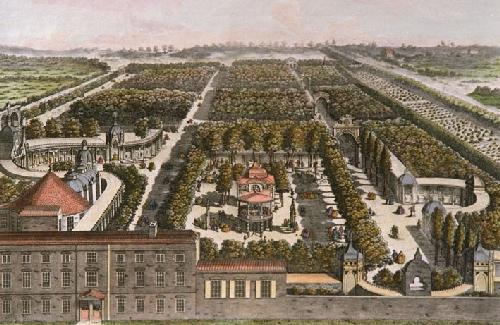
Originally known as New Spring Gardens, it is believed to have opened before the Restoration of 1660, being mentioned by Samuel Pepys in 1662. From 1785 to 1859, the site was known as Vauxhall, a pleasure garden and one of the leading venues for public entertainment in London from the mid-17th century to the mid-19th century. The Gardens consisted of several acres of trees and shrubs with attractive walks. Initially entrance was free, with food and drink being sold to support the venture.
The pleasure grounds was accessed by boats on the Thames until the erection of Vauxhall Bridge in the 1810s. The area was absorbed into the metropolis as the city expanded in the early to mid-19th century.
The site became Vauxhall Gardens in 1785 and admission was charged for its attractions. The Gardens drew enormous crowds, with its paths being noted for romantic assignations. Tightrope walkers, hot-air balloon ascents, concerts and fireworks provided entertainment. The rococo "Turkish tent" became one of the Gardens' structures, the interior of the Rotunda became one of Vauxhall's most viewed attractions, and the chinoiserie style was a feature of several buildings. A statue depicting George Frideric Handel in the Gardens later found its way to Westminster Abbey. In 1817, the Battle of Waterloo was re-enacted, with 1,000 soldiers participating.
It closed in 1840 after its owners became bankrupt, but re-opened in 1841. It changed hands in 1842, and was permanently closed in 1859. The land was redeveloped in the following decades, but slum clearance in the late 20th century saw part of the original site open up as a public park. This was initially called Spring Gardens and was renamed in 2012 as Vauxhall Pleasure Gardens. It is managed as a public park by the London Borough of Lambeth.
Vauxhall Gardens is depicted in a tile motif at Vauxhall tube station by George Smith.
Eminent 18th-century scholar John Barrell, writing in the Times Literary Supplement, brings out Vauxhall's significance. "Vauxhall pleasure gardens, on the south bank of the Thames, entertained Londoners and visitors to London for 200 years. From 1729, under the management of Jonathan Tyers, property developer, impresario, patron of the arts, the gardens grew into an extraordinary business, a cradle of modern painting and architecture, and ... music .... A pioneer of mass entertainment, Tyers had to become also a pioneer of mass catering, of outdoor lighting, of advertising, and of all the logistics involved in running one of the most complex and profitable business ventures of the eighteenth century in Britain." References to Vauxhall are, for 150 years, as ubiquitous as references to "Broadway" later would be. For example, an old Polish word for a pleasure garden (foksal) and the name of Foksal Street in Warsaw are Polonized versions of Vauxhall. In Russia, vokzal (вокзал) has become synonymous with railway stations (and sometimes other transportation hubs) due to the preponderance of such "entertainment establishments" as the Vauxhall near train stations in the 18th and 19th centuries.
The Gardens are believed to have opened just before the Restoration of 1660, on property formerly owned by Jane Fauxe, or Vaux, widow, in 1615. Whereas John Nichols in his History of Lambeth Parish conjectures that she was the widow of Guy Fawkes, executed in 1606, John Timbs in his 1867 Curiosities of London states for a fact that there was no such connection, and that the Vaux name derives from one Falkes de Breauté, a mercenary working for King John who acquired the land by marriage. Jane is stated to be the widow of John, a vintner. Perhaps the earliest record is Samuel Pepys' description of a visit he made to the New Spring Gardens on 29 May 1662. The then name distinguished the gardens from the Old Spring Gardens at Charing Cross; however Pepys implies that there were both Old and New Spring Gardens at Vauxhall; and indeed Spring Gardens appears to have been a longstanding appellation for a variety of entertainment enterprises.
Hub AI
Vauxhall Gardens AI simulator
(@Vauxhall Gardens_simulator)
Vauxhall Gardens
Vauxhall Gardens /ˈvɒksɔːl/ is a public park in Kennington in the London Borough of Lambeth, England, on the south bank of the River Thames.
Originally known as New Spring Gardens, it is believed to have opened before the Restoration of 1660, being mentioned by Samuel Pepys in 1662. From 1785 to 1859, the site was known as Vauxhall, a pleasure garden and one of the leading venues for public entertainment in London from the mid-17th century to the mid-19th century. The Gardens consisted of several acres of trees and shrubs with attractive walks. Initially entrance was free, with food and drink being sold to support the venture.
The pleasure grounds was accessed by boats on the Thames until the erection of Vauxhall Bridge in the 1810s. The area was absorbed into the metropolis as the city expanded in the early to mid-19th century.
The site became Vauxhall Gardens in 1785 and admission was charged for its attractions. The Gardens drew enormous crowds, with its paths being noted for romantic assignations. Tightrope walkers, hot-air balloon ascents, concerts and fireworks provided entertainment. The rococo "Turkish tent" became one of the Gardens' structures, the interior of the Rotunda became one of Vauxhall's most viewed attractions, and the chinoiserie style was a feature of several buildings. A statue depicting George Frideric Handel in the Gardens later found its way to Westminster Abbey. In 1817, the Battle of Waterloo was re-enacted, with 1,000 soldiers participating.
It closed in 1840 after its owners became bankrupt, but re-opened in 1841. It changed hands in 1842, and was permanently closed in 1859. The land was redeveloped in the following decades, but slum clearance in the late 20th century saw part of the original site open up as a public park. This was initially called Spring Gardens and was renamed in 2012 as Vauxhall Pleasure Gardens. It is managed as a public park by the London Borough of Lambeth.
Vauxhall Gardens is depicted in a tile motif at Vauxhall tube station by George Smith.
Eminent 18th-century scholar John Barrell, writing in the Times Literary Supplement, brings out Vauxhall's significance. "Vauxhall pleasure gardens, on the south bank of the Thames, entertained Londoners and visitors to London for 200 years. From 1729, under the management of Jonathan Tyers, property developer, impresario, patron of the arts, the gardens grew into an extraordinary business, a cradle of modern painting and architecture, and ... music .... A pioneer of mass entertainment, Tyers had to become also a pioneer of mass catering, of outdoor lighting, of advertising, and of all the logistics involved in running one of the most complex and profitable business ventures of the eighteenth century in Britain." References to Vauxhall are, for 150 years, as ubiquitous as references to "Broadway" later would be. For example, an old Polish word for a pleasure garden (foksal) and the name of Foksal Street in Warsaw are Polonized versions of Vauxhall. In Russia, vokzal (вокзал) has become synonymous with railway stations (and sometimes other transportation hubs) due to the preponderance of such "entertainment establishments" as the Vauxhall near train stations in the 18th and 19th centuries.
The Gardens are believed to have opened just before the Restoration of 1660, on property formerly owned by Jane Fauxe, or Vaux, widow, in 1615. Whereas John Nichols in his History of Lambeth Parish conjectures that she was the widow of Guy Fawkes, executed in 1606, John Timbs in his 1867 Curiosities of London states for a fact that there was no such connection, and that the Vaux name derives from one Falkes de Breauté, a mercenary working for King John who acquired the land by marriage. Jane is stated to be the widow of John, a vintner. Perhaps the earliest record is Samuel Pepys' description of a visit he made to the New Spring Gardens on 29 May 1662. The then name distinguished the gardens from the Old Spring Gardens at Charing Cross; however Pepys implies that there were both Old and New Spring Gardens at Vauxhall; and indeed Spring Gardens appears to have been a longstanding appellation for a variety of entertainment enterprises.