



Community hub
Recent from talks
Contribute something to knowledge base
Content stats: 0 posts, 0 articles, 1 media, 0 notes
Members stats: 0 subscribers, 0 contributors, 0 moderators, 0 supporters
Subscribers
Supporters
Contributors
Moderators
Hub AI
Vitreomacular adhesion AI simulator
(@Vitreomacular adhesion_simulator)
Hub AI
Vitreomacular adhesion AI simulator
(@Vitreomacular adhesion_simulator)
Vitreomacular adhesion
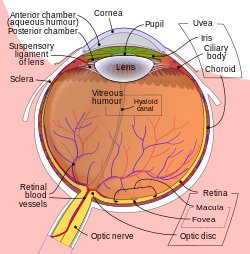
Vitreomacular adhesion (VMA) is a human medical condition where the vitreous gel (or simply vitreous, AKA vitreous humour) of the human eye adheres to the retina in an abnormally strong manner. As the eye ages, it is common for the vitreous to separate from the retina. But if this separation is not complete, i.e. there is still an adhesion, this can create pulling forces on the retina that may result in subsequent loss or distortion of vision. The adhesion in of itself is not dangerous, but the resulting pathological vitreomacular traction (VMT) can cause severe ocular damage.
The current standard of care for treating these adhesions is pars plana vitrectomy (PPV), which involves surgically removing the vitreous from the eye. A biological agent for non-invasive treatment of adhesions called ocriplasmin has been approved by the FDA on October 17, 2012.
Traction caused by VMA is the underlying pathology of an eye disease called symptomatic VMA. There is evidence that symptomatic VMA can contribute to the development of several well-known eye disorders, such as macular hole and macular pucker, that can cause visual impairment, including blindness. It may also be associated with age-related macular degeneration (AMD), diabetic macular edema (DME), retinal vein occlusion, and diabetic retinopathy (DR).[citation needed]
Over time, it is common for the vitreous within the human eye to liquify and collapse in processes known as syneresis and synchisis respectively. This creates fluid-filled areas that can combine to form pockets of vitreous gel that are mostly liquid with very small concentrations of collagen. If these liquid pockets are close enough to the interface between the vitreous gel and the retina, they can cause complete separation of the vitreous from the retina in a normally occurring process in older humans called posterior vitreous detachment (PVD). PVD in of itself is not dangerous and a natural process.[citation needed]
If the separation of the vitreous from the retina is not complete, areas of focal attachment or adhesions can occur, i.e. a VMA. The pulling forces or traction from this adhesion on the retinal surface can sometimes cause edema within the retina, damage to retinal blood vessels causing bleeding, or damage to the optic nerve causing disruption in the nerve signals sent to the brain for visual processing. It is important to note that while the VMA itself is not dangerous, the resultant pulling on the retina called vitreomacular traction (VMT) causes the above damage. The size and strength of the VMA determine the variety of resulting pathologies or symptoms.
VMA can also lead to the development of VMT/traction-related complications such as macular puckers and macular holes leading to distorted vision or metamorphopsia; epiretinal membrane; tractional macular oedema; myopic macular retinoschisis; visual impairment; blindness. The incidence of VMA is reported as high as 84% for patients with macular hole, 100% for patients with vitreomacular traction syndrome, and 56% in idiopathic epimacular membrane.
Careful eye examination by an ophthalmologist or optometrist is critical for diagnosing symptomatic VMA. Imaging technologies such as optical coherence tomography (OCT) have significantly improved the accuracy of diagnosing symptomatic VMA.[citation needed]
A new FDA approved drug was released on the market late 2013. Jetrea (Brand name) or Ocriplasmin (Generic name) is the first drug of its kind used to treat vitreomacular adhesion.[citation needed]
Vitreomacular adhesion
Vitreomacular adhesion (VMA) is a human medical condition where the vitreous gel (or simply vitreous, AKA vitreous humour) of the human eye adheres to the retina in an abnormally strong manner. As the eye ages, it is common for the vitreous to separate from the retina. But if this separation is not complete, i.e. there is still an adhesion, this can create pulling forces on the retina that may result in subsequent loss or distortion of vision. The adhesion in of itself is not dangerous, but the resulting pathological vitreomacular traction (VMT) can cause severe ocular damage.
The current standard of care for treating these adhesions is pars plana vitrectomy (PPV), which involves surgically removing the vitreous from the eye. A biological agent for non-invasive treatment of adhesions called ocriplasmin has been approved by the FDA on October 17, 2012.
Traction caused by VMA is the underlying pathology of an eye disease called symptomatic VMA. There is evidence that symptomatic VMA can contribute to the development of several well-known eye disorders, such as macular hole and macular pucker, that can cause visual impairment, including blindness. It may also be associated with age-related macular degeneration (AMD), diabetic macular edema (DME), retinal vein occlusion, and diabetic retinopathy (DR).[citation needed]
Over time, it is common for the vitreous within the human eye to liquify and collapse in processes known as syneresis and synchisis respectively. This creates fluid-filled areas that can combine to form pockets of vitreous gel that are mostly liquid with very small concentrations of collagen. If these liquid pockets are close enough to the interface between the vitreous gel and the retina, they can cause complete separation of the vitreous from the retina in a normally occurring process in older humans called posterior vitreous detachment (PVD). PVD in of itself is not dangerous and a natural process.[citation needed]
If the separation of the vitreous from the retina is not complete, areas of focal attachment or adhesions can occur, i.e. a VMA. The pulling forces or traction from this adhesion on the retinal surface can sometimes cause edema within the retina, damage to retinal blood vessels causing bleeding, or damage to the optic nerve causing disruption in the nerve signals sent to the brain for visual processing. It is important to note that while the VMA itself is not dangerous, the resultant pulling on the retina called vitreomacular traction (VMT) causes the above damage. The size and strength of the VMA determine the variety of resulting pathologies or symptoms.
VMA can also lead to the development of VMT/traction-related complications such as macular puckers and macular holes leading to distorted vision or metamorphopsia; epiretinal membrane; tractional macular oedema; myopic macular retinoschisis; visual impairment; blindness. The incidence of VMA is reported as high as 84% for patients with macular hole, 100% for patients with vitreomacular traction syndrome, and 56% in idiopathic epimacular membrane.
Careful eye examination by an ophthalmologist or optometrist is critical for diagnosing symptomatic VMA. Imaging technologies such as optical coherence tomography (OCT) have significantly improved the accuracy of diagnosing symptomatic VMA.[citation needed]
A new FDA approved drug was released on the market late 2013. Jetrea (Brand name) or Ocriplasmin (Generic name) is the first drug of its kind used to treat vitreomacular adhesion.[citation needed]
Recent media
Recent media