Hubbry Logo
Vladimir ChurovVladimir ChurovMain
Open search
Vladimir Churov
Community hub
Vladimir Churov
logo
8 pages, 0 posts
0 subscribers
Be the first to start a discussion here.
Vladimir Churov
Vladimir Churov
from Wikipedia

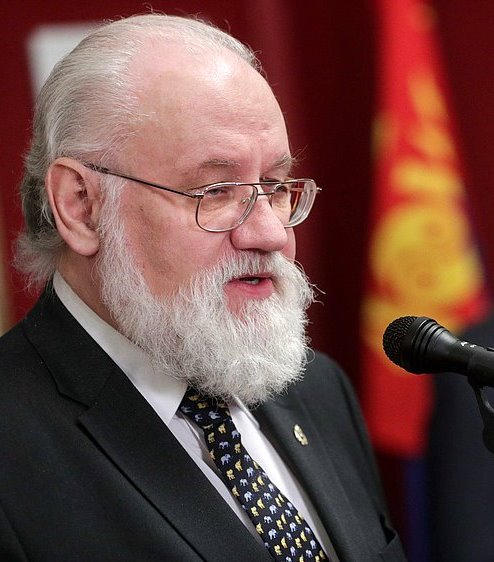
Vladimir Yevgenyevich Churov (Russian: Владимир Евгеньевич Чуров; 17 March 1953 – 22 March 2023) was a Russian official and politician. From March 2007 to March 2016, he served as a member (delegated by the State Duma) and the chairman of the Central Election Commission of Russia. He was associated with mass falsifications of Russian elections. From June 2016 he worked as an Ambassador for Special Tasks at the Russian Ministry of Foreign Affairs.

Key Information

Early life and education

[edit]

Churov was born in Leningrad, Soviet Union, in 1953. In 1977 he graduated from the Department of Physics at Leningrad State University.

Career

[edit]

Early career

[edit]

From 1992 to 2003, he worked on the Committee for External Relations of the Saint Petersburg Mayor's Office, in 1992–1996 under Vladimir Putin, in 1995–2003 as a deputy head of the Committee. According to Marina Salye, Churov worked for the KGB.[1]

State Duma

[edit]

From December 2003 to March 2007, he was a deputy in the State Duma (of LDPR faction).

On 30 January 2007, amendments to the Russian election legislation, which would allow people without a law degree to become members of the Central Election Commission,[2] were passed by the President of Russia.[3] This enabled Churov, who had no relevant experience, to be elected to the Commission.

Loyalty to Putin

[edit]

From the beginning, Churov created an image of a person who would remain loyal to president Putin under any circumstances.[4] During his tenure, he made a number of controversial statements, which were interpreted as his willingness to rubber-stamp election results favorable to Putin even if there were reports of widespread violations. Participation of independent observers was made considerably more complicated.[5] In the 2011 Russian legislative election, Churov maintained that the elections were free of falsifications, although the media reported a number of instances when the data of Central Election Commission of Russia differed with the protocols of election districts.[6] One of the demands during the 2011–2013 Russian protests was the resignation of Churov.[7] On the other hand, according to Alexander Kynev [ru], the Central Electoral Committee did not falsify the results itself, and Churov was even instrumental in creating the efficient appeal system, which helped to strike down some decisions of lower level electoral committees.[5] In any case, Churov became the symbolic figure representing mass falsifications in Russian elections at all levels.[4]

Foreign affairs role

[edit]

On 27 March 2016, the executive term of Churov expired, and he was not reappointed by Putin.[8] Ella Pamfilova became the new chairperson of the Central Election Commission of Russia.[9]

In June 2016 Churov was appointed as an ambassador-at-large for special tasks at the Russian Ministry for Foreign Affairs.[10]

Death

[edit]

Vladimir Churov died from a heart attack in Moscow, on 22 March 2023, at the age of 70.[11] He was buried at the Federal Military Memorial Cemetery on 24 March 2023.[12]

References

[edit]
[edit]
Revisions and contributorsEdit on WikipediaRead on Wikipedia
from Grokipedia
Vladimir Yevgenyevich Churov (17 March 1953 – 22 March 2023) was a Russian government official and who served as chairman of the Central Election Commission (CEC) of the Russian Federation from 2007 to 2016. Born in Leningrad to a naval officer father, Churov graduated from the Faculty of Physics at Leningrad State University in 1977 after earlier studies in . His career included roles in St. Petersburg's city administration during the 1990s, where he worked alongside , and later positions involving military and electoral oversight. Appointed CEC head amid post-Soviet electoral reforms, Churov oversaw multiple national votes, including the controversial 2011 parliamentary elections and 2012 presidential election, where international observers from organizations like the OSCE documented procedural flaws, multiple voting, and ballot irregularities, prompting opposition claims of systematic fraud and mass protests. Critics, him "the magician" for purported vote manipulation techniques, attributed discrepancies in turnout and results to administrative distortions favoring the ruling party, though Churov consistently rejected fraud allegations, asserting the elections' integrity. His tenure ended in 2016 when President Putin approved a new CEC composition excluding him, after which he received state honors; Churov died of a heart attack shortly after his 70th birthday.

Early life and education

Upbringing and family background

Vladimir Evgenievich Churov was born on March 17, 1953, in Leningrad (now Saint Petersburg), Soviet Union, into a family with ties to the military, science, and humanities. His father, Evgenii Petrovich Churov (born 1918, died 1981), served as a naval officer with the rank of captain first rank and worked as a specializing in , later contributing to the development of space systems. His mother, Irina Vladimirovna Churova (née Brezhneva), was a philologist and editor. Churov was named in honor of his maternal grandfather, . Public records provide limited details on his childhood experiences, focusing primarily on his parents' professional roles amid the post-World War II Soviet context, where his father's naval career likely influenced relocations or stability challenges common to military households.

Academic training

Churov completed a graduate course in at the Faculty of Journalism, Leningrad State University (now ), in 1973. He subsequently earned a degree in physics from the university's Physics Faculty in 1977. In 1990, he graduated from the People's University of Technical and Economic Knowledge, obtaining additional qualifications in technical and economic fields. These degrees reflect his early interdisciplinary interests in media and natural sciences prior to his administrative career.

Pre-political career

Early professional roles

Following his graduation from the Physics Faculty of Leningrad State University in , Vladimir Churov commenced his professional career in technical . From to 1991, he occupied various positions at the Experimental Design Bureau () for Aerospace Apparatus "," an entity affiliated with Leningrad State University focused on instrumentation and equipment. In this role, Churov engaged in engineering and scientific work related to systems, leveraging his physics background to contribute to design and apparatus development projects. During his tenure at OKB "Integral," Churov demonstrated productivity in scholarly output, authoring and publishing more than 40 articles in specialized journals on topics pertinent to aerospace technology and related fields. This period marked his foundational experience in applied physics and technical innovation within a Soviet-era academic-industrial framework, prior to his transition into administrative roles in the early 1990s. No public records indicate prior military service or other pre-1977 professional engagements of note.

Entry into public administration

Churov entered public administration in 1990 through election to the Leningrad City Soviet, the local legislative council, marking his initial foray into elected office amid the Soviet Union's transition to market reforms and regional autonomy. In 1991, following the failed August coup and the USSR's dissolution, he was appointed to the Committee for External Relations of the St. Petersburg Mayor's Office, then led by , where he contributed to fostering international ties and economic partnerships for the city. By the mid-1990s, Churov had risen to deputy chairman of the committee, overseeing aspects of foreign collaboration during a period of post-Soviet institutional reconfiguration and St. Petersburg's push for global integration. This role, sustained until 2003, positioned him within the emerging administrative networks that would later align with federal power structures under Putin.

Political ascent

State Duma service

Vladimir Churov was elected as a deputy to the of the fourth convocation on December 7, 2003, via the federal party list of the (LDPR). He served in this capacity until March 2007, when he transitioned to the Central Election Commission. As a member of the LDPR faction, Churov focused primarily on international parliamentary relations. Churov held the position of Deputy Chairman of the State Duma Committee on CIS Affairs and Relations with Compatriots, where he contributed to oversight of Russia's interactions with former Soviet states and expatriate communities. During his tenure, he participated in international election observation missions, including those in , , Pridnestrovie, and , providing assessments on electoral processes in these regions. For instance, he commended the 2005 parliamentary elections in Pridnestrovie for their organization while expressing reservations about certain aspects of 's 2006 elections. These activities aligned with his emerging expertise in electoral matters, foreshadowing his subsequent role in Russian election administration.

Alignment with Putin administration

Churov's professional ties to originated in the early 1990s, when both worked in the St. Petersburg city administration; Churov joined the Committee on External Relations, headed by Putin as first , in 1991. This association positioned him as a long-standing ally within Putin's inner circle from the pre-presidential era. In 2003, Churov entered the as a deputy representing the pro-Kremlin Rodina party, aligning himself with parliamentary factions supportive of the emerging Putin administration's policies on and state control. His legislative service emphasized loyalty to the executive, including endorsements of Putin's leadership strategies, such as commenting on the potential risks of Putin's 2007 bid for United Russia's top spot based on opinion polls. Following his Duma tenure, Churov's alignment manifested in his March 2007 appointment as chairman of the Central Election Commission (CEC), a move by the commission that reflected Kremlin preferences given his prior collaboration with Putin. Shortly after, he publicly declared that his "first law" was "Putin is always right," underscoring his deference to the president amid preparations for pivotal parliamentary and presidential elections. This stance, coupled with consistent defense of election outcomes favoring United Russia and Putin—such as dismissing fraud allegations and advising skeptics to seek psychiatric evaluation—cemented his role as a reliable enforcer of administrative continuity.

Chairmanship of the Central Election Commission

Appointment and initial responsibilities

Vladimir Churov was appointed as a member of Russia's Central Election Commission (CEC) by the on March 9, 2007, on a non-competitive basis following the resignation of previous chairman Aleksandr Veshnyakov. The CEC, as the federal body responsible for administering elections, consists of 15 members appointed for five-year terms by the president, , and Federation Council in equal proportions. Churov's selection aligned with the Putin administration's preference for officials with demonstrated loyalty, given his prior service in the and ties to presidential structures. On March 27, 2007, the CEC elected Churov as its chairman by a vote of 12 to 2, with one , initiating his nine-year tenure in the role. As chairman, Churov assumed over the CEC's core functions, including the organization of federal and regional elections, , candidate and party accreditation, formation of electoral precincts, and oversight of vote tabulation and result certification. His immediate priorities centered on preparations for the December 2, 2007, State Duma elections, which served as a precursor to the 2008 presidential vote and involved registering over 100 political parties and millions of voters across Russia's 85 regions at the time. In his early statements, Churov emphasized strict adherence to electoral laws while signaling alignment with executive authority, reportedly declaring that his "first law" was "Putin is always right," reflecting the commission's role in maintaining administrative stability amid criticisms of tightening political control. He directed initial efforts toward logistical enhancements, such as expanding electronic voter databases and coordinating with regional commissions to standardize procedures, amid ongoing debates over electoral transparency following prior controversies under Veshnyakov. These responsibilities positioned the CEC to enforce federal electoral legislation, including thresholds for party representation and prohibitions on certain campaign practices, setting the framework for subsequent polls.

Oversight of major elections (2007-2016)

Vladimir Churov, as Chairman of the Central Election Commission (CEC) from March 2007 onward, supervised the December 2, 2007, elections, in which , led by President on its party list, obtained 64.3% of the vote and 315 seats, securing a constitutional majority. Turnout was reported at 63.3%, with the CEC certifying the results amid limited international criticism compared to subsequent votes, though Putin publicly accused the of attempting to undermine the election's legitimacy prior to voting. In the March 2, 2008, , overseen by Churov, , Putin's endorsed successor, won with 70.3% of the vote against three opponents, achieving a 75% turnout as certified by the CEC. Official reports from the CEC and domestic observers largely affirmed procedural compliance, though some Western monitors highlighted favoring the and restrictions on opposition campaigning. Churov's tenure faced heightened scrutiny during the December 4, 2011, elections, where received 48.8% of the vote and 238 seats despite pre-election polls suggesting lower support, prompting opposition claims of ballot stuffing and carousel voting. Turnout stood at 60%, but video evidence of violations circulated widely, leading to the largest anti-government protests in since the Soviet Union's collapse, with tens of thousands demanding Churov's resignation and a re-vote. Statistical analyses by independent researcher Sergei Shpilkin indicated anomalies consistent with fraud inflating 's share by up to 15-20 percentage points in certain regions, though the CEC dismissed these as methodological flaws and upheld the results after reviewing complaints. The March 4, 2012, under Churov's oversight resulted in Vladimir Putin's victory with 63.6% of the vote, a 65% turnout, and by the CEC despite reports of irregularities including multiple voting and coerced participation. OSCE and other international observers documented a "serious imbalance" in campaign conditions and of , such as inflated turnout in pro-Putin areas, while Churov defended the process, sacking some regional officials for violations but rejecting systemic issues. Shpilkin-method modeling estimated up to 10-15 million potentially fraudulent votes favoring Putin, patterns echoed in later critiques of CEC data handling under Churov. Churov consistently maintained that isolated infractions did not alter outcomes, attributing discrepancies to administrative errors rather than coordinated manipulation.

Electoral administration and reforms

Implementation of electoral procedures

Under Churov's leadership of the Central Election Commission from 2007 to 2016, Russia's electoral procedures relied on a hierarchical structure of commissions operating at federal, regional, and municipal levels, coordinated by the CEC to manage voter registration, ballot production, polling station operations, and result tabulation. Post-election processes emphasized compiling detailed statistics, adjudicating complaints through interaction with courts, publishing analyses of observer feedback, and evaluating compliance with electoral laws to inform future legislation. Nationwide, approximately 96,000 polling stations were established for major federal elections, supported by 5,500 permanent staff in election commissions and an additional 3,000 personnel dedicated to administrative and informational tasks. To enhance accessibility and efficiency, the CEC under Churov piloted technologies, including mobile voting utilized by 300,000 individuals in regional elections in , alongside proposals for televoting to reduce costs and verify results remotely. Procedures also incorporated centralized data dissemination, with the CEC website providing 2.5 gigabytes of public election information, including protocols and turnout figures accessible via mobile devices. A key logistical innovation was the consolidation of elections into "unified voting days," such as , 2009, when 7,400 regional and local contests were held simultaneously to streamline and minimize disruptions. In response to transparency demands after irregularities alleged in the 2011 State Duma elections, Churov oversaw the deployment of webcams for live broadcasts from polling stations during the March 4, , presidential election, equipping tens of thousands of sites—initial installations began in January across urban and rural areas—to allow remote public monitoring of voting and counting processes. This measure, funded partly through state resources and private contributions, aimed to deter procedural violations by enabling real-time verification, though access to archived required specific requests to commission offices. Installation and operation adhered to protocols mandating dual-camera setups (one for voting areas, one for boxes) and integration with the CEC's online portal for streaming. Voter identification procedures remained consistent with , requiring passports or equivalent documents at entry, followed by issuance of ballots via indelible ink to prevent multiple voting, and supervised counting by commission members with mandatory protocols signed by all parties present. Churov's CEC also enforced restrictions on campaign materials within 50 meters of stations and regulated observer , limiting access to registered representatives from parties, media, and NGOs while prohibiting disruptions during ballot handling. Under Churov's leadership of the Central Election Commission (CEC), significant logistical enhancements were implemented to modernize election operations, particularly through the integration of digital technologies. For the 2012 presidential election, the CEC oversaw the installation of approximately 200,000 webcams across 91,700 polling stations, enabling real-time online monitoring to address prior allegations of irregularities; this initiative, costing 20 billion rubles (with 13 billion from state funds and 7 billion from ), marked a pioneering effort in large-scale video for national voting processes. The system allowed public and international observers to view proceedings remotely, with Churov highlighting it as a historic first for live poll opening visibility. Parallel advancements included the expanded deployment of KOIB (automated ballot-processing complexes), which scanned and transmitted results electronically to reduce manual errors and expedite tabulation. Usage grew to 5,154 units in the parliamentary elections and 5,544 in the 2012 presidential vote, out of roughly 95,000 total stations, facilitating faster via the GAS "Vybori" state automated system, whose modernization began in under CEC coordination. These measures supported the management of unified voting days, culminating in a record 10,700 simultaneous elections on September 13, 2015, demonstrating improved organizational capacity for multi-level polls. On the legal front, Churov's tenure coincided with amendments to federal electoral legislation aimed at refining party participation and voting mechanisms. The minimum party membership threshold was lowered from 40,000 to 500, correlating with an increase from 15 registered parties in 2007 to 77 by 2016, ostensibly broadening political competition. Key restorations included direct elections for regional governors in 2012 (following a 2004-2012 federal appointment system) and single-mandate district voting for seats in 2014, reverting from prior proportional-only models. Additional changes reduced the effective party threshold to 5%, reinstated the "against all" option on municipal ballots, and eliminated electoral deposits, alterations framed by CEC officials as enhancing accessibility while maintaining procedural integrity. These reforms were enacted through laws, with CEC input on implementation guidelines, though critics from opposition sources argued they favored incumbents; official records attribute their passage to post-2011 protest responses for systemic refinement.

Controversies and allegations

Claims of fraud in key elections

During Churov's tenure as chairman of the Central (CEC), allegations of intensified, particularly in the 2011 elections and the 2012 presidential election, where critics accused the CEC of enabling manipulations that favored and President . Opposition figures, independent analysts, and international observers documented instances of ballot stuffing, carousel voting (repeated voting by individuals), and discrepancies between reported turnout and vote shares that suggested statistical impossibilities. For instance, in regions where turnout exceeded 90%, 's vote share often aligned with turnout percentages in patterns indicative of , as analyzed by researchers using exit polls and . The December 4, 2011, Duma elections drew the most immediate backlash, with protesters claiming that United Russia's official 49% share masked up to 15-20 million falsified votes, based on comparisons between precinct-level protocols and aggregate results. Videos circulated showing overt violations, such as multiple ballots inserted into boxes by single voters, prompting mass demonstrations in and other cities under the slogan "For Fair Elections," where hundreds of thousands demanded Churov's resignation for failing to address or investigate these irregularities. The OSCE's Office for Democratic Institutions and reported numerous violations, including restrictions on observers and media, though Russian authorities contested the scale, attributing discrepancies to administrative errors rather than systemic rigging. In the March 4, 2012, presidential election, similar claims emerged, with OSCE observers citing "serious problems" like the absence of genuine competition, biased media coverage, and evidence of fraud such as inflated turnout in rural areas loyal to Putin. Independent studies later estimated that Putin received an artificial boost of up to 10 million votes through techniques dubbed "Churov's saw," involving algorithmic adjustments to results in key precincts. Election officials in some districts were dismissed after refusing to certify padded figures, highlighting internal resistance to reported pressures. Critics, including opposition leader Aleksei Navalny, labeled Churov the architect of these outcomes, nicknaming him "The Magician" or "Count" for his perceived role in conjuring victories from dubious data. Earlier elections under Churov, such as the 2007 vote, also faced accusations of irregularities, including voter intimidation and unequal access for opposition monitors, though these were dismissed by the CEC as isolated and not indicative of widespread . The cumulative claims portrayed Churov's CEC as prioritizing procedural formalities over transparency, with limited independent verification mechanisms exacerbating distrust among skeptics who pointed to the lack of annulled precincts despite documented violations.

Opposition protests and international critiques

Following the December 4, 2011, Russian parliamentary elections, widespread allegations of vote rigging and ballot stuffing led to mass opposition protests across major cities, with demonstrators explicitly demanding the resignation of Central Election Commission (CEC) Chairman Vladimir Churov for his role in overseeing what they described as fraudulent results favoring the ruling United Russia party. On December 10, 2011, an estimated 25,000 to 50,000 protesters gathered in Moscow's Bolotnaya Square in the largest anti-government rally since the Soviet Union's collapse, chanting slogans like "Russia without Putin" and "Churov is a wizard," a reference to claims that he manipulated turnout figures to inflate United Russia's vote share from independent web camera footage analyses showing discrepancies of up to 14 million votes. Similar demonstrations occurred in St. Petersburg and other cities, totaling over 100,000 participants nationwide by mid-December, with opposition leaders like Boris Nemtsov accusing Churov of enabling systemic violations including carousel voting and the deletion of 11 million opposition votes. Protests intensified ahead of the March 4, 2012, , where Churov again supervised the process amid continued fraud claims, resulting in further rallies on February 4 and May 6, 2012, the latter turning violent with over 400 arrests in as demonstrators rejected Vladimir Putin's victory as illegitimate under Churov's administration. Independent analyses, such as those by opposition activists using video evidence, estimated irregularities affecting 10-15% of votes in key regions, fueling calls for Churov's removal as a precondition for . The "Snow Revolution" moniker reflected the winter timing and perceived whitewash of fraud, with protesters viewing Churov's defenses—such as dismissing web cam discrepancies as technical errors—as evidence of complicity in maintaining the . International observers echoed domestic concerns, with the OSCE Parliamentary Assembly reporting in March 2012 that the presidential election under Churov's CEC was "flawed" due to unequal media access, harassment of opposition, and procedural violations like multiple voting, concluding that Putin's 63.6% win lacked genuine competition. Earlier, in December 2007, OSCE monitors criticized the Duma elections Churov oversaw shortly after his appointment as demonstrating "limited political competition" and state bias, including the denial of proportional representation to opposition parties and media dominance by pro-Kremlin outlets. Western governments, including the U.S. State Department, condemned the 2011-2012 polls as falling short of democratic standards, attributing irregularities to CEC mismanagement under Churov, though Russian officials countered that such critiques reflected geopolitical bias rather than objective assessment. These reports highlighted quantifiable issues, such as turnout inflation in rural areas loyal to the Kremlin, where official figures exceeded independent tallies by margins up to 20%.

Defenses and counter-perspectives

Official responses and investigations

The Central Election Commission (CEC), chaired by Vladimir Churov, responded to fraud allegations in the December 2011 parliamentary elections by reviewing complaints and annulling results in nine polling stations based on submitted evidence, including video recordings of irregularities, while asserting that such incidents were isolated and did not impact the overall validity of the vote. Churov publicly maintained that the elections were conducted transparently and honestly, describing reported violations as minor administrative errors rather than systemic manipulation. In parallel, Russia's prosecutorial authorities examined thousands of opposition-submitted complaints but declined to pursue most, citing insufficient evidence of criminal wrongdoing, with outcomes limited to localized administrative sanctions. For the March 2012 presidential election, amid ongoing protests, Churov directed the deployment of webcams at approximately 93,000 polling stations to provide live online broadcasts, a measure explicitly aimed at enhancing and preempting fraud claims through verifiable transparency. Official probes into discrepancies, including those from international observers noting procedural flaws, resulted in no widespread invalidations, with Churov defending the process as compliant with Russian law and rejecting calls for re-runs as politically motivated. These responses emphasized technical compliance over concessions to accusers, framing isolated issues as resolvable within existing frameworks rather than indicative of deeper electoral deficiencies.

Critiques of accusers and alternative explanations

Churov and the Central Election Commission (CEC) consistently maintained that allegations of systemic fraud in the 2011 Duma elections and 2012 presidential vote were overstated, with official probes identifying only isolated violations—such as minor procedural lapses or unauthorized actions by local officials—that did not alter aggregate results. In response to widely circulated amateur videos purporting to depict ballot stuffing, Churov dismissed them as lacking context or representing misunderstandings of legitimate counting procedures, such as of absentee ballots, rather than evidence of coordinated manipulation. Critics of statistical analyses alleging fraud, including those based on turnout-vote correlations, have argued that such methods erroneously assume uniform voter behavior across precincts, ignoring Russia-specific factors like higher administrative (home and early) voting in rural or pro-regime areas, where United Russia support was organically stronger due to demographic and mobilization differences. A 2011 analysis contended that claims of improbable digit distributions or Gaussian violations in vote tallies fail under scrutiny, as Russian elections feature non-random turnout patterns driven by legitimate organizational efforts, not fabricated ballots. These critiques highlight how opposition-driven forensics often overlook baseline variations from genuine voter preferences, potentially inflating perceptions of irregularity to delegitimize outcomes. Accusers, including domestic opposition groups and select international monitors, faced for selective sampling and motivational biases; for instance, video was predominantly from urban opposition strongholds, potentially amplifying localized incidents while underrepresenting compliant rural polling stations, and some claims aligned with broader geopolitical incentives to undermine Russian institutions. Alternative causal accounts posit that apparent discrepancies stemmed from overzealous local commission members seeking to meet informal turnout targets amid competitive pressures, rather than directives from Churov or central authorities, with prosecutorial reviews confirming criminal cases in under 1% of complaints without linking them to CEC leadership. This decentralized explanation aligns with empirical patterns of fraud in hybrid regimes, where agency problems at subnational levels produce errors without top-down orchestration.

International engagement

Views on global electoral standards

Churov maintained that assessments of electoral fairness should be determined solely by a country's voters, rather than external observers, emphasizing national sovereignty over imposed international judgments. In October 2015, while observing Belarusian presidential elections, he stated, "In any country, only the voters can judge the honesty of the elections," arguing that foreign critiques often serve political agendas rather than objective evaluation. He critiqued the OSCE's Office for Democratic Institutions and (ODIHR) for producing reports that blend professional analyses of procedural mechanics with politicized commentary on outcomes, noting that such documents "are never fully objective" and that had learned to disregard the latter portions. Churov viewed concepts like electoral "legitimacy" as artificially constructed tools for external interference, incompatible with principles such as those in the UN Charter that respect state sovereignty. He contended that politicized international monitoring, dominated by Western influences, provokes instability, protests, and regime changes rather than fostering genuine standards. In response to criticisms of Russian elections, he highlighted perceived flaws in Western systems, describing the November 2012 U.S. presidential election as "systematically unfair" due to factors including the lack of , excessive financial influence, and voter suppression tactics. Advocating for depoliticized alternatives, Churov supported frameworks like the 2002 Chisinau Convention on Standards of Democratic Elections, Electoral Rights, and Freedoms in CIS Member States, which he referenced as a model for coordinated, regionally relevant practices emphasizing simultaneous nationwide voting and robust commission staffing—elements he claimed aligned with Russia's professionalized system employing over 5,500 permanent staff. He argued for regulated international observation that focuses on technical compliance without outcome-based judgments, positioning Russia's approach as a counter to what he saw as hypocritical and selective Western standards.

Roles in foreign election observation

Following his resignation as Chairman of Russia's Central (CEC) in March 2016, Vladimir Churov was appointed for Special Assignments by the Russian Ministry of Foreign Affairs in June 2016, with responsibilities centered on international electoral cooperation and observation. In this role, he coordinated Russian participation in monitoring foreign elections, emphasizing the deployment of observers to assess procedures abroad while promoting Russia's standards for transparency. Churov's most prominent assignment involved organizing Russian election observation for the . In September 2016, he was directed to manage the logistics and composition of Russian observer delegations sent to the U.S., including arrangements for travel and under international frameworks like the Organization for Security and Co-operation in Europe (OSCE). He advocated for targeted observation in key states, proposing a systematic approach to evaluate aspects such as and ballot counting, and stated that no external interference could alter outcomes if processes were robust. Earlier, while serving as CEC Chairman, Churov facilitated CEC staff participation in U.S. election monitoring, confirming in October 2008 that Russian experts were invited to observe the presidential vote as part of bilateral electoral exchanges. This reflected his broader interest in comparative analysis, though direct personal involvement in foreign missions was limited until his diplomatic posting. Russian state media portrayed these efforts as reciprocal to Western observations in Russia, countering narratives of asymmetry in international monitoring. Western analyses, however, have questioned the motives, framing such missions as potential vectors for influence operations rather than neutral assessment.

Later positions and death

Post-CEC appointments

Following the end of his chairmanship of Russia's Central on March 3, 2016, Vladimir Churov was appointed by the Russian in June 2016. In this diplomatic role, he coordinated Russia's international activities, focusing on monitoring electoral processes in foreign states to promote what Russian officials described as adherence to democratic standards aligned with national interests. Churov's responsibilities included leading missions to observe elections in countries such as , , , , , and , building on his prior involvement in (CIS) and OSCE Parliamentary Assembly groups. He also contributed to the Association of Russian Diplomats as a council member and authored works on electoral systems, reflecting his continued engagement in the field. This position allowed Churov to represent Russian perspectives on global , often emphasizing against Western interference, though critics viewed it as extending domestic electoral practices abroad. He held the ambassadorship until his death in 2023.

Circumstances of death

Vladimir Churov died on March 22, 2023, at the age of 70 in . Approximately one week prior, he suffered a massive heart attack, underwent emergency heart surgery, and remained in hospital care until his death. The circumstances were reported by Leonid Ivlev, a former deputy chairman of Russia's and deputy, who confirmed Churov's condition and passing to multiple outlets. Official announcements from Russian attributed the death directly to complications from the and , with no indications of external factors in verified reports. Speculation in some Western commentary framed the event as sudden or mysterious given Churov's prior health appearance and political history, but such claims lack substantiation beyond timing and remain unverified against medical details provided.

References

Add your contribution
Related Hubs
User Avatar
No comments yet.