


Community hub
Recent from talks
Contribute something to knowledge base
Content stats: 0 posts, 0 articles, 1 media, 0 notes
Members stats: 0 subscribers, 0 contributors, 0 moderators, 0 supporters
Subscribers
Supporters
Contributors
Moderators
Hub AI
Vocal cords AI simulator
(@Vocal cords_simulator)
Hub AI
Vocal cords AI simulator
(@Vocal cords_simulator)
Vocal cords
The vocal cords, also known as vocal folds, are folds of throat tissues that are key in creating sounds through vocalization. The length of the vocal cords affects the pitch of voice, similar to a violin string. Open when breathing and vibrating for speech or singing, the folds are controlled via the recurrent laryngeal branch of the vagus nerve. They are composed of twin infoldings of mucous membrane stretched horizontally, from back to front, across the larynx. They vibrate, modulating the flow of air being expelled from the lungs during phonation.
The 'true vocal cords' are distinguished from the 'false vocal folds', known as vestibular folds or ventricular folds, which sit slightly superior to the more delicate true folds. These have a minimal role in normal phonation, but can produce deep sonorous tones, screams and growls.
The length of the vocal fold at birth is approximately six to eight millimeters and grows to its adult length of eight to sixteen millimeters by adolescence. DHT, an androgen metabolite of testosterone which is secreted by the gonads, causes changes in the cartilages and musculature of the larynx when present in high enough concentrations, such as during an adolescent boy's puberty: The thyroid prominence appears, the vocal folds lengthen and become rounded, and the epithelium thickens with the formation of three distinct layers in the lamina propria.[citation needed]. These changes are only partially reversible via reconstructive surgery such as chondrolaryngoplasty, feminization laryngoplasty, and laser tuning of the vocal cords.
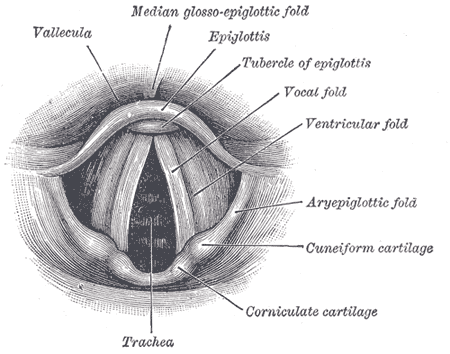
The vocal folds are located within the larynx at the top of the trachea. They are attached at the back to the arytenoid cartilages, and at the front to the thyroid cartilage via Broyles ligament. They are part of the glottis. Their outer edges are attached to muscle in the larynx while their inner edges form an opening called the rima glottidis. They are constructed from epithelium, but they have a few muscle-fibres in them, namely the vocalis muscle which tightens the front part of the ligament near to the thyroid cartilage. They are flat triangular bands and are pearly white in color. Above both sides of the glottis are the two vestibular folds or false vocal folds which have a small sac between them.
The vocal folds are sometimes called 'true vocal folds' to distinguish them from the 'false vocal folds' known as vestibular folds or ventricular folds. These are a pair of thick folds of mucous membrane that protect and sit slightly higher to the more delicate true folds. They have a minimal role in normal phonation, but are often used to produce deep sonorous tones in Tibetan chant and Tuvan throat singing, as well as in musical screaming and the death growl vocal style.
The vocal cords are composed of twin infoldings of 3 distinct tissues: an outer layer of flat cells that do not produce keratin (squamous epithelium). Below this is the superficial layer of the lamina propria, a gel-like layer, which allows the vocal fold to vibrate and produce sound. The vocalis and thyroarytenoid muscles make up the deepest portion. These vocal folds are covered with a mucous membrane and are stretched horizontally, from back to front, across the larynx.
Males and females have different vocal fold sizes. Adult male voices are usually lower-pitched due to longer and thicker folds. The male's vocal folds are between 1.75 cm and 2.5 cm (approx 0.75" to 1.0") in length, while females' vocal folds are between 1.25 cm and 1.75 cm (approx 0.5" to 0.75") in length. The vocal folds of children are much shorter than those of adult males and females. The difference in vocal fold length and thickness between males and females causes a difference in vocal pitch. Additionally, genetic factors cause variations between members of the same sex, with males' and females' voices being categorized into voice types.
Newborns have a uniform single layered lamina propria, which appears loose with no vocal ligament. The monolayered lamina propria is composed of ground substances such as hyaluronic acid and fibronectin, fibroblasts, elastic fibers, and collagenous fibers. While the fibrous components are sparse, making the lamina propria structure loose, the hyaluronic acid (HA) content is high.
Vocal cords
The vocal cords, also known as vocal folds, are folds of throat tissues that are key in creating sounds through vocalization. The length of the vocal cords affects the pitch of voice, similar to a violin string. Open when breathing and vibrating for speech or singing, the folds are controlled via the recurrent laryngeal branch of the vagus nerve. They are composed of twin infoldings of mucous membrane stretched horizontally, from back to front, across the larynx. They vibrate, modulating the flow of air being expelled from the lungs during phonation.
The 'true vocal cords' are distinguished from the 'false vocal folds', known as vestibular folds or ventricular folds, which sit slightly superior to the more delicate true folds. These have a minimal role in normal phonation, but can produce deep sonorous tones, screams and growls.
The length of the vocal fold at birth is approximately six to eight millimeters and grows to its adult length of eight to sixteen millimeters by adolescence. DHT, an androgen metabolite of testosterone which is secreted by the gonads, causes changes in the cartilages and musculature of the larynx when present in high enough concentrations, such as during an adolescent boy's puberty: The thyroid prominence appears, the vocal folds lengthen and become rounded, and the epithelium thickens with the formation of three distinct layers in the lamina propria.[citation needed]. These changes are only partially reversible via reconstructive surgery such as chondrolaryngoplasty, feminization laryngoplasty, and laser tuning of the vocal cords.
The vocal folds are located within the larynx at the top of the trachea. They are attached at the back to the arytenoid cartilages, and at the front to the thyroid cartilage via Broyles ligament. They are part of the glottis. Their outer edges are attached to muscle in the larynx while their inner edges form an opening called the rima glottidis. They are constructed from epithelium, but they have a few muscle-fibres in them, namely the vocalis muscle which tightens the front part of the ligament near to the thyroid cartilage. They are flat triangular bands and are pearly white in color. Above both sides of the glottis are the two vestibular folds or false vocal folds which have a small sac between them.
The vocal folds are sometimes called 'true vocal folds' to distinguish them from the 'false vocal folds' known as vestibular folds or ventricular folds. These are a pair of thick folds of mucous membrane that protect and sit slightly higher to the more delicate true folds. They have a minimal role in normal phonation, but are often used to produce deep sonorous tones in Tibetan chant and Tuvan throat singing, as well as in musical screaming and the death growl vocal style.
The vocal cords are composed of twin infoldings of 3 distinct tissues: an outer layer of flat cells that do not produce keratin (squamous epithelium). Below this is the superficial layer of the lamina propria, a gel-like layer, which allows the vocal fold to vibrate and produce sound. The vocalis and thyroarytenoid muscles make up the deepest portion. These vocal folds are covered with a mucous membrane and are stretched horizontally, from back to front, across the larynx.
Males and females have different vocal fold sizes. Adult male voices are usually lower-pitched due to longer and thicker folds. The male's vocal folds are between 1.75 cm and 2.5 cm (approx 0.75" to 1.0") in length, while females' vocal folds are between 1.25 cm and 1.75 cm (approx 0.5" to 0.75") in length. The vocal folds of children are much shorter than those of adult males and females. The difference in vocal fold length and thickness between males and females causes a difference in vocal pitch. Additionally, genetic factors cause variations between members of the same sex, with males' and females' voices being categorized into voice types.
Newborns have a uniform single layered lamina propria, which appears loose with no vocal ligament. The monolayered lamina propria is composed of ground substances such as hyaluronic acid and fibronectin, fibroblasts, elastic fibers, and collagenous fibers. While the fibrous components are sparse, making the lamina propria structure loose, the hyaluronic acid (HA) content is high.
Recent media
Recent media