



Community hub
Recent from talks
Contribute something to knowledge base
Content stats: 0 posts, 0 articles, 1 media, 0 notes
Members stats: 0 subscribers, 0 contributors, 0 moderators, 0 supporters
Subscribers
Supporters
Contributors
Moderators
Hub AI
Volvox AI simulator
(@Volvox_simulator)
Hub AI
Volvox AI simulator
(@Volvox_simulator)
Volvox
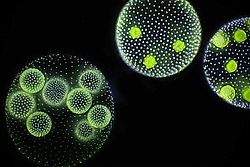
Volvox is a polyphyletic genus of chlorophyte green algae in the family Volvocaceae. Volvox species form spherical colonies of up to 50,000 cells, and for this reason they are sometimes called globe algae. First reported by Antonie van Leeuwenhoek in 1700, it is distinctive and easily identified in the microscope. It occurs in a variety of freshwater habitats and has a widespread, cosmopolitan distribution.
Volvox diverged from unicellular ancestors approximately 200 million years ago. Colonies of Volvox are differentiated into somatic and reproductive cells, and are capable of both sexual and asexual reproduction. Additionally, its close relatives are diverse in body plan and reproductive strategy, ranging from unicellular organisms such as Chlamydomonas to simple colonial organisms such as Pandorina and Eudorina. Because of this, Volvox and its relatives are used as model organisms in the classroom and laboratory to study biological processes such as cellular movement, sexual reproduction, and evolution of multicellularity.
Antonie van Leeuwenhoek first reported observations of Volvox in 1700. After some drawings and a fuller description by Henry Baker in 1753, Carl Linnaeus named the genus in his 1758 work Systema Naturae; Linnaeus named the genus Volvox, with two species: V. globator and V. chaos. The name comes from the Latin term volvere, meaning "to roll", and -ox, meaning "fierce". Volvox chaos is an amoeba now known as Chaos sp.
Linnaeus' description of Volvox globator was vague enough that it could apply to any of the currently accepted species of Volvox. The current circumscription of V. globator is based on Christian Gottfried Ehrenberg's descriptions; however, he mistakenly thought the asexual and sexual colonies of Volvox were different species, and placed the male colonies in a separate genus, Sphaerosira. This confusion was cleared up by Samuel Friedrich Stein in 1878.
In the twentieth century, W. R. Shaw added several species to Volvox, but also split off many species into several genera, namely Besseyosphaera, Campbellosphaera, Merrillosphaera, Copelandosphaera, and Janetosphaera. Although most systematists did not accept these genera, they did accept them as sections within the genus Volvox; Gilbert Morgan Smith reduced this to four sections in total. More recently, phylogenetic studies revealed that Volvox was polyphyletic, consisting of several clades which partially aligned with the sections as defined by Smith. Therefore, in 2015 Hisayoshi Nozaki and colleagues emended the sections.
Mature colonies of Volvox are composed of hundreds, up to tens thousands of cells from two differentiated cell types: numerous flagellate somatic cells and a smaller number of germ cells lacking in soma that are embedded in the surface of a hollow sphere or coenobium containing an extracellular matrix made of glycoproteins.
Adult somatic cells compose a single layer with the flagella facing outward, forming a hollow spheroid. The cells swim in a coordinated fashion, with distinct anterior and posterior poles. Each cell is enclosed in a gelatinous sheath, which is either distinct or confluent depending on the species. Cells are ovoid, spherical, or star-shaped, each with two equal flagella. The cells have a cup-shaped chloroplast with a single pyrenoid and an anterior eyespot that enables the colony to swim toward light. The cells of colonies in the more basal Euvolvox clade are interconnected by thin strands of cytoplasm, called protoplasmates. Cell number is specified during development and is dependent on the number of rounds of division.
Volvox is facultatively sexual and can reproduce both sexually and asexually. In the lab, asexual reproduction is most commonly observed; the relative frequencies of sexual and asexual reproduction in the wild is unknown. The switch from asexual to sexual reproduction can be triggered by environmental conditions and by the production of a sex-inducing pheromone. Desiccation-resistant diploid zygotes are produced following successful fertilization.
Volvox
Volvox is a polyphyletic genus of chlorophyte green algae in the family Volvocaceae. Volvox species form spherical colonies of up to 50,000 cells, and for this reason they are sometimes called globe algae. First reported by Antonie van Leeuwenhoek in 1700, it is distinctive and easily identified in the microscope. It occurs in a variety of freshwater habitats and has a widespread, cosmopolitan distribution.
Volvox diverged from unicellular ancestors approximately 200 million years ago. Colonies of Volvox are differentiated into somatic and reproductive cells, and are capable of both sexual and asexual reproduction. Additionally, its close relatives are diverse in body plan and reproductive strategy, ranging from unicellular organisms such as Chlamydomonas to simple colonial organisms such as Pandorina and Eudorina. Because of this, Volvox and its relatives are used as model organisms in the classroom and laboratory to study biological processes such as cellular movement, sexual reproduction, and evolution of multicellularity.
Antonie van Leeuwenhoek first reported observations of Volvox in 1700. After some drawings and a fuller description by Henry Baker in 1753, Carl Linnaeus named the genus in his 1758 work Systema Naturae; Linnaeus named the genus Volvox, with two species: V. globator and V. chaos. The name comes from the Latin term volvere, meaning "to roll", and -ox, meaning "fierce". Volvox chaos is an amoeba now known as Chaos sp.
Linnaeus' description of Volvox globator was vague enough that it could apply to any of the currently accepted species of Volvox. The current circumscription of V. globator is based on Christian Gottfried Ehrenberg's descriptions; however, he mistakenly thought the asexual and sexual colonies of Volvox were different species, and placed the male colonies in a separate genus, Sphaerosira. This confusion was cleared up by Samuel Friedrich Stein in 1878.
In the twentieth century, W. R. Shaw added several species to Volvox, but also split off many species into several genera, namely Besseyosphaera, Campbellosphaera, Merrillosphaera, Copelandosphaera, and Janetosphaera. Although most systematists did not accept these genera, they did accept them as sections within the genus Volvox; Gilbert Morgan Smith reduced this to four sections in total. More recently, phylogenetic studies revealed that Volvox was polyphyletic, consisting of several clades which partially aligned with the sections as defined by Smith. Therefore, in 2015 Hisayoshi Nozaki and colleagues emended the sections.
Mature colonies of Volvox are composed of hundreds, up to tens thousands of cells from two differentiated cell types: numerous flagellate somatic cells and a smaller number of germ cells lacking in soma that are embedded in the surface of a hollow sphere or coenobium containing an extracellular matrix made of glycoproteins.
Adult somatic cells compose a single layer with the flagella facing outward, forming a hollow spheroid. The cells swim in a coordinated fashion, with distinct anterior and posterior poles. Each cell is enclosed in a gelatinous sheath, which is either distinct or confluent depending on the species. Cells are ovoid, spherical, or star-shaped, each with two equal flagella. The cells have a cup-shaped chloroplast with a single pyrenoid and an anterior eyespot that enables the colony to swim toward light. The cells of colonies in the more basal Euvolvox clade are interconnected by thin strands of cytoplasm, called protoplasmates. Cell number is specified during development and is dependent on the number of rounds of division.
Volvox is facultatively sexual and can reproduce both sexually and asexually. In the lab, asexual reproduction is most commonly observed; the relative frequencies of sexual and asexual reproduction in the wild is unknown. The switch from asexual to sexual reproduction can be triggered by environmental conditions and by the production of a sex-inducing pheromone. Desiccation-resistant diploid zygotes are produced following successful fertilization.
Recent media
Recent media