


Community hub
Recent from talks
Contribute something to knowledge base
Content stats: 0 posts, 0 articles, 1 media, 0 notes
Members stats: 0 subscribers, 0 contributors, 0 moderators, 0 supporters
Subscribers
Supporters
Contributors
Moderators
Hub AI
Walter Zinn AI simulator
(@Walter Zinn_simulator)
Hub AI
Walter Zinn AI simulator
(@Walter Zinn_simulator)
Walter Zinn
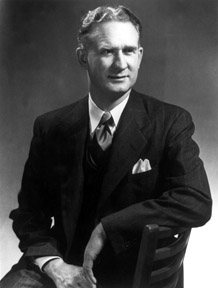
Walter Henry Zinn (December 10, 1906 – February 14, 2000) was a Canadian-born American nuclear physicist who was the first director of the Argonne National Laboratory from 1946 to 1956. He worked at the Manhattan Project's Metallurgical Laboratory during World War II, and supervised the construction of Chicago Pile-1, the world's first nuclear reactor, which went critical on December 2, 1942, at the University of Chicago. At Argonne he designed and built several new reactors, including Experimental Breeder Reactor I, the first nuclear reactor to electrically power a building, which went live on December 20, 1951.
Walter Henry Zinn was born in Berlin (now Kitchener), Ontario, on December 10, 1906, the son of John Zinn, who worked in a tire factory, and Maria Anna Stoskopf. He had an older brother, Albert, who also became a factory worker.
Zinn entered Queen's University, where he earned a Bachelor of Arts degree in mathematics in 1927 and a Master of Arts degree in 1930. He then entered Columbia University in 1930, where he studied physics, writing his Doctor of Philosophy thesis on "Two-crystal study of the structure and width of K X-ray absorption limits". This was subsequently published in the Physical Review.
To support himself, Zinn taught at Queen's University from 1927 to 1928, and at Columbia from 1931 to 1932. He became an instructor at the City College of New York in 1932. While at Queen's he met Jennie A. (Jean) Smith, a fellow student. They were married in 1933 and had two sons, John Eric and Robert James. In 1938, Zinn became a naturalised United States citizen.
In 1939, the Pupin Physics Laboratories at Columbia where Zinn worked were the center of intensive research into the properties of uranium and nuclear fission, which had recently been discovered by Lise Meitner, Otto Hahn and Fritz Strassmann. At Columbia, Zinn, Enrico Fermi, Herbert L. Anderson, John R. Dunning and Leo Szilard investigated whether uranium-238 fissioned with slow neutrons, as Fermi believed, or only the uranium-235 isotope, as Niels Bohr contended. Since pure uranium-235 was not available, Fermi and Szilard chose to work with natural uranium. They were particularly interested in whether a nuclear chain reaction could be initiated. This would require more than one neutron to be emitted per fission on average in order to keep the chain reaction going. By March 1939, they established that about two were being emitted per fission on average. The delay between an atom absorbing a neutron and fission occurring would be the key to controlling a chain reaction.
At this point Zinn began working for Fermi, constructing experimental uranium lattices. To slow neutrons down requires a neutron moderator. Water was Fermi's first choice, but it tended to absorb neutrons as well as slow them. In July, Szilard suggested using carbon, in the form of graphite. The critical radius of a spherical reactor was calculated to be:
In order for a self-sustaining nuclear chain reaction to occur, they needed k > 1. For a practical reactor configuration, it needed to be at least 3 or 4 percent more; but in August 1941 Zinn's initial experiments indicated a disappointing value of 0.87. Fermi pinned his hopes of a better result on an improved configuration, and purer uranium and graphite.
In early 1942, with the United States now embroiled World War II, Arthur Compton concentrated the Manhattan Project's various teams working on plutonium at the Metallurgical Laboratory at the University of Chicago. Zinn used athletes to build Fermi's increasingly large experimental configurations under the stands of the disused Stagg Field. In July 1942, Fermi measured a k = 1.007 from a uranium oxide lattice. This raised hopes that pure uranium would yield a suitable value of k.
Walter Zinn
Walter Henry Zinn (December 10, 1906 – February 14, 2000) was a Canadian-born American nuclear physicist who was the first director of the Argonne National Laboratory from 1946 to 1956. He worked at the Manhattan Project's Metallurgical Laboratory during World War II, and supervised the construction of Chicago Pile-1, the world's first nuclear reactor, which went critical on December 2, 1942, at the University of Chicago. At Argonne he designed and built several new reactors, including Experimental Breeder Reactor I, the first nuclear reactor to electrically power a building, which went live on December 20, 1951.
Walter Henry Zinn was born in Berlin (now Kitchener), Ontario, on December 10, 1906, the son of John Zinn, who worked in a tire factory, and Maria Anna Stoskopf. He had an older brother, Albert, who also became a factory worker.
Zinn entered Queen's University, where he earned a Bachelor of Arts degree in mathematics in 1927 and a Master of Arts degree in 1930. He then entered Columbia University in 1930, where he studied physics, writing his Doctor of Philosophy thesis on "Two-crystal study of the structure and width of K X-ray absorption limits". This was subsequently published in the Physical Review.
To support himself, Zinn taught at Queen's University from 1927 to 1928, and at Columbia from 1931 to 1932. He became an instructor at the City College of New York in 1932. While at Queen's he met Jennie A. (Jean) Smith, a fellow student. They were married in 1933 and had two sons, John Eric and Robert James. In 1938, Zinn became a naturalised United States citizen.
In 1939, the Pupin Physics Laboratories at Columbia where Zinn worked were the center of intensive research into the properties of uranium and nuclear fission, which had recently been discovered by Lise Meitner, Otto Hahn and Fritz Strassmann. At Columbia, Zinn, Enrico Fermi, Herbert L. Anderson, John R. Dunning and Leo Szilard investigated whether uranium-238 fissioned with slow neutrons, as Fermi believed, or only the uranium-235 isotope, as Niels Bohr contended. Since pure uranium-235 was not available, Fermi and Szilard chose to work with natural uranium. They were particularly interested in whether a nuclear chain reaction could be initiated. This would require more than one neutron to be emitted per fission on average in order to keep the chain reaction going. By March 1939, they established that about two were being emitted per fission on average. The delay between an atom absorbing a neutron and fission occurring would be the key to controlling a chain reaction.
At this point Zinn began working for Fermi, constructing experimental uranium lattices. To slow neutrons down requires a neutron moderator. Water was Fermi's first choice, but it tended to absorb neutrons as well as slow them. In July, Szilard suggested using carbon, in the form of graphite. The critical radius of a spherical reactor was calculated to be:
In order for a self-sustaining nuclear chain reaction to occur, they needed k > 1. For a practical reactor configuration, it needed to be at least 3 or 4 percent more; but in August 1941 Zinn's initial experiments indicated a disappointing value of 0.87. Fermi pinned his hopes of a better result on an improved configuration, and purer uranium and graphite.
In early 1942, with the United States now embroiled World War II, Arthur Compton concentrated the Manhattan Project's various teams working on plutonium at the Metallurgical Laboratory at the University of Chicago. Zinn used athletes to build Fermi's increasingly large experimental configurations under the stands of the disused Stagg Field. In July 1942, Fermi measured a k = 1.007 from a uranium oxide lattice. This raised hopes that pure uranium would yield a suitable value of k.
Recent media
Recent media