
Recent from talks
Botanical illustration
Knowledge base stats:
Talk channels stats:
Members stats:
Botanical illustration
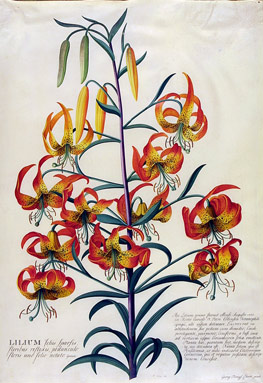
Botanical illustration is the art of depicting the form, color, and details of plant species. They are generally meant to be scientifically descriptive about subjects depicted and are often found printed alongside a botanical description in books, magazines, and other media. Some are sold as artworks. Often composed by a botanical illustrator in consultation with a scientific author, their creation requires an understanding of plant morphology and access to specimens and references.
Many illustrations are in watercolour, but may also be in oils, ink, or pencil, or a combination of these and other media. The image may be life-size or not, though at times a scale is shown, and may show the life cycle and/or habitat of the plant and its neighbors, the upper and reverse sides of leaves, and details of flowers, bud, seed and root system.
The fragility of dried or otherwise preserved specimens, and restrictions or impracticalities of transport, saw illustrations used as valuable visual references for taxonomists. In particular, minute plants or other botanical specimens only visible under a microscope were often identified through illustrations. To that end, botanical illustrations used to be generally accepted as types for attribution of a botanical name to a taxon. However, current guidelines state that on or after 1 January 2007, the type must be a specimen 'except where there are technical difficulties of specimen preservation or if it is impossible to preserve a specimen that would show the features attributed to the taxon by the author of the name.' (Arts 40.4 and 40.5 of the Shenzen Code, 2018).
Early herbals and pharmacopoeia of many cultures include illustrations of plants, as in Ibn al-Baytar's Compendium on Simple Medicaments and Foods. Botanical illustrations in such texts were often created to assist with identification of a species for some medicinal purpose. The earliest surviving illustrated botanical work is the Vienna Dioscurides. It is a copy of Dioscorides's De Materia Medica, and was made in the year 512 for Juliana Anicia, daughter of the former Western Roman Emperor Olybrius. The illustrations did not accurately describe the plants, which was potentially hazardous to medicinal preparations.
The oldest surviving manuscript of the 4th-century Pseudo-Apuleius Herbarius, dates back to the 6th century. It includes stylized plant illustrations and their medicinal uses. Among the first people in Europe to take an interest in plants were monks and nuns, and physicians. Medicinal herbs were grown in monastic gardens and used for self-care and for tending to the sick in local communities. Hildegard von Bingen even wrote about natural medicine and cures in Causae et Curae and Physica. Matthaeus Platearius, a Salerno physician, is credited with the (12th century) "Circa Instans" manuscript, expanded over time into the Treatise on Herbs, containing 500-900 entries depending on version. Later illustrated versions, called Secreta Salernitana, produced from the 14th century onwards influenced later herbals, such as Le Grant Herbier (1498), and its translation, the Grete Herball (1526 or earlier), the first illustrated herbal in English. The illustrations were in fact copies of a series of woodcuts which first appeared in an earlier German herbal, and the same woodcut could be used to represent several plants.
Another notable medical and botanical manuscript is the "Tacuinum Sanitatis", derived from the Taqwīm aṣ Ṣiḥḥa (or "Maintenance of Health"), an 11th-century Arabic medical text by Ibn Butlan, a physician from Baghdad. The text was translated into Latin in the mid-13th century. It was profusely illustrated and widely circulated in Europe, especially in the 14th and 15th centuries. Four handsomely illustrated complete late 14th-century manuscripts of the Tacuinum, all produced in Lombardy, survive, including one in Paris. The Tacuinum was first printed in 1531.
There are many perfectly identifiable flowers in books like The Book of Hours (two volumes) by the Master of Flowers (Maître-aux-fleurs, 15th century) or Jean Bourdichon's Grandes Heures of Anne of Brittany (between 1503 and 1508), with 337 plants from the Queen's garden, captioned in Latin and French. These artists' objective was, though, purely artistic.
At the end of the 16th century, an illustrated manuscript such as the Erbario Carrarese (British Library, London, Egerton Ms.2020), revealed the increased importance attached to plant observation. It is an Italian translation (produced in Veneto between 1390 and 1404 for Francesco Novello da Carrara) of a Latin translation of the Carrara Herbarium, a medical treatise likely written in Arabic by Serapion the Younger at the end of the 12th century, The Book of Simple Medicaments.
Hub AI
Botanical illustration AI simulator
(@Botanical illustration_simulator)
Botanical illustration
Botanical illustration is the art of depicting the form, color, and details of plant species. They are generally meant to be scientifically descriptive about subjects depicted and are often found printed alongside a botanical description in books, magazines, and other media. Some are sold as artworks. Often composed by a botanical illustrator in consultation with a scientific author, their creation requires an understanding of plant morphology and access to specimens and references.
Many illustrations are in watercolour, but may also be in oils, ink, or pencil, or a combination of these and other media. The image may be life-size or not, though at times a scale is shown, and may show the life cycle and/or habitat of the plant and its neighbors, the upper and reverse sides of leaves, and details of flowers, bud, seed and root system.
The fragility of dried or otherwise preserved specimens, and restrictions or impracticalities of transport, saw illustrations used as valuable visual references for taxonomists. In particular, minute plants or other botanical specimens only visible under a microscope were often identified through illustrations. To that end, botanical illustrations used to be generally accepted as types for attribution of a botanical name to a taxon. However, current guidelines state that on or after 1 January 2007, the type must be a specimen 'except where there are technical difficulties of specimen preservation or if it is impossible to preserve a specimen that would show the features attributed to the taxon by the author of the name.' (Arts 40.4 and 40.5 of the Shenzen Code, 2018).
Early herbals and pharmacopoeia of many cultures include illustrations of plants, as in Ibn al-Baytar's Compendium on Simple Medicaments and Foods. Botanical illustrations in such texts were often created to assist with identification of a species for some medicinal purpose. The earliest surviving illustrated botanical work is the Vienna Dioscurides. It is a copy of Dioscorides's De Materia Medica, and was made in the year 512 for Juliana Anicia, daughter of the former Western Roman Emperor Olybrius. The illustrations did not accurately describe the plants, which was potentially hazardous to medicinal preparations.
The oldest surviving manuscript of the 4th-century Pseudo-Apuleius Herbarius, dates back to the 6th century. It includes stylized plant illustrations and their medicinal uses. Among the first people in Europe to take an interest in plants were monks and nuns, and physicians. Medicinal herbs were grown in monastic gardens and used for self-care and for tending to the sick in local communities. Hildegard von Bingen even wrote about natural medicine and cures in Causae et Curae and Physica. Matthaeus Platearius, a Salerno physician, is credited with the (12th century) "Circa Instans" manuscript, expanded over time into the Treatise on Herbs, containing 500-900 entries depending on version. Later illustrated versions, called Secreta Salernitana, produced from the 14th century onwards influenced later herbals, such as Le Grant Herbier (1498), and its translation, the Grete Herball (1526 or earlier), the first illustrated herbal in English. The illustrations were in fact copies of a series of woodcuts which first appeared in an earlier German herbal, and the same woodcut could be used to represent several plants.
Another notable medical and botanical manuscript is the "Tacuinum Sanitatis", derived from the Taqwīm aṣ Ṣiḥḥa (or "Maintenance of Health"), an 11th-century Arabic medical text by Ibn Butlan, a physician from Baghdad. The text was translated into Latin in the mid-13th century. It was profusely illustrated and widely circulated in Europe, especially in the 14th and 15th centuries. Four handsomely illustrated complete late 14th-century manuscripts of the Tacuinum, all produced in Lombardy, survive, including one in Paris. The Tacuinum was first printed in 1531.
There are many perfectly identifiable flowers in books like The Book of Hours (two volumes) by the Master of Flowers (Maître-aux-fleurs, 15th century) or Jean Bourdichon's Grandes Heures of Anne of Brittany (between 1503 and 1508), with 337 plants from the Queen's garden, captioned in Latin and French. These artists' objective was, though, purely artistic.
At the end of the 16th century, an illustrated manuscript such as the Erbario Carrarese (British Library, London, Egerton Ms.2020), revealed the increased importance attached to plant observation. It is an Italian translation (produced in Veneto between 1390 and 1404 for Francesco Novello da Carrara) of a Latin translation of the Carrara Herbarium, a medical treatise likely written in Arabic by Serapion the Younger at the end of the 12th century, The Book of Simple Medicaments.
Recent media