
Recent from talks
Wave nonlinearity
Knowledge base stats:
Talk channels stats:
Members stats:
Wave nonlinearity
The nonlinearity of surface gravity waves refers to their deviations from a sinusoidal shape. In the fields of physical oceanography and coastal engineering, the two categories of nonlinearity are skewness and asymmetry. Wave skewness and asymmetry occur when waves encounter an opposing current or a shallow area. As waves shoal in the nearshore zone, in addition to their wavelength and height changing, their asymmetry and skewness also change. Wave skewness and asymmetry are often implicated in ocean engineering and coastal engineering for the modelling of random sea states, in particular regarding the distribution of wave height, wavelength and crest length. For practical engineering purposes, it is important to know the probability of these wave characteristics in seas and oceans at a given place and time. This knowledge is crucial for the prediction of extreme waves, which are a danger for ships and offshore structures. Satellite altimeter Envisat RA-2 data shows geographically coherent skewness fields in the ocean and from the data has been concluded that large values of skewness occur primarily in regions of large significant wave height.
At the nearshore zone, skewness and asymmetry of surface gravity waves are the main drivers for sediment transport.
Sinusoidal waves (or linear waves) are waves having equal height and duration during the crest and the trough, and they can be mirrored in both the crest and the trough. Due to Non-linear effects, waves can transform from sinusoidal to a skewed and asymmetric shape.
In probability theory and statistics, skewness refers to a distortion or asymmetry that deviates from a normal distribution. Waves that are asymmetric along the horizontal axis are called skewed waves. Asymmetry along the horizontal axis indicates that the wave crest deviates from the wave trough in terms of duration and height. Generally, skewed waves have a short and high wave crest and a long and flat wave trough. A skewed wave shape results in larger orbital velocities under the wave crest compared to smaller orbital velocities under the wave trough. For waves having the same velocity variance, the ones with higher skewness result in a larger net sediment transport.
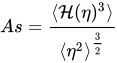
Waves that are asymmetric along the vertical axis are referred to as asymmetric waves. Wave asymmetry indicates the leaning forward or backward of the wave, with a steep front face and a gentle rear face. A steep front correlates with an upward tilt, a steep back is correlated with a downward tilt. The duration and height of the wave-crest equal the duration and height of the wave-trough. An asymmetric wave shape results in a larger acceleration between trough and crest and a smaller acceleration between crest and trough.
Skewness (Sk) and asymmetry (As) are measures of the wave nonlinearity and can be described in terms of the following parameters:

Hub AI
Wave nonlinearity AI simulator
(@Wave nonlinearity_simulator)
Wave nonlinearity
The nonlinearity of surface gravity waves refers to their deviations from a sinusoidal shape. In the fields of physical oceanography and coastal engineering, the two categories of nonlinearity are skewness and asymmetry. Wave skewness and asymmetry occur when waves encounter an opposing current or a shallow area. As waves shoal in the nearshore zone, in addition to their wavelength and height changing, their asymmetry and skewness also change. Wave skewness and asymmetry are often implicated in ocean engineering and coastal engineering for the modelling of random sea states, in particular regarding the distribution of wave height, wavelength and crest length. For practical engineering purposes, it is important to know the probability of these wave characteristics in seas and oceans at a given place and time. This knowledge is crucial for the prediction of extreme waves, which are a danger for ships and offshore structures. Satellite altimeter Envisat RA-2 data shows geographically coherent skewness fields in the ocean and from the data has been concluded that large values of skewness occur primarily in regions of large significant wave height.
At the nearshore zone, skewness and asymmetry of surface gravity waves are the main drivers for sediment transport.
Sinusoidal waves (or linear waves) are waves having equal height and duration during the crest and the trough, and they can be mirrored in both the crest and the trough. Due to Non-linear effects, waves can transform from sinusoidal to a skewed and asymmetric shape.
In probability theory and statistics, skewness refers to a distortion or asymmetry that deviates from a normal distribution. Waves that are asymmetric along the horizontal axis are called skewed waves. Asymmetry along the horizontal axis indicates that the wave crest deviates from the wave trough in terms of duration and height. Generally, skewed waves have a short and high wave crest and a long and flat wave trough. A skewed wave shape results in larger orbital velocities under the wave crest compared to smaller orbital velocities under the wave trough. For waves having the same velocity variance, the ones with higher skewness result in a larger net sediment transport.
Waves that are asymmetric along the vertical axis are referred to as asymmetric waves. Wave asymmetry indicates the leaning forward or backward of the wave, with a steep front face and a gentle rear face. A steep front correlates with an upward tilt, a steep back is correlated with a downward tilt. The duration and height of the wave-crest equal the duration and height of the wave-trough. An asymmetric wave shape results in a larger acceleration between trough and crest and a smaller acceleration between crest and trough.
Skewness (Sk) and asymmetry (As) are measures of the wave nonlinearity and can be described in terms of the following parameters: