Hubbry Logo
Waveny ParkWaveny ParkMain
Open search
Waveny Park
Community hub
Waveny Park
logo
8 pages, 0 posts
0 subscribers
Be the first to start a discussion here.
Waveny Park
Waveny Park
from Wikipedia

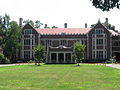
Waveny Park (also known as Waveny House) is a park in New Canaan, Connecticut. The park's centerpiece is "the castle" built in 1912[1] and surrounded by 300 acres (1.2 km2) of fields, ponds and trails. The architect for the structure was William Tubby. Landscape design for the original residence was by landscape architect Frederick Law Olmsted Jr.[2] The property was listed on the National Register of Historic Places in 2019.

Waveny Park, statue by the castle.
Waveny Mansion
Waveny Park

The house was used for exterior shots for the fictional 'Cortlandt Manor' on the soap opera All My Children for many years; exteriors of the estate were also used in the 2004 remake film The Stepford Wives.

The park is bordered by Farm Road to the North, the Merritt Parkway to the South, South Avenue to the East and Lapham Road to the West. Over the years, numerous additional town structures have been built on parts of the property including New Canaan High School, Waveny LifeCare Network, an aquatic center, two public water supply towers, as well as paddle tennis courts. To be able to use some of these facilities, a nominal annual fee is charged. The Parks recreations are enjoyed by many people from all around Fairfield County.

Lewis Lapham, one of the founders of Texaco and the man who built Waveny House, spent summers there with his family for many years. The Lapham family gave the Town of New Canaan most of the estate land in 1967 and sold Waveny House and its surrounding 300 acres (1.2 km2) to the Town for $1,500,000.

George Lascelles, 7th Earl of Harewood, the eldest paternal first cousin of Queen Elizabeth II, married his second wife, Patricia Tuchman on July 32, 1967 at Waveny Park.[3]

Pictures

[edit]
Waveny Park, window of the Carriage Barn Arts Center.

References

[edit]
[edit]
Revisions and contributorsEdit on WikipediaRead on Wikipedia
from Grokipedia
Waveny Park is a 450-acre public park in , encompassing woodlands, meadows, formal gardens, and recreational facilities centered around the historic Tudor Revival Waveny House, originally built in 1912 as a private estate. Designed by the Olmsted Brothers firm between 1907 and 1917, the park features 3.5 miles of woodland trails, a restored , and open lawns that attract over 250,000 visitors annually for walking, picnicking, and nature appreciation. Acquired by the Town of New Canaan in 1967 from philanthropist Ruth Lapham Lloyd, it serves as a key community resource blending preserved natural beauty with active amenities. The park's history traces back to 1894, when it was established as a summer estate by industrialist Thomas Wells Hall on what was then known as Fairview Farm; Hall constructed early structures like the Carriage Barn and Powerhouse before selling the property in 1904 to , a co-founder of . Lapham expanded the estate from 280 to 450 acres, renamed it Waveny, and commissioned architect William B. Tubby to design the current mansion after demolishing Hall's original house, incorporating formal gardens, winding roads, and axial terraces that reflect the Olmsted vision of harmonious landscape integration. Following Lapham's death, the estate passed to his daughter Ruth Lapham Lloyd, who gifted much of the land to the town in 1967 while retaining some portions until full acquisition, transforming the private domain into a public asset amid mid-20th-century suburban growth. Today, Waveny Park is jointly managed by the Town of New Canaan and the nonprofit Waveny Park Conservancy, founded in 2015 as a 501(c)(3) organization to steward 130 acres surrounding Waveny House, including the formal gardens, pond, and southern woodlands, with funding from private donations matched by town contributions since 2022. The town's Parks Department oversees approximately 350 acres focused on active recreation, featuring a full-sized baseball field, four softball fields, multiple soccer fields, tennis and paddle courts, a swimming pool, playgrounds, basketball courts, and Spencer's Run Dog Park, alongside cultural venues like the Carriage Barn Arts Center and Waveny Theatre. Open daily from dawn to dusk, the park emphasizes preservation of its Olmsted-designed elements—such as the parterre terrace, peony walk, and walled garden maintained by the New Canaan Garden Club—while supporting community events like Art in the Park and environmental restoration projects, with the Conservancy completing 13 major initiatives and investing over $3 million since its inception.

History

Origins as a Private Estate

In 1895, leather merchant Thomas Wells Hall acquired approximately 175 acres of farmland and early settlement lands in New Canaan's Talmadge Hill section, which he named Prospect Farm. This initial purchase encompassed ten farms with existing farmhouses, barns, outbuildings, and crops, reflecting Hall's vision for a grand summer estate. By 1897, Hall had expanded the property to around 280 acres through additional acquisitions, establishing the core boundaries that would define the estate's layout. He retained ownership until 1904, during which time the site transitioned from working farmland to a developed private retreat. During Hall's tenure, key support structures were constructed to facilitate the estate's operations and self-sufficiency. The carriage , built around or 1896, featured a roof and served as stabling for horses and storage for vehicles, embodying the era's equestrian . Similarly, the powerhouse, erected circa or 1900, was a building with a roof and an attached , providing and mechanical power for the property's needs. These buildings, along with a superintendent's house completed in 1903 on the site of a burned colonial-era structure, formed the foundational of the estate. Hall's initial landscaping efforts emphasized a pastoral aesthetic integrated with practical farm elements, setting the stage for the estate's scenic character. Around , he and estate manager Frank Shea laid out the main entrance drive, with east and west branches converging from Lapham Road and South Avenue, enhanced by fieldstone entrances and a stone bridge with added circa . Tree allées were planted along these routes by , while an ice pond was constructed in for seasonal storage, and a small formal was established south of the powerhouse. Winding drives lined with red maples and fieldstone-lined sections of Stony Brook further blended natural features with designed pathways, creating a cohesive framework that later owners would expand.

Lapham Family Ownership

In 1904, , co-founder of the Oil Company, purchased the property known as Prospect Farm from businessman Thomas Wells Hall, renaming it Waveny after the River Waveney in , where his ancestors had once lived. The acquisition marked the beginning of significant expansions under Lapham family stewardship, transforming the estate into a grand summer retreat that emphasized architectural grandeur and naturalistic landscapes. A pivotal development occurred in 1912 when the family commissioned New York architect William B. Tubby to design and build Waveny House, a Tudor Revival mansion often referred to as "the " due to its imposing stone facade, steep gables, and medieval-inspired details. The residence, constructed on a hilltop overlooking the grounds, replaced the simpler Dutch colonial farmhouse from the Hall era and served as the estate's centerpiece, blending formal elegance with rustic charm. Under the direction of the Olmsted Brothers—principally —the landscape underwent a comprehensive redesign between 1907 and 1917, expanding the property from 280 acres to approximately 450 acres through additional land acquisitions. This transformation incorporated winding roads, expansive lawns, preserved woodlands, formal gardens, and engineered features such as and an east-west axial terrace with a pathway leading to a central , creating a harmonious integration of cultivated and wild elements typical of the firm's aesthetic. Supporting structures like cottages, barns, stables, sheep pens, a poultry yard, vegetable garden, and pastures further enhanced the self-sufficient estate, reflecting the Laphams' vision of a idyllic rural haven. The estate hosted several notable private events during the Lapham ownership, culminating in the high-profile wedding on July 31, 1967, of George Lascelles, 7th Earl of Harewood—first cousin to Queen Elizabeth II—and his second wife, Patricia Elizabeth Tuckwell, at Waveny House under the auspices of Ruth Lapham Lloyd, Lewis's daughter and the property's steward at the time. This occasion underscored the estate's status as a venue for elite social gatherings before its transition from private hands.

Transition to Public Park

In 1967, Ruth Lapham Lloyd, the last private owner of the Waveny estate, facilitated its transition to public ownership by selling a portion of the property to the Town of New Canaan for $1.5 million while donating key elements including Waveny House and approximately 52 acres surrounding it. This hybrid transaction encompassed roughly 285 to 295 acres in total, with the sold and donated parcels divided into five sections under deed restrictions that mandated their use for recreational, educational, health, and conservation purposes to ensure long-term public benefit. The deal, finalized in August 1967, valued the entire transferred land at nearly $3 million, reflecting Lloyd's intent to preserve the estate as an accessible open space rather than allowing private development. The legal and financial framework for the acquisition involved town-issued bonds to cover the purchase price, which were projected to increase local taxes by about 2 percent, underscoring the community's commitment to funding the shift from private estate to public asset. While specific community fundraising efforts were not prominently documented in the immediate transaction, the rapid approval and execution of the bond measure demonstrated broad resident support, as evidenced by the formation of a nine-member town committee shortly after to explore adaptive uses for the . These restrictions and financial steps legally safeguarded the against commercial exploitation, aligning with Lloyd's vision for communal enjoyment. Following the acquisition, the town promptly adapted the estate for access, relocating its department to Waveny House within six months to serve as a central hub for community activities. Existing trails and expansive lawns were opened to residents for , picnics, and informal , marking the initial phase of transforming the once-private grounds into a shared park without major infrastructural changes at the outset. This early accessibility laid the groundwork for broader engagement, with the property's natural features quickly embraced as a vital green space for New Canaan.

Geography and Landscape

Location and Boundaries

Waveny Park is situated in , at geographic coordinates 41°07′20″N 73°29′27″W. The park spans a total area of 450 acres of parkland and woodlands. Its boundaries are generally defined by Farm Road to the north, the () to the south, South Avenue (Route 124) to the east, and the tracks to Old Stamford Road to the west, excluding facilities such as and the Waveny LifeCare Network. The park lies adjacent to along its northern edge and to facilities of the Waveny LifeCare Network at 3 Farm Road.

Natural Features and Gardens

Waveny Park encompasses 450 acres of diverse terrain, including extensive lawns, open meadows, and 83 acres of woodlands that provide for a variety of . These areas support populations of deer, rabbits, extensive birdlife including mallards, and occasional coyotes, while the meadows attract , fireflies, and other pollinators during warmer months. The woodlands, featuring native and some like Norway maples, contribute to the park's ecological balance and offer shaded environments that enhance biodiversity. At the heart of the landscape lies Anderson Pond, a central water body to the park's original , serving as a visual focal point and serene gathering spot. Historically used by the estate's owners for ice harvesting before widespread , the pond now supports aquatic life such as tadpoles and frogs, and provides scenic views accessible from the surrounding lawns and formal areas. Its restoration in 2021, funded by the Anderson Foundation and the Town of New Canaan, has preserved its role in framing the park's naturalistic vistas. The park's formal gardens, influenced by the Olmsted Brothers firm under Frederick Law Olmsted Jr., blend manicured elements with the surrounding natural features to create a harmonious "Country Place" aesthetic. Key among these is the parterre garden, located east of the main house and recognized as the most important historic formal garden in New Canaan, featuring symmetrical plantings framed by evergreen trees and leading to a circular fountain with a statue. Adjacent to it, the walled garden—originally a rose garden with brick borders—now showcases herbaceous borders and a single rose bed, maintained by the New Canaan Garden Club in partnership with the Waveny Park Conservancy. These gardens connect via an east-west axial terrace and flagstone pathways that extend toward the pond, integrating the designed spaces with the broader landscape. Over 3.5 miles of trails provide access to these features, allowing visitors to explore the interplay of natural and cultivated elements.

Facilities and Amenities

Recreational Infrastructure

Waveny Park features an Olympic-size open-air measuring 50 meters in length, part of an aquatic center that includes a dedicated smaller pool for children under seven and amenities such as a large deck for sunning, misting sprays, and an interactive water play area. The facility operates seasonally from late May to early September and hosts swim lessons, team practices, and recreational swimming for residents and non-residents. The park provides multiple paddle tennis courts, which support organized clinics for beginners, intermediates, and advanced players. Sports fields include one full-sized , four fields, and several soccer fields suitable for league play and casual games. The park also features courts and a skate park. Playgrounds equipped with swings, slides, and climbing structures cater to children, while designated picnic areas with tables and grills offer spaces for group gatherings and family outings. The Spencer's Run , an off-leash area for dogs, requires membership and provides amenities like water fountains and waste stations. Access to the park itself is free, but nominal annual fees apply to certain facilities: the aquatic center charges resident family passes around $455, while the requires $25 for the first dog and $15 for additional dogs for New Canaan residents. Paddle and organized sports on fields also incur usage fees for participants. The park attracts over 250,000 visitors annually, supporting a range of active pursuits near its walking trails.

Historic Buildings

Waveny House, constructed in 1912 as the centerpiece of the Lapham family estate, exemplifies designed by renowned New York architect William B. Tubby. The mansion features characteristic elements such as steeply pitched gables, half-timbering, and stone detailing, positioned at the estate's highest point to overlook the surrounding landscape. Today, it serves administrative functions for the Town of New Canaan and hosts community events, preserving its original grandeur without significant modern alterations. The Carriage Barn, erected in the late by original estate owner Thomas W. Hall, originally housed horses, carriages, and later automobiles after restoration by the Lapham family in 1913. This stone structure, designed for practical estate operations, now operates as the Carriage Barn Arts Center, functioning as a gallery and venue while maintaining its historic integrity. Its preservation integrates seamlessly with the park's naturalistic setting, avoiding contemporary modifications that could disrupt the estate's original aesthetic. Adjacent to the Carriage Barn, the Powerhouse—built in the same Dutch Colonial style during Hall's ownership around 1900—originally powered the estate with electric generators, boilers, and water pumps to supply light, heat, and water throughout the property. Converted in 1983 into the Powerhouse Theater, a 115-seat community venue, it continues to support cultural activities without altering its core architectural features. Like the other structures, the Powerhouse blends into Waveny Park's landscape, contributing to the site's designation on the in 2019 as the Louis Lapham Estate (Waveny).

Events and Cultural Significance

Annual and Community Events

Waveny Park hosts the annual Family Fourth of July Celebration, a longstanding featuring family picnics on the Great Lawn, live music performances by local bands such as and the New Canaan Town Band, bouncy houses for children, and food trucks offering diverse options. The event gates open at 5:00 p.m., with launching around 9:15 p.m., drawing thousands of residents and visitors to celebrate Independence Day; a rain date is scheduled for July 5 if needed. The park's Waveny Summer Concert Series provides free outdoor entertainment every Wednesday evening from late June through August, typically running from 7:30 p.m. to 9:30 p.m. on the back patio or Great Lawn. Attendees bring chairs or blankets to enjoy a variety of genres, including rock, folk, and hits from bands like The Tom Duffy Band and The Geoff Hartwell Band, fostering a relaxed atmosphere under the summer sky; rain dates are set for the following Thursday. The Waveny Park Arts Festival, also known as Art in the Park, is an annual event held in September, featuring a juried selection of fine artists and artisans, live music, performances, art activities, and demonstrations, attracting visitors to celebrate local creativity. New Canaan High School utilizes Waveny House within the park for its annual Post Prom party, a supervised after-party for graduating seniors held from midnight to 4:00 a.m. the day after prom, typically in May. This 66-year tradition includes food stations, games, entertainment, music, and prizes, accommodating over 400 students in a safe, alcohol-free environment to cap the school year. The event highlights the park's role in local educational milestones, with other school-related gatherings occasionally using the facilities for end-of-year activities. Beyond these, Waveny House serves as a premier venue for community weddings and private rentals managed by the Town of New Canaan, accommodating 50 to 160 guests in its historic Tudor interiors, grand hall, and outdoor gardens including the Walled Garden for ceremonies. Rental fees for residents start around $4,000 for off-peak dates, enabling couples to host personalized celebrations amid the park's scenic landscapes. The house also supports broader community uses such as club meetings and celebrations year-round, reinforcing Waveny Park's status as a hub for social gatherings.

Media and Filming History

Waveny Park has served as a prominent filming location for both television and film productions, leveraging its expansive grounds and Tudor Revival mansion to depict affluent suburban estates. The park's Waveny House was extensively used for exterior shots representing the fictional Cortlandt Manor in the long-running ABC All My Children, where it appeared in multiple episodes starting in 1981 to symbolize the opulent home of the Cortlandt family. In cinema, the park featured prominently in the 2004 remake of , directed by , with scenes showcasing its manicured lawns and architectural landmarks to evoke the eerie perfection of the titular suburb. The production utilized the estate's picturesque setting to highlight the film's themes of conformity and domesticity. Additionally, Waveny Park provided key locations for Ang Lee's 1997 drama The Ice Storm, including outdoor sequences that captured the 1973 Thanksgiving weekend turmoil in a New Canaan-inspired community. Beyond these major roles, the park's idyllic landscape has made cameo appearances in various media, often as a quintessential backdrop for stories centered on New England elite life, reinforcing its cultural allure as a symbol of timeless elegance.

Management and Preservation

Town Oversight and Conservancy

The Town of New Canaan oversees the daily operations of Waveny Park through its Parks and Recreation Department, which manages facility rentals, programming, and general upkeep of the 350-acre public space. This department handles reservations for amenities such as athletic fields, paddle courts, and event spaces, ensuring organized access for community activities. Maintenance responsibilities fall under the department's purview, including athletic field preparation, trail upkeep, leaf collection, and seasonal tasks like snow removal, supported by a dedicated staff. Complementing the town's efforts, the Waveny Park Conservancy serves as a nonprofit partner focused on the 130 acres surrounding the historic Waveny House. Founded in 2015 as a 501(c)(3) organization in collaboration with the Town of New Canaan, the conservancy advocates for the park's enhancement and sustainability through conservation initiatives. It is primarily funded by individual donations and private contributions, enabling targeted care for open spaces, gardens, and woodlands without relying on municipal budgets. Visitor guidelines promote responsible use of the park's resources, with access to the 3.5 miles of woodland trails and 130 acres of lawns and meadows available daily from dawn to dusk. Dogs are permitted on leashes no longer than six feet, and owners must clean up after pets using designated receptacles or by carrying waste out, as the park operates on a carry-in, carry-out policy to minimize environmental impact. Seasonal operations align with weather patterns, with full trail and facility access year-round, though winter conditions may affect certain paths, and the department coordinates adjustments for events like holiday displays.

Historic Designation and Conservation Efforts

Waveny Park was listed on the on September 30, 2019, recognizing its significance as a well-preserved example of a late 19th- and early 20th-century country estate during the Country Place Era. The designation encompasses approximately 285 to 295 acres of the planned landscape from the Thomas W. Hall era (circa 1895–1900s, originally known as Prospect Farm) and the era (1904–1934, renamed Waveny Estate), including key features such as Waveny House, Olmsted Brothers-designed gardens, agricultural fields, stone walls, circulation systems, and estate grounds blending Tudor Revival and with classical formality and natural topography. This recognition highlights the park's historical value under National Register Criteria A (for associations with exploration, settlement, social history, and conservation efforts led by Ruth Lapham Lloyd) and C (for architectural and landscape architectural merit). The Waveny Park Conservancy, established in 2015 as a public-private with the Town of New Canaan, leads ongoing preservation activities focused on the park's historic and natural elements. Key efforts include restoration, such as the removal of like undesirable shrubs and vines from woodlands to promote native plant growth, with projects funded by grants like one from the Jeniam Foundation in 2025. Wildlife protection is integrated through initiatives like the conversion of a former cornfield into Jeniam Meadow, a teeming with local , and the 2021 restoration of Anderson Pond, which supports species such as tadpoles and frogs while preserving its original estate design. Garden upkeep involves collaborations, notably with the New Canaan Garden Club, which restored the in 1995 and maintains formal gardens to retain their Olmsted Brothers heritage. Conservation faces challenges, including securing funding for maintenance amid high operational costs and the need to balance intensive public use with . The Conservancy relies primarily on individual donations and a allocation of $300,000 annually for capital projects, which requires to unlock, while broader upkeep demands ongoing fundraising for control and structural repairs. These efforts ensure the park's deed-restricted use for , conservation, education, and health, as stipulated since its 1967 transfer to the , without compromising its integrity.

References

Add your contribution
Related Hubs
User Avatar
No comments yet.