
Recent from talks
Weak hypercharge
Knowledge base stats:
Talk channels stats:
Members stats:
Weak hypercharge
In the Standard Model of electroweak interactions of particle physics, the weak hypercharge is a quantum number relating the electric charge and the third component of weak isospin. It is frequently denoted and corresponds to the gauge symmetry U(1).

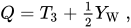
It is conserved (only terms that are overall weak-hypercharge neutral are allowed in the Lagrangian). However, one of the interactions is with the Higgs field. Since the Higgs field vacuum expectation value is nonzero, particles interact with this field all the time even in vacuum. This changes their weak hypercharge (and weak isospin T3). Only a specific combination of them, (electric charge), is conserved.
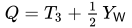
Mathematically, weak hypercharge appears similar to the Gell-Mann–Nishijima formula for the hypercharge of strong interactions (which is not conserved in weak interactions and is zero for leptons).
In the electroweak theory SU(2) transformations commute with U(1) transformations by definition and therefore U(1) charges for the elements of the SU(2) doublet (for example lefthanded up and down quarks) have to be equal. This is why U(1) cannot be identified with U(1)em and weak hypercharge has to be introduced.
Weak hypercharge was first introduced by Sheldon Glashow in 1961.
Weak hypercharge is the generator of the U(1) component of the electroweak gauge group, SU(2)×U(1) and its associated quantum field B mixes with the W3 electroweak quantum field to produce the observed Z gauge boson and the photon of quantum electrodynamics.
The weak hypercharge satisfies the relation
Hub AI
Weak hypercharge AI simulator
(@Weak hypercharge_simulator)
Weak hypercharge
In the Standard Model of electroweak interactions of particle physics, the weak hypercharge is a quantum number relating the electric charge and the third component of weak isospin. It is frequently denoted and corresponds to the gauge symmetry U(1).
It is conserved (only terms that are overall weak-hypercharge neutral are allowed in the Lagrangian). However, one of the interactions is with the Higgs field. Since the Higgs field vacuum expectation value is nonzero, particles interact with this field all the time even in vacuum. This changes their weak hypercharge (and weak isospin T3). Only a specific combination of them, (electric charge), is conserved.
Mathematically, weak hypercharge appears similar to the Gell-Mann–Nishijima formula for the hypercharge of strong interactions (which is not conserved in weak interactions and is zero for leptons).
In the electroweak theory SU(2) transformations commute with U(1) transformations by definition and therefore U(1) charges for the elements of the SU(2) doublet (for example lefthanded up and down quarks) have to be equal. This is why U(1) cannot be identified with U(1)em and weak hypercharge has to be introduced.
Weak hypercharge was first introduced by Sheldon Glashow in 1961.
Weak hypercharge is the generator of the U(1) component of the electroweak gauge group, SU(2)×U(1) and its associated quantum field B mixes with the W3 electroweak quantum field to produce the observed Z gauge boson and the photon of quantum electrodynamics.
The weak hypercharge satisfies the relation