
Weak hypercharge
View on Wikipedia| Flavour in particle physics |
|---|
| Flavour quantum numbers |
|
| Related quantum numbers |
|
| Combinations |
|
| Flavour mixing |
In the Standard Model of electroweak interactions of particle physics, the weak hypercharge is a quantum number relating the electric charge and the third component of weak isospin. It is frequently denoted and corresponds to the gauge symmetry U(1).[1][2]

It is conserved (only terms that are overall weak-hypercharge neutral are allowed in the Lagrangian). However, one of the interactions is with the Higgs field. Since the Higgs field vacuum expectation value is nonzero, particles interact with this field all the time even in vacuum. This changes their weak hypercharge (and weak isospin T3). Only a specific combination of them, (electric charge), is conserved.
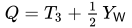
Mathematically, weak hypercharge appears similar to the Gell-Mann–Nishijima formula for the hypercharge of strong interactions (which is not conserved in weak interactions and is zero for leptons).
In the electroweak theory SU(2) transformations commute with U(1) transformations by definition and therefore U(1) charges for the elements of the SU(2) doublet (for example lefthanded up and down quarks) have to be equal. This is why U(1) cannot be identified with U(1)em and weak hypercharge has to be introduced.[3][4]
Weak hypercharge was first introduced by Sheldon Glashow in 1961.[4][5][6]
Definition
[edit]Weak hypercharge is the generator of the U(1) component of the electroweak gauge group, SU(2)×U(1) and its associated quantum field B mixes with the W3 electroweak quantum field to produce the observed Z gauge boson and the photon of quantum electrodynamics.
The weak hypercharge satisfies the relation
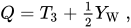
where Q is the electric charge (in elementary charge units) and T3 is the third component of weak isospin (the SU(2) component).
Rearranging, the weak hypercharge can be explicitly defined as:

| Fermion family |
Left-chiral fermions | Right-chiral fermions | ||||||
|---|---|---|---|---|---|---|---|---|
| Electric charge Q |
Weak isospin T3 |
Weak hyper- charge YW |
Electric charge Q |
Weak isospin T3 |
Weak hyper- charge YW | |||
| Leptons | ν e, ν μ, ν τ |
0 | +1/2 | −1 | νR May not exist |
0 | 0 | 0 |
| e− , μ− , τ− |
−1 | −1/2 | −1 | e− R, μ− R, τ− R |
−1 | 0 | −2 | |
| Quarks | u, c, t | +2/3 | +1/2 | +1/3 | u R, c R, t R |
+2/3 | 0 | +4/3 |
| d, s, b | −1/3 | −1/2 | +1/3 | d R, s R, b R |
−1/3 | 0 | −2/3 | |
where "left"- and "right"-handed here are left and right chirality, respectively (distinct from helicity). The weak hypercharge for an anti-fermion is the opposite of that of the corresponding fermion because the electric charge and the third component of the weak isospin reverse sign under charge conjugation.
.svg)

| Interaction mediated |
Boson | Electric charge Q |
Weak isospin T3 |
Weak hypercharge YW |
|---|---|---|---|---|
| Weak | W± |
±1 | ±1 | 0 |
| Z0 |
0 | 0 | 0 | |
| Electromagnetic | γ0 |
0 | 0 | 0 |
| Strong | g | 0 | 0 | 0 |
| Higgs | H0 |
0 | −1/2 | +1 |

The sum of −isospin and +charge is zero for each of the gauge bosons; consequently, all the electroweak gauge bosons have

Hypercharge assignments in the Standard Model are determined up to a twofold ambiguity by requiring cancellation of all anomalies.
Alternative half-scale
[edit]For convenience, weak hypercharge is often represented at half-scale, so that

which is equal to just the average electric charge of the particles in the isospin multiplet.[8][9]
Baryon and lepton number
[edit]Weak hypercharge is related to baryon number minus lepton number via:

where X is a conserved quantum number in GUT. Since weak hypercharge is always conserved within the Standard Model and most extensions, this implies that baryon number minus lepton number is also always conserved.
Neutron decay
[edit]Hence neutron decay conserves baryon number B and lepton number L separately, so also the difference B − L is conserved.
Proton decay
[edit]Proton decay is a prediction of many grand unification theories.

Hence this hypothetical proton decay would conserve B − L , even though it would individually violate conservation of both lepton number and baryon number.
See also
[edit]References
[edit]- ^ Donoghue, J.F.; Golowich, E.; Holstein, B.R. (1994). Dynamics of the Standard Model. Cambridge University Press. p. 52. ISBN 0-521-47652-6.
- ^ Cheng, T.P.; Li, L.F. (2006). Gauge Theory of Elementary Particle Physics. Oxford University Press. ISBN 0-19-851961-3.
- ^ Tully, Christopher G. (2012). Elementary Particle Physics in a Nutshell. Princeton University Press. p. 87. doi:10.1515/9781400839353. ISBN 978-1-4008-3935-3. Archived from the original on 2022-12-21. Retrieved 2021-02-07.
- ^ a b Glashow, Sheldon L. (February 1961). "Partial-symmetries of weak interactions". Nuclear Physics. 22 (4): 579–588. Bibcode:1961NucPh..22..579G. doi:10.1016/0029-5582(61)90469-2.
- ^ Hoddeson, Lillian; Brown, Laurie; Riordan, Michael; Dresden, Max, eds. (1997-11-13). The rise of the Standard Model: A history of particle physics from 1964 to 1979 (1st ed.). Cambridge University Press. p. 14. doi:10.1017/cbo9780511471094. ISBN 978-0-521-57082-4.
- ^ Quigg, Chris (2015-10-19). "Electroweak symmetry breaking in historical perspective". Annual Review of Nuclear and Particle Science. 65 (1): 25–42. arXiv:1503.01756. Bibcode:2015ARNPS..65...25Q. doi:10.1146/annurev-nucl-102313-025537. ISSN 0163-8998.
- ^ Lee, T.D. (1981). Particle Physics and Introduction to Field Theory. Boca Raton, FL / New York, NY: CRC Press / Harwood Academic Publishers. ISBN 978-3718600335 – via Archive.org.
- ^ Peskin, Michael E.; Schroeder, Daniel V. (1995). An Introduction to Quantum Field Theory. Addison-Wesley Publishing Company. ISBN 978-0-201-50397-5.
- ^ Anderson, M.R. (2003). The Mathematical Theory of Cosmic Strings. CRC Press. p. 12. ISBN 0-7503-0160-0.
| Background |  | ||||||||
|---|---|---|---|---|---|---|---|---|---|
| Constituents | |||||||||
| Beyond the Standard Model |
| ||||||||
| Experiments | |||||||||


Weak hypercharge
View on GrokipediaDefinition and Formulation
Core Definition
In the Standard Model of particle physics, weak hypercharge, denoted $ Y_W _Y$ gauge field and serving as the quantum number for the abelian U(1) symmetry that complements the SU(2) weak isospin.[1] This quantum number is essential for classifying particles within the electroweak sector, where it complements weak isospin to determine overall charge properties.[1] The mathematical definition of weak hypercharge is given by the relationNormalization Conventions
In the electroweak theory, the standard normalization of weak hypercharge $ Y_W $ is defined through the relation $ Q = T^3 + \frac{Y_W}{2} $, where $ Q $ is the electric charge and $ T^3 $ is the third component of the weak isospin. This convention assigns $ Y_W = 1 $ to the Higgs doublet, ensuring that the upper component has $ Q = 1 $ and the lower component has $ Q = 0 $. The U(1)Y gauge coupling $ g' $ enters the theory such that the hypercharge contribution to the fermion kinetic term in the Lagrangian is $ \overline{\psi} \gamma^\mu \left( \frac{g'}{2} Y_W \right) \psi B\mu $, where $ B_\mu $ is the hypercharge gauge field. An alternative half-scale convention defines $ Y' = \frac{Y_W}{2} $, so that $ Q = T^3 + Y' $, with the Higgs doublet assigned $ Y' = \frac{1}{2} $. In this framework, the covariant derivative includes the term $ -i g' Y' B_\mu $, simplifying the notation for particle assignments: for instance, the left-handed quark doublet has $ Y' = \frac{1}{6} $ and the left-handed lepton doublet has $ Y' = -\frac{1}{2} $. This choice is common in pedagogical treatments and aligns the hypercharge values more closely with the weak isospin components, facilitating the Higgs vacuum expectation value expression as $ \langle \phi^0 \rangle = \frac{v}{\sqrt{2}} $, where $ v \approx 246 $ GeV is the electroweak scale.[7][8] The two conventions differ only in the rescaling of the hypercharge quantum number, with a corresponding adjustment in the definition of $ g' $ to preserve physical predictions. In Lagrangian terms, the standard convention yields the neutral current interaction involving $ \frac{g'}{2} Y_W \overline{f} \gamma^\mu f B_\mu $, while the half-scale version uses $ g' Y' \overline{f} \gamma^\mu f B_\mu $; both lead to identical electroweak phenomenology after gauge boson mixing. These normalizations are selected to ensure consistency with the definition of the Weinberg angle $ \theta_W $, where $ \sin^2 \theta_W = \frac{g'^2}{g^2 + g'^2} \approx 0.231 $, matching precision electroweak measurements from Z-pole observables.[9][8]Quantum Number Relations
Link to Electric Charge and Isospin
In the electroweak theory, the weak hypercharge $ Y_W $ is intrinsically linked to the electric charge $ Q $ and the third component of weak isospin $ T_3 $ through the fundamental relation $ Q = T_3 + \frac{Y_W}{2} $.[10] This equation, analogous to the Gell-Mann–Nishijima formula in quantum chromodynamics, ensures the consistent assignment of electric charges to particles within the SU(2)_L × U(1)_Y gauge structure. It was first proposed by Sheldon Glashow in his 1961 model of partial symmetries for weak interactions, where $ Y_W $ was introduced as an additional quantum number to unify weak and electromagnetic processes while accommodating both left- and right-handed currents.[10] In this framework, the U(1)_Y gauge group associated with $ Y_W $ mixes with the SU(2)_L neutral component to form the photon and Z boson fields after electroweak symmetry breaking. For left-handed fermion doublets under SU(2)_L, the relation quantizes charges by assigning $ T_3 = +\frac{1}{2} $ to the upper component (up-type) and $ T_3 = -\frac{1}{2} $ to the lower component (down-type), with a common $ Y_W $ for the doublet. This yields fractional charges that match observed values, such as $ Q = +\frac{2}{3} $ for up-type and $ Q = -\frac{1}{3} $ for down-type quarks when $ Y_W = \frac{1}{3} $, or $ Q = 0 $ for neutrinos and $ Q = -1 $ for charged leptons when $ Y_W = -1 $. Right-handed fermions, transforming as SU(2)_L singlets with $ T_3 = 0 $, have $ Y_W = 2Q $, directly tying their hypercharge to electric charge—for instance, $ Y_W = \frac{4}{3} $ for right-handed up-type quarks and $ Y_W = -2 $ for right-handed charged leptons. These assignments preserve charge conservation across chiral sectors, distinguishing the theory from purely left-handed models. The relation also governs neutral current interactions mediated by the Z boson, whose coupling to fermions is proportional to $ g_V = T_3 - 2 Q \sin^2 \theta_W $ for the vector part and $ g_A = T_3 $ for the axial-vector part, where $ \theta_W $ is the weak mixing angle. Here, $ Y_W $ enters indirectly through the definition of $ \sin^2 \theta_W = \frac{g'^2}{g^2 + g'^2} $, with $ g' $ the U(1)_Y coupling constant, ensuring the Z boson is neutral under electromagnetism ($ Q = 0 $). This structure predicted neutral currents before their experimental discovery in 1973, validating the role of $ Y_W $ in suppressing right-handed contributions to certain processes while allowing parity violation.Connection to Baryon and Lepton Numbers
In the Standard Model, the weak hypercharge $ Y_W $ for fermions is determined by the relation $ Y_W = 2(Q - T_3) $, where $ Q $ is the electric charge and $ T_3 $ is the third component of weak isospin; this assignment ensures consistent charge quantization across left- and right-handed fields.[11] The specific values of $ Y_W $ for chiral multiplets—such as $ Y_W = 1/3 $ for left-handed quark doublets $ Q_L $, $ Y_W = -1 $ for left-handed lepton doublets $ L_L $, $ Y_W = 4/3 $ for right-handed up-type quarks $ u_R $, $ Y_W = -2/3 $ for right-handed down-type quarks $ d_R $, and $ Y_W = -2 $ for right-handed electrons $ e_R $—are crucial for canceling all gauge anomalies in the electroweak sector, including the $ [\mathrm{SU}(2)_L]^2 \mathrm{U}(1)_Y $, $ \mathrm{U}(1)_Y^3 $, and mixed $ \mathrm{SU}(3)_c^2 \mathrm{U}(1)_Y $ triangle diagrams across three generations.[11] This anomaly-free structure arises precisely from the interplay of these $ Y_W $ values with the representation content under $ \mathrm{SU}(2)_L \times \mathrm{U}(1)_Y \times \mathrm{SU}(3)_c $, rendering the theory quantum consistent without additional fields.[11] The connection to baryon number $ B $ and lepton number $ L $ emerges through the global $ \mathrm{U}(1)_B $ and $ \mathrm{U}(1)_L $ symmetries, which are vector-like classically but chiral at the quantum level due to the left-handed nature of electroweak interactions. Assigning $ B = 1/3 $ to quarks and $ L = 1 $ to leptons (with zeros otherwise), the mixed anomalies between these global currents and the electroweak gauge fields—particularly the Adler-Bell-Jackiw (ABJ) anomalies involving $ \mathrm{SU}(2)_L^2 \mathrm{U}(1)_B $, $ \mathrm{SU}(2)_L^2 \mathrm{U}(1)_L $, and $ \mathrm{U}(1)Y^2 \mathrm{U}(1){B,L} $—are nonzero and identical for $ B $ and $ L $.[11] As a result, individual $ B $ and $ L $ are violated by instanton processes, with the anomaly equation taking the formParticle Assignments
Fermions
In the Standard Model, the weak hypercharge $ Y_W $ is assigned to fermions according to their chiral representations under the electroweak gauge group $ SU(2)_L \times U(1)_Y $. Left-handed fermions transform as doublets under $ SU(2)_L $, while right-handed fermions are singlets. These assignments ensure consistency with the electric charge formula $ Q = T_3 + Y_W / 2 $, where $ T_3 $ is the third component of weak isospin, and apply identically across all three generations of fermions.[12][2] For quarks, the left-handed fields form doublets $ (u_L, d_L) $ (and analogously for charm-strange and top-bottom pairs) with $ Y_W = +1/3 $. The right-handed up-type quarks $ u_R $ (and similarly $ c_R, t_R $) have $ Y_W = +4/3 $, while right-handed down-type quarks $ d_R $ (and $ s_R, b_R $) have $ Y_W = -2/3 $. Quarks also carry color charge under $ SU(3)_C $, but $ Y_W $ is the same for each of the three color components and independent of color.[12][13] For leptons, the left-handed fields form doublets $ (\nu_L, e_L) $ (and similarly for muon and tau pairs) with $ Y_W = -1 $. The right-handed charged leptons $ e_R $ (and $ \mu_R, \tau_R $) have $ Y_W = -2 $. The minimal Standard Model does not include right-handed neutrinos, but in extensions accommodating neutrino masses, sterile right-handed neutrinos $ \nu_R $ are singlets with $ Y_W = 0 $.[12][14] The following table summarizes the assignments for one generation of fermions (replicated for the other generations), verifying the charges via $ Q = T_3 + Y_W / 2 $. For quarks, the values apply per color triplet.| Fermion Field | $ SU(2)_L $ Rep. | $ T_3 $ | $ Y_W $ | $ Q $ |
|---|---|---|---|---|
| $ (u_L, d_L) $ doublet | 2 | +1/2 ($ u_L d_L $) | +1/3 | +2/3 ($ u_L d_L $) |
| $ u_R $ | 1 | 0 | +4/3 | +2/3 |
| $ d_R $ | 1 | 0 | -2/3 | -1/3 |
| $ (\nu_L, e_L) $ doublet | 2 | +1/2 ($ \nu_L e_L $) | -1 | 0 ($ \nu_L e_L $) |
| $ e_R $ | 1 | 0 | -2 | -1 |
| $ \nu_R $ (if present) | 1 | 0 | 0 | 0 |