Hubbry Logo
Welman submarineWelman submarineMain
Open search
Welman submarine
Community hub
Welman submarine
logo
8 pages, 0 posts
0 subscribers
Be the first to start a discussion here.
Welman submarine
Welman submarine
from Wikipedia

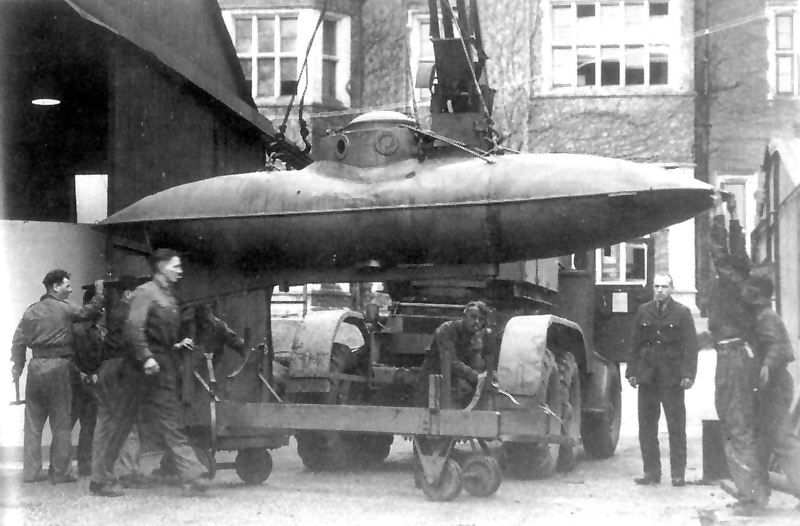
Welman with detachable warhead being trialled at Queen Mary Reservoir, Staines
Class overview
NameWelman submarine
BuildersMorris Motors Limited
Operators United Kingdom Special Operations Executive
Completed100+
General characteristics Welman submarine
Typemidget submarine
Displacement
  • 2,000 pounds (910 kg) without warhead
  • (warhead: 500 pounds (230 kg))
Length
  • 17 ft 3 in (5.26 m) without charge
  • 20 ft 6 in (6.25 m) with charge
PropulsionOne electric motor, 2.5 hp, powered by a 40v 220amp/hr battery.
Speed3 knots (5.6 km/h)
Range36 nautical miles (67 km) at 3 knots (5.6 km/h)
Test depth300 ft (91 m) (reduced to 100 ft (30 m) after trials)
Crew1
Armament1 x detachable charge of 425 pounds (193 kg) of Torpex

The Welman submarine was a Second World War one-man British midget submarine developed by the Special Operations Executive. It only saw action once and was not particularly successful.[1]

Design

[edit]

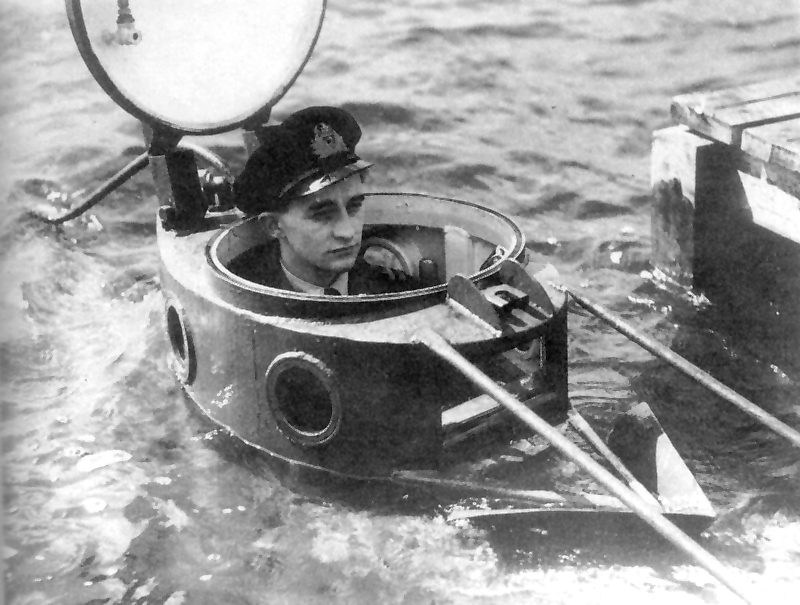
Designed by the Commanding Officer of SOE's Inter Services Research Bureau (ISRB), Lt Col. John Dolphin, as a method of delivering a large explosive charge below an enemy ship, the Welman was a submersible craft 20 feet 6 inches (6.25 m) in length (including explosive charge), weighing about 2,000 pounds (910 kg). Unlike the "Chariot" human torpedo, the operator was enclosed within the craft, and did not need to wear diving gear. The Welman could transport a 425-pound (193 kg) time-fused explosive charge of Torpex, which was intended to be magnetically attached to a target's hull.[2] Vision was through armoured glass segments in the small conning tower, and no periscope was fitted.

Production

[edit]

Following trials in the Queen Mary Reservoir near Staines towards the end of 1942, the Welman was put into production, the production being contracted out to Morris Motors Limited's requisitioned factory at Oxford.

Despite the craft's inability to cut a way through anti-submarine nets (which both X class submarines and Chariot manned torpedoes could do) and the poor visibility available to the crewman, 150 production examples were ordered in February 1943.[2]

Production was halted in October 1943 when operational research showed the concept suffered from too many disadvantages, by which time some 100 examples had been produced (precise numbers are unknown).

Operational service

[edit]

In early 1943 the Royal Navy establishment on board the submarine depot ship HMS Titania was expanded to carry out sea trials of the Welman. Training courses for operators were located at Fort Blockhouse in Gosport. Trainees were drawn from the Royal Navy, the Royal Navy Reserve, and other Special Forces groups which included the Special Boat Section of the Commandos.

HMS Titania was relocated to Loch a' Chàirn Bhàin, south of Cape Wrath, in the north west of Scotland, which became a secret training base for all mini submarine operations. A Welman (W10) was lost on exercise in Rothesay Bay on 9 September.

By autumn 1943, sufficient trained operators and craft existed for the Welman to be considered for operational use.

In the autumn of 1943 the Combined Ops commander, General Sir Robert Laycock (who took over from the then Lord Louis Mountbatten) decided that the Welman was unsuitable for their purposes, so the craft were returned to the Royal Navy. Admiral Sir Lionel Wells, Flag Officer commanding Orkney and Shetland, thought they might be useful for attacks on German shipping using coastal waters inside the Leads off Norway. Motor Torpedo Boats (MTBs) of the 30th Flotilla, manned by officers and men of the Royal Norwegian Navy, were making these raids already and agreed to try the Welmans in an attack on the Floating Dock in Bergen harbour (eventually sunk in September 1944 by X-24). On 20 November 1943 MTB635 and MTB625 left Lunna Voe, Shetland, carrying Welmans W45 (Lt. C. Johnsen, Royal Norwegian Navy), W46 (Lt Bjørn Pedersen (1922), Norwegian Army), W47 (Lt. B. Marris, RNVR) and W48 (Lt. J. Holmes, RN). The craft were launched at the entrance to the fjord.

Pedersen's W46 encountered an anti-submarine net and was forced to the surface, where she was spotted by a German patrol craft. Pedersen was captured along with the Welman, surviving the war in a prison camp. The other three, having lost the element of surprise, could not press the attack and so eventually had to be scuttled. Their operators made their way north with the help of Norwegian resistance members and were picked up in February 1944 by MTB653. The failure made the Royal Navy concentrate on X craft and XE craft, although further Welman trials occurred, especially in Australia.

Subsequent to the failed attack the Germans salvaged one of the craft. Even though the German navy were appalled by the unsophisticated quality of the engineering they found in the Welman, there is some similarity between it and the Biber midget submarines used against Allied shipping in 1944.

The major drawback of the Welman from its operators' point of view was that it had no periscope. Without a way of viewing its surroundings without surfacing, it was impossible to navigate covertly. It was also found that when travelling on the surface the operator's eye level was so close to sea level that objects more than two miles away were not visible.

See also

[edit]

Citations

[edit]
  1. ^ "Midget Submarines, 1939 - 1952: Welman Type Midget". submariners.co.uk. Archived from the original on 18 July 2009. Retrieved 26 April 2009.
  2. ^ a b Akermann, p. 462

References

[edit]
[edit]
Revisions and contributorsEdit on WikipediaRead on Wikipedia
from Grokipedia
The Welman submarine was a one-man midget submarine developed by the British Special Operations Executive (SOE) during World War II for clandestine attacks on enemy shipping using magnetic limpet mines, as well as for reconnaissance and supply transport missions. Designed by Lieutenant Colonel John Dolphin of the Royal Engineers in mid-1942 and prototyped at SOE's Station IX (the Inter-Service Research Bureau) near Welwyn Garden City, it featured a simple construction with armoured glass observation windows in place of a periscope, a single electric motor, and no armament beyond a detachable 193 kg warhead. Approximately 100 units were produced starting in 1943, primarily at the Morris Motors plant in Oxford with body panels manufactured by Pressed Steel Company, emphasizing ease of production and minimal crew training for Royal Marines of No. 2 Commando (later the Special Boat Service). Measuring over 6 meters in length and displacing approximately 1 , the Welman achieved a maximum speed of 3 knots and a surfaced range of 36 nautical miles, making it suitable for short-range operations in confined waters like Norwegian harbors targeting merchant vessels. Despite trials showing potential for such roles, the design proved unreliable in practice due to handling issues and vulnerability, leading to only one known combat deployment: Operation Barbara in November 1943, when four Welmans were towed by motor torpedo boats toward Harbour, , to attack a German floating but were forced to abort after one craft was swamped and captured intact by the enemy. Efforts to redesign the continued into 1944, but the project was ultimately deemed unsuccessful and phased out in favor of more capable midget submarines like the X-class, with remaining units repurposed for training or scrapped post-war.

Development and Design

Origins and Development

During , the (SOE) urgently required specialized tools for covert sabotage missions behind enemy lines, including attacks on Axis naval assets in protected harbors. Inspired by the Royal Navy's early experiments, such as the , which highlighted the effectiveness of compact submersible vehicles for stealthy underwater incursions despite their limitations in operator protection and endurance, SOE initiated its own program to develop midget submarines tailored for special operations. These efforts aimed to equip agents with reliable means to disrupt enemy shipping without relying on larger naval forces. The Welman submarine's inception is credited to John Dolphin, a officer and of SOE's Inter-Services Research Bureau (ISRB), the covert designation for Station IX. In late 1942, amid escalating demands for innovative sabotage weapons, Dolphin proposed the concept of a single-operator designed to transport and attach a 425 lb Torpex explosive charge directly beneath enemy ships' hulls, emphasizing undetectable approach, ease of use, and minimal crew requirements to reduce training time compared to more elaborate designs. Development accelerated through close collaboration between Dolphin and SOE's research experts at Station IX, located at The Frythe near Welwyn, , including Professor Dudley Newitt, who oversaw technical refinements. Beginning with preliminary sketches in 1942, the project culminated in the completion of the first full-scale prototype by early 1943, followed by initial trials at the Queen Mary Reservoir in Staines, , to validate its submersible capabilities. The name "Welman" derived from "Welwyn" and "one-man submarine," reflecting its origins at the facility.

Technical Specifications

The Welman submarine was a compact, one-man engineered for covert sabotage operations during , featuring a streamlined hull designed to withstand underwater s while maintaining stealth. Its construction utilized welded plates for the pressure hull, providing resistance to depths initially rated at 300 feet (91 m), though operational limits were conservatively reduced to 100 feet (30 m) following structural evaluations to ensure safety. The detachable nose section allowed for the attachment of the explosive charge, facilitating mission-specific configurations without compromising the core vehicle's integrity. Key physical dimensions included a of 20 feet 6 inches (6.25 m) when fitted with the , with the base hull measuring approximately 17 feet 3 inches (5.26 m) without it; the overall displacement was about 2,000 pounds (910 kg) excluding the charge, increasing to roughly 2,425 pounds (1,100 kg) when loaded. The hull was just over 2.5 feet (0.76 m), enabling the single operator to be enclosed in a cramped accessed via a hatch in the . Visibility was provided through armored glass ports in the short , as the design omitted a to minimize size and complexity, requiring the operator to surface for . Basic controls included a for , hydroplanes for depth adjustment, and a simple electric system for propulsion management, all operated manually by the lone crewman without need for diving suits. Propulsion was driven by a single 2.5 horsepower , capable of both surfaced and submerged operation, drawing power from onboard batteries to achieve a maximum speed of 3 knots (5.6 km/h). The system's efficiency supported a surfaced range of approximately 36 nautical miles (67 km) at economical speeds around 2-3 knots, sufficient for approaching coastal targets but limiting endurance for extended missions. This electric-only setup ensured underwater but restricted overall mobility compared to larger . Armament consisted of a single 425-pound (193 kg) explosive charge, a high-explosive mixture optimized for underwater detonation, housed in the detachable nose and equipped with a time fuse. The charge was deployed via a magnetic attachment mechanism, allowing the operator to affix it directly to an enemy ship's hull at close range before withdrawing; this limpet-mine style delivery emphasized precision placement over ranged attack, though the design's inability to slice through anti-submarine nets posed tactical limitations.

Production and Trials

Manufacturing Process

In February 1943, the (SOE) placed an order for 150 Welman submersibles with Limited, utilizing the company's requisitioned factory in , , for wartime production. This contract leveraged ' automotive expertise to adapt existing assembly lines for the rapid manufacture of these one-man midget submarines, transitioning from civilian vehicle production to military hardware amid the demands of . Production scaled quickly, with approximately 100 units completed by , when the program was halted due to operational shortcomings identified in trials. The manufacturing process involved pressed steel panels fabricated by the at their Cowley facility, which were then assembled at alongside other components such as electric motors and batteries sourced from British suppliers. The submarines' hulls were primarily constructed from for durability in underwater conditions, with the overall build emphasizing to facilitate high-volume output on repurposed automotive lines. The workforce comprised skilled engineers and laborers reassigned from ' civilian automobile projects, enabling a swift ramp-up from mid-1943 to meet SOE's urgent requirements for covert operations. This adaptation of industrial facilities underscored the broader wartime mobilization of the British motor industry, where factories like those in contributed to diverse military efforts beyond traditional vehicle production.

Testing and Modifications

The initial trials of the Welman submarine prototypes took place at the Queen Mary Reservoir near Staines, , in late 1942, where evaluations centered on buoyancy control, propulsion system reliability, and the physical endurance required of a single operator in the confined . These tests uncovered significant performance limitations that compromised the submarine's viability. The , powered by a 40-volt, 220-ampere-hour battery, delivered a maximum speed of 3 knots but restricted the operational range to just 36 nautical miles, severely constraining mission duration to approximately 12 hours submerged. Hull integrity under proved inadequate, with one sinking uncontrollably in 180 feet of water during a dive and another experiencing water ingress while being towed at 60 feet. Navigation was further hampered by the lack of a , forcing operators to surface periodically for orientation. To mitigate these flaws, several adjustments were made during subsequent evaluations. Minor enhancements, such as a waterproof cape for the operator, were added to improve comfort and reduce ingress risks during handling. The planned test depth was scaled back to to avoid repeated pressure failures observed in deeper simulations. By October 1943, following comprehensive operational research that highlighted these persistent fundamental deficiencies—including inadequate range, depth reliability, and navigational accuracy—production of the Welman was ordered halted, with no further units built beyond the initial batch of approximately 100.

Operational History

Training and Preparation

Operators for the Welman submarine were selected from and allied military volunteers, including of , with a focus on individuals possessing strong . The program was brief and tailored to develop proficiency in the vehicle's controls and mission execution. Initial occurred at Fort Blockhouse in , , where recruits underwent basic instruction on submarine handling and safety protocols. Advanced sessions took place at a’ Chàirn Bhàin ( Cairnbawn) in , utilizing the sheltered waters for realistic exercises under the support of depot ships like HMS Titania. During , at least one Welman (No. 10) was lost when it sank alongside HMS Titania in Loch Cairnbawn in 1943. The curriculum emphasized hands-on skills, including simulator sessions to familiarize operators with the Welman’s steering and propulsion systems, as well as submerged navigation drills to simulate stealthy approaches to targets. Trainees practiced attaching mines to mock hulls, replicating scenarios, and received intensive instruction on escape procedures, such as bailing out from the craft in emergencies. These elements were critical given the submarine's limited speed of 3 knots and range of 36 nautical miles (surfaced), which demanded precise control during missions. Norwegian commandos played a significant role in the program, particularly for operations tied to Norwegian coastal targets, with key figures like Lt. C. Johnsen of the Royal Norwegian Navy participating in preparatory exercises. This collaboration enhanced the training's focus on cross-channel sabotage tactics.

Combat Deployment

The Welman submarine's sole combat deployment occurred as part of Operation Barbara, a British special operation launched in November 1943 to sabotage the Laksevåg floating dock in Bergen harbour, Norway, which supported German U-boat and surface ship repairs. Four Welman craft—Welman 45, 46, 47, and 48—were selected for the mission, each manned by a single operator: Norwegian Army Lieutenant Bjørn Pedersen (Welman 46), Royal Norwegian Navy Lieutenant Carsten Johnsen, Royal Navy Volunteer Reserve Lieutenant Basil M. Marris, and Royal Navy Lieutenant James Holmes. The operation aimed to infiltrate the heavily defended harbour under cover of darkness, attach limpet mines to the dock's underside, and withdraw, thereby disrupting German naval logistics in the region. On 20 November 1943, the Welmans were towed from Lunna Voe in the Shetland Islands by Royal Navy motor torpedo boats MTB 635 and MTB 625, crossing the North Sea to a release point approximately 5 miles off the Norwegian coast near Solsviksund. The craft proceeded independently on the night of 21 November, intending to conceal themselves at Hjeltholmen island before launching the attack the following evening. However, the mission encountered immediate setbacks: Norwegian fishermen spotted the approaching Welmans and alerted German forces, compromising the element of surprise. Pedersen, leading in Welman 46, pressed forward toward the target but was detected by a German minesweeper around 18:45 on 22 November; after sustaining gunfire damage that rendered his craft unmaneuverable in the strong harbour currents, he surrendered and was captured along with the intact submarine. The remaining operators—Johnsen, Marris, and Holmes—abandoned their Welmans 45, 47, and 48 after hearing gunfire, scuttling the craft due to mechanical failures exacerbated by the tidal currents and the need to evade detection; no attacks on the target were achieved. The three operators evaded immediate capture with assistance from the Norwegian resistance, making their way northward through occupied territory before being extracted by MTB 653 on 5 February 1944. Pedersen, held for interrogation, was imprisoned in a German camp but survived the war without sustaining serious injury. German forces salvaged and analyzed the captured Welman 46, which provided technical insights that influenced subsequent development of their own midget submarines, such as the Biber. The mission resulted in no fatalities or significant damage to the target, underscoring operational vulnerabilities including limited maneuverability in confined, current-swept waters.

Legacy and Analysis

Operational Outcomes and Lessons Learned

The Welman submarine's sole operational deployment, Operation Barbara I launched from motor torpedo boats near , , in November 1943, ended in complete failure to inflict damage on the targeted Laksevåg floating dock or any German shipping. One Welman, W-46 piloted by Bjørn Pedersen, encountered an , surfaced, and was detected by a German patrol vessel, resulting in the capture of the craft and its operator; the remaining three Welmans, having lost the element of surprise, were scuttled by their pilots without approaching the objective. This outcome led to the loss of valuable equipment and alerted German forces to the threat of British midget submersibles, prompting them to study the captured Welman and incorporate its features into their own experimental designs, thereby enhancing coastal defenses in Norwegian fjords. Post-mission assessments by the (SOE) highlighted the Welman's inherent limitations, including its short operational range of approximately 30-40 miles, lack of a for , and overall unreliability in contested waters, which severely hampered stealth and precision during the Bergen approach. These critiques, drawn from operator debriefs and technical reviews, contributed directly to the program's abrupt cancellation in late , with production halted after roughly 100 units despite initial plans for 150. The Welman initiative's shortcomings redirected Allied resources toward more capable alternatives, notably the Admiralty's X-craft midget submarines, which successfully destroyed the same Laksevåg floating dock in September 1944 during a subsequent raid. This shift underscored the need for closer integration between SOE's unconventional and the Royal Navy's conventional forces, influencing future sabotage planning to prioritize joint command structures and proven naval platforms over standalone SOE inventions. Captured operator Bjørn Pedersen endured interrogation by German authorities following his November 1943 apprehension but provided no critical , remaining in a until liberation by advancing Allied forces in May 1945. The other three pilots—Lieutenants C. Johnsen, B. Marris, and J. Holmes—evaded capture with assistance from the Norwegian resistance, enduring harsh winter conditions in hiding before repatriation via in February 1944; their accounts emphasized the psychological strain of operating in isolation without visual aids, reinforcing the human vulnerabilities of such high-risk missions.

Comparisons and Influence

The Welman submarine, as a compact one-man , was substantially smaller and simpler than the British X-class midget submarines, which featured a four-man crew and greater operational endurance for extended missions. In contrast, it shared similarities with the German Biber, another one-man design that emphasized portability and minimal crew requirements for covert harbor attacks. However, the Welman demonstrated lower operational effectiveness compared to the Italian MTM explosive motor boats, which achieved notable successes in disrupting Allied shipping, such as the damaging strikes against British vessels in Suda Bay in 1941. The capture of a Welman (designated W46) by German forces in , , on 22 November 1943, directly influenced the rapid development of the Biber . German naval engineers, led by Hans Bartels, examined the salvaged craft and incorporated modifications like a 32 hp to address the Welmans battery-limited range and speed, resulting in the Biber prototype's completion by and production of 324 units. This examination informed key improvements, though the Biber retained inherent flaws such as poor depth control and vulnerability to from the added engine. The Welmans operational limitations, particularly its single-operator constraints exposed during the failed mission, contributed to Allied preferences for multi-crew designs in subsequent programs. This perspective partially shaped the evolution toward the XE-class submarines, adapted for Pacific theater operations with enhanced range and crew capacity to overcome one-man reliability issues. The Welmans design flaws also highlighted broader challenges in small submersibles, accelerating interest in alternative approaches like human torpedoes in post-war evaluations of WWII innovations. Post-war, no original Welman submarines survive intact, with few related examples or variants, such as the Welfreighter at the Royal Museums Greenwich, underscoring its role in early experimentation despite reliability shortcomings that rendered such one-man craft largely obsolete by the era.
Add your contribution
Related Hubs
User Avatar
No comments yet.