Hubbry Logo
Eighty Years' WarEighty Years' WarMain
Open search
Eighty Years' War
Community hub
Eighty Years' War
logo
8 pages, 0 posts
0 subscribers
Be the first to start a discussion here.
Eighty Years' War
Eighty Years' War
from Wikipedia

Eighty Years' War
Dutch Revolt
Part of the European wars of religion and the Thirty Years' War (1621–1648)

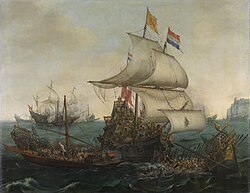
The Battle of Gibraltar, 1607
Datec. 1566/1568 – 30 January 1648
Location
European theatre (c. 1566/1568):
Result Peace of Münster
Territorial
changes
Spain recognises Dutch independence[10]
Belligerents

Spain Spanish Empire


European co-belligerent:
Habsburg monarchy Holy Roman Empire
(1629, 1632, 1635)[f]
Commanders and leaders
Units involved
Dutch States Army Army of Flanders
Strength
1629:[11]
70,000 regular soldiers
50,000 militia
8,500 sailors with 100+ warships
60,000 (average strength in the Army of Flanders)[12]
88,000 (peak strength in the Army of Flanders)

The Eighty Years' War[g] or Dutch Revolt (Dutch: Tachtigjaarige Oorlog or Nederlandse Opstand; c. 1566/1568–1648)[h] was an armed conflict in the Habsburg Netherlands[i] between disparate groups of rebels and the Spanish government. The causes of the war included the Reformation, centralisation, excessive taxation, and the rights and privileges of the Dutch nobility and cities.

After the initial stages, Philip II of Spain, the sovereign of the Netherlands, deployed his armies and regained control over most of the rebel-held territories. However, widespread mutinies in the Spanish army caused a general uprising. Under the leadership of the exiled William the Silent, the Catholic and Protestant-dominated provinces sought to establish religious peace while jointly opposing the king's regime with the Pacification of Ghent, but the general rebellion failed to sustain itself.

Despite steady military and diplomatic successes by the Governor of Spanish Netherlands and General for Spain, the Duke of Parma, the Union of Utrecht continued their resistance, proclaiming their independence through the 1581 Act of Abjuration and establishing the Calvinist-dominated Dutch Republic in 1588. In the Ten Years thereafter, the Republic (whose heartland was no longer threatened) made conquests in the north and east and received diplomatic recognition from France and England in 1596. The Dutch colonial empire emerged, which began with Dutch attacks on Portugal's overseas territories.

Facing a stalemate, the two sides agreed to a Twelve Years' Truce in 1609; when it expired in 1621, fighting resumed as part of the broader Thirty Years' War. An end was reached in 1648 with the Peace of Münster when Spain retained the Southern Netherlands and recognised the Dutch Republic as an independent country.

Background

[edit]

The origins of the Eighty Years' War are complicated, and have been a source of disputes amongst historians for centuries.[13]

The Habsburg Netherlands emerged as a result of the territorial expansion of the Burgundian State in the 14th and 15th centuries. Upon extinction of the Burgundian State in 1477/1482, these lands were inherited by the House of Habsburg, whose Charles V became both King of Spain[j] and Holy Roman Emperor. By conquering the rest of what would become the "Seventeen Provinces" during the Guelders Wars (1502–1543), and seeking to combine these disparate regions into a single political entity, Charles aspired to counter the Protestant Reformation and keep all his subjects obedient to the Catholic Church.

King Philip II of Spain, in his capacity as sovereign of Habsburg Netherlands, continued the anti-heresy and centralisation policies of his father Charles V. Resistance grew among the moderate nobility and population (both Catholic and dissenting) of the Netherlands.[k] This mood first led to peaceful protests (as from the Compromise of Nobles), but the summer of 1566 erupted in violent protests by Calvinists, known as the iconoclastic fury, or (Dutch: Beeldenstorm) across the Netherlands. The Governor of the Habsburg Netherlands, Margaret of Parma, as well as lower authorities, feared insurrection and made further concessions to the Calvinists (such as designation of churches for Calvinist worship), but in December 1566 and early 1567 the first actual battles between Calvinist rebels and Habsburg governmental forces took place, in what would become known as the Eighty Years' War.[14]

War

[edit]

Insurrection, repression, and invasion (1566–1572)

[edit]
The Beeldenstorm or Iconoclastic Fury was a more or less organised destruction of Catholic sacred objects which swept through the Habsburg Netherlands' churches in 1566. 1630 painting by Dirck van Delen

The period between the start of the Beeldenstorm in August 1566 until early 1572 (before the Capture of Brielle on 1 April 1572) contained the first events of a series that would later be known as the Eighty Years' War between the Spanish Empire and disparate groups of rebels in the Habsburg Netherlands.[l] Some of the first pitched battles and sieges between radical Calvinists and Habsburg governmental forces took place in the years 1566–1567, followed by the arrival and government takeover by Fernando Álvarez de Toledo, 3rd Duke of Alba (simply known as "Alba" or "Alva") with an army of 10,000 Spanish and Italian soldiers. Next, an ill-fated invasion by the most powerful nobleman of the Low Countries, the exiled but still-Catholic William "the Silent" of Orange, failed to inspire a general anti-government revolt. Although the war seemed over before it got underway, in the years 1569–1571, Alba's repression grew severe, and opposition against his regime mounted to new heights and became susceptible to rebellion.

Although virtually all historians place the start of the war somewhere in this period, there is no historical consensus on which exact event should be considered to have begun the war. Consequently, there is no agreement whether the war really lasted exactly eighty years. For this and other reasons, some historians have endeavoured to replace the name "Eighty Years' War" with "Dutch Revolt", but there is also no consensus either to which period the term "Dutch Revolt" should apply (be it the prelude to the war, the initial stage(s) of the war, or the entire war).[16]

Rebellion (1572–1576)

[edit]
Capture of Brielle in 1572 by Anthonie Waldorp (1862)

The period between the Capture of Brielle (1 April 1572) and the Pacification of Ghent (8 November 1576) was an early stage of the Eighty Years' War (c. 1568–1648) between the Spanish Empire and groups of rebels in the Habsburg Netherlands.

After Watergeuzen (in English known as "Sea Beggars") seized several poorly defended towns and cities in Holland and Zeeland in April 1572, the exiled stadtholder William "the Silent" of Orange launched his second invasion of the Netherlands from the east in another attempt to generate a general uprising against the repressive regime of Spanish General-Governor Fernando Álvarez de Toledo, 3rd Duke of Alba. Acting on orders of Philip II of Spain, Alba sought to exterminate all manifestations of Protestantism and disobedience through inquisition and public executions, as well as abolishing several privileges of the Netherlandish nobility and autonomy of cities, and introducing more stringent taxes.[17]

William's second invasion in 1572 had mixed results, and Alba's son Don Fadrique went on a lightning campaign to retake all towns occupied by Orangist and Geuzen troops in October 1572. Several towns (including Mechelen, Zutphen and Naarden[18]) which refused to surrender were brutally sacked by Fadrique's forces in an attempt to intimidate others into resubmitting themselves to the royal government, culminating in the seven-month-long Siege of Haarlem before it was conquered and sacked in July 1573.[18] By this point, the rebel territory had been reduced to most towns in Holland (notably excluding royalist Amsterdam) and Zeeland, and two towns in Guelders; knowing that violent repression would result from resistance, these cities resolved to fight to the bitter end, while the others capitulated. The Spanish offensive stalled after Haarlem, with the Dutch rebels capturing Geertruidenberg, winning the Siege of Alkmaar and Battle of Delft, and achieving naval superiority. Citing ill health, Alba resigned and returned to Spain in December 1573.[18]

His successor Requesens was more conciliatory,[18] but was unable to force or persuade many places back into governmental control, losing the Siege of Leiden (1573–1574).[19] After his death in March 1576, exacerbated by Spain's state bankruptcy in November 1575, mutinies amongst the unpaid Spanish soldiers started spreading into what became known as the "Spanish Fury", plundering many towns and villages even in loyal territories of the Netherlands.[20] Faced with the mutineer atrocities, particularly the Sack of Antwerp, all the provinces except Luxembourg made an alliance known as the Pacification of Ghent, rising in revolt in November 1576 to demand that Philip II withdraw all foreign troops from the Netherlands, suspend the persecution of Protestants, and consult the States-General in matters of local governance rather than rule by unilateral autocratic action.[21]

From Pacification of Ghent to Union of Utrecht (1576–1579)

[edit]
From 8 November 1576 until 23 July 1577
  Union of Brussels: the 16 rebel provinces that concluded the 1576 Pacification of Ghent, and demanded the departure of all foreign Spanish troops from the Netherlands
  Luxemburg, the only province to remain fully loyal to the Spanish government. Most Spanish troops withdrawing from the other provinces were temporarily stationed here from late 1576 to mid-1577

The period between the Pacification of Ghent (8 November 1576), and the Unions of Arras (6 January 1579) and Utrecht (23 January 1579) constituted a crucial phase of the Eighty Years' War (c. 1568–1648) between the Spanish Empire and the rebelling United Provinces, which would become the independent Dutch Republic. Sometimes known as the "general revolt", the period marked the only time of the war where the States–General of all Seventeen Provinces of the Habsburg Netherlands, except Luxemburg, were in joint active political and military rebellion against the Spanish Imperial government through the Pacification of Ghent.[1] The Pacification formulated several agreements amongst the rebellious provinces themselves, and laid down their demands – including the immediate withdrawal of foreign (mostly Spanish, Italian and German) troops from the Netherlands, restitution of old rights and privileges, and self-rule – to king Philip II of Spain.[1]

From 8 November 1576 until 23 July 1577, the new Spanish Governor-General of the Netherlands John of Austria (known to history as "Don Juan") engaged in peace negotiations with the States-General. The First Union of Brussels (9 January 1577) confirmed the Pacification, adding that the States would uphold the Catholic religion in their provinces. By signing the Edict of 1577 on 12 February 1577 at Marche-en-Famenne, Don Juan nominally accepted all demands of the Pacification.[22] Most foreign troops withdrew to the territory of Luxemburg, which had not joined the Pacification. Although a few sieges of cities with Spanish garrisons that refused to withdraw took place, these were mostly resolved quickly by paying them off; in general, the situation had potential for putting an end to the war if agreements could be reached and respected between the parties.[22]

From 24 July 1577 until 6 January 1579, starting with the capture of the Citadel of Namur, Don Juan and his second-in-command and successor Alexander Farnese, Duke of Parma launched a military offensive against the United Provinces, while seeking to reconcile provinces that were willing to subject themselves back under the Spanish royal government under certain conditions.[22] In response, the States-General's Second Union of Brussels (10 December 1577) showed a more fierce and determined opposition to the Spanish government, now demanding (and themselves guaranteeing) equal protection for Catholics and Protestants in all provinces of the Netherlands. William "the Silent" of Orange became the de facto political leader of the United Provinces, while Matthias of Austria was brought in to replace Don Juan as Governor-General.[22]

The Battle of Gembloux (31 January 1578) was a devastating defeat for the rebels, however, and many began to talk about surrender. Moreover, radical Calvinists had seized power in various cities in Flanders and Brabant, most notably the so-called Calvinist Republic of Ghent, persecuting Catholics and alienating many Catholic allies which had up until that point supported the rebellion, but now became known as the Malcontents.[22] Parma was able to successfully exert his diplomatic skills on some of these Malcontents, negotiating with several Catholic noblemen and regents in various southern provinces with promises of respecting their interests in return for abandoning the revolt.[22] Finally, the united front of the States-General collapsed on 6 January 1579 when the County of Artois, the County of Hainaut and the city of Douai signed the Union of Arras, seeking to revert to Catholicism and the Spanish government under more moderate demands than the Pacification.[23] On 17 May 1579, they signed a separate peace treaty with the king. In response, most of the other provinces and cities (virtually only in the Dutch-speaking parts of the Low Countries) sought to reaffirm their commitment to the Pacification, as well as the Second Union of Brussels, and forging an even closer political and military alliance by concluding the Union of Utrecht on 23 January 1579.[3]

Secession and reconquest (1579–1588)

[edit]
Under Parma's command, the Spanish Army reconquered large parts of the Netherlands in the 1580s.

The years 1579–1588 constituted a phase of the Eighty Years' War (c. 1568–1648) between the Spanish Empire and the United Provinces in revolt after most of them concluded the Union of Utrecht on 23 January 1579, and proceeded to carve the independent Dutch Republic out of the Habsburg Netherlands. It followed the 1576–1579 period, in which a temporary alliance of 16 out of the Seventeen Provinces' States–General established the Pacification of Ghent (8 November 1576) as a joint Catholic–Protestant rebellion against the Spanish government, but internal conflicts as well as military and diplomatic successes of the Spanish Governors-General Don Juan of Austria and Alexander Farnese, Duke of Parma split them apart, finally leading the Malcontent County of Artois, County of Hainaut and city of Douai to sign the Union of Arras on 6 January 1579, reverting to Catholicism and loyalty to the Spanish crown.[24][22][25]

In response, most of the remaining rebel provinces and cities would forge or later accede to the Union of Utrecht,[26] a closer military alliance treaty that would go on to become the most important fundamental law of the United Provinces,[27] who on 26 July 1581 proclaimed the Act of Abjuration, a de facto declaration of independence from Spain.[28] While the nascent polity was struggling to find a new sovereign head of state, including Matthias of Austria, Francis of Anjou, William "the Silent" of Orange and Robert of Leicester,[28] before giving up and deciding to become the Dutch Republic by the instruction of 12 April 1588,[8] the Duke of Parma continued his successful military and diplomatic offensive, bringing ever more provinces and cities in the southern, eastern and northeastern parts of the Netherlands back into royalist hands.[28]

Parma's reconquests more or less stalled after the Fall of Antwerp (1585),[29] and finally came to an end with the failure of the Spanish Armada (July–August 1588) and Philip II ordered him to intervene in the French Wars of Religion (September 1589) to prevent the Succession of Henry IV and France becoming a Protestant kingdom.[29] These developments gave rise to a new phase,[29] the Ten Years (1588–1598), that saw significant conquests by the Dutch States Army under the leadership of stadtholders Maurice of Nassau and William Louis of Nassau-Dillenburg, and the Dutch Republic's rise as a commercial great power.[30][31]

Ten Years (1588–1598)

[edit]
Conquests made by Maurice in his 1597 campaign
The Ten Years (Dutch: Tien jaren) were a period in the Eighty Years' War spanning the years 1588 to 1598.[32] In this period of ten years, stadtholder Maurice of Nassau, the future prince of Orange and son of William "the Silent" of Orange, and his cousin William Louis, Count of Nassau-Dillenburg and stadtholder of Friesland as well as the English general Francis Vere, were able to turn the tide of the war against the Spanish Empire in favour of the Dutch Republic. They achieved many victories over the Spanish Army of Flanders, conquering large swathes of land in the north and east of the Habsburg Netherlands that were incorporated into the Republic and remained part of the Netherlands into the present. Starting with the important fortification of Bergen op Zoom (1588), Maurice and William Louis subsequently took Breda (1590), Zutphen, Deventer, Delfzijl, and Nijmegen (1591), Steenwijk, Coevorden (1592) Geertruidenberg (1593), Groningen (1594), Grol, Enschede, Ootmarsum, and Oldenzaal (1597),[33] recovering territories lost in 1580 through the treachery of George de Lalaing. Maurice's most successful years were 1591 and 1597, in which his campaigns resulted in the capture of numerous vital fortified cities, some of which were regarded as "impregnable". His novel military tactics earned him fame amongst the courts of Europe, and the borders of the present-day Netherlands were largely defined by the campaigns of Maurice of Orange during the Ten Years.

Run-up to the Truce (1599–1609)

[edit]
Stadtholder Maurice of Nassau during the 1600 Battle of Nieuwpoort, a tactical Dutch victory for little gain
The years 1599–1609 constituted a phase in the Eighty Years' War (c. 1568–1648) between the Spanish Empire and the emerging Dutch Republic. It followed the Ten Years (1588–1598) that saw significant conquests by the Dutch States Army under the leadership of stadtholders Maurice of Nassau and William Louis of Nassau-Dillenburg, and ended with the conclusion of the Twelve Years' Truce (1609–1621) on 9 April 1609. From 1599 to 1609 the conflict largely settled into a stalemate. The Battle of Nieuwpoort (1600) yielded a Dutch tactical victory without durable strategic gains. Spain recorded successes at the Siege of Ostend (1601–1604) and during Spinola’s 1605–1606 campaign [nl], while the Dutch won a naval victory at the Battle of Gibraltar (1607); Spain also went bankrupt that year, and had to suspend payments of its troops in the Low Countries. Financial pressures were among the factors that led both sides, especially Spain, to pursue a ceasefire.[34]

Twelve Years' Truce (1609–1621)

[edit]
The Synod of Dort.

The military upkeep and decreased trade had put both Spain and the Dutch Republic under financial strain. To alleviate conditions, a ceasefire was signed in Antwerp on 9 April 1609, marking the end of the Dutch Revolt and the beginning of the Twelve Years' Truce. The conclusion of this Truce was a major diplomatic coup for Holland's advocate Johan van Oldenbarnevelt, as Spain by concluding the Treaty, formally recognised the independence of the Republic.[35] In Spain the truce was seen as a major humiliation – she had suffered a political, military and ideological defeat, and the affront to its prestige was immense.[36] The closure of the river Scheldt to traffic in and out of Antwerp, and the acceptance of Dutch commercial operations in the Spanish and Portuguese colonial maritime lanes were just a few points that the Spanish found objectionable.[37]

Although there was peace on an international level, political unrest took hold of Dutch domestic affairs. What had started as a theological quarrel resulted in riots between Remonstrants (Arminians) and Counter-Remonstrants (Gomarists). In general, regents would support the former and civilians the latter. Even the government got involved, with Oldenbarnevelt taking the side of the Remonstrants and stadtholder Maurice of Nassau their opponents. In the end, the Synod of Dort condemned the Remonstrants for heresy and excommunicated them from the national Public Church. Van Oldenbarnevelt was sentenced to death, together with his ally Gilles van Ledenberg, while two other Remonstrant allies, Rombout Hogerbeets and Hugo Grotius received life imprisonment.[38]

Final phase of the war (1621–1648)

[edit]
The Low Countries in 1621–1628
  Dutch conquests
  Spanish conquests

The years 1621–1648 constituted the final phase of the Eighty Years' War (c. 1568–1648) between the Spanish Empire and the emerging Dutch Republic. It began when the Twelve Years' Truce (1609–1621) expired, and concluded with the Peace of Münster in 1648.

Although the Dutch and Spanish were both involved in opposite sides of the War of the Jülich Succession (June 1609 – October 1610; May–October 1614) in Jülich-Cleves-Berg, they carefully avoided each other, and thus the hostilities never spread back into the Habsburg Netherlands, and the truce held firm.[39] Nevertheless, attempts to negotiate a definitive peace also failed, and the war resumed as anticipated in 1621.[40] Essentially, it became a side theatre of the wider Thirty Years' War that had already broken out with the Bohemian Revolt in 1618 in eastern parts of the Holy Roman Empire (Bohemia and Austria), pitting Central Europe's Protestant Union against the Catholic League, although the two conflicts never fully merged.[41] With several back and forths – notably, the Spanish conquered Breda in 1625, but the Dutch took it back in 1637[41] – the Dutch Republic was able to conquer the eastern border forts of Oldenzaal (1626) and Groenlo (1627), the major Brabantian city of 's-Hertogenbosch (1629), the fortified cities of Venlo, Roermond and Maastricht along the Meuse (1632), and Sas van Gent (1644) and Hulst (1645) in Zeelandic Flanders.[41]

Nevertheless, peace talks in 1629–1630 came to nothing. More ambitious plans to conquer Brussels in 1632–1633 with the help of anti-Spanish nobility in the Southern Netherlands never came to fruition. Several attempted Northern republican surprises and sieges of Antwerp were parried by the Spanish Army of Flanders.[42]

Nor did the Franco-Dutch alliance bring significant changes to the situation on the ground. It began with a disastrous Franco-Dutch invasion of the southern Netherlands in 1635. This in fact made matters worse for the Dutch when French and Dutch troops sacked the city of Tienen, which cost them the sympathies of the southern Netherlands population.[43]

However, French intervention and internal discontent at the costs of the war in the Low Countries led to a change in Spain's 'Netherlands First' policy. Instead Spain focused on suppressing the French-backed Reapers' War in Catalonia.[44] The resulting stalemate and financial troubles, plus Spanish military exhaustion and Dutch desire for formal political recognition, eventually convinced both sides in the mid-1640s to hold peace talks.[42]

The outcome was the 1648 Peace of Münster, which confirmed most agreements already reached with the Truce of 1609.[45]

Peace of Münster

[edit]
Swearing of the Peace of Münster by Gerard ter Borch
The Celebration of the Peace of Münster (1648) by Bartholomeus van der Helst

The negotiations between Spain and the Republic formally started in January 1646 as part of the more general peace negotiations between the warring parties in the Thirty Years' War. The States General sent eight delegates from several of the provinces as none trusted the others to represent them adequately. They were Willem van Ripperda (Overijssel), Frans van Donia (Friesland), Adriaen Clant tot Stedum (Groningen), Adriaan Pauw and Jan van Mathenesse (Holland), Barthold van Gent (Gelderland), Johan de Knuyt (Zeeland) and Godert van Reede (Utrecht). The Spanish delegation was led by Gaspar de Bracamonte, 3rd Count of Peñaranda. The negotiations were held in what is now the Haus der Niederlande in Münster.

The Dutch and Spanish delegations soon reached an agreement, based on the text of the Twelve Years' Truce. It therefore confirmed Spain's recognition of Dutch independence. The Dutch demands (closure of the Scheldt, cession of the Meierij, formal cession of Dutch conquests in the Indies and Americas, and lifting of the Spanish embargoes) were generally met. However, the general negotiations between the main parties dragged on, because France kept formulating new demands. Eventually it was decided therefore to split off the peace between the Republic and Spain from the general peace negotiations. This enabled the two parties to conclude what technically was a separate peace (to the annoyance of France, which maintained that this contravened the alliance treaty of 1635 with the Republic).[46]

The text of the Treaty (in 79 articles) was fixed on 30 January 1648. It was then sent to the principals (King Philip IV of Spain and the States General) for ratification. Five provinces voted to ratify (against the advice of stadtholder William) on 4 April (Zeeland and Utrecht being opposed). Utrecht finally yielded to pressure by the other provinces, but Zeeland held out and refused to sign. It was eventually decided to ratify the peace without Zeeland's consent. The delegates to the peace conference affirmed the peace on oath on 15 May 1648 (though the delegate of Zeeland refused to attend, and the delegate of Utrecht suffered a possibly diplomatic illness).[47]

In the broader context of the treaties between France and the Holy Roman Empire, and Sweden and the Holy Roman Empire of 14 and 24 October 1648, which comprise the Peace of Westphalia, but which were not signed by the Republic, the Republic now also gained formal "independence" from the Holy Roman Empire, just like the Swiss Cantons. In both cases this was just a formalisation of a situation that had already existed for a long time. France and Spain did not conclude a treaty and so remained at war until the peace of the Pyrenees of 1659. The peace was celebrated in the Republic with sumptuous festivities. It was solemnly promulgated on the 80th anniversary of the execution of the Counts of Egmont and Horne on 5 June 1648.[m]

Aftermath

[edit]
The aftermath of the Eighty Years' War (c. 1568–1648) had far-reaching military, political, socio-economic, religious, and cultural effects on the Low Countries, the Spanish Empire, the Holy Roman Empire, as well as other regions of Europe and European colonies overseas. By the Peace of Münster (15 May 1648), the Habsburg Netherlands were split in two, with the northern Protestant-dominated Netherlands becoming the Dutch Republic, independent of the Spanish and Holy Roman Empires, while the southern Catholic-dominated Spanish Netherlands remained under Spanish Habsburg sovereignty. Whereas the Spanish Empire and the Southern Netherlands along with it were financially and demographically ruined, declining politically and economically, the Dutch Republic became a global commercial power and achieved a high level of prosperity for its upper and middle classes known as the Dutch Golden Age, despite continued great socio-economic, geographic and religious inequalities and problems, as well as internal and external political, military and religious conflicts.[49][50]

Historiography

[edit]

The Eighty Years' War has given rise to more historical controversies than any other topic from the history of the Nederlanden [Low Countries] whatsoever.

Encarta Encyclopedie Winkler Prins (2002)[51]
The historiography of the Eighty Years' War examines how the Eighty Years' War has been viewed or interpreted throughout the centuries. Some of the main issues of contention between scholars include the name of the war (most notably "Eighty Years' War" versus "Dutch Revolt"[51]), the periodisation of the war (particularly when it started, which events to include or exclude, and whether the effective length of the war justifies counting "eighty years" or not[51]), the origins or causes of the war (the Protestant Reformation or the violation of the rights and privileges of the nobility and autonomous cities[51]) and thus its nature (a religious war, a civil war or a war of independence[51]), the meaning of its historical documents such as the Act of Abjuration, and the role of its central characters such as Philip II of Spain, William "the Silent" of Orange, Margaret of Parma, the Duke of Alba, the Duke of Parma, Maurice of Orange, and Johan van Oldenbarnevelt. It has been theorised that Protestant Reformation propaganda has given rise to the Spanish Black Legend in order to portray the actions of the Spanish Empire, the Army of Flanders and the Catholic Church in an exaggerated extremely negative light, while other scholars maintain that the atrocities committed by the Spanish military in order to preserve the Habsburg Netherlands for the Empire have historically been portrayed fairly accurately. Controversy also rages about the importance of the war for the emergence of the Dutch Republic as the predecessor of the current Kingdom of the Netherlands and the role of the House of Orange's stadtholders in it, as well as the development of Dutch and Belgian national identities as a result of the split of the Northern and Southern Netherlands.[51]
[edit]

See also

[edit]

Notes

[edit]

References

[edit]

Bibliography

[edit]

Further reading

[edit]
[edit]
Revisions and contributorsEdit on WikipediaRead on Wikipedia
from Grokipedia
The Eighty Years' War (1568–1648), also known as the Dutch Revolt or Dutch War of Independence, was a rebellion by the provinces of the against the Spanish , primarily led by (William of Orange) against King Philip II's policies of religious persecution, heavy taxation, and political centralization. This conflict arose from the Protestant Reformation's spread in the region, clashing with Spain's enforcement of Catholicism via the and Duke of Alba's Council of Troubles, which executed nobles like the Counts of Egmont and . The war unfolded in phases, including initial uprisings such as the 1566 Iconoclastic Fury, the formation of the in 1579 uniting the northern provinces, and a (1609–1621) that temporarily halted hostilities before resumption amid Spain's involvement in the . Key military developments featured Dutch naval prowess, exemplified by victories like the Battle of Gibraltar in 1607, and the eventual exhaustion of Spanish resources, paving the way for the 1581 declaring independence from Philip II. It concluded with the (1648), part of the , wherein recognized the sovereignty of the Republic of the Seven United Netherlands in the north, while the southern provinces remained under Spanish control, marking the de facto end of Spanish dominance in the region and the rise of the of commerce and culture. The conflict's legacy includes the establishment of modern notions of in the and a precedent for successful peripheral rebellions against imperial overreach.

Causes and Preconditions

Political and Institutional Framework of the

The encompassed the , a patchwork of duchies, counties, and lordships inherited by the Habsburg dynasty following the marriage of I to in 1477, with effective control passing to their grandson Charles V (son of their son Philip the Handsome) upon his assumption of rule in 1506. Charles V, born in in 1500, pursued administrative unification through the Transaction of on 26 June 1548, which detached the provinces from jurisdiction and designated them as a hereditary Habsburg possession, complemented by the of 1549 to ensure indivisible inheritance. This framework preserved a where the sovereign held titles such as , , and Lord of , but provincial privileges—codified in charters like Brabant's Joyeuse Entrée of 1356—limited royal authority by requiring consent for taxation and upholding local customs. Governance operated through a dual structure of central and provincial institutions, with the sovereign exercising power via appointed regents resident in or . Central bodies included the for policy advice, the for high-level administration, and the Great Council of as the supreme judicial authority, re-established by Philip the Handsome in 1504 to standardize appeals across provinces. Regents, such as Margaret of Austria (1507–1530), Mary of Hungary (1531–1555), and later (1559–1567) under Philip II, coordinated these councils while provincial stadtholders—nobles like William of Orange in , , and —handled military, judicial, and fiscal enforcement locally. The States General, convened irregularly by the sovereign for extraordinary subsidies or war declarations, comprised delegates from provincial estates but lacked executive power, serving primarily as a forum for rather than legislation. At the provincial level, power was decentralized, with estates assemblies—comprising clergy, nobility, and urban representatives—dominating fiscal decisions, as towns in and Brabant often controlled voting and resisted central impositions. In , for instance, the States of Holland functioned as a corporate body negotiating with Habsburg officials, where urban delegates from cities like and prioritized trade interests over dynastic demands, supported by a sparse central of roughly 1.5 sovereign-appointed officials per 1,000 inhabitants. Charles V's centralization initiatives, including the 1543 annexation of Guelders and the creation of the in 1512 (significantly enlarged in 1548), aimed to erode feudal fragmentation but encountered resistance, as provinces jealously guarded exemptions from imperial diets and foreign troops. Under Philip II, who inherited the provinces in 1555 alongside his Spanish realms, absentee rule intensified tensions, with regents reliant on Spanish councillors and edicts like the 1559-1560 reorganization bypassing provincial input, straining the balance between and .

Religious Schisms and the Spread of Protestantism

The Protestant Reformation reached the shortly after Martin Luther's in 1517, with Lutheran ideas circulating by 1521 through trade networks, printed pamphlets, and contacts with German reformers. Initial adherents were primarily among urban artisans, merchants, and intellectuals in cities like and , drawn to critiques of clerical corruption and indulgences, though open propagation remained limited due to Habsburg enforcement of Catholic orthodoxy. Anabaptist radicals, inspired by figures like , emerged around 1530, advocating adult baptism and pacifism under leaders such as , but their communal experiments provoked severe backlash. Under Charles V, who ruled the from 1515 to 1556, heresy placards issued from the 1520s mandated death penalties for disseminating Protestant texts or holding unorthodox services, resulting in the execution of the first known Lutheran in in 1525 and subsequent inquisitorial tribunals. The 1550 Edict of Blood targeted Anabaptists and other sects with summary executions—sword for men, burial alive for women—amid fears of social upheaval, leading to thousands fleeing to Protestant-friendly regions in and . Despite repression, Calvinist doctrines, introduced via French Huguenot refugees in the 1540s, gained traction in Walloon areas and northern ports by the 1550s, appealing to the mercantile class through emphasis on , , and resistance to centralized papal authority. Underground "hedge preachings" and clandestine consistories formed, with the Confessio Belgica drafted by Guy de Brès in articulating a distinctly Reformed confession. Philip II's accession in 1556 escalated enforcement via the 1556 Edict, which reaffirmed prior bans and expanded inquisitorial powers, framing as a threat to monarchical and divine order. This period saw intensified executions, with estimates of over 1,000 heretics burned or beheaded between 1523 and 1566, fostering resentment among nobles and burghers who viewed the as an imported Spanish tool eroding local privileges. Religious schisms deepened divides: Calvinists, organized into synods by the mid-1560s, clashed with residual Lutherans and Anabaptists over views and governance, while Catholic loyalty held stronger in rural south and among elites. By 1566, swelling Protestant sympathizers—perhaps numbering in the tens of thousands amid a of about 3 million—demanded suspension of heresy laws, culminating in the Iconoclastic Fury, where mobs destroyed church images across and Brabant, signaling the fusion of doctrinal dissent with political revolt.

Fiscal Exploitation and Centralizing Reforms under Philip II

Philip II's accession to the throne of the in 1555 marked a shift toward intensified centralization, as he sought to assert greater royal control over the ' disparate institutions and privileges. Unlike his father Charles V, who had respected local customs due to his Burgundian roots, Philip, ruling from , prioritized uniformity in administration and religious policy, appointing Spanish-born officials to councils such as the and reducing the advisory role of native nobility. This included reliance on figures like Cardinal Granvelle, whose influence from 1560 onward sidelined traditional provincial estates in decision-making, fostering resentment among elites who viewed such appointments as an erosion of their advisory prerogatives. A key element of these reforms was the 1559 ecclesiastical reorganization, enacted via papal bulls Super universas and Pastoralis officii, which established three archdioceses (Mechlin, , ) and fourteen new bishoprics to replace the previous three, aiming to bolster Catholic orthodoxy amid rising . Bishops were to be nominated by the king rather than elected by chapters, centralizing appointments under royal authority and aligning the church hierarchy more closely with Habsburg interests; funding for the new sees was partly drawn from secular revenues, further intertwining state and religious control. These changes, justified as countermeasures to heresy edicts' enforcement failures, were criticized by local and nobles for infringing on ancient immunities and increasing fiscal burdens through tithe reallocations. Concurrently, Philip's fiscal policies imposed heavy demands on the provinces to service empire-wide debts from conflicts like the 1555-1559 Habsburg-Valois War, with total crown indebtedness reaching about 29 million ducats by 1560. The States-General had approved a nine-year in 1558, yielding roughly 400,000 guilders annually from alone, but this proved insufficient; by 1565-1566, Philip instructed Regent to secure permanent levies, including a 1% on (quohundredesima), a 0.5-2% impost on , and a 10% dubbed the "tenth penny" (tiende penning), to be administered centrally without recurrent provincial ratification. These proposals, intended to fund ongoing military needs including garrisons in the , doubled prior levels in some estimates and bypassed customary estate approvals, prompting fierce opposition from urban magistrates and rural assemblies who argued they violated the Joyous Entry privileges and exacerbated trade disruptions from existing excises (aides) on necessities like meat and beer. The interplay of these reforms amplified perceptions of exploitation, as centralization curtailed provincial fiscal —provinces traditionally controlled and collection—while revenues flowed primarily to Spanish treasuries for distant campaigns against and the Ottomans, yielding minimal local security benefits. Resistance manifested in the States of Holland's 1566 refusal to endorse the tenth penny without Philip's personal ratification, highlighting causal tensions between absolutist imperatives and entrenched ; economic data from the period indicate Netherlands contributions comprised up to 10-15% of Habsburg income despite representing a fraction of the empire's .

Outbreak and Initial Suppression (1566–1572)

The Nobles' Compromise and Iconoclastic Riots

On April 5, 1566, a confederation of approximately 400 lower nobles from the , organized as the Compromise of Nobles and led by Hendrik van Brederode, presented a petition to Governor in , requesting the suspension of Philip II's anti-heresy edicts and the Inquisition's enforcement, which they argued imposed undue spiritual and temporal burdens on loyal subjects. The document, drafted in Dutch and French, emphasized fidelity to the Spanish crown while decrying the edicts' violation of ancient privileges and the impracticality of suppressing widespread Protestant sympathies amid economic strains from war taxes. Margaret, initially alarmed by the petitioners' numbers—mocked by her advisor Berlaymont as "beggars" ()—consulted Philip II and temporarily halted heresy prosecutions on April 14 to avert immediate escalation, though she rejected full edict suspension. This concession, perceived as weakness, encouraged unauthorized Calvinist "hedge preaching" in open fields across and Brabant during the summer, drawing thousands and fostering anti-Catholic sentiment among artisans, merchants, and disaffected urban crowds frustrated by Philip's centralizing absolutism. By late August, tensions erupted into the Iconoclastic Fury (), a wave of Calvinist-led vandalism beginning on August 10 in Steenvoorde, , where rioters smashed statues, altars, and religious artwork in St. Martin's Church, viewing them as idolatrous. The destruction spread rapidly southward and eastward, affecting over 400 churches and monasteries by mid-September, with major outbreaks in (August 22–23, where mobs demolished icons in the cathedral and dozens of other sites), , , and 's-Hertogenbosch; participants, often organized in groups of 50–200, targeted perceived symbols of Catholic "superstition" while sparing some artworks deemed non-offensive. Margaret of Parma, lacking sufficient troops, issued amnesties and further suspensions of edicts on August 29 to quell the riots, but the violence exposed the fragility of Habsburg control, radicalized moderate nobles, and prompted Philip II to dispatch the with 10,000 veteran soldiers in October 1567 to restore order through repression. The events, driven by doctrinal zeal rather than coordinated rebellion, nonetheless marked a causal tipping point: the Compromise's legalistic protest evolved into physical defiance, undermining the regime's religious monopoly and galvanizing underground Protestant networks that sustained the ensuing revolt.

Duke of Alba's Council of Troubles and Repression

In response to the Iconoclastic Fury of 1566 and the perceived threat of rebellion, dispatched Fernando Álvarez de Toledo, 3rd , to the in 1567 with an army of approximately 10,000 troops to restore order, suppress , and punish participants in the unrest. Alba arrived in on 22 August 1567 and quickly moved to centralize authority, sidelining the regent . On 5 September 1567, he established the Council of Troubles (Raad van Beroerten), a special tribunal empowered to investigate and prosecute crimes of , , and lèse-majesté without to higher courts, effectively bypassing the traditional provincial councils and privileging royal absolutism over local customs. The council, initially comprising seven Spanish members and later augmented by some Netherlanders, operated under Alba's direct oversight and became notorious for its summary procedures, reliance on for confessions, and issuance of judgments in absentia. The council's proceedings targeted nobles, clergy, and commoners alike, with accusations often based on participation in the Compromise of Nobles or tolerance of Protestant worship. Notable among its victims were Catholic moderates, including the counts of Egmont and , arrested in 1567 for their roles in opposing the but deemed insufficiently vigilant against it; they were tried for treason and beheaded in on 5 1568, an event that shocked the nobility and galvanized opposition. On 1 1568, the council ordered the simultaneous execution of 22 other noblemen in , underscoring its efficiency in mass sentencing. Proceedings continued vigorously, condemning around 9,000 to 12,000 individuals by 1573, though many sentences were for fines, , or property confiscation rather than death. Historical estimates place actual executions at approximately 1,000 to 1,100, with claims of higher figures (such as Alba's reported 18,000 or Requesens's 6,000) likely inflated by including battle deaths or unverified denunciations; thousands more, perhaps up to 60,000, fled into to evade prosecution. Beyond judicial repression, Alba's regime imposed fiscal measures to fund ongoing operations, including the "hundredth penny" tax in 1569, escalated to the "twentieth penny" on real estate, and culminating in the "tenth penny" (a 10% sales tax) proposed in 1571, which paralyzed trade and provoked widespread resentment even among loyalists by infringing on chartered privileges. Military repression complemented the council's work, with Alba's forces razing rebellious towns like Naarden (November 1572) and conducting punitive campaigns that involved plunder and massacres, though these peaked after the council's most active phase. The council's dissolution followed Alba's recall in December 1573, with formal abolition in 1574 under Luis de Requesens, but its legacy of perceived Spanish overreach—earning it the moniker "Council of Blood" among Netherlanders—intensified alienation, emigration of skilled artisans, and the revolt's expansion, as moderate Catholics joined William of Orange's cause against what they viewed as tyrannical centralization. While effective in temporarily quelling open revolt by 1568, the repression's causal role in radicalizing the population stemmed from its disregard for local legal traditions and disproportionate targeting of elites, fostering a narrative of Habsburg oppression that propaganda amplified, though contemporary defenses argued it curbed anarchy proportionate to the threat.

William of Orange's First Campaigns and Exile

Following his flight to in the in April 1567 to evade the Duke of Alba's Council of Troubles, William of Orange began organizing armed resistance against Spanish authority in the . In early 1568, he financed and directed his brother Louis of Nassau to lead an invasion force of approximately 4,000 men into the northern provinces, aiming to exploit local discontent and rally support against Habsburg rule. Louis's campaign achieved an initial success at the Battle of Heiligerlee on May 23, 1568, where Dutch and German troops defeated a smaller Spanish force under Count Floris van den Bergh, killing him and capturing the town briefly; however, William's younger brother Adolf was among the casualties. Alba responded swiftly, defeating Louis's enlarged army of about 10,000 at the Battle of Jemmingen on July 21, 1568, where Spanish forces under Fadrique Álvarez de Toledo massacred up to 7,000 rebels in a rout, though Louis escaped. Concurrently, assembled a larger of 20,000 to 30,000 German troops for a southern invasion from the , crossing into Brabant in October 1568 with the goal of linking up with sympathizers and challenging Alba directly. The effort collapsed due to unpaid wages, leading to widespread and among the largely Protestant force unwilling to fight Alba's German auxiliaries; William retreated without engaging in major combat, disbanding the near the German border. These failures left William financially strained and without territorial gains, forcing him into prolonged exile in Dillenburg and other Nassau territories in the Holy Roman Empire, where he shifted to propaganda efforts, including pamphlets decrying Spanish "tyranny" and appeals for Protestant support across Europe. From this base, he issued privateer commissions to the Sea Beggars in 1569, authorizing maritime raids to harass Spanish shipping and sustain the rebellion indirectly, while avoiding personal return to the Netherlands until 1572. Alba's regime, meanwhile, intensified executions through the Council of Troubles, sentencing over 1,000 in absentia, including William, whose properties were confiscated.

Expansion of Rebellion and Internal Fractures (1572–1579)

Sea Beggars' Capture of Brielle and Northern Uprisings

On March 25, 1572, English authorities, under diplomatic pressure from , ordered the expulsion of the Sea Beggars—Dutch Protestant privateers operating against Spanish shipping—from ports including Dover and . The fleet, consisting of approximately 26 ships under commanders William Bloys van Treslong and Admiral William de la Marck (known as Lumey), initially headed toward but encountered a severe storm that forced a course change toward the Dutch coast. Anchoring off (also known as Brill), a strategically located seaport at the mouth of the Maas River in with a lightly defended Spanish garrison of around 300–400 troops under an ailing commander, the Sea Beggars decided to seize the town in the name of William of Orange, the exiled Dutch noble leading the opposition from . On April 1, 1572, roughly 600 Sea Beggars landed and overwhelmed the defenses after townsfolk, fearing plunder, largely fled with their valuables, marking the first permanent rebel foothold on land since the revolt's initial suppression. A Spanish counterattack on was repelled when local rebel Rochus Meeuwisz. opened sluices to flood the approaches, securing the position. The capture ignited widespread uprisings across northern provinces, particularly in Zeeland and Holland, where anti-Spanish sentiment had simmered amid religious persecution and heavy taxation. Inspired by Brielle's success, Zeeland towns like Vlissingen (Flushing) revolted on April 3, followed by Middelburg's siege later that year, while in Holland, Dordrecht joined on April 22, with rapid defections in Gouda, Leiden, Haarlem, and others by late April. By July 1572, rebels controlled most of Holland and Zeeland except royalist strongholds like Amsterdam and Naarden, providing William of Orange bases to launch land campaigns from Germany and shifting the revolt from scattered guerrilla actions to coordinated provincial resistance. These northern gains contrasted with southern loyalty to Spain, fracturing the Habsburg Netherlands along regional lines.

Spanish Fury and the Pacification of Ghent

The of Flanders, strained by Philip II's repeated financial bankruptcies and inability to remit pay since early 1575, descended into widespread by mid-1576. Soldiers, including elite tercios units, seized fortresses and cities to enforce payment through plunder, with arrears totaling millions of ducats amid Spain's wartime overextension. This indiscipline peaked in October 1576 when mutineers under Governor Sancho d'Ávila, numbering around 4,000 infantry and 800 cavalry, targeted —a wealthy, partially rebel-sympathizing commercial hub guarded by some 9,000 civic and provincial defenders. On November 4, 1576, the mutineers stormed Antwerp's defenses after a brief , initiating a three-day sack known as the Spanish Fury. Troops systematically looted homes, warehouses, and the , committing massacres, rapes, and that razed over 1,000 buildings and temporarily halted the city's economic preeminence. Contemporary estimates of civilian deaths varied widely, with Antwerp's States-General reporting up to 18,000 fatalities, a local burgher citing 7,000, and later historians converging on 7,000–8,000 killed amid the chaos. The atrocities, unmitigated by Spanish command due to the mutiny's autonomy, alienated even loyalist Catholics by underscoring the destructive presence of foreign mercenaries. The sack's horror galvanized opposition across the , bridging Protestant rebels and Catholic provinces in revulsion against Spanish troops. Four days later, on November 8, 1576, delegates from all convened in and ratified the , a provisional alliance to expel the Spanish Army of Flanders and restore order. The treaty's core articles demanded the immediate withdrawal of all Spanish and other foreign soldiers, the reinstatement of Habsburg-era privileges (joyeuses entrées and urban charters), and joint provincial governance via the States General pending a mutually acceptable governor—initially floated as Don John of Austria. Religious disputes were suspended to preserve unity, prohibiting Calvinist or Catholic inquisitions until resolution, though this truce masked deepening confessional rifts. Signatories, including Flemish and Brabantine loyalists alongside and rebels, committed to mutual defense against Spanish reconquest, effectively sidelining Philip II's authority and empowering William of Orange as de facto leader. While the Pacification unified the provinces long enough to besiege and disband mutinous garrisons—culminating in the Spanish evacuation by early 1577—it proved fragile. Southern Catholic provinces prioritized troop removal over permanent rebellion, sowing seeds for later splits like the 1579 Union of Arras, as religious pragmatism yielded to doctrinal intransigence. Nonetheless, it marked a pivotal escalation in the revolt, transforming localized uprisings into a collective bid for .

Divisions: Union of Utrecht versus Union of Arras

The deepening religious and political fissures within the rebel provinces, following the Pacification of Ghent in 1576, culminated in the formation of two opposing alliances in early 1579. Southern provinces, predominantly Catholic and weary of Calvinist iconoclasm and radicalism, prioritized reconciliation with Philip II of Spain under the governorship of Alexander Farnese, Duke of Parma, who assumed command in late 1578. On 6 January 1579, representatives from the provinces of Artois, Hainaut, and the Cambrésis (including the city of Douai), along with several Flemish cities, signed the Union of Arras. This pact affirmed loyalty to the Spanish monarch, demanded the withdrawal of Spanish troops, and insisted on the restoration of Catholicism as the sole public religion, while rejecting Protestant worship and seeking to preserve provincial privileges against centralization. In direct counterpoint, the northern provinces—, , and , with partial adherence from and , and later —responded by negotiating the , initially drafted on 23 1579 and progressively ratified through the year. Orchestrated by William of Orange and delegates including John VI, Count of Nassau, the treaty established a defensive league for mutual aid against external threats, particularly Spanish forces, while upholding the sovereignty of each province and eschewing any supranational authority. Critically, Article 13 enshrined a policy of religious toleration, prohibiting persecution for conscience and allowing private worship, though in practice, gained dominance in the north amid ongoing resistance to Habsburg rule. These unions formalized an irreconcilable divide: the Arras signatories, numbering about four provinces and oriented toward compromise, negotiated the Treaty of Arras on 17 May 1579 with Farnese, securing amnesties, troop withdrawals, and Catholic exclusivity in exchange for renewed allegiance to , which facilitated Parma's subsequent reconquests in the south. Conversely, the Utrecht alliance, expanding to seven provinces by , rejected monarchical reconciliation and laid the constitutional groundwork for the de facto independent United Provinces, prioritizing sustained rebellion and inter-provincial coordination despite internal Calvinist pressures that alienated moderate elements. The schism dissolved the fragile unity of , enabling Spanish forces to exploit the split and reconquer Walloon territories, while entrenching the north's trajectory toward sovereignty amid protracted warfare.

Contested Independence and Stalemate (1579–1609)

Alexander Farnese's Reconquests in the South

Alexander Farnese, Duke of Parma, assumed the role of governor-general of the Spanish Netherlands following the death of Don John of Austria on 1 October 1578, inheriting a fragmented territory amid ongoing rebellion. He promptly launched a systematic reconquest of the southern provinces, employing a dual strategy of targeted military operations and negotiated reconciliations to exploit religious and regional divisions among the rebels. This approach contrasted with prior Spanish repression, emphasizing capitulation treaties that offered clemency, restoration of urban privileges, and delayed enforcement of religious uniformity to secure voluntary submissions. Farnese's early efforts focused on securing Walloon territories through diplomacy, culminating in the Union of Arras on 17 May 1579, whereby four southern provinces (Hainaut, , , and part of Tournaisis) pledged loyalty to Philip II while rejecting Calvinist extremism and northern radicalism. Military advances followed, including the and capture of from June to October 1579, which neutralized a key rebel stronghold and demonstrated his tactical proficiency in siege warfare. By 1581, he had initiated in and , incorporating these cities via negotiated surrenders that preserved local governance structures. In 1583–1584, Farnese accelerated reconquests along the Flemish coast and interior, capturing in 1583 and then swiftly taking in April 1584, in May, and in September after a brief . These operations relied on fortified camps, riverine blockades, and Walloon auxiliaries to isolate rebel forces, resulting in the reincorporation of over 70 towns and cities by mid-decade through a mix of assault and attrition. The campaign's pinnacle was the of , begun in September 1584, where Farnese constructed a 2-kilometer of boats across the River to sever supply lines, enduring counterattacks including explosive vessels deployed by the defenders. capitulated on 17 August 1585 after 13 months, with terms allowing Protestant emigration but mandating Catholic restoration, marking the effective recovery of the urban south. By 1585, Farnese's reconquests had stabilized Spanish control over the , transforming the conflict into a partition: the Catholic south reconciled under Habsburg rule, while northern resistance persisted. His forces, numbering around 60,000 at peak mobilization including mercenaries, inflicted heavy casualties on divided rebel armies, whose internal fractures—exacerbated by the assassination of William of Orange in July 1584—prevented effective coordination. This phase halted further northern incursions but strained Spanish finances, as ongoing garrisons and fortifications diverted resources from broader European commitments.

Maurice of Nassau's Military Reforms and Counteroffensives

Maurice of Nassau, appointed captain-general of the Dutch army in 1590, implemented reforms to transform the rebel forces into a disciplined standing army capable of sustained operations against the Spanish. He prioritized regular pay to curb mutinies prevalent among mercenaries, maintained troops year-round rather than discharging them seasonally, and restructured units into battalions of about 550 men, with 250 pikemen and 300 shot to emphasize firepower. These changes drew on classical influences, including Roman tactics revived through advisors like Justus Lipsius, and incorporated engineering improvements from Simon Stevin for logistics and fortifications. Central to the reforms was the introduction of standardized drill, termed the "Dutch Discipline," which trained soldiers in precise maneuvers, uniform equipment such as standardized pike lengths and firearm calibers, and tactical innovations like the countermarch for sustained . This technique, developed around 1594 and allowing rear ranks to reload while front ranks fired, was inspired by ancient texts like those of Aelian and detailed in Jacob de Gheyn's 1607 manual Wapenhandelinghe with 116 instructional plates. The reforms reduced reliance on large, unwieldy tercios, favoring smaller, more mobile formations that integrated , , and artillery effectively, enabling the Dutch to conduct 29 sieges and win two pitched battles over two decades. These innovations underpinned Maurice's counteroffensives from 1590 onward, shifting the war from stalemate to Dutch gains in the northern and eastern provinces. In 1590, he captured after a short using a disguised peat barge to infiltrate troops, establishing a base for further operations. The 1591 campaign secured in June, in October, and in November, reclaiming and from Spanish control through methodical sieges leveraging improved engineering and firepower. The 1597 offensive, known as part of the "Ten Glory Years," targeted eastern strongholds, capturing , Groenlo, Bredevoort, and Lingen by November 27, exploiting Spanish distractions in . Maurice's only major field engagement, the Battle of Nieuport on July 2, 1600, demonstrated reformed tactics as 12,000 Dutch troops, including English auxiliaries, defeated 18,000 Spaniards under Archduke Albert using and coordinated advances amid dunes, though strategic gains were limited due to logistical strains. These successes halted Spanish reconquests, fortified Dutch borders, and validated Maurice's emphasis on professionalization and .

Economic Attrition and the Twelve Years' Truce

By the early 1600s, the prolonged conflict had imposed severe economic burdens on both combatants, with Spain facing recurrent financial crises exacerbated by the costs of sustaining the . The Spanish under Philip III declared state bankruptcy in 1607, amid mounting debts from military expenditures estimated at over 20 million ducats annually for the Netherlands campaigns alone, compounded by disruptions to transatlantic silver convoys from Dutch privateering. These fiscal strains were intensified by the need to finance multiple fronts, including the aftermath of the Anglo-Spanish War, rendering continued aggression unsustainable without respite. The , while also taxed heavily— with provincial debt in reaching 150 million guilders by 1607—benefited from resilient maritime trade and innovative mechanisms that lowered borrowing costs over time. Dutch privateers, operating under letters of marque, captured Spanish and shipping valued at tens of millions of guilders, including significant interceptions of silver fleets, which funded rebel operations and eroded Spain's liquidity. Trade networks expanded northward to the Baltic and eastward via the (VOC), founded in 1602, generating revenues that offset war costs and positioned as a burgeoning entrepôt, even as southern reconquests limited access to traditional Flemish markets. This economic divergence—Spain's attrition through debt defaults and convoy losses versus the Republic's adaptation via commerce and predation—culminated in mutual exhaustion, prompting negotiations for a . The , formally agreed on 9 April 1609 in , halted hostilities for twelve years, driven primarily by Spanish overtures from , who advocated armistice to alleviate treasury pressures after his 1607-1608 campaigns stalled. Terms included a mutual cessation of arms, lifting of Spanish trade embargoes allowing Dutch merchants unrestricted access to ports outside the Indies, and recognition of the Republic's sovereignty without formal independence, preserving Habsburg claims for future leverage. For the Dutch, States General advocate championed the truce to secure commercial gains and avert domestic fiscal collapse, though it sowed religious tensions between Arminians and Counter-Remonstrants. Spain utilized the interval to reorganize finances under the Duke of Lerma's regency, while the Republic's shipping costs plummeted post-embargo, fueling a golden age of trade expansion. The armistice, however, remained fragile, as unresolved issues over colonial trade and religious freedoms foreshadowed its 1621 breakdown.

Resumed Conflict and Exhaustion (1609–1648)

Truce Breakdown and Spinola's Invasions

The formally expired on 9 April 1621 without renewal, as Spanish demands for recognition of Habsburg sovereignty, Catholic worship rights in the , and restrictions on Dutch clashed irreconcilably with Dutch insistence on and commercial freedoms. Spain's new monarch Philip IV, ascending the throne in March 1621, and his chief minister Gaspar de Guzmán, Count-Duke of Olivares, viewed the truce as a humiliating concession that had allowed Dutch economic ascendancy, particularly in Asian and Atlantic , to undermine Iberian interests; they prioritized resumption of war to crush the rebellion before it solidified further. Dutch hardliners, led by Maurice of Nassau, opposed extension amid fears of Spanish rearmament and unresolved border disputes in the principalities. Ambrosio Spinola, the Genoese-born Marquis of the Balbases, returned to command the in early 1621 with renewed funding and reinforcements, enabling aggressive operations after years of fiscal constraint. In , Spinola launched a bold invasion eastward into the Dutch Republic's vulnerable province of ( and Upper Guelders regions), crossing the with around 20,000 troops to exploit lightly defended frontiers; he swiftly captured frontier strongholds including Bredevoort (July 1621), Diepenheim, , and Groenlo through methodical sieges, advancing to within striking distance of and , which sparked panic in the Republic's heartland and forced Maurice to divert forces from naval pursuits. Dutch countermeasures, including scorched-earth tactics and flooding polders, combined with Spinola's overstretched logistics amid harvest disruptions, compelled a withdrawal by October, though the incursion demonstrated the Republic's interior remained penetrable and boosted Spanish morale. Spinola's subsequent offensives in 1622–1623 focused on consolidating gains and supporting Habsburg allies in the against Protestant incursions tied to the , including the repulsion of Ernst von Mansfeld's forces at the Battle of Fleurus on 29 August 1622, where Spanish tercios inflicted heavy casualties without decisive commitment to deeper Dutch territory. The pinnacle of his Dutch campaigns came with the Siege of , initiated on 28 August 1624 against a Dutch garrison of about 7,000 under Justin of Nassau; Spinola encircled the fortress city with 23,000 men in parallel lines, enduring harsh winter conditions, , and relentless sorties until the starving defenders surrendered on 2 June 1625 after nearly ten months. This triumph secured a key Brabant gateway but at prohibitive cost—over 10,000 Spanish dead from attrition—and failed to precipitate broader collapse, as Frederick Henry (Maurice's successor after his death in April 1625) stabilized defenses and shifted to counteroffensives, underscoring the war's shift toward mutual exhaustion. Spinola's invasions revitalized Spanish field armies through disciplined and but highlighted persistent funding shortfalls that limited sustained penetration.

Integration into the Thirty Years' War

The expiration of the Twelve Years' Truce on April 6, 1621, aligned the renewed Dutch-Spanish hostilities with the intensifying phases of the , effectively merging the Eighty Years' War into a wider anti-Habsburg contest spanning multiple European fronts. Spanish strategists, including the Count-Duke of Olivares, prioritized subduing the to consolidate resources for supporting the Austrian Habsburgs against Protestant uprisings in and the Palatinate, but commitments in compelled the diversion of troops and funds from the . For instance, veteran units and silver shipments intended for the were redirected to aid Imperial forces, weakening Spanish offensives led by Ambrosio Spinola, who captured in 1625 but failed to achieve decisive breakthroughs due to logistical strains exacerbated by the German theater. This resource split prolonged the Dutch stalemate, as Maurice of Nassau exploited Habsburg overextension by reinforcing fortifications and conducting raids that tied down Spanish garrisons. The Dutch actively intervened in the to undermine Spanish power, providing financial and military aid to Protestant allies in the . During the , the States General allocated loans and subsidies totaling around 300,000 guilders to Frederick V, the Winter King, while Maurice dispatched roughly 4,000 troops in 1620, arriving after the Catholic victory at White Mountain on but signaling Dutch commitment to diverting enemy attention. Subsequent support extended to Christian IV of Denmark's campaign (1625–1629) and of Sweden's intervention from 1630, with Dutch subsidies and naval operations in the Baltic indirectly bolstering Swedish logistics against Habsburg supply lines. Maurice, and later Frederick Henry after 1625, viewed German Protestant successes as causal levers to relieve pressure on the United Provinces, coordinating intelligence and mercenary recruitment to amplify trans-regional effects. Under Frederick Henry, Dutch campaigns synchronized with Thirty Years' War developments, yielding territorial gains that eroded Spanish dominance in the southern Netherlands. Victories such as the capture of 's-Hertogenbosch (June 1629) and (August 1632) capitalized on Habsburg defeats in , including Swedish triumphs at Breitenfeld (1631), by drawing reinforcements away from the . France's declaration of war on in May 1635 cemented a formal Dutch-Franco , transforming the into a pivotal western flank that absorbed Spanish reserves, with over 20,000 troops committed annually across theaters by the 1640s. This interconnected exhaustion—evident in 's bankruptcy declarations in 1627 and 1647—facilitated the negotiations, culminating in the on October 24, 1648, which granted Dutch independence while resolving broader Imperial conflicts.

Final Campaigns and Path to Negotiation

The final phase of the Eighty Years' War saw Dutch forces under Frederick Henry prioritize the reduction of Spanish-held fortresses in , aiming to consolidate control over the northern provinces' borders. In 1644, Dutch troops besieged Sas van Gent starting on July 28, capturing the stronghold on September 5 after breaching its defenses and compelling surrender; this victory secured Dutch dominance over the River approaches and disrupted Spanish supply lines to the south. The following year, Frederick Henry launched the siege of Hulst on October 31, 1645, enveloping the heavily fortified town with and trenches; despite fierce Spanish resistance under Don Mathew Wolrat von Broun, the garrison capitulated on August 9, 1646, marking the last significant territorial gain for the Dutch and eliminating the final Spanish enclave within the United Provinces' de facto boundaries. These successes exacerbated Spain's strategic overextension, as the Habsburgs simultaneously contended with the since December 1, 1640—which severed vital colonial revenue—and escalating French offensives in the Franco-Spanish War amid the Thirty Years' War's broader exhaustion of imperial finances and manpower. Dutch naval privateering further eroded Spanish maritime trade, with merchant losses compounding fiscal strain estimated at over 100 million guilders in seized cargoes by the 1640s. Frederick Henry's death on March 14, 1647, shifted leadership to his son William II, whose initial aggressive posture yielded to pragmatic amid mutual war-weariness, as Dutch debt servicing consumed 70% of provincial revenues by 1647 while Spanish credit collapsed. Formal peace talks, integrated into the Congress of convening since 1644, gained momentum in January 1646 for the Dutch-Spanish track, focusing on territorial ante with concessions on . The resulting Treaty of , signed January 30, 1648, compelled to recognize the sovereignty of the United Provinces, cease hostilities, and restore seized properties (with exceptions for wartime gains), while affirming Dutch rights to trade in the Indies and ending eight decades of conflict through explicit separation from Habsburg rule. Ratification followed on May 15, 1648, solidifying the Dutch Republic's emergence as an independent power without further major campaigns.

Military Dynamics

Innovations in Land Warfare and Fortifications

The Eighty Years' War marked a pivotal shift toward bastion-style fortifications, or trace italienne, which prioritized low-lying, angular designs with projecting bastions to enable enfilading fire from artillery and small arms, countering the destructive power of gunpowder weapons that had rendered high medieval walls ineffective. Originating in during the , this system spread to the by the late , where Dutch rebels invested heavily in constructing rings of such forts to exploit watery terrain and deny Spanish field armies maneuverability; for instance, , a star-shaped , was erected in 1593 in to control key invasion routes. These defenses emphasized geometric precision in bastion angles and moats, increasing construction costs but prolonging sieges and favoring defenders with superior engineering resources. Maurice of Nassau, appointed Captain-General of the in 1587, drove innovations in land tactics by reforming infantry organization and drill, drawing from classical Roman texts like ' De Re Militari and Aelian's Tactica, translated and adapted by his cousin William Louis of Nassau in the 1590s. He standardized training across a professionalizing force of up to 20,000 men by 1600, dividing regiments into smaller, maneuverable companies of 100-250 soldiers trained in coordinated musket volleys and the countermarch—a technique where rear ranks advanced to fire while front ranks reloaded, enabling sustained firepower without breaking formation. This countered the looser, mercenary-heavy Spanish tercios, which relied on pikemen for shock but struggled against disciplined musketry at range. Maurice's emphasis on included maintaining vast siege trains, with over 100 guns deployed in campaigns like the 1597 offensive that captured key southern towns such as Groenlo and Bredevoort, reducing them methodically through parallels, saps, and bombardment rather than costly assaults. These reforms shifted land warfare from decisive battles to attritional sieges, as trace italienne forts demanded weeks or months to breach—exemplified by the three-year (1601-1604), where Dutch engineers under Maurice's oversight built counter-forts and flooded approaches, inflicting 100,000 casualties on Spanish attackers despite eventual loss. Spanish commanders like adapted by matching Dutch engineering prowess, employing parallel trenches and mine warfare, but the Dutch innovations laid groundwork for linear tactics later refined in the , prioritizing firepower, discipline, and fortified positions over feudal levies. By 1620, Dutch forces had captured over 40 fortified sites through these methods, sustaining their stalemate against Habsburg resources. The Eighty Years' War's naval dimension began with privateering by the Watergeuzen, or Sea Beggars, who operated as Calvinist rebel sailors targeting Spanish shipping from bases in and . On April 1, 1572, a fleet of approximately 24 Sea Beggars vessels, commanded by Willem van der Marck, surprised and captured the lightly defended port of after the Spanish garrison had departed for a campaign elsewhere, establishing the first permanent rebel foothold in and inspiring widespread uprisings against Spanish rule. This action shifted momentum toward the rebels by providing a secure harbor for further privateering raids that disrupted Spanish coastal supply lines and trade routes. Privateering remained a cornerstone of Dutch strategy throughout the conflict, compensating for limited state resources by licensing merchant vessels to attack enemy commerce under letters of marque. The , chartered in 1621 with a monopoly on Atlantic trade and warfare, intensified this asymmetric approach, authorizing raids on Spanish colonies and shipping; in 1628, Piet Heyn's squadron intercepted and captured the off , seizing silver valued at over 11 million guilders that bolstered Dutch war finances. Spanish countermeasures included privateers from , who preyed on Dutch merchantmen, prompting the States General to allocate funds for dedicated blockade squadrons by the 1630s to patrol the coast and intercept convoys. Formal naval engagements escalated after the , with Dutch squadrons exploiting superior maneuverability of lighter, shallow-draft vessels suited to shallows against heavier Spanish galleons. On April 25, 1607, a Dutch fleet of 30 ships under Jacob van Heemskerck launched a dawn surprise attack on 21 anchored Spanish galleons in Gibraltar Bay, sinking or burning 17 and capturing others in a four-hour battle that inflicted 4,000 Spanish casualties while Dutch losses totaled 100, including Heemskerck himself. This victory demonstrated the effectiveness of bold raiding tactics in Spanish home waters, weakening Iberian naval projection. Blockades formed a critical economic weapon, with Dutch fleets enforcing intermittent closures of and Iberian ports to starve Spanish armies in the of silver and munitions from the . The sustained blockade of from the 1620s onward aimed to neutralize its corsairs and halt reinforcements to Spanish Flanders, though sandbanks and weather often complicated operations; lighter Dutch flyboats enabled persistent patrolling despite these challenges. The strategy culminated in the on October 21, 1639, where Maarten Tromp's 25 warships and numerous merchant auxiliaries trapped and annihilated Antonio de Oquendo's 70-vessel —carrying 13,000 troops—in the Downs anchorage off , sinking or capturing over 40 ships and killing or capturing thousands, thereby shattering Spanish maritime power and securing Dutch control of the Channel approaches. These naval efforts, combining privateer harassment and state-directed blockades, eroded Spain's logistical superiority and contributed decisively to the war's eventual stalemate favoring Dutch independence.

Logistics, Mercenaries, and Atrocities on Both Sides

The , Spain's primary force in the , depended on the "," an overland logistical corridor stretching approximately 700 miles from in , through the and along the , to deliver reinforcements, munitions, and provisions without relying on sea routes vulnerable to Dutch interdiction. This network, operational from 1567, enabled the annual transit of 10,000-15,000 recruits and vast quantities of supplies—equivalent to sustaining 20,000-30,000 troops in the field—but incurred high attrition from disease, desertion, and ambushes, with up to 20% losses per convoy in harsh conditions. Logistical strains intensified after 1621, as Dutch naval blockades of and disrupted riverine access, forcing reliance on costly overland foraging that alienated local populations. Dutch forces, by contrast, leveraged geographic proximity, maritime superiority, and a decentralized economy for more resilient . Control of inland waterways like the and IJssel allowed efficient transport of , powder, and from urban centers such as and , supplemented by privateering captures of enemy convoys. Maurice of Nassau's reforms emphasized fortified magazines and rapid mobilization, reducing vulnerability to warfare, though inland campaigns still faced shortages during prolonged operations in royalist-held southern territories. Both combatants fielded armies dominated by mercenaries, reflecting the era's reliance on contract soldiers amid limited national . The comprised multinational tercios divided by "nations"—Spaniards (20-30% of effectives, providing elite pikemen and officers), Italians (disciplined arquebusiers), Germans (Landsknechts for heavy infantry), , and —totaling peaks of 86,000 men in 1635, with pay arrears averaging 18-24 months triggering over 40 mutinies between 1572 and 1607, during which troops seized towns as fortified camps to extort back wages. The , numbering 20,000-30,000 by the 1590s, integrated similar foreign contingents—English and Scottish under Vere, German reiters— but Maurice's professionalization via drill, pay incentives (funded by excise taxes yielding 8 million guilders annually), and integration with burgher militias minimized mutinies, fostering loyalty through shared Protestant ideology and economic stakes. Atrocities permeated the conflict, driven by ideological fervor, reprisals, and mercenary indiscipline, affecting civilians on both sides. Spanish operations under the Duke of Alba's regime (1567-1573) included systematic executions via the Council of Blood (over 1,000 beheadings) and massacres such as (November 1572, ~1,500 inhabitants slaughtered post-surrender) and (1572, widespread killings during sack). Mutinies exacerbated this: the Antwerp "Spanish Fury" (November 4-7, 1576) saw unpaid tercios rape, murder 2,000-8,000 residents, and raze 1,000 houses, while similar outrages struck Maestricht (1579, 4,000 civilian deaths during siege and sack). Rebel forces reciprocated with early sectarian violence, including the 1572 killings of ~1,000-2,000 Catholic clergy by Sea Beggars and mobs in and , and plundering of ecclesiastical properties. Later campaigns involved Dutch troops ravaging royalist countryside for supplies, imposing harsh billeting, and executing prisoners in retaliation—evident in border skirmishes where both armies torched villages to deny resources, contributing to a 20-30% in contested areas through and . Historians emphasize equivalence in rural devastation, with mercenary and scorched-earth tactics by Maurice's armies mirroring Spanish practices, though Dutch urban resilience mitigated overall impact.

Economic and Social Underpinnings

War Financing through Trade and Debt

The Dutch rebels financed their prolonged resistance primarily through a combination of provincial taxation and innovative public mechanisms, with the province of bearing the heaviest burden. taxes on commodities such as , , and wine—known as "common means"—generated revenues that escalated from 540,000 florins in 1575 to over 8.4 million florins by 1648, funding the bulk of expenditures until around 1600. Public , issued as short-term obligations and long-term annuities (renten), expanded rapidly; by 1609, interest-bearing obligations exceeded 14 million florins at an average rate of 7.1%, dropping to 5% by 1640 due to investor confidence in repayment reliability. This system allowed sustained borrowing without default, supplemented by foreign subsidies, such as 15 million florins from between 1585 and 1603. Trade played a complementary role, particularly through commerce raiding and emerging colonial ventures that disrupted Spanish monopolies and generated direct inflows. Early privateering yields averaged 148,000 florins annually from 1573 to 1576, while trade permits (licenten) added about 150,000 florins per year in the late 1570s. The (VOC), chartered in 1602, eroded Iberian dominance, with its profits bolstering the broader economy and indirectly supporting war finance through enhanced provincial revenues; by the 1620s, VOC dividends contributed to fiscal resilience amid resumed hostilities. A pivotal windfall came in 1628, when Admiral Piet Hein captured the Spanish silver fleet off Bay, , seizing cargo valued at approximately 11 million guilders—equivalent to over a year's provincial tax revenue—directly funding naval and land campaigns. In contrast, Spanish financing strained under imperial overextension, relying on American silver imports, tax revenues, and high-interest loans that culminated in repeated state bankruptcies. Under Philip II (r. 1556–1598), military costs exceeded 60% of expenditures, fueled by the Dutch revolt and other conflicts, leading to defaults in 1557, 1575 (suspending 12.3 million ducats, or 1.9 times annual revenue), and 1596 (rescheduling 5.4 million ducats). Short-term asientos loans from Genoese bankers totaled 83.2 million ducats, often at 10–20% interest, collateralized against future silver fleets and taxes like the alcabala and millones, while long-term juros bonds accumulated to 20.7 million ducats by 1600. Further bankruptcies in 1607, 1627, and 1647 exacerbated fiscal instability, as silver inflows—disrupted by Dutch privateers—failed to offset multi-theater commitments, eroding creditor confidence and inflating borrowing costs. This cycle of debt rescheduling and revenue shortfalls undermined Spain's ability to sustain the war, contrasting sharply with the Dutch model's emphasis on domestic credit markets and trade disruption.

Demographic Impacts and Urban Resilience

The Eighty Years' War inflicted heavy demographic tolls through direct combat casualties, famines, epidemics, and displacement, though precise aggregate figures remain debated due to incomplete records. In the under Spanish reconquest, urban centers suffered acute depopulation from sieges, , and , with Antwerp's inhabitants falling from roughly 100,000 in the 1560s to 42,000 by 1585 amid the 1584-1585 sack and blockade effects. Overall, the southern provinces experienced net stagnation or decline, as war disruptions compounded plague waves (e.g., 1573-1575 outbreaks killing tens of thousands) and prompted of skilled Protestant populations northward or abroad. Northern provinces, forming the United Provinces, faced comparable early hardships—including rural devastation during Spanish incursions like the 1572-1576 campaigns—but saw these mitigated by inflows exceeding losses. More than 100,000 artisans, merchants, and refugees relocated from the south between 1585 and 1609, injecting capital, expertise, and labor into and . This migration, alongside natural growth, drove overall expansion; the Dutch Republic's inhabitants roughly doubled from mid-sixteenth-century baselines to around 1.5-2 million by 1650, defying wartime strains through elevated birth rates and reduced mortality from improved urban and food imports. Urban resilience in the north stemmed from fortified defenses, communal solidarity, and economic pivots. Cities like Alkmaar (1573) and Leiden (1574) withstood sieges via dike breaches and militia resistance, preserving populations despite starvation rations—Leiden's relief on October 3, 1574, sustaining ~12,000 survivors. Amsterdam's populace surged from ~30,000 in 1585 to over 100,000 by 1620, fueled by immigrant entrepreneurs redirecting Antwerp's trade after the Scheldt River closure in 1585, which funneled Baltic and Atlantic commerce northward. Such adaptability, rooted in pre-war high urbanization (over 30% of northern population urban by 1560), enabled fiscal innovations like public debt markets to fund defenses without total collapse.
Key Urban Population Shifts (Approximate Figures)
City/Region
(South)
(North)
These divergences highlight causal factors beyond mere violence: southern re-Catholicization deterred Protestant retention, while northern religious tolerance and maritime access attracted settlers, underscoring war's uneven impacts on flows.

Religious Enforcement versus Pragmatic Tolerance

The Spanish Habsburg authorities under II pursued a policy of strict Catholic orthodoxy in the , enforcing religious uniformity through the introduction of the in 1561 and severe suppression of . This intensified following the Iconoclastic Fury of August 1566, when Calvinist mobs destroyed religious images and fittings in approximately 400 churches across and other provinces, prompting to dispatch the Duke of Alva in 1567 to restore order. Alva's Council of Troubles, established that year, prosecuted perceived heretics and rebels, resulting in the execution of over 1,000 individuals in its early months alone, including the beheading of Counts Egmont and on June 5, 1568, for alleged treason linked to religious dissent. Historical estimates attribute up to 18,000 executions during Alva's six-year tenure (1567–1573), encompassing judicial killings, military reprisals, and property confiscations aimed at eradicating and reimposing Catholic dominance. In contrast, the rebellious northern provinces, led by William of Orange, adopted a more pragmatic approach to , prioritizing political unity and economic viability over doctrinal purity. The in November 1576 temporarily suspended religious enforcement to consolidate anti-Spanish forces, allowing provisional Catholic worship while curbing Calvinist excesses. This evolved into the (January 1579), which formalized provincial autonomy in religious matters under Article 13, stipulating that "each province was permitted to conduct its religious affairs according to its own wishes, provided that freedom of conscience was retained" and prohibiting forced conversions or persecution. In practice, and established the Reformed Church as dominant for public life but permitted private Catholic and other nonconformist worship, a concession driven by the need to maintain trade networks with Catholic merchants and attract skilled refugees, including and , whose influx bolstered urban economies amid wartime disruptions. This divergence—rigid enforcement alienating broad segments of the population in the south and fueling defections, versus calculated tolerance sustaining cohesion and prosperity in the north—shaped the war's trajectory. Spanish intransigence deepened resentments, contributing to the southern provinces' realignment with Habsburg rule by 1585, while Dutch pragmatism, though contested by strict Calvinists, enabled resource mobilization through commerce and immigration, ultimately supporting prolonged resistance until the 1648 . The policy's economic underpinnings were evident in mercantile hubs like , where religious diversity underpinned the Republic's fiscal resilience against Spanish blockades.

International Ramifications

English and French Interventions

Queen Elizabeth I of England initially provided covert financial and material aid to the Dutch rebels starting in the 1570s, but openly intervened following the fall of Antwerp to Spanish forces in August 1585. The Treaty of Nonsuch, signed on August 10, 1585, committed England to send 6,000 foot soldiers and 1,000 cavalry under Robert Dudley, Earl of Leicester, who was appointed governor-general of the rebel provinces, along with an annual subsidy of 600,000 guilders; in return, the Dutch granted England control of strategic ports including Brill and Flushing as security. English troops participated in key operations, such as the relief of Grave in 1586 and the Battle of Nieuwpoort in 1600, where they formed a significant portion—sometimes nearly half—of the Dutch field armies during the Anglo-Spanish War (1585–1604). The English naval campaign, including the defeat of the Spanish Armada in 1588, indirectly bolstered Dutch sea power by disrupting Spanish reinforcements and supply lines to the Netherlands. Formal English military involvement ended with the Treaty of London in 1604, though informal support persisted until the Twelve Years' Truce. French involvement began earlier with diplomatic overtures, as William of Orange invited , Duke of Anjou, to assume over the northern provinces in 1580, leading to Anjou's arrival with 15,000 troops in 1581; however, his forces achieved limited success and his attempted coup in in January 1583 soured relations, prompting his withdrawal by June 1583. Direct French military aid remained minimal during the (1562–1598), with countering by supporting the Catholic League against the . Under , France shifted to subsidizing the with annual payments starting in the 1620s to sustain their resistance against . The pivotal French intervention occurred in 1635 with the formal Franco-Dutch alliance, prompting France's on and a joint invasion of the ; French forces under Marshal Urbain de Maillé-Brézé captured key Walloon fortresses like (though already Dutch-held) and advanced into , diverting Spanish resources from the Dutch front. This coordination inflicted severe strain on Spanish logistics, with French armies numbering over 100,000 by the late 1630s engaging in campaigns such as the Battle of the Dunes (1639), where Dutch naval support aided French land operations. French commitment persisted through the war's end, contributing to the exhaustion that forced to negotiate the in 1648, though early joint offensives like the 1635 incursion into the initially faltered due to poor coordination and Spanish counterattacks.

Spanish Commitments Elsewhere and Resource Strain

The Spanish Habsburgs, under Philip II (r. 1556–1598) and his successors, contended with a sprawling that necessitated deployments across and beyond, diverting troops, ships, and funds from the tasked with quelling the Dutch Revolt. In the Mediterranean, persistent Ottoman threats demanded the upkeep of substantial fleets; for instance, Spain committed over 200 vessels and 80,000 oarsmen to the Holy League's victory at Lepanto in 1571, yet subsequent Ottoman corsair raids and naval skirmishes through the 1570s and 1580s absorbed fiscal resources equivalent to millions of ducats annually, resources that strained the crown's capacity to pay northern garrisons. This southern focus compounded logistical challenges, as the — the primary overland supply route from through the and to the —remained vulnerable to disruptions while Mediterranean commitments limited alternative sea reinforcements. The Anglo-Spanish War (1585–1604), triggered by English aid to Dutch rebels, further fragmented Spanish efforts; Philip II dispatched the Grand Armada of approximately 130 ships and 30,000 men in 1588 to invade England and sever its support for the United Provinces, but storms and English fireships led to the loss of over 50 vessels and 15,000 personnel, crippling naval projection and indemnity payments that exceeded 10 million ducats. The expedition's failure not only hampered blockade attempts against Dutch ports but also diverted tercio regiments from Flanders, where field armies hovered between 50,000 and 80,000 troops amid urbanized terrain demanding high manpower for sieges, exacerbating mutinies like those at Antwerp in 1576 due to arrears in pay. Intervention in the (1562–1598) imposed additional burdens, as Spain backed the Catholic League against Protestant Henry IV; from 1589, Alessandro Farnese, and governor of the , redeployed up to 15,000–20,000 soldiers from to besiege and secure French frontiers, stalling reconquests in the north and contributing to the 1590 mutiny of 4,000 troops near over unpaid wages totaling months of backpay. These diversions persisted into Philip III's reign (r. 1598–1621), where the 1580 with added defenses against Dutch incursions in and , yet overall military outlays—eleven wars against , eight against the Ottomans, and concurrent revolts—outstripped revenues, prompting crown bankruptcies in 1575, 1596, and 1607 that halted remittances to . Financial overextension manifested in chronic deficits, as American silver inflows fueled (prices rising 300–400% from 1500–1600) while war costs for the alone approached 20 million ducats yearly by the 1590s, forcing reliance on Genoese and Flemish bankers whose loans carried 10–20% interest amid default risks. This strain eroded troop morale and effectiveness, with the suffering 80% attrition from disease and desertion in some campaigns, underscoring how peripheral commitments eroded Spain's ability to decisively crush the rebellion despite tactical successes like Parma's 1585 capture of .

Shifts in European Power Balances

The Eighty Years' War accelerated the decline of Spanish Habsburg power by imposing unsustainable financial and military strains. Spain expended vast sums—exceeding 200 million ducats by the early seventeenth century—on campaigns in the , contributing to serial bankruptcies under Philip II (r. 1556–1598) and Philip III (r. 1598–1621), while diverting forces from defenses against and the . This overcommitment, amid defeats such as the Anglo-Dutch repulsion of the in 1588, eroded Spain's capacity to project dominance, allowing rivals to exploit its vulnerabilities. The war's outcome elevated the to a formidable economic and maritime power, altering trade balances in Europe's favor. Formal recognition of Dutch via the 1648 enabled the United Provinces to consolidate control over lucrative Baltic and Asian commerce, with the (VOC), chartered in 1602, capturing key spice monopolies from Portuguese and Spanish competitors by the 1620s. This mercantile ascendancy, fueled by innovations in shipping and finance, positioned the Dutch as a counterweight to Iberian colonial empires, fostering a "Golden Age" of prosperity that persisted into the late seventeenth century. French strategic interventions under further disrupted Habsburg preeminence, prioritizing national interest over confessional ties. From 1624, Richelieu subsidized Dutch resistance with annual payments reaching 1 million livres, escalating to open warfare against in ; these efforts weakened Spanish logistics in the and secured French gains in the broader context. By fracturing Habsburg encirclement of , such maneuvers laid groundwork for Bourbon ascendancy, culminating in territorial acquisitions that shifted the continental power equilibrium eastward. The intertwined resolution of the Eighty Years' War within the 1648 institutionalized these shifts, fragmenting imperial authority and endorsing state sovereignty as a bulwark against . relinquished claims to , while the treaty's affirmation of Dutch autonomy and empowerment of and engendered a multipolar order reliant on diplomatic equilibria rather than dynastic supremacy. This framework curbed aggressive , though it exposed persistent tensions in colonial peripheries.

Resolution and Consequences

Peace of Münster and Formal Recognition

The , signed on January 30, 1648, between representatives of the United Provinces of the Netherlands and King , formally concluded the Eighty Years' War that had begun in 1568. Negotiations had been ongoing since 1644 as part of the broader congress in and , where Dutch envoys, including Adriaan Pauw and Jan van Oldenbarnevelt the Younger, pressed for explicit acknowledgment of their autonomy achieved through decades of military resistance and economic leverage. The treaty's preamble affirmed the United Provinces' status as free and sovereign states, relinquishing Spanish claims to overlordship without requiring territorial concessions beyond the existing lines of control, thus preserving the division between the independent north and Spanish-held south. Central to the agreement was Spain's explicit recognition of Dutch independence, phrased as the Provinces being "disentangled and discharged from all subjection and obedience to the King of Spain," granting sovereignty after years of provisional truces like the (1609–1621). This provision ended Habsburg efforts to reimpose Catholic rule and feudal allegiance, allowing the Dutch to maintain their republican confederation under the (1579) without feudal oaths or tribute payments. Additional clauses addressed practical matters, such as mutual restoration of seized properties (with exceptions for war damages exceeding 100,000 florins) and Dutch access to certain trade routes, though Spain retained veto rights over navigation on the River to protect Antwerp's commerce. Ratification followed on May 15, 1648, solidifying the treaty's legal force amid the concurrent Westphalian settlements ending the . The formal recognition marked a pivotal shift in European sovereignty norms, validating republican against monarchical absolutism and enabling the Dutch Republic's ascent as a maritime and commercial power unencumbered by Spanish interference. Spanish concessions stemmed from exhaustion after prolonged conflicts, including defeats at sea and resource drains from other fronts, rather than ideological capitulation, as evidenced by Philip IV's internal correspondence lamenting the loss but prioritizing peace to stabilize the empire. This outcome not only halted hostilities but also precluded future Spanish , fostering Dutch diplomatic engagement with powers like and on equal terms.

Establishment of the Dutch Republic

The Treaty of Münster, signed on 30 January 1648 as part of the Peace of Westphalia, formally recognized the independence of the Republic of the Seven United Provinces from Spanish Habsburg rule, thereby establishing the Dutch Republic as a sovereign entity after 80 years of conflict. This recognition ended Spain's legal claims over the northern provinces, granting them full diplomatic autonomy and the right to conduct independent foreign relations, which had been de facto practiced since the Twelve Years' Truce of 1609 but lacked universal acceptance. The treaty specified that the United Provinces would retain territories captured during the war, including parts of Brabant and Limburg, while Spain kept the Southern Netherlands intact. Internally, the Dutch Republic's structure as a confederation of seven sovereign provinces—, , , , , , and —remained rooted in the (1579), which emphasized mutual defense, within Calvinist bounds, and provincial without a central monarch. The States General, convening in since 1586, functioned as the federal assembly with equal voting rights per province, requiring unanimity for declarations of war, treaties, and taxation, which preserved local oligarchic control by urban regents and limited federal authority. No formal written was enacted in 1648; governance evolved organically through customs, provincial statutes, and the 1588 dedications of to the States General, rejecting monarchical restoration despite stadtholder influence. The establishment solidified a republican model distinct from absolutist monarchies, where power balanced between merchant elites in dominant (contributing over 50% of federal revenue by the ) and the House of Orange stadtholders, who commanded armies and influenced diplomacy but lacked hereditary sovereignty until later disputes. This , while enabling rapid economic mobilization through monopolies like the (VOC, founded 1602), engendered inefficiencies, such as veto powers stalling reforms and contributing to internal factionalism between States Party republicans and Orangists. By , the Republic's population stood at approximately 1.5–2 million, with urban centers like driving prosperity from commerce rather than territorial expansion.

Territorial, Economic, and Cultural Legacies

The , signed on January 30, 1648, confirmed the de facto territorial divisions achieved during the war, granting the sovereignty over the seven northern provinces—, , , Guelders, , , and —while retained control of the southern provinces, forming the . This bifurcation, rooted in the successful northern resistance and southern reconquests by Spanish forces under the and later governors, entrenched a north-south divide along ethno-religious lines, with Protestant majorities consolidating in the urbanized north and Catholic loyalty prevailing in the agrarian south. The resulting borders, adjusted minimally for Dutch-held enclaves like Staats-Overmaas and parts of Brabant, persisted through subsequent conflicts, laying the groundwork for the modern distinction between the and , as the southern territories evolved into the after 1714 before Belgian independence in 1830. Economically, the protracted conflict compelled the northern provinces to innovate beyond Spanish trade restrictions, fostering the Dutch Republic's emergence as Europe's premier mercantile power in the ensuing (approximately 1588–1672), characterized by annual GDP per capita growth of around 0.2–0.5% in through the mid-17th century. The establishment of the (VOC) in 1602, capitalized at 6.4 million guilders with monopoly rights on Asian trade, exemplified this shift, yielding average annual returns of 18% until 1640 and enabling to supplant as the continent's financial center through advancements like perpetual bonds and the first modern in 1602. Refugee influxes from the war-torn south, including 's merchant elite after its 1585 fall, transferred commercial expertise and capital northward, amplifying sectors like —where Dutch vessels reduced crew needs by 60%—and Baltic grain imports, which sustained from 1.5 million in the Republic in 1600 to over 2 million by 1675 despite wartime depredations. Culturally, the war's resolution reinforced a nascent Dutch identity, distinct from Habsburg universalism, promoting the standardization of the in governance and literature, as seen in the 1618–1619 Statenvertaling Bible translation that unified Protestant vernacular expression across provinces. Relative pragmatic tolerance in the Republic, contrasting Spanish religious enforcement, drew approximately 100,000 Protestant and Jewish exiles from reconquered southern territories and beyond, enriching intellectual life and underpinning the era's artistic output, including over 1.2 million paintings produced in the , with masters like Rembrandt van Rijn (active 1625–1669) depicting war themes in works such as (1642). This milieu also nurtured scientific advancements, such as ' pendulum clock improvements in 1656, amid a boom that printed 25,000 titles annually by mid-century, disseminating ideas and fostering republican political thought that influenced later Enlightenment figures.

Historiography and Interpretive Debates

Nationalist and Black Legend Traditions

The Black Legend, a propagandistic narrative portraying Spanish imperial rule as inherently despotic, fanatical, and barbaric, played a central role in Dutch interpretive traditions during and after the Eighty Years' War. Originating in the 1560s amid escalating religious tensions, it was amplified through a torrent of pamphlets, engravings, and treatises produced by rebel leaders and printers in the northern provinces, which depicted Philip II and his governors—such as the Duke of Alba—as orchestrators of systematic extermination campaigns against Protestant subjects. Key events fueling this portrayal included the Council of Troubles (1567–1573), under Alba's oversight, which resulted in approximately 1,100 executions and thousands of exiles for heresy, and the Spanish Fury in Antwerp on November 4, 1576, where unpaid Spanish mutineers slaughtered between 5,000 and 8,000 civilians in a three-day orgy of violence, destroying much of the city. Dutch pamphleteers, including Philips van Marnix de Sainte-Aldegonde, disseminated vivid accounts of these atrocities via multilingual publications translated into Dutch, French, German, and English, framing them as evidence of innate Spanish cruelty rather than wartime excesses or fiscal strains on the Habsburg army. This narrative drew partial substantiation from empirical records of Spanish reprisals but systematically omitted comparable rebel actions, such as the Iconoclastic Fury of 1566, which saw Calvinist mobs destroy Catholic art and churches across dozens of cities, killing clergy and laypeople. William of Orange's Apologie (1581), a seminal text smuggled and circulated widely, exemplified the Black Legend's rhetorical peak by accusing Philip II of tyrannical intent to "utterly extirpate" the Netherlandish people through inquisitorial terror and military subjugation, invoking biblical parallels to Pharaoh's oppression of the . Over 3,000 distinct pamphlets on the war appeared in the between 1566 and 1648, many explicitly anti-Spanish, leveraging the era's printing revolution to sustain morale, recruit allies like and , and legitimize the revolt as a defensive crusade for against orientalized "Spanish Moors." English translations and adaptations, including John Stubbs's The Discovery of a Gaping Gulf (1579), extended this abroad, intertwining it with Elizabethan . While rooted in verifiable Spanish policies—like the 1566 placards enforcing Tridentine Catholicism and suppressing Anabaptists—the tradition exaggerated their uniqueness, ignoring that religious coercion and urban sackings were endemic to 16th-century European conflicts, from the to the sack of Rome in 1527. Spanish apologists countered with their own tracts decrying Dutch "heretics" as ingrates rebelling against lawful , but the Black Legend's asymmetry in volume and appeal endured due to the rebels' control of northern printing hubs. Dutch nationalist historiography, emerging in the 17th-century and solidifying in the , recast the war as the primordial forge of Netherlandish identity, liberty, and commercial prowess against Spanish absolutism. Early chroniclers like Pieter Bor (1592–1593) and Emanuel van Meteren portrayed as a proto-national liberator, mythologizing the revolt's origins in ancient Batavian resistance to Roman tyranny—a trope revived to evoke ethnic continuity and justify independence as organic rather than Calvinist . This view gained traction amid 19th-century unification efforts, with historians like Robert Fruin emphasizing economic grievances and constitutional privileges over religious schism, framing the (1579) as a foundational pact for federal . Empirical support lay in the war's tangible outcomes—the northern provinces' de facto sovereignty by 1609 via the —but nationalist accounts often elided internal divisions, such as the initial Catholic support for the revolt or the role of Orange's dynastic ambitions. In contrast, Spanish traditions viewed the conflict—termed the Guerra de Flandes—as a lamentable but justified suppression of provincial disloyalty and Protestant , upholding Habsburg and Catholic against Calvinist . 16th- and 17th-century Spanish chronicles, such as those by Bernardino de Escalante, emphasized the rebels' oath-breaking against Philip II's ancestral rights inherited from Charles V, portraying governors like Alba as restorers of order amid fiscal overstretch from global commitments. Atrocities were contextualized as regrettable necessities in a multi-front war, with mutinies blamed on delayed pay rather than systemic brutality, and Dutch success attributed to foreign subsidies rather than indigenous resolve. This perspective persisted in later Franco-era , which lauded Spanish resilience despite the Peace of Münster's cession of the north, but understated the war's drain on resources—over 200 million ducats expended by 1609—that accelerated Habsburg decline. Both nationalist lenses prioritized causal narratives aligning with —Dutch versus Spanish —over balanced assessment of mutual escalations driven by confessional zeal and imperial overextension, a evident in their selective sourcing from partisan eyewitnesses. Modern analyses, drawing on archival ledgers and neutral correspondence, reveal the traditions' propagandistic origins while affirming the war's complexity as neither pure liberation nor mere pacification.

Spanish Perspectives on Rebellion and Loyalty

Spanish authorities under Philip II regarded the Dutch Revolt as a pernicious blend of religious and feudal , orchestrated by Calvinist agitators and opportunistic nobles who violated ancient oaths of to the Habsburg crown. The king's centralizing reforms, including the enforcement of the 1555 edicts against Protestantism, were seen not as impositions but as necessary bulwarks against doctrinal subversion that eroded monarchical sovereignty and social order. In response, Philip dispatched the to the on August 22, 1567, tasking him with reimposing loyalty through and the Council of Troubles, which prosecuted dissent as existential threats to Catholic unity and imperial integrity. Loyalty was idealized in Spanish discourse as an unyielding virtue binding subjects to their divinely ordained ruler, exemplified by the steadfast resistance of southern provinces against rebel incursions. Cities and elites in and , enduring sieges and economic devastation, reaffirmed allegiance via the Union of Arras in January 1579, pledging fidelity to Philip II in exchange for moderated governance while denouncing northern secessionists as perfidious heretics. This pact facilitated Alexander Farnese's reconquests, such as in 1585, where loyalist militias collaborated with Spanish tercios to reclaim territories, underscoring a causal link between fidelity and restoration of order over the chaos of rebellion. Contemporary Spanish military correspondence and chronicles portrayed commanders as exemplars combating treasonous disruption, with figures like Julián Romero enduring hardships in service to the king from 1567 to 1577, framing the revolt as a moral failing of ingrates rather than legitimate protest. These narratives emphasized causal realism in attributing prolongation to foreign Protestant aid and internal sabotage, while valorizing loyalists' sacrifices as proofs of righteous obedience, countering any narrative of Spanish overreach with evidence of restrained severity amid existential stakes.

Modern Analyses of Causality, Duration, and Morality

Modern historians attribute the outbreak of the Eighty Years' War in 1568 to a confluence of fiscal, political, and religious pressures rather than a singular ideological clash. Heavy taxation imposed by Philip II to finance Habsburg conflicts, such as the 1560s campaigns against the and , strained the prosperous economy, which contributed over 20% of Spain's imperial revenue by the 1550s despite comprising less than 2% of its territory. This burden, combined with Philip's centralizing reforms that diminished provincial privileges guaranteed under the Joyous Entry of 1356 and eroded noble influence by appointing non-local officials, fostered resentment among urban elites and aristocracy who prioritized local autonomy and commercial freedoms. Religious tensions exacerbated these grievances, as Philip's enforcement of the 1550 Ecclesiastical Ordinances aimed to eradicate Protestantism through inquisitorial mechanisms, prompting Calvinist iconoclasm in 1566; however, scholars emphasize that heresy alone did not ignite the revolt, as many Catholic nobles joined the rebellion to defend secular liberties against perceived overreach. The war's protracted duration from 1568 to 1648 stemmed from structural asymmetries favoring rebel persistence over Spanish suppression. The Dutch heartland's geography—interlaced rivers, dikes, and polders—enabled defensive flooding and guerrilla tactics, rendering large-scale Spanish invasions logistically unsustainable, as evidenced by the failure of the 1574–1576 sieges despite deploying 60,000 troops. Spain's overextension across a global empire diverted resources, with commitments in the , (1580–1640), and the (1618–1648) causing chronic army mutinies due to unpaid soldiers—over 50 mutinies recorded between 1572 and 1609—while the rebels, controlling lucrative ports like after 1578, generated self-sustaining revenues exceeding 10 million guilders annually by the 1590s through trade and privateering. Interruptions like the (1609–1621) reflected mutual exhaustion rather than resolution, as neither side could achieve decisive victory amid evolving military innovations, such as Maurice of Nassau's adoption of Swedish-style linear tactics and fortified camps that neutralized Habsburg numerical superiority. Evaluations of the war's morality in contemporary scholarship reject binary narratives of Spanish tyranny versus Dutch liberty, highlighting reciprocal brutalities and pragmatic motivations over ethical absolutes. While early accounts amplified Spanish atrocities like the 1576 Antwerp sack—killing 7,000–8,000 civilians—modern analyses contextualize these as responses to rebel iconoclasm that destroyed 1,500 churches and the Sea Beggars' 1572 Brielle capture involving executions of Spanish garrisons, viewing both as conventional counter-insurgency amid civil strife rather than exceptional depravity. The revolt's initiation through unauthorized Calvinist violence and noble petitions like the 1566 Compromise of Breda, which demanded policy reversal under threat of arms, underscores contingency and self-interest, with participants driven by defense of economic privileges—such as exemption from the 10th penny tax—over universal rights. Scholars like Geoffrey Parker argue the conflict's outcome hinged on material contingencies, not moral inevitability, cautioning against anachronistic projections of modern nationalism or human rights onto a dynastic loyalty dispute where Philip II acted as legitimate sovereign enforcing obedience, much as rebels later suppressed internal dissent like the 1672 Orangist revolts. This perspective critiques traditional Dutch historiography for overstating the war's proto-democratic virtue while underplaying Spanish fiscal legitimacy in sustaining a multi-front empire.

References

Add your contribution
Related Hubs
User Avatar
No comments yet.