


Community hub
Recent from talks
Contribute something to knowledge base
Content stats: 0 posts, 0 articles, 1 media, 0 notes
Members stats: 0 subscribers, 0 contributors, 0 moderators, 0 supporters
Subscribers
Supporters
Contributors
Moderators
Hub AI
Western Belorussia AI simulator
(@Western Belorussia_simulator)
Hub AI
Western Belorussia AI simulator
(@Western Belorussia_simulator)
Western Belorussia
Western Belorussia or Western Belarus (Belarusian: Заходняя Беларусь, romanized: Zachodniaja Biełaruś; Polish: Zachodnia Białoruś; Russian: Западная Белоруссия, romanized: Zapadnaya Belorussiya) is a historical region of modern-day Belarus which belonged to the Second Polish Republic during the interwar period. For twenty years before the 1939 invasion of Poland, it was the northern part of the Polish Kresy macroregion. Following the end of World War II in Europe, most of Western Belorussia was ceded to the Soviet Union by the Allies, while some of it, including Białystok, was given to the Polish People's Republic. Until the dissolution of the Soviet Union in 1991, Western Belorussia formed the western part of the Byelorussian Soviet Socialist Republic (BSSR). Today, it constitutes the west of modern Belarus.
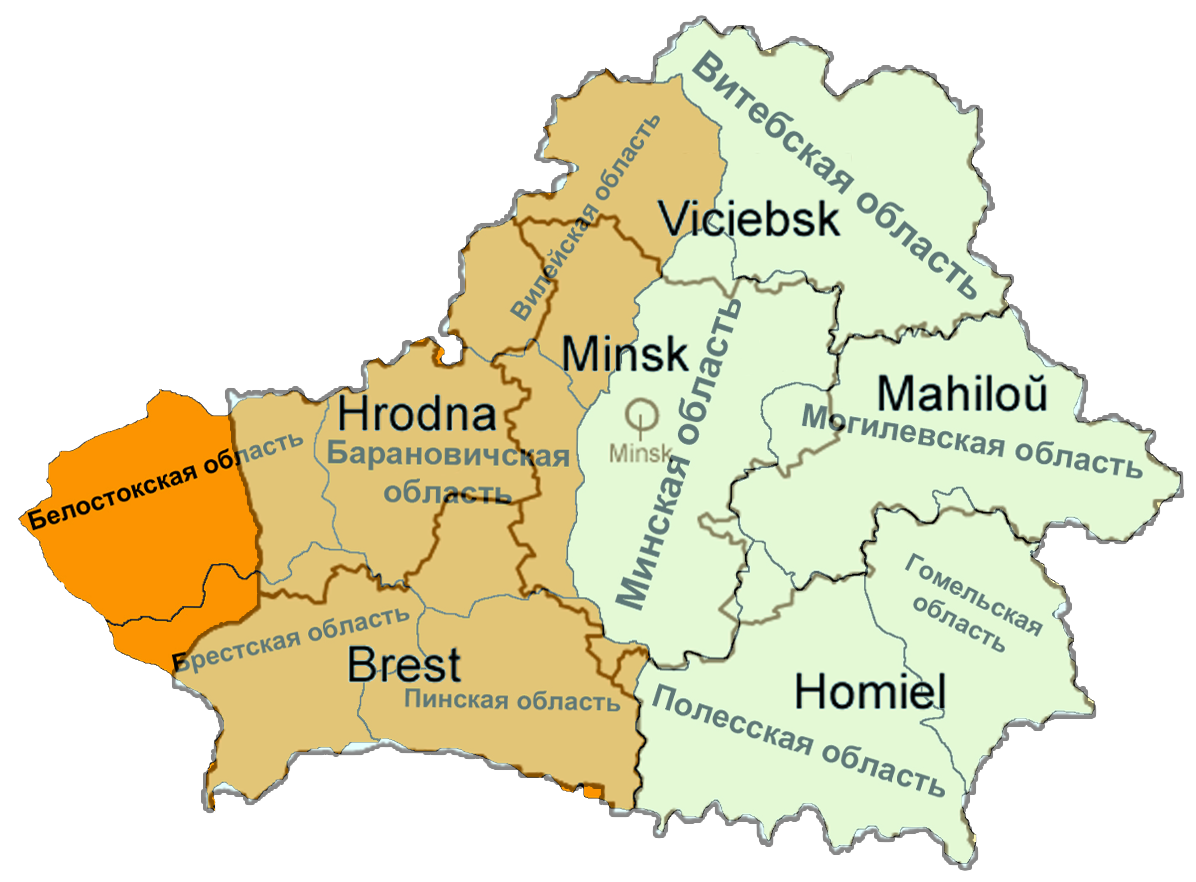
Created by the USSR after the conquest of Poland, the new western provinces of Byelorussian SSR acquired from Poland included Baranavichy, Belastok, Brest, Vileyka and the Pinsk Regions. The majority of Belastok Region was returned to Poland and the rest of the regions were reorganized one more time after the Soviet liberation of Belarus into the contemporary western provinces of Belarus which include all of Grodno and Brest regions, as well as parts of today's Minsk and Vitebsk regions. Vilnius was returned by the USSR to the Republic of Lithuania which soon after that became the Lithuanian SSR.
The territories of contemporary Belarus, Poland, Ukraine, and the Baltic states were a major theatre of operations during World War I; all the while, the Bolshevik Coup overturned the interim Russian Provisional Government and formed Soviet Russia. The Bolsheviks withdrew from the war with the Central Powers by signing the Treaty of Brest-Litovsk, and ceded Belarus to Germany for the next eight and a half months.[citation needed] The German high command used this window of opportunity to transfer its troops to the Western Front for the 1918 Spring Offensive, leaving behind a power vacuum. The non-Russians inhabiting the lands ceded by the Soviets to the German Empire, saw the treaty as an opportunity to set up independent states under the German umbrella. Three weeks after the Treaty of Brest-Litovsk was signed on 3 March 1918, the newly formed Belarusian Central Council founded the Belarusian People's Republic. The idea was rejected by the Germans, the Bolsheviks and the Americans. Woodrow Wilson rejected it, because the Americans intended to protect the territorial integrity of European Russia.
The fate of the region was not settled for the following three and a half years. The Polish–Soviet War which erupted in 1919, was particularly bitter; it ended with the Peace of Riga of 1921. Poland and the Baltic states emerged as independent countries bordering the USSR. The territory of modern-day Belarus was split by the treaty into Western Belorussia ruled by the Polish and the Soviet Eastern Belorussia, with the border town in Mikaszewicze. Notably, the peace treaty was signed with the full active participation of the Belarusian delegation on the Soviet side. In paragraph 3, Poland abandoned all rights and claims to the territories of Soviet Belarus, while Soviet Russia abandoned all rights and claims to Polish Western Belarus.
As soon as the Soviet-German peace treaty was signed in March 1918, the newly formed Rada of the Belarusian Democratic Republic laid territorial claims to Belarus based on areas specified in the Third Constituent Charter unilaterally as inhabited by the Belarusian majority.[citation needed] The same Rada charter also declared that the Treaty of Brest-Litowsk of March 1918 was invalid because it was signed by foreign governments partitioning territories that were not theirs.
In February 1919, a joint Lithuanian Belorussian Soviet Republic (Litbel) was established, and then a separate Byelorussian SSR. Thus, the almost unsolicited national state, which arose during the First World War, owed its existence directly to the alternative German, Russian and Polish attempts to secure control over the area. — Tania Raffass
In the Second Constituent Charter, the Rada abolished the right to private ownership of land (paragraph 7) in line with the Communist Manifesto. Meanwhile, by 1919, the Bolsheviks took control over large parts of Belarus and forced the Belarusian Rada into exile in Germany. The Bolsheviks formed the Socialist Soviet Republic of Byelorussia during the war with Poland on roughly the same territory claimed by the Belarusian Republic.
The League of Nations ratified the new Polish-Soviet border. The peace agreement remained in place throughout the interwar period. The borders established between the two countries remained in force until World War II and the 17 September 1939 Soviet invasion of Poland. On Joseph Stalin's insistence, the borders were redrawn in the Yalta and Potsdam Conferences.
Western Belorussia
Western Belorussia or Western Belarus (Belarusian: Заходняя Беларусь, romanized: Zachodniaja Biełaruś; Polish: Zachodnia Białoruś; Russian: Западная Белоруссия, romanized: Zapadnaya Belorussiya) is a historical region of modern-day Belarus which belonged to the Second Polish Republic during the interwar period. For twenty years before the 1939 invasion of Poland, it was the northern part of the Polish Kresy macroregion. Following the end of World War II in Europe, most of Western Belorussia was ceded to the Soviet Union by the Allies, while some of it, including Białystok, was given to the Polish People's Republic. Until the dissolution of the Soviet Union in 1991, Western Belorussia formed the western part of the Byelorussian Soviet Socialist Republic (BSSR). Today, it constitutes the west of modern Belarus.
Created by the USSR after the conquest of Poland, the new western provinces of Byelorussian SSR acquired from Poland included Baranavichy, Belastok, Brest, Vileyka and the Pinsk Regions. The majority of Belastok Region was returned to Poland and the rest of the regions were reorganized one more time after the Soviet liberation of Belarus into the contemporary western provinces of Belarus which include all of Grodno and Brest regions, as well as parts of today's Minsk and Vitebsk regions. Vilnius was returned by the USSR to the Republic of Lithuania which soon after that became the Lithuanian SSR.
The territories of contemporary Belarus, Poland, Ukraine, and the Baltic states were a major theatre of operations during World War I; all the while, the Bolshevik Coup overturned the interim Russian Provisional Government and formed Soviet Russia. The Bolsheviks withdrew from the war with the Central Powers by signing the Treaty of Brest-Litovsk, and ceded Belarus to Germany for the next eight and a half months.[citation needed] The German high command used this window of opportunity to transfer its troops to the Western Front for the 1918 Spring Offensive, leaving behind a power vacuum. The non-Russians inhabiting the lands ceded by the Soviets to the German Empire, saw the treaty as an opportunity to set up independent states under the German umbrella. Three weeks after the Treaty of Brest-Litovsk was signed on 3 March 1918, the newly formed Belarusian Central Council founded the Belarusian People's Republic. The idea was rejected by the Germans, the Bolsheviks and the Americans. Woodrow Wilson rejected it, because the Americans intended to protect the territorial integrity of European Russia.
The fate of the region was not settled for the following three and a half years. The Polish–Soviet War which erupted in 1919, was particularly bitter; it ended with the Peace of Riga of 1921. Poland and the Baltic states emerged as independent countries bordering the USSR. The territory of modern-day Belarus was split by the treaty into Western Belorussia ruled by the Polish and the Soviet Eastern Belorussia, with the border town in Mikaszewicze. Notably, the peace treaty was signed with the full active participation of the Belarusian delegation on the Soviet side. In paragraph 3, Poland abandoned all rights and claims to the territories of Soviet Belarus, while Soviet Russia abandoned all rights and claims to Polish Western Belarus.
As soon as the Soviet-German peace treaty was signed in March 1918, the newly formed Rada of the Belarusian Democratic Republic laid territorial claims to Belarus based on areas specified in the Third Constituent Charter unilaterally as inhabited by the Belarusian majority.[citation needed] The same Rada charter also declared that the Treaty of Brest-Litowsk of March 1918 was invalid because it was signed by foreign governments partitioning territories that were not theirs.
In February 1919, a joint Lithuanian Belorussian Soviet Republic (Litbel) was established, and then a separate Byelorussian SSR. Thus, the almost unsolicited national state, which arose during the First World War, owed its existence directly to the alternative German, Russian and Polish attempts to secure control over the area. — Tania Raffass
In the Second Constituent Charter, the Rada abolished the right to private ownership of land (paragraph 7) in line with the Communist Manifesto. Meanwhile, by 1919, the Bolsheviks took control over large parts of Belarus and forced the Belarusian Rada into exile in Germany. The Bolsheviks formed the Socialist Soviet Republic of Byelorussia during the war with Poland on roughly the same territory claimed by the Belarusian Republic.
The League of Nations ratified the new Polish-Soviet border. The peace agreement remained in place throughout the interwar period. The borders established between the two countries remained in force until World War II and the 17 September 1939 Soviet invasion of Poland. On Joseph Stalin's insistence, the borders were redrawn in the Yalta and Potsdam Conferences.
Recent media
Recent media