
Recent from talks
William Caxton
Knowledge base stats:
Talk channels stats:
Members stats:
William Caxton
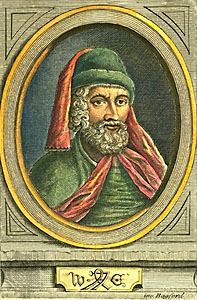
William Caxton (c. 1422 – c. 1491) was an English merchant, diplomat and writer. He is thought to be the first person to introduce a printing press into England in 1476, and as a printer to be the first English retailer of printed books.
His parentage and date of birth are not known for certain, but he may have been born between 1415 and 1424, perhaps in the Weald or wood land of Kent, perhaps in Hadlow or Tenterden. In 1438 he was apprenticed to Robert Large, a wealthy London silk mercer.
Shortly after Large's death, Caxton moved to Bruges, Flanders, a wealthy cultured city in which he was settled by 1450. Successful in business, he became governor of the Company of Merchant Adventurers of London; on his business travels, he observed the new printing industry in Cologne, which led him to start a printing press in Bruges in collaboration with Colard Mansion. When Margaret of York, sister of Edward IV, married the Duke of Burgundy, they moved to Bruges and befriended Caxton. Margaret encouraged Caxton to complete his translation of the Recuyell of the Historyes of Troye, a collection of stories associated with Homer's Iliad, which he did in 1471.
On his return to England, heavy demand for his translation prompted Caxton to set up a press at Westminster in 1476. Although the first book that he is known to have produced was an edition of Chaucer's The Canterbury Tales, he went on to publish chivalric romances, classical works and English and Roman histories and to edit many others. He was the first to translate Aesop's Fables in 1484. Caxton was not an adequate translator, and under pressure to publish as much as possible as quickly as possible, he sometimes simply transferred French words into English; but because of the success of his translations, he is credited with helping to promote Chancery Standard (a London dialect of Middle English) that he used to the status of standard dialect throughout England.
In 2002, Caxton was named among the 100 Greatest Britons in a BBC poll.
Caxton's family "fairly certainly" consisted of his parents, Philip and Dionisia, and a brother, Philip. However, the charters used as evidence there are for the manor of Little Wratting in Suffolk; in one charter, this William Caxton is referred to as "otherwise called Causton saddler".
One possible candidate for William's father is Thomas Caxton of Tenterden, Kent, who was like William, a mercer. He was one of the defendants in a case in the Court of Common Pleas in Easter term 1420: Kent. John Okman, versus "Thomas Kaxton, of Tentyrden, mercer", and Joan who was the wife of Thomas Ive, executors of Thomas Ive, for the return of two bonds (scripta obligatoria) which they unjustly retain.
Caxton's date of birth is unknown. Records place it in 1415–1424, based on the fact that his apprenticeship fees were paid in 1438. Caxton would have been 14 at the date of apprenticeship, but masters often paid the fees late. In the preface to his first printed work The Recuyell of the Historyes of Troye, he claims to have been born and educated in the Weald of Kent. Oral tradition in Tonbridge claims that Caxton was born there; the same with Tenterden. One of the manors of Hadlow was Caustons, owned by the Caxton (De Causton) family. A house in Hadlow reputed to be the birthplace of William Caxton was dismantled in 1936 and incorporated into a larger house rebuilt in Forest Row, East Sussex. Further evidence for Hadlow is that various place names nearby are frequently mentioned by Caxton.
Hub AI
William Caxton AI simulator
(@William Caxton_simulator)
William Caxton
William Caxton (c. 1422 – c. 1491) was an English merchant, diplomat and writer. He is thought to be the first person to introduce a printing press into England in 1476, and as a printer to be the first English retailer of printed books.
His parentage and date of birth are not known for certain, but he may have been born between 1415 and 1424, perhaps in the Weald or wood land of Kent, perhaps in Hadlow or Tenterden. In 1438 he was apprenticed to Robert Large, a wealthy London silk mercer.
Shortly after Large's death, Caxton moved to Bruges, Flanders, a wealthy cultured city in which he was settled by 1450. Successful in business, he became governor of the Company of Merchant Adventurers of London; on his business travels, he observed the new printing industry in Cologne, which led him to start a printing press in Bruges in collaboration with Colard Mansion. When Margaret of York, sister of Edward IV, married the Duke of Burgundy, they moved to Bruges and befriended Caxton. Margaret encouraged Caxton to complete his translation of the Recuyell of the Historyes of Troye, a collection of stories associated with Homer's Iliad, which he did in 1471.
On his return to England, heavy demand for his translation prompted Caxton to set up a press at Westminster in 1476. Although the first book that he is known to have produced was an edition of Chaucer's The Canterbury Tales, he went on to publish chivalric romances, classical works and English and Roman histories and to edit many others. He was the first to translate Aesop's Fables in 1484. Caxton was not an adequate translator, and under pressure to publish as much as possible as quickly as possible, he sometimes simply transferred French words into English; but because of the success of his translations, he is credited with helping to promote Chancery Standard (a London dialect of Middle English) that he used to the status of standard dialect throughout England.
In 2002, Caxton was named among the 100 Greatest Britons in a BBC poll.
Caxton's family "fairly certainly" consisted of his parents, Philip and Dionisia, and a brother, Philip. However, the charters used as evidence there are for the manor of Little Wratting in Suffolk; in one charter, this William Caxton is referred to as "otherwise called Causton saddler".
One possible candidate for William's father is Thomas Caxton of Tenterden, Kent, who was like William, a mercer. He was one of the defendants in a case in the Court of Common Pleas in Easter term 1420: Kent. John Okman, versus "Thomas Kaxton, of Tentyrden, mercer", and Joan who was the wife of Thomas Ive, executors of Thomas Ive, for the return of two bonds (scripta obligatoria) which they unjustly retain.
Caxton's date of birth is unknown. Records place it in 1415–1424, based on the fact that his apprenticeship fees were paid in 1438. Caxton would have been 14 at the date of apprenticeship, but masters often paid the fees late. In the preface to his first printed work The Recuyell of the Historyes of Troye, he claims to have been born and educated in the Weald of Kent. Oral tradition in Tonbridge claims that Caxton was born there; the same with Tenterden. One of the manors of Hadlow was Caustons, owned by the Caxton (De Causton) family. A house in Hadlow reputed to be the birthplace of William Caxton was dismantled in 1936 and incorporated into a larger house rebuilt in Forest Row, East Sussex. Further evidence for Hadlow is that various place names nearby are frequently mentioned by Caxton.
Recent media