Hubbry Logo
Forest RowForest RowMain
Open search
Forest Row
Community hub
Forest Row
logo
8 pages, 0 posts
0 subscribers
Be the first to start a discussion here.
Forest Row
Forest Row
from Wikipedia

Forest Row is a village and a large civil parish[3] in the Wealden District of East Sussex, England. The village is located three miles (5 km) south-east of East Grinstead. In January 2023, it ranked as Britain’s 3rd poshest village.[4]

Key Information

History

[edit]

The village draws its name from its proximity to the Ashdown Forest, a royal hunting park first enclosed in the 13th century. From its origins as a small hamlet, Forest Row has grown, first with the establishment of a turnpike road in the 18th century; and later with the opening of the railway between East Grinstead and Tunbridge Wells in 1866; the line, which included an intermediate station at Forest Row, closed in 1967 as a result of the Beeching Axe (a programme of closures put forward by East Grinstead resident and British Railways Board Chairman Richard Beeching).

A part medieval public house the Yew Tree (now known as The Swan), was a centre of smuggling in the 18th century.[5]

Brambletye House (known locally as Brambletye Castle) was built by Sir Henry Compton in 1631. This building features in the 1826 Horace Smith novel Brambletye House.

A mail coach robbery occurred at the bottom of Wall Hill on 27 June 1801. John Beatson and his adopted son William Whalley Beatson hid in a meadow at the foot of Wall Hill, by the entrance to an old Roman road. The mail coach made its way up Wall Hill, where it was stopped by them just after midnight. The Beatsons took between £4,000 and £5,000. Judge Baron Hotham sentenced the two men to death by hanging at the trial on 29 March 1802. Gallows were erected on the spot where the robbery took place, on 17 April 1802. Beatson and his adopted son were hanged in the presence of 3,000 people.[citation needed]

John F. Kennedy, the 35th President of the United States, came to Forest Row in June 1963 during his visit to the UK,[6] attending mass at the Our Lady of the Forest church. At the time he was engaged in a series of discussions with the Prime Minister Harold Macmillan at his home in nearby Birch Grove.[6] There is a plaque commemorating the visit on Freshfield Hall.

Forest Row became a Transition village in 2007 with the official unveiling in March 2008 at the Village Hall.

Governance

[edit]

An electoral ward in the same name exists. The population of this ward taken at the 2011 Census was 5,278.[7]

Geography

[edit]

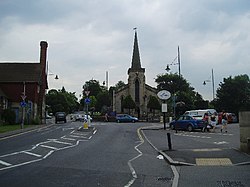
The civil parish of Forest Row is in the north-west corner of East Sussex, and borders West Sussex, Kent and Surrey. Ashdown Forest surrounds the village on three sides, and the upper reaches of the River Medway flow through the parish. The centre of the village lies at the intersection of the A22 road, the erstwhile turnpike, and the B2110 to Hartfield and Tunbridge Wells and there is a wide range of shops and businesses to serve the surrounding area.

Weir Wood Reservoir is a Site of Special Scientific Interest within the parish. It is also one of the largest areas of open water in the county and hosts a wide variety of resident and migrating birds.[8]

The hotels in the village are The Brambletye Hotel, The Chequers and The Swan. In the 2006 radiation scare surrounding KGB agent Alexander Litvinenko the Ashdown Park Hotel and Country Club were closed for 6 hours and the nearby Roebuck hotel was used as an evacuation point for arriving guests.[9] Italian security expert Mario Scaramella may have stayed there but tests showed no evidence of "radiation toxicity".

The village architecture is a mixture of traditional and modern. As well as many older cottages in the classic Sussex style there is a variety of more modern development, which generally blends in well. Gage Ridge and Michael Fields, with their copper-roofed houses are examples of the latter.

In addition to the businesses in the village centre, there is also an industrial estate.

Religion

[edit]

The Church of England ecclesiastical parish combines two churches: Holy Trinity, Forest Row, and St Dunstan's Ashurst Wood.[10] There are also other denominational churches: The Christian Community Forest Row;[11] a Baptist chapel; Providence church; and the cemetery chapel.

The Roman Catholic Our Lady of the Forest Church opened in the 1950s and closed on Christmas Day in 2009.[12]

Education

[edit]

State education is provided at Forest Row CE Primary School.[13] Greenfields School, which caters for children of all ages, is an independent school in the village which gives its students the opportunity to follow the teachings of L. Ron Hubbard, amongst other things. Institutions associated with the Anthroposophical movement of Rudolf Steiner are located in or near the village, notably Michael Hall, a Steiner Waldorf School offering education to children from kindergarten up to age 18[14] and Emerson College.[15]

Leisure and culture

[edit]
  • The village hall was a gift for the people of Forest Row by the Alpine mountaineer Douglas Freshfield and his mother in memory of his son Henry Douglas Freshfield who died aged fourteen in 1891. The first Freshfield Hall was very short-lived, for it was burnt down on 14 February 1895, the day after the funeral of Henry Freshfield. Douglas Freshfield and his mother rebuilt and it reopened on 17 November 1895. At the reopening Freshfield expressed the wishes of his mother and himself when he hoped the hall would be used by all classes of parishioners, and that it would keep alive the memory of its original founder.[16]
  • The Forest Way, on the trackbed of the disused railway line, passes through the village from East Grinstead and continues eastwards as far as Groombridge, a total distance of 10 miles (14.5 km). Either side of the village the footpath is fairly level and is used primarily by pedestrians. Cyclists and horse riders can use the track, but must give pedestrians priority.[17]
  • The Royal Ashdown Forest Golf Club was established in 1889: there are two courses.

Literary connections

[edit]
  • The Brambletye Inn was frequented by Sir Arthur Conan Doyle and features in "The Adventure of Black Peter", in which Sherlock Holmes and Dr Watson stay at the hotel in Forest Row whilst they investigate the murder of a retired sea captain.
  • The film adaptation of John Fowles's novel The Collector, directed by William Wyler in 1965, contains locations (at the close of the film) shot in Forest Row.
  • Writer Helen Humphreys describes staying with her paternal grandmother at Ashcroft as an aspiring novelist in her 2013 memoir Nocturnes.
  • Arthur Owen Barfield (9 November 1898 – 14 December 1997), English philosopher, author, poet, critic, and member of the Inklings. Retired to Forest Row after the death of his wife in 1980.

Twin towns

[edit]

Notable people

[edit]

There have been several notable residents of Forest Row in the recent past and present. These include: Owen Barfield, the writer and philosopher, Ben Elton, the comedian and novelist, David Gilmour from the band Pink Floyd, Violet Needham, author Richard Jones, bass player and background singer in the Feeling, Jonael Schickler, a Swiss Philosopher and Sean Yates, professional cyclist. The singer Engelbert Humperdinck had a holiday cottage in the village during the 1980s. Actor Ed Sanders is from Forest Row.[19] American-born DJ and producer Secondcity (real name Rowan Harrington) lived in Forest Row having moved there when he was 12. Noted amateur golfer and writer Horace Hutchinson called Forest Row his home in the late 1920s and early 1930s, before his death in 1932.

References

[edit]
[edit]
Revisions and contributorsEdit on WikipediaRead on Wikipedia
from Grokipedia
Forest Row is a village and in the of , , situated on the northern fringe of the ancient and approximately three miles (5 km) south-east of . As of the 2021 Census, the had a population of 4,864 residents, down slightly from 4,954 in 2011, in this rural community bordered by , , and . The area is renowned for its natural beauty, historical ties to medieval hunting grounds, and literary associations, particularly as the inspiration for A.A. Milne's Winnie-the-Pooh stories, with serving as the model for the . Geographically, Forest Row encompasses about 33.66 square kilometers (13 square miles) of woodland, heathland, and farmland, dominated by the expansive , a former royal deer park established in the and now a protected . The village itself features a mix of traditional cottages, modern housing, and several village greens, with the River forming a natural boundary to the east. Its location at the crossroads of the A22 and B2110 roads has historically facilitated trade and travel, contributing to its development from a sparse medieval settlement into a vibrant community. Historically, human activity in the Forest Row area dates back to prehistoric times, evidenced by flint tools and ancient remains, followed by Saxon clearings for amid the dense woodlands. After the in 1066, the land fell under feudal management, with reserved for royal hunting; the village originated as a small at one of the forest's gates in the 14th century. The 15th and 16th centuries brought prosperity through the Wealden iron industry, which utilized local timber and streams for furnaces, while the arrival of in 1866 spurred further expansion with new infrastructure and visitor influx to the forest. The line closed in 1967 under the Beeching Axe, but the village adapted, establishing s like the Royal Ashdown Forest Golf Club in 1888 and Michael Hall School, a Steiner-Waldorf , in 1925. Today, Forest Row serves as a hub for and , influenced by anthroposophical principles from nearby , and is celebrated for its organic and biodynamic farming at sites like Tablehurst and Plawhatch Farms. The local economy blends —drawn to Pooh-themed attractions and walking trails—with independent shops, artisan bakeries such as Cyrnel, and small-scale industries. Notable landmarks include the Grade II-listed Brambletye House ruins, a 17th-century manor, and the village's community facilities managed by the Forest Row Parish Council, which oversees services like allotments, burial grounds, and public spaces to preserve the area's unique character.

History

Origins and Medieval Period

Forest Row derives its name from its location on the edge of , an expansive area that served as a royal hunting park during the medieval period. The forest itself has roots tracing back to Saxon times, when it was part of the vast Anderida woodland mentioned in historical records as early as 731 AD, but it was formally vested in in perpetuity in 1268 during the reign of Henry III, marking its establishment as a protected royal hunting ground primarily for deer. This , reinforced by a 23-mile pale or fence by the late , preserved the area's character and restricted access to support royal hunts and . Early settlement in the Forest Row area was sparse and tied closely to the forested landscape, consisting mainly of scattered agrarian farmsteads and hamlets under the feudal system imposed after the in 1066. The region remained predominantly wooded, with land use focused on , , and limited , as the provided essential resources like , timber, and rights to local inhabitants and manorial lords. Medieval manors, such as those surrounding the forest including Duddleswell, formed a network of jurisdictions that managed these resources, often under oversight to prevent . The first recorded mention of Forest Row itself appears in 1467 as "Forstrowe," reflecting its linear development along paths leading into the forest. Key historical records from the 13th century, including the vesting of in the Crown, underscore its status as a regulated domain, with perambulations and charters defining boundaries to curb encroachments. The nearby Wealden iron industry, which revived during the , began influencing the local economy by drawing on the forest's abundant timber for production in bloomery furnaces, fostering early industrial activity in hamlets like Forest Row without significantly altering the sparse settlement patterns. This integration of forestry and nascent ironworking laid foundational economic ties for the area.

Modern Development and Key Events

The construction of turnpike roads in the significantly influenced Forest Row's development, with the and Turnpike Trust established by an in 1718, initially running from to . This route was extended in 1724 through Forest Row to , and further to Wych Cross by 1785, forming part of the principal link from to and . A cross-turnpike from Tunbridge Wells to via Forest Row, now the B2110, was added in 1788, improving connectivity and addressing longstanding poor road conditions dating back to Roman times. These enhancements spurred by boosting traffic and supporting , such as coaching inns including the Crown and Swan, which catered to increased travelers. Smuggling activities thrived in Forest Row during the 18th and 19th centuries, facilitated by its position on key routes and the dense woodland of , which provided cover for illicit operations. The Swan Inn, a part-medieval public house formerly known as the Yew Tree, was involved in activities prevalent in the region during the 18th and 19th centuries. These activities reflected broader regional patterns in , where evasion of taxes was a common economic response until stricter enforcement in the mid-19th century curtailed them. A notable incident occurred on 27 June 1801, when a mail coach was robbed at the bottom of Wall Hill near Forest Row, with perpetrators John Beatson and his adopted son William Whalley Beatson stealing between £4,000 and £5,000—equivalent to around £400,000 today—hidden in a meadow before their capture and execution by hanging at the site on 17 April 1802. The arrival of the railway in 1866 further transformed the village, as Forest Row station opened on the London, Brighton & South Coast Railway's extension from East Grinstead to Tunbridge Wells, featuring a goods yard, shed, and later a doubled track and footbridge in 1897. As the busiest intermediate station on the line, it supported commuter travel to London (taking 1¼ to 1½ hours) and goods services until 7 November 1966, while fostering economic growth by attracting affluent Londoners, expanding the population, and aiding local industries like recreation at the Royal Ashdown Golf Club and military logistics. The station closed to passengers on 2 January 1967, just over 100 years after opening on 1 October 1866, as part of the Beeching Report's rationalization of uneconomic lines. In June 1963, U.S. President made his final visit to the , staying nearby at Prime Minister Harold Macmillan's estate and visiting Forest Row to attend Mass at Our Lady of the Forest Church on 30 June, just five months before his . Following the railway's closure, acquired the line in 1971 and designated it as the Forest Way Country Park in 1974, converting the disused track into a 10-mile multi-use trail for walking, cycling, and wildlife habitat along the River Medway valley. In 2007, Forest Row became the UK's first designated , initiating community-led sustainability efforts to address and through local food production, , and reduced carbon initiatives.

Geography

Location and Boundaries

Forest Row is a situated in the of , , with its approximate central coordinates at 51°05′47″N 0°01′58″E. The village lies approximately 3 miles (5 km) southeast of , positioning it within the broader region. As a , it falls under the administrative oversight of Council and . The parish covers an area of 33.66 km² (13 sq mi), encompassing rural landscapes in the northwest corner of . Its boundaries border to the west, to the northeast, and to the north, reflecting the parish's position at the convergence of these counties. The entire area is designated as part of the High Area of Outstanding Natural Beauty, a protected landscape spanning 1,461 km² across southeast England known for its wooded hills and historic field patterns. To the south, the parish adjoins , an expansive ancient heathland that serves as a significant natural neighbor. Urban centers nearby include , approximately 12 miles (19 km) to the north, providing regional connectivity for residents. These positional attributes contribute to Forest Row's character as a semi-rural settlement with access to both local amenities and broader regional features.

Physical Features and Environment

Forest Row lies within the High Weald, an characterized by undulating terrain formed from folded and faulted sandstone ridges interspersed with clay valleys, supporting a mosaic of ancient woodlands, heathlands, and meandering streams. The landscape features gentle hills and valleys, with elevations ranging from approximately 60 to 220 meters above , contributing to its intimate scale and scenic diversity. This topography fosters a network of small watercourses that drain the area, including the upper reaches of the , which originates from springs in nearby and flows through the parish, shaping local wetlands and riparian habitats. A prominent feature is Weir Wood Reservoir, located just west of Forest Row, covering approximately 153 hectares and designated as a biological (SSSI) since 1966 for its and open water ecosystems. The reservoir supports diverse birdlife, including breeding populations of species such as great crested grebes and tufted ducks, alongside marginal vegetation like reedbeds that enhance its ecological value as a refuge for migratory waterfowl. Conservation efforts by and focus on maintaining water quality and habitat integrity to sustain this . Ashdown Forest, encompassing much of the surrounding area, originated as a medieval royal deer park and now serves as a protected expanse of lowland heathland, one of the largest continuous blocks in southeast , designated as an SSSI and for its rare habitats. The forest's sandy soils and acidic conditions support specialized flora such as heather and cross-leaved heath, alongside fauna including nightjars, Dartford warblers, and adders, making it a key site for biodiversity conservation. Ongoing management by the Conservators of Ashdown Forest emphasizes habitat restoration, control, and public access to preserve these internationally important ecosystems amid pressures from and recreation.

Demographics and Society

Population and Demographics

According to the 2011 Census, the population of Forest Row parish was 4,954, while the Forest Row ward recorded 5,278 residents, with a population density of 152 inhabitants per square kilometre across the parish's 32.52 km² area. By 2021, the parish population had slightly declined to 4,864, reflecting a -0.18% annual change since 2011, though broader East Sussex trends indicate modest growth in surrounding areas due to net internal migration and natural increase. Forest Row exhibits an older age profile compared to national averages, with around 25% of aged 65 and over in —higher than England's 18.5%—driven by retiree influx and low birth rates, resulting in a age of approximately 44 years. The demographic composition features a high proportion of professionals, with 39% of working-age adults holding Level 4 qualifications or higher in Wealden (encompassing Forest Row), alongside a notable retiree segment contributing to the area's stability. Ethnic diversity remains low, with approximately 95% of the identifying as in 2011, a figure consistent with data showing 92% White ethnic groups district-wide, reflecting limited . Household types are predominantly owner-occupied (77% in Wealden, ), with couples and families forming the majority, supported by low net migration patterns where 90% of residents have lived in the area for over three years, indicating a settled . As of mid-2024, Wealden district's population was estimated at 165,200, aligning with East Sussex's overall growth trends observed in recent years.

Religion and Community Life

Forest Row's religious landscape is dominated by the Church of England, with the parish encompassing two key sites. Holy Trinity Church, located centrally on the A22, was constructed in 1836 as a chapel of ease to serve the growing population, designed by architect William Moseley and funded by subscription; it is a Grade II listed building reflecting early Victorian Gothic Revival style. St Dunstan's Church in nearby Ashurst Wood, part of the same parish, originated with a mission room built in 1884 to extend services from Holy Trinity, later replaced in 1979 by the conversion of a former Congregational chapel dating to 1859, adapting to local demographic shifts. Nonconformist traditions are represented by the Forest Row Baptist Church, established in 1811 as Bethesda Chapel, with its current structure erected in 1841 to accommodate the congregation's needs amid 19th-century religious revivalism. The Roman Catholic community once centered on Our Lady of the Forest Church, built in the 1950s on Hartfield Road and notable for visits by figures like President in 1963; it closed after Christmas Mass in 2009 due to declining attendance and priest shortages, leaving the building disused thereafter. Churches in Forest Row serve as vital hubs for village life, hosting worship alongside community events such as coffee mornings, youth groups, and charitable activities that foster social cohesion among residents. Beyond faith-based roles, the broader community fabric includes sustainability efforts through Transition Forest Row, launched in 2007 as the UK's first transition village initiative, promoting local resilience via energy reduction projects, food growing networks, and minimization programs. Complementing this, the Forest Row Twinning Association, active since the late , strengthens international ties with Milly-la-Forêt in through organized exchanges, cultural fetes, and social gatherings that enhance community spirit.

Governance and Economy

Local Governance

Forest Row is a civil parish within the Wealden District of East Sussex, England, falling under the jurisdiction of Wealden District Council for district-level administration and East Sussex County Council for county-level matters. The village forms part of the Forest Row & Groombridge electoral ward for Wealden District Council elections, which elects three councillors every four years, with the most recent full election held in May 2023. At the county level, it is included in the Forest Row & Groombridge division of East Sussex County Council, which elects a single councillor every four years; the county council election scheduled for May 2025 was postponed due to local government reorganisation plans. As of November 2025, the ward is represented at the district level by three Green Party councillors elected in 2023, including Councillor Diana Patricia Patterson-Vanegas (937 votes), with a turnout of 43.54%; and at the county level by Councillor Georgia Taylor of the Green Party, elected in 2021. The Forest Row Parish Council serves as the lowest tier of local government, established in 1894 under an Act of Parliament and comprising 15 elected volunteer councillors representing three internal wards: Forest Row, Ashurst Wood and Hammerwood, and Weirwood. The council is funded primarily through a precept added to council tax, supplemented by grants and service charges, and operates via full council meetings for major decisions alongside specialized committees and working groups, such as the Planning Committee, to address community issues. Its core responsibilities include maintaining public spaces like village greens, play areas, and allotments; managing burial grounds, bus shelters, and street lighting; providing community services such as a weekly market, community lunches, medical transport, youth programs, and the Thursday Club for seniors; and offering input on planning applications to higher authorities. The council's office is located in the Community Centre on Hartfield Road, with a small staff supporting these operations. In recent years, the Parish Council has focused on community representation amid broader administrative changes, including an uncontested scheduled for 27 November 2025 to fill a vacancy in the Forest Row ward, which will bring active membership to 14 councillors. Local governance discussions in 2025 have centered on potential reorganisation, with Council submitting proposals by September for a possible shift to unitary authorities, including a request to postpone future county elections and facilitate transition to a single-tier , though no immediate changes affect Forest Row's . On policy fronts, the council has advanced green initiatives through its , adopted to achieve net zero for the community by promoting incentives for local businesses and supporting sources like renewables. In May 2025, it received funding from a Council grant of over £42,000 allocated across 12 projects district-wide to enhance green spaces, including an accessible pathway to the , aligning with broader climate emergency declarations by both and councils.

Economy and Employment

Forest Row's economy is predominantly service-oriented, with a focus on retail and small-scale business activities that serve both local residents and surrounding rural communities. The village functions as a shopping hub for a wide area, featuring independent shops, delicatessens, and specialty stores along Lewes Road, which supports local commerce through daily consumer needs and boutique offerings. Additionally, the Station Road Industrial Estate provides space for light manufacturing and mixed-use enterprises, including a timber yard and modern business units that accommodate small-scale operations in trades like woodworking and office-based services, contributing to modest employment in non-agricultural sectors. Tourism and leisure play a significant role in the local economy, driven by the proximity to , which attracts approximately 1.35 million visitors annually for recreational activities such as walking and , thereby boosting demand for hospitality, retail, and guided services in Forest Row. The Royal Ashdown Forest Golf Club, established in 1888, stands as a key employer, offering positions in , maintenance, and to support its operations as a prestigious 36-hole members' club, and it draws affluent visitors who contribute to nearby businesses. Recent developments reflect Forest Row's appeal to high-income professionals, with the village ranked third among Britain's poshest in a 2023 study by , attributed to its low crime rates, quality schools, and scenic environment, which has spurred growth in eco-tourism initiatives tied to Ashdown Forest's conservation efforts and an influx of remote workers leveraging the area's affluent demographics and reliable . Agriculture remains limited within the village itself but maintains connections to broader Wealden farming through biodynamic operations like Tablehurst Farm, which supplies organic produce, meat, and dairy to local markets and shops, supporting sustainable food networks.

Infrastructure

Transport

Forest Row is primarily accessed by road, with the A22 trunk road forming a central north-south artery through the village, linking it to nearby towns and the wider motorway network. Approximately 3 miles north lies , from where the A264 provides a connection to the about 5 miles further west at Junction 10. The B2110 road also connects Forest Row directly to , facilitating local traffic flow. Historically, served the village via Forest Row station on the Three Bridges to Tunbridge Wells line, which opened in to support commuter and freight needs. The line was closed on 2 January 1967 as part of the aimed at rationalizing Britain's rail network. The disused trackbed has since been transformed into the Forest Way Country Park, a 10-mile managed by , popular for , walking, and . Current relies on bus services, with no operational railway station in the village—the nearest is station, roughly 3 miles north, offering connections to and other regional destinations. Key routes include the 261 bus operated by Compass Travel, providing hourly services (weekdays) between and via Forest Row, and the 291 bus by Metrobus, linking to Tunbridge Wells and with multiple daily departures. These services support commuting and local travel, though frequencies vary outside peak hours. As of 2025, County Council's Local Transport Plan 4 (LTP4, covering 2024–2050) prioritizes modes to reduce carbon emissions and enhance connectivity in rural areas like Forest Row. This includes targeted bus service enhancements through the Bus Service Improvement Plan, such as extended evening operations funded until 2026, and investments in active travel infrastructure like improved paths along former rail routes and pedestrian-friendly links to bus stops.

Education

Forest Row is served by a mix of state and independent educational s, reflecting the village's historical ties to alternative pedagogies influenced by . The primary is Forest Row Church of England Primary School and Nursery, a voluntary controlled catering to children aged 3 to 11 with approximately 181 pupils. It emphasizes a nurturing environment with a focus on Christian values, community belonging, and outdoor learning opportunities near . Among independent schools, Michael Hall School stands out as the oldest Waldorf institution in the UK, founded in 1925 and relocated to Forest Row in 1945. This co-educational day and serves over 400 pupils aged 3 to 18, following Rudolf Steiner's anthroposophical principles that prioritize holistic development through artistic, practical, and intellectual activities across three developmental stages. The curriculum integrates , , and crafts to foster and spiritual awareness, distinguishing it from conventional education. Greenfields School, an independent day and for ages 2 to 16 with around 130 pupils as of 2025, was established in 1981 and moved to Forest Row in 1983. Its philosophy centers on —methods developed by to enhance learning efficiency—combined with the , promoting individualized study skills, arts, and in a rural setting. In early 2025, the school experienced a 25% decline in enrollment following the revocation of its status to sponsor visas and concerns raised in an inspection report. For adult learners, provides specialized education in arts, spirituality, and personal development, drawing directly from Rudolf Steiner's anthroposophical framework. Founded in , it offers short courses, workshops, and retreats focused on holistic integration of body, , and spirit, including topics like anthroposophic and creative therapies, serving as a hub for and community building. The prominence of Steiner-inspired education in Forest Row stems from its early 20th-century anthroposophical community, which attracted pioneers of Waldorf methods and continues to shape local pedagogy. In 2025, Michael Hall marked its centenary, highlighting the enduring impact of Steiner's philosophy on the village's educational landscape.

Culture and Leisure

Leisure Facilities and Activities

Forest Row offers a range of outdoor recreational opportunities centered on its natural surroundings. The Forest Way Country Park provides a 10-mile traffic-free path suitable for hiking, cycling, and horse riding, linking East Grinstead to Groombridge along a former railway line and passing through scenic countryside near the village. Access to Ashdown Forest, a expansive heathland area adjacent to Forest Row, supports walking trails and wildlife observation, with designated routes highlighting biodiversity including birds, deer, and rare flora. Sports facilities in the village cater to various interests, particularly , , and . The Royal Ashdown Forest features two renowned courses—the bunkerless Old Course and the West Course—both set amid heathland and recognized among the top 100 golf courses in the for their challenging natural layout and international prestige. The Forest Row Lawn Club maintains three hard courts at the , fostering a community-oriented environment for players of all levels with regular social sessions. Similarly, the Forest Row Club operates two Saturday teams in the Cricket League from grounds in the vicinity, promoting inclusive village-level play. Community events and opportunities complement these amenities. The Forest Row Village Hall, originally constructed in 1892 as a gift from the Freshfield family and rebuilt after a 1895 , serves as a versatile venue for local gatherings, classes, and recreational activities. Nearby, Weir Wood Reservoir, a 280-acre site just west of the village, supports coarse and with stocked populations of species like pike, , roach, and , available through day tickets and syndicates while sharing space with other watersports.

Cultural Events and Traditions

Forest Row hosts the annual Forest Row Festival, a three-day event in that celebrates , , , , , food, and community creativity across various village locations. The festival features live performances on Forester's Green, including genres such as Celtic tunes, , and family-friendly sets, drawing local and talent to foster village engagement. Additionally, the village holds a at Forest Row Village Hall in early , offering handmade gifts, crafts, and festive foods from local artisans, with free entry to promote community spirit. The local arts scene is notably influenced by Steiner education at Michael Hall School, where the integrates theater productions, , and hands-on crafts like , , and textile work to develop artistic skills from . These educational approaches contribute to community theater groups and craft workshops that emphasize creative expression and anthroposophical principles of holistic development. Music events in Forest Row often highlight local performers through venues like the festival and village hall, supporting intimate gigs and collaborative sessions that reflect the area's artistic vibrancy. Traditional celebrations include May Day events at Michael Hall School, where younger classes participate in outdoor gatherings with flower arches, dances, and seasonal rituals rooted in anthroposophical festivals to honor spring renewal. As one of the UK's first Transition Towns since , Forest Row organizes community sustainability fairs and initiatives through Transition Forest Row, focusing on eco-friendly practices, local resources, and environmental awareness events that align with the village's commitment to resilience and low-carbon living. These gatherings, often tied to broader village markets, promote sustainable crafts, food, and discussions on . Leisure venues such as the village hall occasionally host these cultural happenings alongside regular activities.

Notable Figures and Connections

Literary Associations

Forest Row and its surrounding have inspired several literary works, particularly through their evocative Wealden landscape of ancient woodlands and open heaths. , who frequented the area, incorporated the village into his canon in the short story "The Adventure of Black Peter" (1904), where the retired naval officer John Hopley Neligan resides at a property called Woodman's Lee near Forest Row in . The Brambletye Inn in Forest Row also served as a favored haunt for Doyle during his visits to the region. Rudyard Kipling's residence at , a Jacobean in nearby (approximately 8 miles southeast of Forest Row), profoundly shaped the area's literary heritage from 1902 until his death in 1936. There, Kipling penned works such as (1906) and (1910), drawing directly from the Weald's ancient hills, forests, and folklore to evoke England's mythic past. The proximity of Bateman's to Forest Row has fostered a shared cultural legacy, with Kipling's celebrations of the local landscape influencing regional perceptions of the area's timeless, enchanted quality. Philosopher and Inklings member Owen Barfield spent his final years in Forest Row, relocating to the village in 1986 following his wife's death and residing there until 1997. His late writings reflected the surrounding environment, incorporating natural imagery from the and Ashdown Forest's ridges and heaths, as seen in the short story "Night Operation and Eager Spring," which blends elements of southeast England's wooded landscapes to explore themes of perception and renewal. Barfield's presence in Forest Row during this period also connected the village to broader 20th-century literary and philosophical circles associated with and .

Notable Residents

Forest Row has been associated with several prominent historical figures, notably George Nevill, 1st Earl of Abergavenny (1727–1785), a British peer and local landowner whose family acquired significant farmland in the area during the 18th century. In the modern era, the village has attracted musicians of international renown. Similarly, singer Engelbert Humperdinck owned a holiday cottage in Forest Row during the 1980s, using it as a retreat amid his performing career. The village's connections extend to acting and comedy. Damian Lewis, acclaimed actor known for roles in Homeland and Billions, attended Ashdown House School in Forest Row as a boarder, residing there during his formative years in the late 1970s and early 1980s. Comedian and writer Ben Elton, creator of Blackadder and The Young Ones, has been a local resident, praising village establishments as among his favorites. Politically, former UK Prime Minister lived in Forest Row while boarding at Ashdown House School in the late 1970s. Philosopher and writer (1898–1997), a key figure in the Inklings literary group alongside and , spent his final years in Forest Row after moving to the residential hotel "The Walhatch" in 1986 following his wife's death; he resided there until his passing, engaging in scholarly work amid the village's anthroposophical community. Notable transient visitors include U.S. President , who briefly stayed in the area in June 1963 while visiting Prime Minister at nearby , attending Mass at Our Lady of the Forest Church in Forest Row on June 30.

International Relations

Twin Towns

Forest Row is twinned with Milly-la-Forêt, a commune in the department of , since 1992. This partnership, established in the early 1990s shortly after the end of the , aims to promote European understanding through cultural exchanges and the forging of personal friendships between residents of the two communities. The Forest Row Twinning Association (FRTA), founded to manage the arrangement, organizes a range of activities focused on cultural immersion and language practice. These include annual reciprocal visits to each , typically lasting several days, which facilitate shared experiences such as local tours and family homestays. Social events in Forest Row, such as barn dances, barbecues, outdoor games, and an annual spring dinner, complement these exchanges by building community ties. Joint festivals and language-oriented gatherings further strengthen the bond, with examples including the annual Franglais Fête on Foresters Green, featuring family-friendly activities like , , and children's games to encourage bilingual interaction. As of 2025, the FRTA remains active, with planned summer visits to Milly-la-Forêt resuming after pandemic-related cancellations, alongside regular committee meetings and membership drives open to all interested residents.

Community Partnerships

Forest Row has established partnerships with to advance sustainability efforts, particularly through its designation as a initiative launched in 2007. This collaboration supports community-led projects aimed at building resilience against and , including local food cooperatives and schemes. For instance, Community Energy South, in partnership with the county council, is developing renewable heat solutions for Forest Row as part of broader low-carbon initiatives outlined in the East Sussex Climate Change Road Map (2022-2025). These sustainability ties extend to alignments with the Local Transport Plan 4 (LTP4), which from 2024 to 2050 emphasizes decarbonization and sustainable mobility in rural areas like Forest Row. The plan facilitates joint efforts to reduce emissions through improved and active travel options, integrating with county-wide climate emergency actions. On the regional front, Forest Row maintains strong links with the Trust and Conservators for conservation activities, given the village's proximity to the ancient heathland. These partnerships involve local volunteers and commoners in habitat management, such as programs to preserve and prevent encroachment, as detailed in the Ashdown Forest Vision and Management Strategy. Community involvement from Forest Row supports educational programs and access improvements to the forest, enhancing across . Collaborations with nearby parishes, including , focus on shared services for transport and leisure. The Forest Way Country Park, a multi-use connecting the two areas, is managed jointly by and local authorities to promote sustainable recreation and cycling, serving residents from both communities. Additionally, initiatives like school-based support for the East Grinstead Food Bank highlight informal ties in addressing local needs. Anthroposophical networks in Forest Row are anchored by the Michael Hall Steiner School, the UK's oldest Waldorf institution founded in 1925, which fosters local-focused groups inspired by Rudolf Steiner's philosophy. The Forest Row/Sussex Anthroposophy Group organizes study sessions and community events, extending the school's holistic educational principles to broader village engagement while maintaining ties to national networks like the Anthroposophical Society in Great Britain. These efforts emphasize sustainable living and cultural activities within the local context.

References

Add your contribution
Related Hubs
User Avatar
No comments yet.