



Community hub
Recent from talks
Knowledge base stats:
Talk channels stats:
Members stats:
William Henry Flower
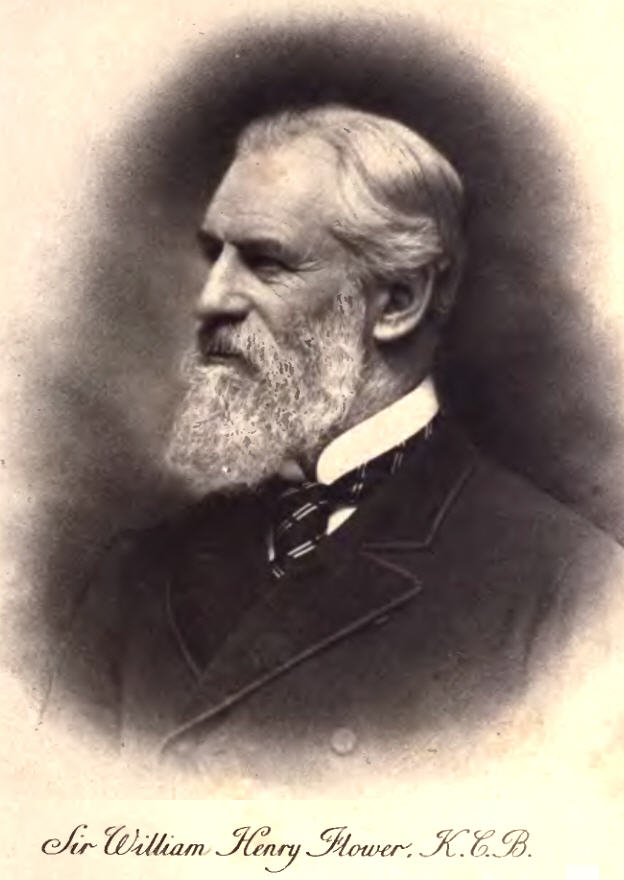
Sir William Henry Flower KCB FRS FRCS FRAI (30 November 1831 – 1 July 1899) was an English surgeon, museum curator and comparative anatomist, who became a leading authority on mammals and especially on the primate brain. He supported Thomas Henry Huxley in an important controversy with Richard Owen about the human brain and eventually succeeded Owen as Director of the Natural History Museum in London.
Born on 30 November 1831 in his father's house at Stratford-upon-Avon in Warwickshire, he was the second son of Edward Fordham Flower, founder of the town brewery, and his wife Celina Greaves (1804–1884), eldest daughter of John Greaves and his wife Mary Whitehead. His paternal grandfather Richard Flower had married Elizabeth Fordham on 24 Dec 1786 in St Andrew's Church, Newcastle upon Tyne, and settled at Albion, Illinois, where their children grew up.
His uncles included the slate entrepreneur John Whitehead Greaves and William Pickering, Governor of Washington. His elder brother Charles Edward Flower ran the family brewery with the third brother Edgar Flower, while he chose a scientific career.
First taught at home by his mother, he went to a school in Edgbaston at the age 11 and then from age 13 to a Pestalozzian school at Worksop under a Swiss headmaster, Dr B. Heldenmaier. There were ten hours schooling each day which included, rare at that time, science. Already a collector of natural history objects, he was made curator of the school museum and for almost all the rest of his life was a museum curator of one kind or another.
He then attended University College, London, followed by the Middlesex Hospital, where he studied medicine and surgery. Graduating as an MB of London University in 1851, he won a gold medal in physiology and a silver in zoology and comparative anatomy. In 1852 he read his first paper before the Zoological Society of London, of which he was made a Fellow.
Appointed a junior house surgeon at the Middlesex Hospital, after six months he was promoted to senior house surgeon and in 1854 passed the exam to become an MRCS (Member of the Royal College of Surgeons). Also in 1854 he became Curator of the Middlesex Hospital Museum.
However, with the outbreak of the Crimean War that year, he joined the British Army and was appointed as Assistant-Surgeon to the 63rd (West Suffolk) Regiment of Foot. Embarking at Cork in July 1854, they sailed for Constantinople and then on to the Crimea, landing at Kalamita Bay in August. Within four months, the regiment was reduced in strength by almost one half from cold, exposure, infectious disease and, lastly, enemy action. His own health broke down and he had to be invalided home, never fully recovering. In recognition of his services, he received from the hands of Queen Victoria the Crimea Medal with clasps for Alma, Inkerman, Balaclava, and Sebastopol. Later, he received the Turkish Crimean War medal as well.
When fit to work he returned to London, taking the diploma to become an FRCS (Fellow of the Royal College of Surgeons) in 1857 and joining the staff of the Middlesex Hospital as a Demonstrator in Anatomy. In 1858 he married, and during the next year became Assistant-Surgeon at the Middlesex, curator of the Anatomical Museum and also Lecturer on Comparative Anatomy. In his 1859 lecture to the Royal United Services Institute on practical surgery for naval and military officers, as a direct result of his Crimean experience he summarised the first aid knowledge needed by soldiers and sailors to help the wounded before a surgeon was available.
Hub AI
William Henry Flower AI simulator
(@William Henry Flower_simulator)
William Henry Flower
Sir William Henry Flower KCB FRS FRCS FRAI (30 November 1831 – 1 July 1899) was an English surgeon, museum curator and comparative anatomist, who became a leading authority on mammals and especially on the primate brain. He supported Thomas Henry Huxley in an important controversy with Richard Owen about the human brain and eventually succeeded Owen as Director of the Natural History Museum in London.
Born on 30 November 1831 in his father's house at Stratford-upon-Avon in Warwickshire, he was the second son of Edward Fordham Flower, founder of the town brewery, and his wife Celina Greaves (1804–1884), eldest daughter of John Greaves and his wife Mary Whitehead. His paternal grandfather Richard Flower had married Elizabeth Fordham on 24 Dec 1786 in St Andrew's Church, Newcastle upon Tyne, and settled at Albion, Illinois, where their children grew up.
His uncles included the slate entrepreneur John Whitehead Greaves and William Pickering, Governor of Washington. His elder brother Charles Edward Flower ran the family brewery with the third brother Edgar Flower, while he chose a scientific career.
First taught at home by his mother, he went to a school in Edgbaston at the age 11 and then from age 13 to a Pestalozzian school at Worksop under a Swiss headmaster, Dr B. Heldenmaier. There were ten hours schooling each day which included, rare at that time, science. Already a collector of natural history objects, he was made curator of the school museum and for almost all the rest of his life was a museum curator of one kind or another.
He then attended University College, London, followed by the Middlesex Hospital, where he studied medicine and surgery. Graduating as an MB of London University in 1851, he won a gold medal in physiology and a silver in zoology and comparative anatomy. In 1852 he read his first paper before the Zoological Society of London, of which he was made a Fellow.
Appointed a junior house surgeon at the Middlesex Hospital, after six months he was promoted to senior house surgeon and in 1854 passed the exam to become an MRCS (Member of the Royal College of Surgeons). Also in 1854 he became Curator of the Middlesex Hospital Museum.
However, with the outbreak of the Crimean War that year, he joined the British Army and was appointed as Assistant-Surgeon to the 63rd (West Suffolk) Regiment of Foot. Embarking at Cork in July 1854, they sailed for Constantinople and then on to the Crimea, landing at Kalamita Bay in August. Within four months, the regiment was reduced in strength by almost one half from cold, exposure, infectious disease and, lastly, enemy action. His own health broke down and he had to be invalided home, never fully recovering. In recognition of his services, he received from the hands of Queen Victoria the Crimea Medal with clasps for Alma, Inkerman, Balaclava, and Sebastopol. Later, he received the Turkish Crimean War medal as well.
When fit to work he returned to London, taking the diploma to become an FRCS (Fellow of the Royal College of Surgeons) in 1857 and joining the staff of the Middlesex Hospital as a Demonstrator in Anatomy. In 1858 he married, and during the next year became Assistant-Surgeon at the Middlesex, curator of the Anatomical Museum and also Lecturer on Comparative Anatomy. In his 1859 lecture to the Royal United Services Institute on practical surgery for naval and military officers, as a direct result of his Crimean experience he summarised the first aid knowledge needed by soldiers and sailors to help the wounded before a surgeon was available.