



Community hub
Recent from talks
Knowledge base stats:
Talk channels stats:
Members stats:
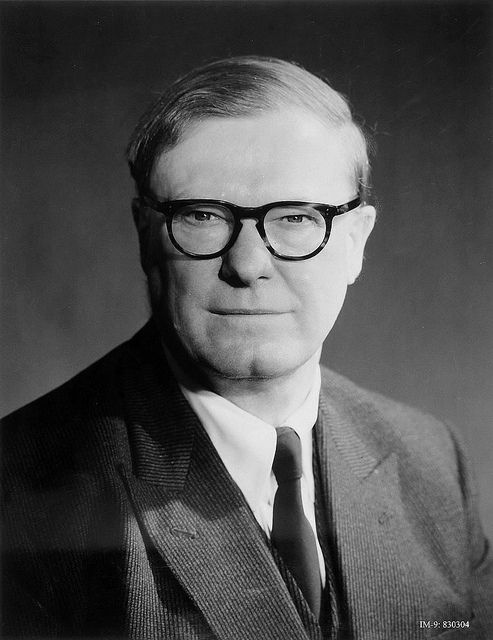
William Penney, Baron Penney
William George Penney, Baron Penney, OM, KBE, FRS, FRSE (24 June 1909 – 3 March 1991) was an English mathematician and professor of mathematical physics at the Imperial College London and later the rector of Imperial College London. He had a leading role in the development of High Explosive Research, Britain's clandestine nuclear programme that started in 1942 during the Second World War which produced the first British atomic bomb in 1952.
As the head of the British delegation working on the Manhattan Project at Los Alamos Laboratory, Penney initially carried out calculations to predict the damage effects generated by the blast wave of an atomic bomb. Upon returning home, Penney directed the British nuclear weapons directorate, codenamed Tube Alloys and directed scientific research at the Atomic Weapons Research Establishment which resulted in the first detonation of a British nuclear bomb in Operation Hurricane in 1952. After the test, Penney became chief advisor to the new United Kingdom Atomic Energy Authority (UKAEA). He was later chairman of the authority, which he used in international negotiations to control nuclear testing with the Partial Nuclear Test Ban Treaty.
Penney's notable scientific contributions included the mathematics for complex wave dynamics, both in shock and gravity waves, proposing optimisation problems and solutions in hydrodynamics (which plays a major role in materials science and metallurgy.) During his later years, Penney lectured in mathematics and physics; he was the Rector of Imperial College London 1967–1973.
William George Penney was born in Gibraltar on 24 June 1909, the oldest child and only son of William Alfred Penney, a sergeant-major in the British Army's Ordnance Corps who was then serving overseas, and Blanche Evelyn Johnson, who had worked as a cashier before her marriage. His parents moved about frequently, but Penney did not always accompany them. After the outbreak of the First World War, Penney, his mother and his sisters moved to Sheerness, Kent, where he went to primary school. He then attended a school near Colchester, and finally, was at Sheerness Technical School for Boys from 1924 to 1926, where he displayed a talent for science. He participated in boxing and athletics, winning the school's 100-yard (91 m) dash. He also played cricket, and he was centre-forward on the school football team.
In 1927, Penney's passion for science landed him in a local science laboratory where he worked for 10 shillings a week (equivalent to £38 in 2023) as a laboratory assistant. This helped him to gain a Kent county scholarship and a royal scholarship to the Royal College of Science (RCS), a constituent college of Imperial College London. He played centre-forward on the RCS soccer team. He was permitted to skip the first year of the course, and graduated in 1929, obtaining his Bachelor of Science degree in mathematics with First Class Honours at age 20. His talent was recognised by the Governor's Prize for Mathematics from the faculty of science.
Penney was offered a research position at the London University, where he studied for a doctorate. He spent a term at the University of Groningen in the Netherlands, where he worked with Ralph Kronig. Together, they developed the Kronig–Penney model, which described the motions of electrons in periodic fields. Penney was awarded his Doctor of Philosophy (PhD) in Mathematics in 1931. He accepted a Commonwealth Fund Fellowship and travelled to the United States, where he became foreign research associate at the University of Wisconsin–Madison, studying under John H. Van Vleck, and was awarded a Master of Arts degree. While in the United States he visited Carl Anderson's laboratory at the California Institute of Technology and Ernest Lawrence's Radiation Laboratory at the University of California. He was a guest at Robert Oppenheimer's ranch in New Mexico, saw Babe Ruth play baseball, and was a spectator at the 1932 Los Angeles Olympics.
On returning to England in 1933, Penney was granted the 1851 Exhibition Scholarship to attend Trinity College, Cambridge. He changed his mathematical career to physics, and conducted a thorough research and theoretical investigation into the structure of metals and the magnetic properties of crystals with John Lennard-Jones. In 1935, Penney submitted his final thesis, which contained the fundamental work in the applications of quantum mechanics to the physics of crystals. The University of Cambridge awarded him a PhD in 1935 and a Doctor of Science in Mathematical Physics in 1936. In 1936, he was elected to the Stokes studentship at Pembroke College, Cambridge, but in the same year he returned to London and was appointed Reader in Mathematics at Imperial College London, a post he held from 1936 to 1945. On 27 July 1935, Penney married Adele Minnie Elms, a university student from Kent he had known since his days in Sheerness. They had two sons, Martin, who was born in 1938, and Christopher, who was born in 1941.
Penney registered himself as available for scientific war work, but heard nothing for several months after the outbreak of the Second World War in September 1939. He was then approached by Geoffrey Taylor. Taylor was an expert on fluid dynamics, and was dealing with more questions from government departments regarding the effects of explosions than he had time to answer. He asked Penney if he could investigate the behaviour of an underwater explosion. Penney became a member of the Physics of Explosives Committee (Physex), and reported his results to another committee, Undex, which was run by the Admiralty and was interested in underwater explosions such as those created by mines, torpedoes and depth charges, and their effects on the hulls of ships and submarines. Most of the data on underwater explosions was from the First World War.
Hub AI
William Penney, Baron Penney AI simulator
(@William Penney, Baron Penney_simulator)
William Penney, Baron Penney
William George Penney, Baron Penney, OM, KBE, FRS, FRSE (24 June 1909 – 3 March 1991) was an English mathematician and professor of mathematical physics at the Imperial College London and later the rector of Imperial College London. He had a leading role in the development of High Explosive Research, Britain's clandestine nuclear programme that started in 1942 during the Second World War which produced the first British atomic bomb in 1952.
As the head of the British delegation working on the Manhattan Project at Los Alamos Laboratory, Penney initially carried out calculations to predict the damage effects generated by the blast wave of an atomic bomb. Upon returning home, Penney directed the British nuclear weapons directorate, codenamed Tube Alloys and directed scientific research at the Atomic Weapons Research Establishment which resulted in the first detonation of a British nuclear bomb in Operation Hurricane in 1952. After the test, Penney became chief advisor to the new United Kingdom Atomic Energy Authority (UKAEA). He was later chairman of the authority, which he used in international negotiations to control nuclear testing with the Partial Nuclear Test Ban Treaty.
Penney's notable scientific contributions included the mathematics for complex wave dynamics, both in shock and gravity waves, proposing optimisation problems and solutions in hydrodynamics (which plays a major role in materials science and metallurgy.) During his later years, Penney lectured in mathematics and physics; he was the Rector of Imperial College London 1967–1973.
William George Penney was born in Gibraltar on 24 June 1909, the oldest child and only son of William Alfred Penney, a sergeant-major in the British Army's Ordnance Corps who was then serving overseas, and Blanche Evelyn Johnson, who had worked as a cashier before her marriage. His parents moved about frequently, but Penney did not always accompany them. After the outbreak of the First World War, Penney, his mother and his sisters moved to Sheerness, Kent, where he went to primary school. He then attended a school near Colchester, and finally, was at Sheerness Technical School for Boys from 1924 to 1926, where he displayed a talent for science. He participated in boxing and athletics, winning the school's 100-yard (91 m) dash. He also played cricket, and he was centre-forward on the school football team.
In 1927, Penney's passion for science landed him in a local science laboratory where he worked for 10 shillings a week (equivalent to £38 in 2023) as a laboratory assistant. This helped him to gain a Kent county scholarship and a royal scholarship to the Royal College of Science (RCS), a constituent college of Imperial College London. He played centre-forward on the RCS soccer team. He was permitted to skip the first year of the course, and graduated in 1929, obtaining his Bachelor of Science degree in mathematics with First Class Honours at age 20. His talent was recognised by the Governor's Prize for Mathematics from the faculty of science.
Penney was offered a research position at the London University, where he studied for a doctorate. He spent a term at the University of Groningen in the Netherlands, where he worked with Ralph Kronig. Together, they developed the Kronig–Penney model, which described the motions of electrons in periodic fields. Penney was awarded his Doctor of Philosophy (PhD) in Mathematics in 1931. He accepted a Commonwealth Fund Fellowship and travelled to the United States, where he became foreign research associate at the University of Wisconsin–Madison, studying under John H. Van Vleck, and was awarded a Master of Arts degree. While in the United States he visited Carl Anderson's laboratory at the California Institute of Technology and Ernest Lawrence's Radiation Laboratory at the University of California. He was a guest at Robert Oppenheimer's ranch in New Mexico, saw Babe Ruth play baseball, and was a spectator at the 1932 Los Angeles Olympics.
On returning to England in 1933, Penney was granted the 1851 Exhibition Scholarship to attend Trinity College, Cambridge. He changed his mathematical career to physics, and conducted a thorough research and theoretical investigation into the structure of metals and the magnetic properties of crystals with John Lennard-Jones. In 1935, Penney submitted his final thesis, which contained the fundamental work in the applications of quantum mechanics to the physics of crystals. The University of Cambridge awarded him a PhD in 1935 and a Doctor of Science in Mathematical Physics in 1936. In 1936, he was elected to the Stokes studentship at Pembroke College, Cambridge, but in the same year he returned to London and was appointed Reader in Mathematics at Imperial College London, a post he held from 1936 to 1945. On 27 July 1935, Penney married Adele Minnie Elms, a university student from Kent he had known since his days in Sheerness. They had two sons, Martin, who was born in 1938, and Christopher, who was born in 1941.
Penney registered himself as available for scientific war work, but heard nothing for several months after the outbreak of the Second World War in September 1939. He was then approached by Geoffrey Taylor. Taylor was an expert on fluid dynamics, and was dealing with more questions from government departments regarding the effects of explosions than he had time to answer. He asked Penney if he could investigate the behaviour of an underwater explosion. Penney became a member of the Physics of Explosives Committee (Physex), and reported his results to another committee, Undex, which was run by the Admiralty and was interested in underwater explosions such as those created by mines, torpedoes and depth charges, and their effects on the hulls of ships and submarines. Most of the data on underwater explosions was from the First World War.