



Community hub
Recent from talks
Knowledge base stats:
Talk channels stats:
Members stats:
Operation Hurricane
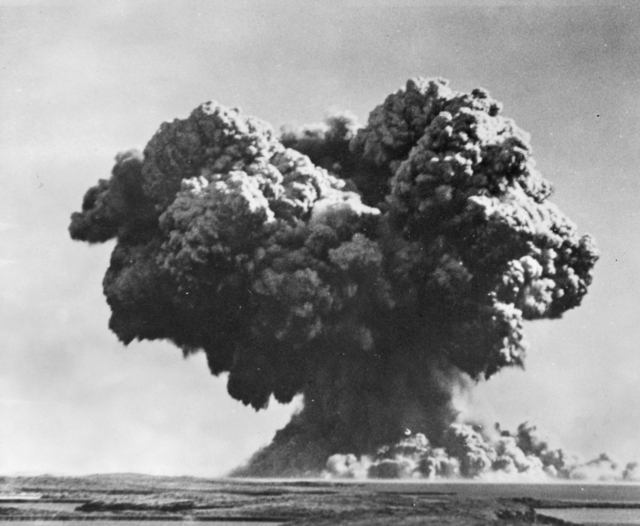
Operation Hurricane was the first test of a British atomic device. A plutonium implosion device was detonated on 3 October 1952 in Main Bay, Trimouille Island, in the Montebello Islands in Western Australia. With the success of Operation Hurricane, the United Kingdom became the third nuclear power, after the United States and the Soviet Union.
During the Second World War, Britain commenced a nuclear weapons project, code-named Tube Alloys, but the 1943 Quebec Agreement merged it with the American Manhattan Project. Several key British scientists worked on the Manhattan Project, but after the war the American government ended cooperation on nuclear weapons. In January 1947, a cabinet sub-committee decided to resume British efforts to build nuclear weapons, in response to an apprehension of American isolationism and fears of Britain losing its great power status. The project was called High Explosive Research, and was directed by Lord Portal, with William Penney in charge of bomb design.
Implicit in the decision to develop atomic bombs was the need to test them. The preferred site was the Pacific Proving Grounds in the US-controlled Marshall Islands. As a fallback, sites in Canada and Australia were considered. The Admiralty suggested that the Montebello Islands might be suitable, so the prime minister of the United Kingdom, Clement Attlee, sent a request to the Prime Minister of Australia, Robert Menzies. The Australian government formally agreed to the islands being used as a nuclear test site in May 1951. In February 1952, Attlee's successor, Winston Churchill, announced in the House of Commons that the first British atomic bomb test would occur in Australia before the end of the year.
A small fleet was assembled for Operation Hurricane under the command of Rear Admiral A. D. Torlesse; it included the escort carrier HMS Campania, which served as the flagship, and the LSTs Narvik, Zeebrugge and Tracker. Leonard Tyte from the Atomic Weapons Research Establishment at Aldermaston was appointed the technical director. The bomb for Operation Hurricane was assembled (without its radioactive components) at Foulness and taken to the frigate HMS Plym for transport to Australia. On reaching the Montebello Islands, the five Royal Navy ships were joined by eleven Royal Australian Navy ships, including the aircraft carrier HMAS Sydney. To test the effects of a ship-smuggled atomic bomb on a port (a threat of great concern to the British at the time), the bomb was exploded inside the hull of Plym, anchored 350 metres (1,150 ft) off Trimouille Island. The explosion occurred 2.7 metres (8 ft 10 in) below the water line and left a saucer-shaped crater on the seabed 6 metres (20 ft) deep and 300 metres (980 ft) across.
The December 1938 discovery of nuclear fission by Otto Hahn and Fritz Strassmann—and its explanation and naming by Lise Meitner and Otto Frisch—raised the possibility that an extremely powerful "atomic bomb" could be created. During the Second World War, Frisch and Rudolf Peierls at the University of Birmingham calculated the critical mass of a metallic sphere of pure uranium-235, and found that instead of tonnes, as everyone had assumed, as little as 1 to 10 kilograms (2 to 22 lb) would suffice, which would explode with the power of thousands of tonnes of dynamite. In response, Britain initiated an atomic bomb project, codenamed Tube Alloys.
At the Quebec Conference in August 1943, the prime minister of the United Kingdom, Winston Churchill, and the president of the United States, Franklin Roosevelt, signed the Quebec Agreement, which merged Tube Alloys with the American Manhattan Project to create a combined British, American and Canadian project. The British contribution to the Manhattan Project included assistance in the development of gaseous diffusion technology at the SAM Laboratories in New York, and the electromagnetic separation process at the Berkeley Radiation Laboratory. John Cockcroft became the director of the joint British-Canadian Montreal Laboratory. A British mission to the Los Alamos Laboratory led by James Chadwick, and later Peierls, included scientists such as Geoffrey Taylor, James Tuck, Niels Bohr, William Penney, Frisch, Ernest Titterton, and Klaus Fuchs, who was later revealed to be a spy for the Soviet Union. As overall head of the British Mission, Chadwick forged a close and successful partnership with Brigadier General Leslie R. Groves, the director of the Manhattan Project, and ensured that British participation was complete and wholehearted.
With the end of the war the Special Relationship between Britain and the United States "became very much less special". The British government had trusted that America would share nuclear technology, which the British saw as a joint discovery, but the terms of the Quebec Agreement remained secret. Senior members of the United States Congress were horrified when they discovered that it gave the British a veto over the use of nuclear weapons. On 9 November 1945, the new prime minister of the United Kingdom, Clement Attlee, and the prime minister of Canada, William Lyon Mackenzie King, went to Washington, D.C., to confer with Truman about future cooperation in nuclear weapons and nuclear power. They signed a Memorandum of Intention that replaced the Quebec Agreement. It made Canada a full partner, and reduced the obligation to obtain consent for the use of nuclear weapons to merely requiring consultation. The three leaders agreed that there would be full and effective cooperation on civil and military applications of atomic energy, but the British were soon disappointed; the Americans made it clear that cooperation was restricted to basic scientific research. The Atomic Energy Act of 1946 (McMahon Act) ended technical cooperation. Its control of "restricted data" prevented the United States' allies from receiving any information.
Attlee set up a cabinet sub-committee, the Gen 75 Committee (known informally as the "Atomic Bomb Committee"), on 10 August 1945 to examine the feasibility of a nuclear weapons program. In October 1945, it accepted a recommendation that responsibility be placed within the Ministry of Supply. The Tube Alloys Directorate was transferred from the Department of Scientific and Industrial Research to the Ministry of Supply on 1 November 1945. To coordinate the effort, Lord Portal, the wartime Chief of the Air Staff, was appointed Controller of Production, Atomic Energy (CPAE), with direct access to the Prime Minister. An Atomic Energy Research Establishment (AERE) was established at RAF Harwell, south of Oxford, under the directorship of Cockcroft. AERE moved to Aldermaston in 1952. Christopher Hinton agreed to oversee the design, construction and operation of the new atomic weapons facilities. These included a new uranium plant at Springfields in Lancashire, and nuclear reactors and plutonium processing facilities at Windscale in Cumbria. Hinton established his headquarters in a former Royal Ordnance Factory at Risley in Lancashire on 4 February 1946.
Hub AI
Operation Hurricane AI simulator
(@Operation Hurricane_simulator)
Operation Hurricane
Operation Hurricane was the first test of a British atomic device. A plutonium implosion device was detonated on 3 October 1952 in Main Bay, Trimouille Island, in the Montebello Islands in Western Australia. With the success of Operation Hurricane, the United Kingdom became the third nuclear power, after the United States and the Soviet Union.
During the Second World War, Britain commenced a nuclear weapons project, code-named Tube Alloys, but the 1943 Quebec Agreement merged it with the American Manhattan Project. Several key British scientists worked on the Manhattan Project, but after the war the American government ended cooperation on nuclear weapons. In January 1947, a cabinet sub-committee decided to resume British efforts to build nuclear weapons, in response to an apprehension of American isolationism and fears of Britain losing its great power status. The project was called High Explosive Research, and was directed by Lord Portal, with William Penney in charge of bomb design.
Implicit in the decision to develop atomic bombs was the need to test them. The preferred site was the Pacific Proving Grounds in the US-controlled Marshall Islands. As a fallback, sites in Canada and Australia were considered. The Admiralty suggested that the Montebello Islands might be suitable, so the prime minister of the United Kingdom, Clement Attlee, sent a request to the Prime Minister of Australia, Robert Menzies. The Australian government formally agreed to the islands being used as a nuclear test site in May 1951. In February 1952, Attlee's successor, Winston Churchill, announced in the House of Commons that the first British atomic bomb test would occur in Australia before the end of the year.
A small fleet was assembled for Operation Hurricane under the command of Rear Admiral A. D. Torlesse; it included the escort carrier HMS Campania, which served as the flagship, and the LSTs Narvik, Zeebrugge and Tracker. Leonard Tyte from the Atomic Weapons Research Establishment at Aldermaston was appointed the technical director. The bomb for Operation Hurricane was assembled (without its radioactive components) at Foulness and taken to the frigate HMS Plym for transport to Australia. On reaching the Montebello Islands, the five Royal Navy ships were joined by eleven Royal Australian Navy ships, including the aircraft carrier HMAS Sydney. To test the effects of a ship-smuggled atomic bomb on a port (a threat of great concern to the British at the time), the bomb was exploded inside the hull of Plym, anchored 350 metres (1,150 ft) off Trimouille Island. The explosion occurred 2.7 metres (8 ft 10 in) below the water line and left a saucer-shaped crater on the seabed 6 metres (20 ft) deep and 300 metres (980 ft) across.
The December 1938 discovery of nuclear fission by Otto Hahn and Fritz Strassmann—and its explanation and naming by Lise Meitner and Otto Frisch—raised the possibility that an extremely powerful "atomic bomb" could be created. During the Second World War, Frisch and Rudolf Peierls at the University of Birmingham calculated the critical mass of a metallic sphere of pure uranium-235, and found that instead of tonnes, as everyone had assumed, as little as 1 to 10 kilograms (2 to 22 lb) would suffice, which would explode with the power of thousands of tonnes of dynamite. In response, Britain initiated an atomic bomb project, codenamed Tube Alloys.
At the Quebec Conference in August 1943, the prime minister of the United Kingdom, Winston Churchill, and the president of the United States, Franklin Roosevelt, signed the Quebec Agreement, which merged Tube Alloys with the American Manhattan Project to create a combined British, American and Canadian project. The British contribution to the Manhattan Project included assistance in the development of gaseous diffusion technology at the SAM Laboratories in New York, and the electromagnetic separation process at the Berkeley Radiation Laboratory. John Cockcroft became the director of the joint British-Canadian Montreal Laboratory. A British mission to the Los Alamos Laboratory led by James Chadwick, and later Peierls, included scientists such as Geoffrey Taylor, James Tuck, Niels Bohr, William Penney, Frisch, Ernest Titterton, and Klaus Fuchs, who was later revealed to be a spy for the Soviet Union. As overall head of the British Mission, Chadwick forged a close and successful partnership with Brigadier General Leslie R. Groves, the director of the Manhattan Project, and ensured that British participation was complete and wholehearted.
With the end of the war the Special Relationship between Britain and the United States "became very much less special". The British government had trusted that America would share nuclear technology, which the British saw as a joint discovery, but the terms of the Quebec Agreement remained secret. Senior members of the United States Congress were horrified when they discovered that it gave the British a veto over the use of nuclear weapons. On 9 November 1945, the new prime minister of the United Kingdom, Clement Attlee, and the prime minister of Canada, William Lyon Mackenzie King, went to Washington, D.C., to confer with Truman about future cooperation in nuclear weapons and nuclear power. They signed a Memorandum of Intention that replaced the Quebec Agreement. It made Canada a full partner, and reduced the obligation to obtain consent for the use of nuclear weapons to merely requiring consultation. The three leaders agreed that there would be full and effective cooperation on civil and military applications of atomic energy, but the British were soon disappointed; the Americans made it clear that cooperation was restricted to basic scientific research. The Atomic Energy Act of 1946 (McMahon Act) ended technical cooperation. Its control of "restricted data" prevented the United States' allies from receiving any information.
Attlee set up a cabinet sub-committee, the Gen 75 Committee (known informally as the "Atomic Bomb Committee"), on 10 August 1945 to examine the feasibility of a nuclear weapons program. In October 1945, it accepted a recommendation that responsibility be placed within the Ministry of Supply. The Tube Alloys Directorate was transferred from the Department of Scientific and Industrial Research to the Ministry of Supply on 1 November 1945. To coordinate the effort, Lord Portal, the wartime Chief of the Air Staff, was appointed Controller of Production, Atomic Energy (CPAE), with direct access to the Prime Minister. An Atomic Energy Research Establishment (AERE) was established at RAF Harwell, south of Oxford, under the directorship of Cockcroft. AERE moved to Aldermaston in 1952. Christopher Hinton agreed to oversee the design, construction and operation of the new atomic weapons facilities. These included a new uranium plant at Springfields in Lancashire, and nuclear reactors and plutonium processing facilities at Windscale in Cumbria. Hinton established his headquarters in a former Royal Ordnance Factory at Risley in Lancashire on 4 February 1946.