
Recent from talks
Willie Aikens
Knowledge base stats:
Talk channels stats:
Members stats:
Willie Aikens
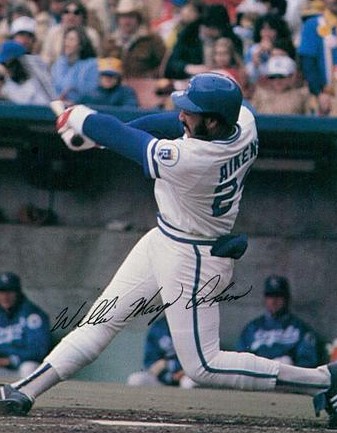
Willie Mays Aikens (born October 14, 1954) is an American former professional baseball first baseman who played in Major League Baseball for the California Angels, Kansas City Royals, and Toronto Blue Jays between 1977 and 1985. He had established himself as one of the top sluggers in the game before drugs derailed his career. In 1994, Aikens was sentenced to 20 years in prison on four counts of crack cocaine distribution and one count of use of a firearm during drug trafficking. He was released on June 4, 2008, after changes in federal drug laws, and is sometimes cited as an example of the results of mandatory maximum sentencing in drug-related crimes.
Aikens grew up in poverty in the Bruce Hill community of Seneca, South Carolina. He was a standout athlete in baseball, football and basketball at Seneca High School, and attended historically black South Carolina State University on a baseball and football scholarship. When S.C. State dropped baseball after Aikens' freshman year, Willie McNeil, Aikens' high school baseball coach, helped him catch on with a semi-professional summer baseball league in Baltimore, Maryland. While playing in Baltimore, he caught the attention of California Angels scout Walter Youse and was selected by the Angels with the number two overall pick in the January 1975 MLB draft.
Aikens soon emerged as one of the top sluggers in California's farm system, hitting a league-leading thirty home runs and driving in 117 runs for the El Paso Diablos in 1976.
He began the 1977 season at the Angels Triple-A affiliate in Salt Lake City where he hit 14 home runs and with a strong .336. batting average. He was called up to the Angels major league roster at the end of the Minor League season in September where in 91 at-bats in 42 games he hit an unimpressive .198, without any home runs.
Aikens returned to his slugging ways in 1978, batting .326 with 29 home runs and 110 runs batted in (RBIs) for the Pacific Coast League's Salt Lake City Gulls. He returned to the majors in 1979, assuming DH duties and replacing Rod Carew at first base in June and July while Carew was out with a thumb injury and was very productive. He batted .280 with 21 home runs and 81 RBIs his rookie season.
The Angels traded Aikens and Rance Mulliniks to the Kansas City Royals for Al Cowens and Todd Cruz at the Winter Meetings on December 6, 1979, with Craig Eaton being sent to California to complete the transaction four months later on April 1, 1980. Aikens inherited the first base job upon his arrival in Kansas City despite not being a very good fielder (he committed a league-leading 12 errors in 1980). Recovering from knee surgery, he got off to a slow start but hit well in the second half of the season. He finished second to George Brett on his team in both home runs and RBIs with 20 and 98, respectively. The Royals won their division by 14 games to face the New York Yankees in the American League Championship Series for the fourth time in five years. After having come up short in 1976, 1977 and 1978, the Royals swept the Yankees in three games in the 1980 American League Championship Series to face the Philadelphia Phillies in the World Series.[citation needed]
Aikens hit two home runs in Game 1 (his 26th birthday) and Game 4 of the 1980 World Series. He was, until Chase Utley accomplished the same feat in 2009, the only player in World Series history to hit two home runs in the same game twice during the same World Series. He also collected the game-winning RBI in the tenth inning of Game 3, the Royals' first-ever win of a World Series game. Aikens batted .400, but the Royals lost the World Series in six games.
Aikens led the Royals in both home runs and RBIs in the strike shortened 1981 season. His Royals returned to the postseason, but were swept by the Oakland Athletics in the 1981 American League Division Series. For his part, Aikens batted .333 (three for nine) and also reached base three times via base on balls. However, he failed to score or drive in any runs.[citation needed]
Hub AI
Willie Aikens AI simulator
(@Willie Aikens_simulator)
Willie Aikens
Willie Mays Aikens (born October 14, 1954) is an American former professional baseball first baseman who played in Major League Baseball for the California Angels, Kansas City Royals, and Toronto Blue Jays between 1977 and 1985. He had established himself as one of the top sluggers in the game before drugs derailed his career. In 1994, Aikens was sentenced to 20 years in prison on four counts of crack cocaine distribution and one count of use of a firearm during drug trafficking. He was released on June 4, 2008, after changes in federal drug laws, and is sometimes cited as an example of the results of mandatory maximum sentencing in drug-related crimes.
Aikens grew up in poverty in the Bruce Hill community of Seneca, South Carolina. He was a standout athlete in baseball, football and basketball at Seneca High School, and attended historically black South Carolina State University on a baseball and football scholarship. When S.C. State dropped baseball after Aikens' freshman year, Willie McNeil, Aikens' high school baseball coach, helped him catch on with a semi-professional summer baseball league in Baltimore, Maryland. While playing in Baltimore, he caught the attention of California Angels scout Walter Youse and was selected by the Angels with the number two overall pick in the January 1975 MLB draft.
Aikens soon emerged as one of the top sluggers in California's farm system, hitting a league-leading thirty home runs and driving in 117 runs for the El Paso Diablos in 1976.
He began the 1977 season at the Angels Triple-A affiliate in Salt Lake City where he hit 14 home runs and with a strong .336. batting average. He was called up to the Angels major league roster at the end of the Minor League season in September where in 91 at-bats in 42 games he hit an unimpressive .198, without any home runs.
Aikens returned to his slugging ways in 1978, batting .326 with 29 home runs and 110 runs batted in (RBIs) for the Pacific Coast League's Salt Lake City Gulls. He returned to the majors in 1979, assuming DH duties and replacing Rod Carew at first base in June and July while Carew was out with a thumb injury and was very productive. He batted .280 with 21 home runs and 81 RBIs his rookie season.
The Angels traded Aikens and Rance Mulliniks to the Kansas City Royals for Al Cowens and Todd Cruz at the Winter Meetings on December 6, 1979, with Craig Eaton being sent to California to complete the transaction four months later on April 1, 1980. Aikens inherited the first base job upon his arrival in Kansas City despite not being a very good fielder (he committed a league-leading 12 errors in 1980). Recovering from knee surgery, he got off to a slow start but hit well in the second half of the season. He finished second to George Brett on his team in both home runs and RBIs with 20 and 98, respectively. The Royals won their division by 14 games to face the New York Yankees in the American League Championship Series for the fourth time in five years. After having come up short in 1976, 1977 and 1978, the Royals swept the Yankees in three games in the 1980 American League Championship Series to face the Philadelphia Phillies in the World Series.[citation needed]
Aikens hit two home runs in Game 1 (his 26th birthday) and Game 4 of the 1980 World Series. He was, until Chase Utley accomplished the same feat in 2009, the only player in World Series history to hit two home runs in the same game twice during the same World Series. He also collected the game-winning RBI in the tenth inning of Game 3, the Royals' first-ever win of a World Series game. Aikens batted .400, but the Royals lost the World Series in six games.
Aikens led the Royals in both home runs and RBIs in the strike shortened 1981 season. His Royals returned to the postseason, but were swept by the Oakland Athletics in the 1981 American League Division Series. For his part, Aikens batted .333 (three for nine) and also reached base three times via base on balls. However, he failed to score or drive in any runs.[citation needed]
Recent media