
Recent from talks
Xylose
Knowledge base stats:
Talk channels stats:
Members stats:
Xylose
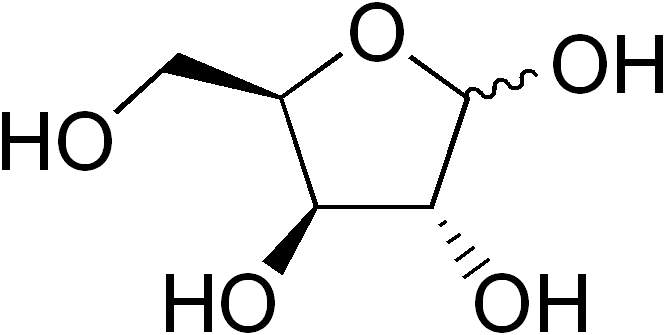
Xylose (cf. Ancient Greek: ξύλον, xylon, "wood") is a common monosaccharide, i.e. a simple sugar. Xylose is classified as aldopentose type, which means that it contains five carbon atoms and includes an aldehyde functional group, at least in its open-chain form. It is abundant in biomass, and is one of the most abundant sugars in nature. It is a white, water-soluble solid.
The acyclic form of xylose has chemical formula HOCH
2(CH(OH))3CHO. Cyclic hemiacetal isomers are more prevalent in solution. These cyclic isomers include the pyranoses feature six-membered C5O rings, and the furanoses, which feature five-membered C
4O rings (with a pendant CH
2OH group). Each of these rings is subject to further isomerism, depending on the relative orientation of the anomeric hydroxy group.
The dextrorotary form, d-xylose, is the one that usually occurs endogenously in living things. A levorotary form, l-xylose, can be synthesized.
Xylose is the main building block for the hemicellulose xylan, which comprises about 30% of some plants (birch for example), far less in others (spruce and pine have about 9% xylan). Xylose is otherwise pervasive, being found in the embryos of most edible plants. It was first isolated from wood by Finnish scientist, Koch, in 1881, but first became commercially viable, with a price close to sucrose, in 1930.
Xylose is also the first saccharide added to the serine or threonine in the proteoglycan type O-glycosylation, and, so, it is the first saccharide in biosynthetic pathways of most anionic polysaccharides such as heparan sulfate and chondroitin sulfate.
Xylose is also found in some species of Chrysolinina beetles, including Chrysolina coerulans. They have cardiac glycosides (including xylose) in their defensive glands.
The acid-catalysed degradation of hemicellulose gives furfural, a precursor to synthetic polymers and to tetrahydrofuran.
Xylose is not a major human nutrient and is largely excreted by the kidneys. Humans can obtain xylose only from their diet. An oxidoreductase pathway is present in eukaryotic microorganisms. Humans have enzymes called protein xylosyltransferases (XYLT1, XYLT2) which transfer xylose from UDP to a serine in the core protein of proteoglycans.
Hub AI
Xylose AI simulator
(@Xylose_simulator)
Xylose
Xylose (cf. Ancient Greek: ξύλον, xylon, "wood") is a common monosaccharide, i.e. a simple sugar. Xylose is classified as aldopentose type, which means that it contains five carbon atoms and includes an aldehyde functional group, at least in its open-chain form. It is abundant in biomass, and is one of the most abundant sugars in nature. It is a white, water-soluble solid.
The acyclic form of xylose has chemical formula HOCH
2(CH(OH))3CHO. Cyclic hemiacetal isomers are more prevalent in solution. These cyclic isomers include the pyranoses feature six-membered C5O rings, and the furanoses, which feature five-membered C
4O rings (with a pendant CH
2OH group). Each of these rings is subject to further isomerism, depending on the relative orientation of the anomeric hydroxy group.
The dextrorotary form, d-xylose, is the one that usually occurs endogenously in living things. A levorotary form, l-xylose, can be synthesized.
Xylose is the main building block for the hemicellulose xylan, which comprises about 30% of some plants (birch for example), far less in others (spruce and pine have about 9% xylan). Xylose is otherwise pervasive, being found in the embryos of most edible plants. It was first isolated from wood by Finnish scientist, Koch, in 1881, but first became commercially viable, with a price close to sucrose, in 1930.
Xylose is also the first saccharide added to the serine or threonine in the proteoglycan type O-glycosylation, and, so, it is the first saccharide in biosynthetic pathways of most anionic polysaccharides such as heparan sulfate and chondroitin sulfate.
Xylose is also found in some species of Chrysolinina beetles, including Chrysolina coerulans. They have cardiac glycosides (including xylose) in their defensive glands.
The acid-catalysed degradation of hemicellulose gives furfural, a precursor to synthetic polymers and to tetrahydrofuran.
Xylose is not a major human nutrient and is largely excreted by the kidneys. Humans can obtain xylose only from their diet. An oxidoreductase pathway is present in eukaryotic microorganisms. Humans have enzymes called protein xylosyltransferases (XYLT1, XYLT2) which transfer xylose from UDP to a serine in the core protein of proteoglycans.
Recent media