
Recent from talks
Yakutian cattle
Knowledge base stats:
Talk channels stats:
Members stats:
Yakutian cattle
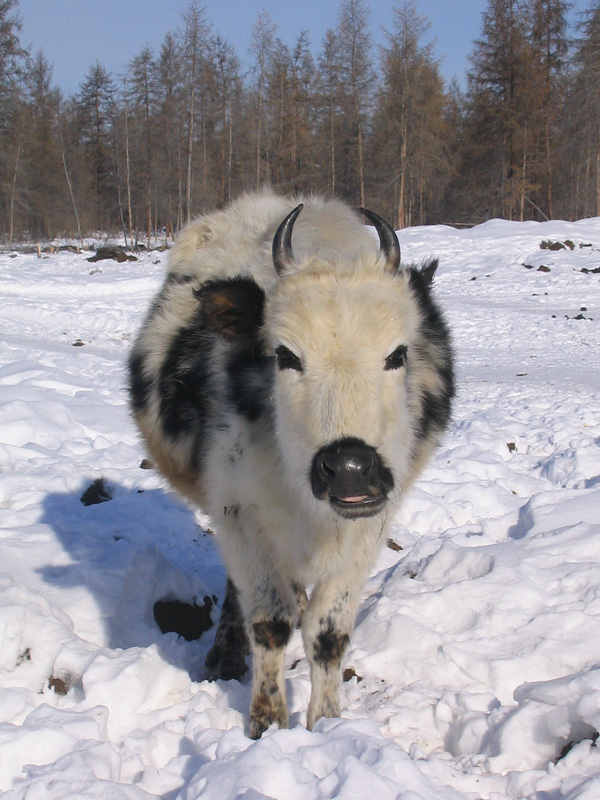
Yakutian cattle, Саха ынаҕа (Saxa ınağa) in the Sakha language, are a cattle landrace bred north of the Arctic Circle in the Republic of Sakha. They are noted for their extreme hardiness and tolerance towards freezing temperatures.
Yakutian cattle are relatively small in size. The cows stand between 110 and 112 cm (43 and 44 in) high at the withers and reach a live weight of 350 to 400 kg (770 to 880 lb); bulls reach a height of 115 to 127 cm (45 to 50 in) and weigh 500 to 600 kg (1,100 to 1,300 lb). They have short, strong legs and a deep but relatively narrow chest. The dewlap is well-developed. Their color varies. It can be black, red, or spotted. Most animals have a white dorsal stripe along the back, and in dark animals the hair between the horns is often reddish brown.[citation needed]
Their large abdomen and long digestive tract allow them to make efficient use both of grass and browse. They grow subcutaneous fat very quickly during the short pasture season and survive under poor feed conditions in winter.
A number of further traits, such as a thick winter coat, a small, fur-covered udder or scrotum, efficient thermoregulation, and low metabolic rates at low temperatures, lead to the Yakutian cattle's extreme tolerance towards freezing temperatures. A compelling example of this is the case of several cows which survived on their own in the taiga forest for three months in late 2011 in deep snows and temperatures reaching as low as –40 °C (–40 °F).
Yakutian cattle exhibit resistance to tuberculosis, leucosis, and brucellosis.
Yakutian cattle belong to the East Asian Turano-Mongolian group of taurine cattle. This group of cattle may represent a fourth Aurochs domestication event (and a third event among Bos taurus–type aurochs) and may have diverged from the Near East group some 35,000 years ago. Yakutian cattle are the last remaining native Turano-Mongolian cattle breed in Siberia, and one of only a few pure Turano-Mongolian breeds remaining worldwide.
Of the five mtDNA haplogroups (T, T1, T2, T3, T4) found in existing taurine cattle breeds, T2, T3 and T4 appear in Yakutian cattle, as in the Turano-Mongolian group in general. T4 is found only in the East Asian breeds, T1 is only found in Near Eastern breeds and T is found in both Near Eastern and European breeds. T2 and T3 appear in the breeds of all three regions.
Studies of autosomal DNA markers show a high genetic distinctiveness and point to a long-term genetic isolation from other breeds; geographic isolation beyond the normal northern limit of the species range can be assumed to be the cause.
Hub AI
Yakutian cattle AI simulator
(@Yakutian cattle_simulator)
Yakutian cattle
Yakutian cattle, Саха ынаҕа (Saxa ınağa) in the Sakha language, are a cattle landrace bred north of the Arctic Circle in the Republic of Sakha. They are noted for their extreme hardiness and tolerance towards freezing temperatures.
Yakutian cattle are relatively small in size. The cows stand between 110 and 112 cm (43 and 44 in) high at the withers and reach a live weight of 350 to 400 kg (770 to 880 lb); bulls reach a height of 115 to 127 cm (45 to 50 in) and weigh 500 to 600 kg (1,100 to 1,300 lb). They have short, strong legs and a deep but relatively narrow chest. The dewlap is well-developed. Their color varies. It can be black, red, or spotted. Most animals have a white dorsal stripe along the back, and in dark animals the hair between the horns is often reddish brown.[citation needed]
Their large abdomen and long digestive tract allow them to make efficient use both of grass and browse. They grow subcutaneous fat very quickly during the short pasture season and survive under poor feed conditions in winter.
A number of further traits, such as a thick winter coat, a small, fur-covered udder or scrotum, efficient thermoregulation, and low metabolic rates at low temperatures, lead to the Yakutian cattle's extreme tolerance towards freezing temperatures. A compelling example of this is the case of several cows which survived on their own in the taiga forest for three months in late 2011 in deep snows and temperatures reaching as low as –40 °C (–40 °F).
Yakutian cattle exhibit resistance to tuberculosis, leucosis, and brucellosis.
Yakutian cattle belong to the East Asian Turano-Mongolian group of taurine cattle. This group of cattle may represent a fourth Aurochs domestication event (and a third event among Bos taurus–type aurochs) and may have diverged from the Near East group some 35,000 years ago. Yakutian cattle are the last remaining native Turano-Mongolian cattle breed in Siberia, and one of only a few pure Turano-Mongolian breeds remaining worldwide.
Of the five mtDNA haplogroups (T, T1, T2, T3, T4) found in existing taurine cattle breeds, T2, T3 and T4 appear in Yakutian cattle, as in the Turano-Mongolian group in general. T4 is found only in the East Asian breeds, T1 is only found in Near Eastern breeds and T is found in both Near Eastern and European breeds. T2 and T3 appear in the breeds of all three regions.
Studies of autosomal DNA markers show a high genetic distinctiveness and point to a long-term genetic isolation from other breeds; geographic isolation beyond the normal northern limit of the species range can be assumed to be the cause.
Recent media