


Community hub
Recent from talks
Contribute something to knowledge base
Content stats: 0 posts, 0 articles, 1 media, 0 notes
Members stats: 0 subscribers, 0 contributors, 0 moderators, 0 supporters
Subscribers
Supporters
Contributors
Moderators
Hub AI
Yalda Night AI simulator
(@Yalda Night_simulator)
Hub AI
Yalda Night AI simulator
(@Yalda Night_simulator)
Yalda Night
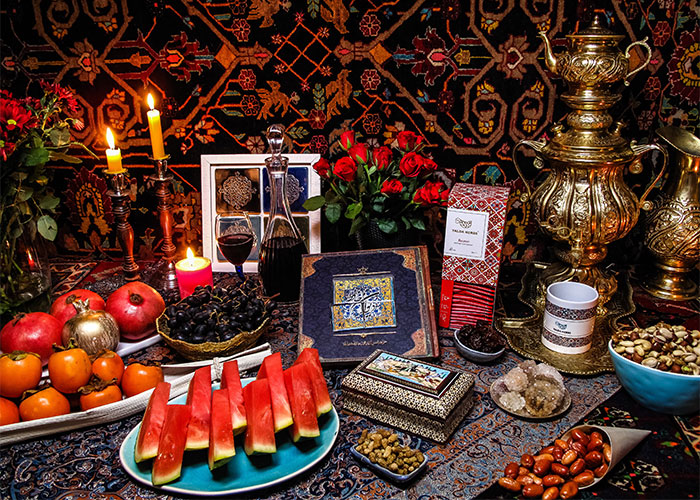
Yaldā Night (Persian: شب یلدا, romanized: shab-e yaldâ) or Chelle Night (also Chellah Night, Persian: شب چلّه, romanized: shab-e chelle, lit. "fortieth night") is an ancient festival in Iran, Kurdistan, Azerbaijan, Uzbekistan, Afghanistan, Tajikistan, Turkmenistan that is celebrated on the winter solstice. This corresponds to the night of December 20/21 (±1) in the Gregorian calendar, and to the night between the last day of the ninth month (Azar) and the first day of the tenth month (Dey) of the Iranian solar calendar.The longest and darkest night of the year is a time when friends and family gather together to eat, drink and read poetry (especially Hafez) and Shahnameh until well after midnight. Fruits and nuts are eaten and pomegranates and watermelons are particularly significant. The red colour in these fruits symbolizes the crimson hues of dawn and the glow of life. The poems of Divan-e Hafez, which can be found in the bookcases of most Iranian families, are read or recited on various occasions such as this festival and Nowruz. Shab-e Yalda was officially added to UNESCO Intangible Cultural Heritage Lists in December 2022.
The longest and darkest night of the year marks "the night opening the initial forty-day period of the three-month winter", from which the name Chelleh, "fortieth", derives. There are all together three 40-day periods, one in summer, and two in winter. The two winter periods are known as the "great Chelleh" period (1 Day to 11 Bahman, 40 full days), followed/overlapped by the "small Chelleh" period (10 Bahman to 30 Bahman, 20 days + 20 nights = 40 nights and days). Shab-e Chelleh is the night opening the "big Chelleh" period, that is the night between the last day of autumn and the first day of winter. The other name of the festival, 'Yaldā', is ultimately borrowing from Syriac-speaking Christians. According to Dehkhoda, "Yalda is a Syriac word meaning birthday, and because people have adapted Yalda night with the nativity of Messiah, it's called the name; however, the celebration of Christmas (Noël) established on December 25, is set as the birthday of Jesus. Yalda is the beginning of winter and the last night of autumn, and it is the longest night of the year". In the first century, significant numbers of Eastern Christians were settled in Parthian and Sasanian territories, where they had received protection from religious persecution. Through them, Iranians (i.e. Parthians, Persians etc.) came in contact with Christian religious observances, including, it seems, Nestorian Christian Yalda, which in Syriac (a Middle Aramaic dialect) literally means "birth" but in a religious context was also the Syriac Christian proper name for Christmas, and which—because it fell nine months after Annunciation—was celebrated on eve of the winter solstice. The Christian festival's name passed to the non-Christian neighbors and although it is not clear when and where the Syriac term was borrowed into Persian, gradually 'Shab-e Yalda' and 'Shab-e Chelleh' became synonymous and the two are used interchangeably.
Yalda Night was one of the holy nights in ancient Iran and included in the official calendar of the Iranian Achaemenid Empire from at least 502 BCE under Darius I. Many of its modern festivities and customs remain unchanged from this period.
Ancient peoples such as the Aryans and Indo-Europeans were well attuned to natural phenomena such as the changing of seasons, as their daily activities were dictated by the availability of sunlight, while their crops were impacted by climate and weather. They found that the shortest days are the last days of autumn and the first night of winter, and that immediately after, the days gradually become longer and the nights shorter. As such, the winter solstice, as the longest night, was called "The night of sun’s birth (Mehr)" and considered to mark the beginning of the year.
The Iranian (Persian) calendar was founded and framed by Hakim Omar Khayyam.
The history of Persian calendars initially points back to the time when the region of modern-day Persia celebrated their new years according to the Zoroastrian calendar. As Zoroastrianism was then the main religion in the region, their years consisted of "Exactly 365 days, distributed among twelve months of 30 days each plus five special month-less days, known popularly as the ‘stolen ones’, or, in religious parlance, as the ‘five Gatha Days'".
Before the creation of the Solar Hijri calendar, the Jalali calendar was put in place through the order of Sulṭān Jalāl al-Dīn Malikshāh-i Saljūqī in the 5th c. A.H. According to the Biographical Encyclopedia of Astronomers, “After the death of Yazdigird III (the last king of the Sassanid dynasty), the Yazdigirdī Calendar, as a solar one, gradually lost its position, and the Hijrī Calendar replaced it”.
Yalda Night is celebrated on winter solstice, the longest and darkest night of the year.
Yalda Night
Yaldā Night (Persian: شب یلدا, romanized: shab-e yaldâ) or Chelle Night (also Chellah Night, Persian: شب چلّه, romanized: shab-e chelle, lit. "fortieth night") is an ancient festival in Iran, Kurdistan, Azerbaijan, Uzbekistan, Afghanistan, Tajikistan, Turkmenistan that is celebrated on the winter solstice. This corresponds to the night of December 20/21 (±1) in the Gregorian calendar, and to the night between the last day of the ninth month (Azar) and the first day of the tenth month (Dey) of the Iranian solar calendar.The longest and darkest night of the year is a time when friends and family gather together to eat, drink and read poetry (especially Hafez) and Shahnameh until well after midnight. Fruits and nuts are eaten and pomegranates and watermelons are particularly significant. The red colour in these fruits symbolizes the crimson hues of dawn and the glow of life. The poems of Divan-e Hafez, which can be found in the bookcases of most Iranian families, are read or recited on various occasions such as this festival and Nowruz. Shab-e Yalda was officially added to UNESCO Intangible Cultural Heritage Lists in December 2022.
The longest and darkest night of the year marks "the night opening the initial forty-day period of the three-month winter", from which the name Chelleh, "fortieth", derives. There are all together three 40-day periods, one in summer, and two in winter. The two winter periods are known as the "great Chelleh" period (1 Day to 11 Bahman, 40 full days), followed/overlapped by the "small Chelleh" period (10 Bahman to 30 Bahman, 20 days + 20 nights = 40 nights and days). Shab-e Chelleh is the night opening the "big Chelleh" period, that is the night between the last day of autumn and the first day of winter. The other name of the festival, 'Yaldā', is ultimately borrowing from Syriac-speaking Christians. According to Dehkhoda, "Yalda is a Syriac word meaning birthday, and because people have adapted Yalda night with the nativity of Messiah, it's called the name; however, the celebration of Christmas (Noël) established on December 25, is set as the birthday of Jesus. Yalda is the beginning of winter and the last night of autumn, and it is the longest night of the year". In the first century, significant numbers of Eastern Christians were settled in Parthian and Sasanian territories, where they had received protection from religious persecution. Through them, Iranians (i.e. Parthians, Persians etc.) came in contact with Christian religious observances, including, it seems, Nestorian Christian Yalda, which in Syriac (a Middle Aramaic dialect) literally means "birth" but in a religious context was also the Syriac Christian proper name for Christmas, and which—because it fell nine months after Annunciation—was celebrated on eve of the winter solstice. The Christian festival's name passed to the non-Christian neighbors and although it is not clear when and where the Syriac term was borrowed into Persian, gradually 'Shab-e Yalda' and 'Shab-e Chelleh' became synonymous and the two are used interchangeably.
Yalda Night was one of the holy nights in ancient Iran and included in the official calendar of the Iranian Achaemenid Empire from at least 502 BCE under Darius I. Many of its modern festivities and customs remain unchanged from this period.
Ancient peoples such as the Aryans and Indo-Europeans were well attuned to natural phenomena such as the changing of seasons, as their daily activities were dictated by the availability of sunlight, while their crops were impacted by climate and weather. They found that the shortest days are the last days of autumn and the first night of winter, and that immediately after, the days gradually become longer and the nights shorter. As such, the winter solstice, as the longest night, was called "The night of sun’s birth (Mehr)" and considered to mark the beginning of the year.
The Iranian (Persian) calendar was founded and framed by Hakim Omar Khayyam.
The history of Persian calendars initially points back to the time when the region of modern-day Persia celebrated their new years according to the Zoroastrian calendar. As Zoroastrianism was then the main religion in the region, their years consisted of "Exactly 365 days, distributed among twelve months of 30 days each plus five special month-less days, known popularly as the ‘stolen ones’, or, in religious parlance, as the ‘five Gatha Days'".
Before the creation of the Solar Hijri calendar, the Jalali calendar was put in place through the order of Sulṭān Jalāl al-Dīn Malikshāh-i Saljūqī in the 5th c. A.H. According to the Biographical Encyclopedia of Astronomers, “After the death of Yazdigird III (the last king of the Sassanid dynasty), the Yazdigirdī Calendar, as a solar one, gradually lost its position, and the Hijrī Calendar replaced it”.
Yalda Night is celebrated on winter solstice, the longest and darkest night of the year.
Recent media
Recent media