



Community hub
Recent from talks
Knowledge base stats:
Talk channels stats:
Members stats:
Yaldabaoth
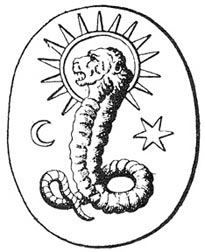
Yaldabaoth, otherwise known as Jaldabaoth or Ialdabaoth (/ˌjɑːldəˈbeɪɒθ/; Koine Greek: Ιαλδαβαώθ, romanized: Ialdabaóth; Latin: Ialdabaoth; Coptic: ⲒⲀⲖⲦⲀⲂⲀⲰⲐ Ialtabaôth), is a malevolent god and demiurge (creator of the material world) according to various Gnostic sects, represented sometimes as a theriomorphic, lion-headed serpent. He is identified as a false god who keeps souls trapped in physical bodies, imprisoned in the material universe.
The etymology of the name Yaldabaoth has been subject to many speculative theories. The first etymology was advanced in 1575 by François Feuardent, supposedly translating it from Hebrew to mean Latin: a patribus genitus, lit. 'the child of fathers'. A theory proposed by Jacques Matter in 1828 identified the name as descending from Hebrew: ילדא, romanized: yāldā, lit. 'child' and from Hebrew: בהות, romanized: bahot, a supposed plural form of Hebrew: בוהו, romanized: bōhu, lit. 'emptiness, darkness'. Matter however interpreted it to mean 'chaos', thus translating Yaldaboath as "child of darkness [...] an element of chaos".
This etymology was popular due to its perceived literary merits. It inspired Adolf Hilgenfeld to keep Matter's proposed 'chaos' translation, while fabulating a more plausible sounding, but unattested second noun: Aramaic: בהותא, romanized: bāhūthā, deriving the name from Aramaic: ילדא בהותא, romanized: yaldā bāhūthā supposedly meaning 'child of chaos' in 1884. This and variants of it became the majority opinion from the late 19th to the mid-20th century which was endorsed by Schenke, Böhlig, and Labib.
This analysis was convincingly deconstructed by Jewish historian of religion Gershom Scholem in 1974, who showed the unattested Aramaic term to have been fabulated and attested only in a single corrupted text from 1859, with its listed translation having been transposed from the reading of an earlier etymology, whose explanation seemingly equated "darkness" and "chaos" when translating an unattested supposed plural form of Hebrew: בוהו, romanized: bōhu. Consequently most scholars retracted their endorsement (for example, Gilles Quispel did so by lamenting humorously that due its literary merits he believes the originator of the name Yaldabaoth had made the same erroneous association between baoth and tohuwabohu as the former majority opinion). Additionally, Scholem argued that based on the earliest textual data, which termed Yaldabaoth "the King of Chaos", he was the progenitor of chaos, not its progeny.
Scholem's own theory rendered the name as Yald' Abaoth. Yald' being Aramaic: ילדא, romanized: yaldā but translated as 'begetter', not 'child' and Abaoth being a term attested in magic texts, descending from Hebrew: צבאות, romanized: Tzevaot, lit. 'Sabaoth, armies', one of the names of God in Judaism. Thus he rendered Yald' Abaoth as 'begetter of Sabaoth'. Matthew Black objects to this, because Sabaoth is the name of one of Yaldaboth's sons in some Gnostic texts. Instead he suggests the second noun to be Jewish Aramaic: בהתייה, romanized: behūṯā, lit. 'shame'. Which is cognate with Hebrew: בושה, romanized: bōšeṯ, a term used to replace the name Ba'al in the Hebrew Bible. Thus Blacks' proposal renders Aramaic: ילדא בהתייה, romanized: yaldā behūṯā, lit. 'son of shame/Ba'al'.
In his proposed 1967 etymology Alfred Adam already diverged from the then majority opinion and translated Aramaic: ילדא, romanized: yaldā similarly to Scholem, as German: Erzeugung, lit. 'bringing forth'. He believed the name's second part to derive from Syriac: ܐܒܗܘܬܗ, romanized: ˀabbāhūṯā, lit. 'fatherhood'. This he interpreted however to describe more broadly 'the power of generation'; thus suggesting the name to mean 'the bringing forth of the power of generation'.
Robert M. Grant proposed in 1957 that Ialdabaoth was derived from Yahweh Elohe Zebaoth, "Yahweh God of hosts (armies)" (Hebrew: צבאות, romanized: Tzevaot, lit. 'Sabaoth, armies'), a name for the God of Israel found with variants in 1 Samuel 1:3, 2 Samuel 7, Amos (3:13, 5:15-16, 27, and elsewhere) 1 Kings, Jeremiah, Zechariah 3:10, and Psalm 89:9. He notes that the change from the "z" (tzadi) to a "d" (daleth) or a "t" (teth) is sometimes seen in Aramaic. fr:Simone Pétrement made an argument against Schloem's etymology through analysis of Gnostic mythic texts, and derived it from Iao Sabaoth, which is attested in the Greek Magical Papyri — possibly independently from Grant, although she would not rule out having read Grant's article at some prior point.
After the Assyrian conquest of Egypt during the 7th century BCE, Seth was considered an evil deity by the Egyptians and not commonly worshipped, in large part due to his role as the god of foreigners. From at least 200 BCE onward, a tradition developed in the Graeco-Egyptian Ptolemaic Kingdom which identified Yahweh, the God of the Jews, with the Egyptian god Seth. Diverging from previous zoologically multiplicitous depictions, Seth's appearance during the Hellenistic period onwards was depicted as resembling a man with a donkey's head. The Greek practice of interpretatio graeca, ascribing the gods of another people's pantheon to corresponding ones in one's own, had been adopted by the Egyptians after their Hellenisation; during the process of which they had identified Seth with Typhon, a snake-monster, which roars like a lion.
Hub AI
Yaldabaoth AI simulator
(@Yaldabaoth_simulator)
Yaldabaoth
Yaldabaoth, otherwise known as Jaldabaoth or Ialdabaoth (/ˌjɑːldəˈbeɪɒθ/; Koine Greek: Ιαλδαβαώθ, romanized: Ialdabaóth; Latin: Ialdabaoth; Coptic: ⲒⲀⲖⲦⲀⲂⲀⲰⲐ Ialtabaôth), is a malevolent god and demiurge (creator of the material world) according to various Gnostic sects, represented sometimes as a theriomorphic, lion-headed serpent. He is identified as a false god who keeps souls trapped in physical bodies, imprisoned in the material universe.
The etymology of the name Yaldabaoth has been subject to many speculative theories. The first etymology was advanced in 1575 by François Feuardent, supposedly translating it from Hebrew to mean Latin: a patribus genitus, lit. 'the child of fathers'. A theory proposed by Jacques Matter in 1828 identified the name as descending from Hebrew: ילדא, romanized: yāldā, lit. 'child' and from Hebrew: בהות, romanized: bahot, a supposed plural form of Hebrew: בוהו, romanized: bōhu, lit. 'emptiness, darkness'. Matter however interpreted it to mean 'chaos', thus translating Yaldaboath as "child of darkness [...] an element of chaos".
This etymology was popular due to its perceived literary merits. It inspired Adolf Hilgenfeld to keep Matter's proposed 'chaos' translation, while fabulating a more plausible sounding, but unattested second noun: Aramaic: בהותא, romanized: bāhūthā, deriving the name from Aramaic: ילדא בהותא, romanized: yaldā bāhūthā supposedly meaning 'child of chaos' in 1884. This and variants of it became the majority opinion from the late 19th to the mid-20th century which was endorsed by Schenke, Böhlig, and Labib.
This analysis was convincingly deconstructed by Jewish historian of religion Gershom Scholem in 1974, who showed the unattested Aramaic term to have been fabulated and attested only in a single corrupted text from 1859, with its listed translation having been transposed from the reading of an earlier etymology, whose explanation seemingly equated "darkness" and "chaos" when translating an unattested supposed plural form of Hebrew: בוהו, romanized: bōhu. Consequently most scholars retracted their endorsement (for example, Gilles Quispel did so by lamenting humorously that due its literary merits he believes the originator of the name Yaldabaoth had made the same erroneous association between baoth and tohuwabohu as the former majority opinion). Additionally, Scholem argued that based on the earliest textual data, which termed Yaldabaoth "the King of Chaos", he was the progenitor of chaos, not its progeny.
Scholem's own theory rendered the name as Yald' Abaoth. Yald' being Aramaic: ילדא, romanized: yaldā but translated as 'begetter', not 'child' and Abaoth being a term attested in magic texts, descending from Hebrew: צבאות, romanized: Tzevaot, lit. 'Sabaoth, armies', one of the names of God in Judaism. Thus he rendered Yald' Abaoth as 'begetter of Sabaoth'. Matthew Black objects to this, because Sabaoth is the name of one of Yaldaboth's sons in some Gnostic texts. Instead he suggests the second noun to be Jewish Aramaic: בהתייה, romanized: behūṯā, lit. 'shame'. Which is cognate with Hebrew: בושה, romanized: bōšeṯ, a term used to replace the name Ba'al in the Hebrew Bible. Thus Blacks' proposal renders Aramaic: ילדא בהתייה, romanized: yaldā behūṯā, lit. 'son of shame/Ba'al'.
In his proposed 1967 etymology Alfred Adam already diverged from the then majority opinion and translated Aramaic: ילדא, romanized: yaldā similarly to Scholem, as German: Erzeugung, lit. 'bringing forth'. He believed the name's second part to derive from Syriac: ܐܒܗܘܬܗ, romanized: ˀabbāhūṯā, lit. 'fatherhood'. This he interpreted however to describe more broadly 'the power of generation'; thus suggesting the name to mean 'the bringing forth of the power of generation'.
Robert M. Grant proposed in 1957 that Ialdabaoth was derived from Yahweh Elohe Zebaoth, "Yahweh God of hosts (armies)" (Hebrew: צבאות, romanized: Tzevaot, lit. 'Sabaoth, armies'), a name for the God of Israel found with variants in 1 Samuel 1:3, 2 Samuel 7, Amos (3:13, 5:15-16, 27, and elsewhere) 1 Kings, Jeremiah, Zechariah 3:10, and Psalm 89:9. He notes that the change from the "z" (tzadi) to a "d" (daleth) or a "t" (teth) is sometimes seen in Aramaic. fr:Simone Pétrement made an argument against Schloem's etymology through analysis of Gnostic mythic texts, and derived it from Iao Sabaoth, which is attested in the Greek Magical Papyri — possibly independently from Grant, although she would not rule out having read Grant's article at some prior point.
After the Assyrian conquest of Egypt during the 7th century BCE, Seth was considered an evil deity by the Egyptians and not commonly worshipped, in large part due to his role as the god of foreigners. From at least 200 BCE onward, a tradition developed in the Graeco-Egyptian Ptolemaic Kingdom which identified Yahweh, the God of the Jews, with the Egyptian god Seth. Diverging from previous zoologically multiplicitous depictions, Seth's appearance during the Hellenistic period onwards was depicted as resembling a man with a donkey's head. The Greek practice of interpretatio graeca, ascribing the gods of another people's pantheon to corresponding ones in one's own, had been adopted by the Egyptians after their Hellenisation; during the process of which they had identified Seth with Typhon, a snake-monster, which roars like a lion.