


Community hub
Recent from talks
Contribute something
Nothing was collected or created yet.
Yama-dera
View on Wikipedia- You may also be looking for the voice actor Kōichi Yamadera.

Key Information


Yama-dera (山寺, lit. "Mountain Temple") (山号 宝珠山; Sangō Hōshu-zan) is the popular name for the Buddhist temple of Risshaku-ji (立石寺) located northeast of Yamagata, in Yamagata Prefecture, Japan. Its main image is a hibutsu statue of Yakushi Nyorai. The temple has been a place for pilgrimage for centuries, and is designated as both a Place of Scenic Beauty and as a National Historic Site[1] It is located within the borders of the Zaō Quasi-National Park. The temple buildings clinging to the steep, forested, rocky hillsides are picturesque and unusual.
History
[edit]According to temple tradition, it was founded in 860 AD by the priest Ennin, who is better known by his posthumous name, Jikaku Daishi (慈覺大師). In 847 AD Ennin returned to Japan from studies in Tang dynasty China and in 854 AD he became the chief priest of the Tendai sect at Enryaku-ji on Mt. Hiei near Kyoto. Risshaku-ji was founded as a branch temple of Enryaku-ji by the order of Emperor Seiwa, and to this day the ritual fire brought from Enryaku-ji is still burning in the main temple. The exact date and circumstances of the foundation of the temple are uncertain, but it dates to at least the early Heian period based on dating of the oldest of its surviving wooden statuary. The temple has a long-standing tradition that it houses the grave of Ennin in a cave within the temple grounds. Although Ennin died on Mount Hiei in 864 AD, and there is no record that his remains were transferred here, an archaeological investigation in 1948 found a gold-leaf encrusted casket containing five sets of human remains and fragments of a Heian period wooden statue of Ennin within the cave. The temple developed into the major Heian period center for Buddhism in Dewa Province (now Yamagata and Akita prefectures).[2]
The temple was patronized by the Kamakura shogunate and grew in territory. It was rebuilt after a fire in the mid-13th century and was converted to Zen Buddhism. The current Main Hall, known here as the Konpon-chūdō was rebuilt in 1356 by Shiba Kaneyori, lord of Yamagata Castle, who also returned it to the Tendai sect. It was visited by the artist Sesshū Tōyō in 1482, who made many sketches of its precincts. The temple was burned down again during the wars of the Sengoku period, but was restored by the Date clan and the Mogami clan. Under the Edo Period Tokugawa shogunate, it was awarded estates with a kokudaka of 1420 koku for its upkeep.[2]
Yama-dera is where the well-known haiku poet Matsuo Bashō wrote his famous haiku "ah this silence / sinking into the rocks / voice of cicada" in 1689. A museum of Basho's writings and paintings and other related art, the Yamadera Basho Memorial Museum, is a short walk up the hill on the opposite side of the steep valley. In 1996, the Ministry of the Environment selected the cicadas of Yama-dera as one of the 100 Soundscapes of Japan.[3]
Important cultural properties
[edit]- Building: Konpon-chūdō, built between 1346 and 1370 and repaired in 1608.
- Building: Three-storied Miniature Pagoda (height 2.5 meters), built in 1519 and housed in a stone chapel
- Monument: Stone stele inscribed with the Lotus Sutra, dated 1144
- Statue: Yakushi Nyorai, wooden, seated, Heian-period, repaired in 1205.
- Statue: Ennin (head portion only), wooden, Heian-period. recovery from alleged grave-tomb of Ennin
These historical assets can be seen along the main trail that leads up the mountain along its stone steps. You can also see the remains of the original temple of Yamadera in a course located to the right of the main entrance.[4]
Yamadera holds many other important cultural assets in its treasure house, the Hihokan, including standing wooden images of Shaka Nyorai, Yakushi Nyorai and Amida Nyorai, a seated wooden image of Dengyo Daishi, a hanging wooden mandala of Buddha.[5]
-
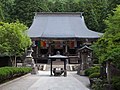 Konpon-chūdō (main hall)
 -
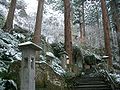 Approach in winter
 -
 View from the top (sutra repository in sight)
 -
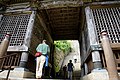 Niomon
 -
 Oku-no-In
 -
 Lantern
 -
 Three-storied Miniature Pagoda
 -
![The Taimenseki (対面石) where Ennin is said to have met Banji Banzaburō[6]](//upload.wikimedia.org/wikipedia/commons/thumb/a/ad/Ry%C5%ABshaku-ji_temple%2C_Sendai%3B_August_2018_%2801%29.jpg/120px-Ry%C5%ABshaku-ji_temple%2C_Sendai%3B_August_2018_%2801%29.jpg)


![The Taimenseki (対面石) where Ennin is said to have met Banji Banzaburō[6]](https://en.wikipedia.org/wiki/File:Ry%C5%ABshaku-ji_temple,_Sendai;_August_2018_(01).jpg)
Access
[edit]Railway
[edit]
- Yamadera (7 minutes' walk away from the entrance to the mountain)
Highway
[edit] Yamagata Expressway – Yamagata-kita Interchange, located about 10km from the temple
- Yamagata Prefectural Road Route 19 (山形県道19号山形山寺線)
- Yamagata Prefectural Road Route 62 (山形県道62号仙台山寺線)

See also
[edit]References
[edit]- ^ "山寺". Agency for Cultural Affairs. Retrieved 11 February 2020.
- ^ a b Kodansha Encyclopedia of Japan vol. 6 p. 320 and 321, 1983
- ^ "100 Soundscapes of Japan" (in Japanese). Ministry of the Environment. Archived from the original on 8 June 2012. Retrieved 8 February 2012.
- ^ "Yamadera Temple".
- ^ Tourism Section, Yamagata City Hall
- ^ 地域観光資源の多言語解説文データベース Database of Multilingual Explanations of Local Tourist Attractions. "Shishi-odori" (PDF). 国土交通省 Kokudokōtsūshō.
External links
[edit] Media related to Risshaku-ji at Wikimedia Commons

- Yamadera Tourism Association Archived 2007-08-11 at the Wayback Machine (in Japanese)
- Japan Photo Guide: Yamadera
| International | |
|---|---|
| National | |
| Other | |

Yama-dera
View on GrokipediaOverview
Name and Founding
Yama-dera, popularly known as the "Mountain Temple" due to its location on a steep mountainside, is the common name for the Buddhist temple complex officially known as Hōjōzan Risshaku-ji (立石寺), which translates to "Standing Stone Temple" in reference to the prominent rocky cliffs that form its natural foundation.[4][1][5] This dual nomenclature reflects both its geographical setting and the distinctive geological features that integrate with its architecture, distinguishing it from other Tendai sect temples in Japan.[6] The temple was founded in 860 CE by the monk Ennin, also known as Jikaku Daishi (794–864), a key figure in the Tendai school of Buddhism who served as the third abbot of Enryaku-ji on Mount Hiei.[7] Ennin established Hōjōzan Risshaku-ji as a branch of Enryaku-ji in response to an imperial edict from Emperor Seiwa (r. 858–876), who sought to propagate Tendai teachings across the northern regions to ensure national peace and spiritual protection amid political instability.[4][6] This founding aligned with broader efforts to extend Buddhist influence into frontier areas, marking Hōjōzan Risshaku-ji's inception as a center for Tendai practices focused on esoteric rituals and monastic discipline.[8] At its establishment, the temple's core was the enshrinement of the principal deity Yakushi Nyorai, the Buddha of healing and medicine, in the Konpon-chūdō (Fundamental Central Hall), symbolizing the site's original dedication to health, protection, and the alleviation of suffering for the realm.[7][8] This initial enshrinement underscored the temple's role in imperial prayers for prosperity, with the eternal flame lit from Enryaku-ji during founding still maintained today as a symbol of unbroken lineage.[4]Location and Designations
Yama-dera, officially known as Hōjōzan Risshaku-ji, is situated at the base of Mount Hōju in the northeastern part of Yamagata City, Yamagata Prefecture, Japan. Its geographic coordinates are approximately 38°18′45″N 140°26′15″E, placing it within the scenic mountainous region of the Tōhoku area. The temple's address is 4456-1 Yamadera, Yamagata-shi, Yamagata 999-3301, and it lies within the boundaries of Zaō Quasi-National Park, which encompasses volcanic landscapes and forested highlands.[5][9] The site integrates into a rugged terrain rising from about 200 meters to 400 meters above sea level, featuring steep cliffs and a series of over 1,000 stone steps that ascend through dense cedar forests and rocky outcrops. This elevation range highlights the temple's vertical layout, with key structures distributed along the mountainside, blending human architecture with the natural granite formations of the surrounding peaks.[10][11] Yama-dera holds official designations as a National Historic Site and a Place of Scenic Beauty, both conferred by the Japanese government on March 25, 1932, under the oversight of the Agency for Cultural Affairs. These protections recognize its historical and aesthetic value, preserving the temple complex and its environs as integral cultural heritage. As an active Tendai sect Buddhist temple, it continues to function as a significant pilgrimage destination and tourist attraction, drawing visitors for its spiritual ambiance and panoramic views.[10][5]History
Establishment
Yama-dera, officially known as Risshaku-ji, was established in 860 during the Heian period as a direct response to Emperor Seiwa's prayers for national peace amid the political turbulence of the era, including rebellions and court intrigues.[4] The emperor commissioned the creation of Tendai sect temples across the Tohoku region to propagate Buddhist teachings and stabilize the realm, with Risshaku-ji serving as a key outpost.[12] The temple's founding is attributed to Ennin, posthumously titled Jikaku Daishi, who served as the third abbot of the Tendai school and had previously studied esoteric Buddhism in China.[12] Ennin selected the rugged site on Mount Hōju for its profound spiritual potency, which he perceived as echoing the sacred energies of Mount Hiei, home to the Tendai headquarters at Enryaku-ji.[4] Upon arriving in the area, Ennin acquired approximately 40 square kilometers of land from a local lord and oversaw the initial rituals to consecrate the grounds, including the transport of an eternal ritual flame from Enryaku-ji, which continues to burn today.[13] He directed the early construction efforts, erecting foundational structures such as the core hall that would become the Konpon-chūdō, integrating local granite foundations with timber framing to harmonize the temple with the mountainous terrain.[1] The initial community at Risshaku-ji comprised a modest monastic order of Tendai practitioners, emphasizing esoteric rituals, meditative disciplines, and the meticulous copying of sutras to disseminate Buddhist doctrine in the frontier region.[4] This small group of monks focused on shingon-influenced ceremonies and scholarly transcription, establishing the temple as a center for spiritual cultivation amid Tohoku's isolation.[12]Later Developments
During the Kamakura period, Yama-dera experienced significant upheaval, including a major fire in the 13th century that caused widespread destruction amid regional conflicts. The temple was rebuilt with support from the shogunate, which provided patronage and allowed it to expand its territories and influence.[5] In the 14th century, the temple underwent a temporary conversion to Zen Buddhism, reflecting broader sectarian shifts in Japanese Buddhism during the medieval era. This change was reversed in 1356 when Shiba Kaneyori, the first lord of Yamagata Castle, oversaw its return to the Tendai sect and reconstructed key structures like the Konpon-chūdō hall using beechwood, marking it as Japan's oldest surviving building of its kind.[12][5] The Sengoku period brought further devastation, with the temple suffering repeated burnings during intense civil wars that ravaged northern Japan. Restoration efforts in the late 16th and early 17th centuries were led by the Date and Mogami clans, who played crucial roles in reviving the site and ensuring its continuity as a Tendai center.[5] Prosperity returned during the Edo period, when the Tokugawa shogunate granted Yama-dera a stipend of 1,420 koku of rice in 1623, funding expansions, maintenance, and cultural activities that solidified its regional prominence. The temple navigated challenges from Meiji-era secularization policies, which separated Shinto and Buddhism and threatened institutional autonomy, yet it persisted through adaptive reforms. Preservation initiatives culminated in 1932, when the site was designated a National Historic Site and Place of Scenic Beauty, supporting ongoing conservation efforts such as the 1987 repair of the Nōkyōdō hall.[5]Site Description
Architectural Features
The Yama-dera temple complex features a tiered layout that ascends the steep mountainside through a series of over 1,015 narrow stone steps, integrating approximately 30 human-made structures directly into the rocky cliffs to form a vertical progression from base halls to summit pavilions.[12][14] At the base sits the Konpon-chūdō, the principal main hall, reconstructed in 1356 from durable beech wood—the oldest such structure surviving in Japan—and designated an Important Cultural Property; it was later repaired in 1608 to maintain its structural integrity.[12][15] This hall employs traditional wooden beam construction in a single-story format, providing a sturdy foundation for the altar while exemplifying Muromachi-period carpentry adapted to the site's elevation.[12] Among other notable buildings, the Hihokan (also known as Hiho-kan or Homotsu-den), constructed in 1144, serves as the dedicated treasure house to safeguard historical artifacts, featuring a compact wooden design suited for secure storage within the lower precincts.[16][6] A symbolic highlight is the miniature three-storied wooden pagoda (Sanjū-shōtō), standing 2.5 meters tall and erected in 1519 within a cavern-like chamber, representing condensed pagoda architecture embedded into the rock face.[17] Architectural design elements reflect adaptations to the rugged terrain, including local stone foundations integrated into the cliffs for enhanced stability against seismic activity, alongside exposed wooden beams that allow flexibility in the structures.[12] Some halls, such as the Sanmon gate from the Kamakura period, incorporate thatched roofs to harmonize with the environment and provide weather resistance on elevated slopes.[2] Accessibility is facilitated by lantern-lined stone paths that guide pilgrims along the ascent, supplemented by small bridges and connected walkways that link the lower base area to upper halls, ensuring safe navigation across uneven cliffs despite the steep incline.[1][18]Natural Landscape
Yama-dera is perched on the steep slopes of Mount Hōju, a prominent peak in the Zao mountain range, characterized by dramatic cliffs, boulders, and distinctive rock formations that create natural barriers and striking viewpoints along the ascent.[12][19] The site's geology features rugged outcrops, including the notable Mida Hora Rock, a massive boulder resembling the head of Amida Buddha, which enhances the temple's integration with the surrounding terrain.[20] These natural elements contribute to the spiritual isolation and awe-inspiring ambiance of the location. The pathways to the upper temple areas consist of 1,015 uneven stone steps that wind through rocky crevices and ascend approximately 190 meters in elevation from the base, passing dense groves of ancient Japanese cedars.[1][8] This challenging route, spanning elevations from about 220 to 410 meters, immerses visitors in a vertical journey that blends physical exertion with the mountain's raw topography.[21][17] Seasonally, the landscape transforms to accentuate its serene qualities: autumn brings vibrant foliage in shades of red and gold, particularly from maple trees, peaking in mid-October and drawing crowds to the colorful slopes.[22] In summer, the resounding chorus of cicadas fills the air, recognized as one of Japan's 100 Soundscapes since 1996 for its evocative natural symphony amid the rocks.[23] Winter blankets the area in deep snow, creating ethereal white vistas that contrast with the dark evergreens. The flora is dominated by thick stands of Japanese cedar (Cryptomeria japonica), forming shaded canopies along the paths, while mixed deciduous trees, including beeches, add to the layered forest ecosystem typical of the Tohoku region's mountainous zones.[24] Fauna includes a variety of birds, such as flycatchers observed hunting insects mid-air, and diverse insect species that thrive in the humid understory, all contributing to the site's tranquil, biodiverse atmosphere.[25] At the summit, the Okunoin inner sanctuary provides panoramic vistas overlooking the Yamagata basin and surrounding valleys, where the interplay of mountain ridges and distant lowlands offers a profound sense of elevation and perspective.[2][26]Cultural Properties
Important Buildings
The Konpon-chūdō, the main hall of Risshaku-ji Temple at Yama-dera, serves as the foundational structure symbolizing the temple's enduring spiritual core. Traditionally attributed to a rebuild in 1356 by the first lord of Yamagata Castle, Shiba Kaneyori, during the Nanboku-chō period, though scholarly dating places it in the mid-Muromachi period (1393–1466), this hall exemplifies Heian-period architectural influences in its irimoya-zukuri style with a hip-and-gable roof. Designated a National Important Cultural Property on April 23, 1908, it measures approximately 13.6 meters in length and 11.4 meters in width, constructed primarily from Japanese beech wood, making it the oldest known structure of its material in Japan.[27][12][28] The Three-storied Miniature Pagoda (Sanju-kotō), a compact tower standing 2.5 meters tall, represents a rare example of Muromachi-period craftsmanship in miniaturization techniques. Erected in 1519 by a local artisan, it features a one-ken square base with kokerabuki (wooden shingle) roofing and enshrines a principal image of Dainichi Nyorai. Designated a National Important Cultural Property on July 19, 1952, this pagoda highlights the temple's historical role in esoteric Buddhist practices through its symbolic form and precise detailing.[29] (Note: Wikipedia not cited, but fact verified via official database) The Hihokan, or Treasure House, functions as a repository for the temple's safeguarded artifacts, though the structure itself lacks individual National Important Cultural Property status. Constructed in 1976 in a style incorporating Heian aesthetic elements for secure, climate-controlled storage, it protects items such as the Ten'yō 1-year Jōhō-kyōsho Monument (1144, designated 1953) and wooden statues of Shaka Nyorai, Yakushi Nyorai, and Amida Nyorai. This modern facility ensures the preservation of these protected treasures amid the site's mountainous environment.[30] Preservation of these buildings involves ongoing maintenance supported by Japanese government subsidies through the Agency for Cultural Affairs and private donations from pilgrims and organizations. Efforts include periodic repairs to combat weathering and seismic vulnerabilities, with notable reinforcements implemented around 2005 to enhance earthquake resistance in line with national heritage standards, ensuring the structures' integrity against regional tectonic activity.Statues and Artifacts
The principal religious artifact at Yama-dera is the wooden statue of Yakushi Nyorai, the Buddha of healing and medicine, which serves as the temple's main deity symbolizing protection from illness and promotion of well-being. Carved from a single block of katsura wood in the late Heian period around the mid-12th century, the seated figure stands approximately 1.3 meters tall and features a serene expression with gentle curves typical of Heian sculpture. It underwent significant repairs in 1205 (Genkyu 2), as evidenced by inscriptions on the back of the knees, and is enshrined as a secret Buddha in the Konpon-chūdō hall, with public viewings occurring only every 50 years, most recently in 2013. Designated a National Important Cultural Property by Japan's Agency for Cultural Affairs in 1966, it underscores the temple's Tendai Buddhist roots and devotion to Yakushi worship. The statue was last publicly displayed in 2013.[31][32] Another key statue is the wooden head of Ennin (Jikaku Daishi), the temple's legendary founder and a pivotal figure in the Tendai school's transmission to Japan, symbolizing the continuity of esoteric Tendai practices. This bust, carved from wood in a single block during the early Heian period (9th century), depicts a closed-eyed, contemplative face; it was discovered in a golden coffin within Ennin's alleged burial cave (Nyūjō-kutsu) alongside his remains. Representing the lineage from Enryaku-ji on Mount Hiei, it highlights Yama-dera's historical ties to Tendai esotericism. Designated a National Important Cultural Property in 2006, it is typically non-public but was briefly displayed that year.[33] The temple's oldest extant inscription is the Ten'yō Gannen Nyohō Kyōjo Stone Stele, a granite monument from 1144 (Ten'yō 1) that records the burial of copies of the Lotus Sutra (Hoke-kyō) near a sacred site for future protection under Ennin's spiritual guardianship, marking it as the earliest known sutra dedication at Yama-dera and reflecting medieval Tendai devotion to the sutra's teachings on enlightenment. Standing about 1.08 meters tall with elegant archaic script, it was originally placed near the Nyūjō-kutsu cave and now resides in the treasure house. Designated a National Important Cultural Property in 1915, it provides crucial historical context for the temple's 12th-century activities.[34][35] The temple's treasure house (Hihō-kan), constructed in 1976 to preserve artifacts, houses additional significant items, including a wooden mandala hanging plaque (kake-botoke) from the Kamakura period with a 1231 (Kanjoy 3) inscription on the reverse, depicting Buddhist deities in relief and exemplifying lay devotion through non-canonical iconography; a Kamakura-period triad of standing wooden statues—Shaka Nyorai (78 cm), Yakushi Nyorai (68.5 cm), and Amida Nyorai (53 cm)—assembled from multiple wood pieces and originally from a nearby shrine, symbolizing the foundational Buddhas of Tendai cosmology; and a mid-to-late Heian seated wooden figure of Dengyō Daishi (Saichō, 73 cm), the Tendai patriarch, possibly reinterpreted as Monju Bosatsu, honoring the school's origins. These were designated Yamagata Prefecture Cultural Properties between 1952 and 1960, complementing the national treasures and illustrating the temple's artistic evolution from Heian to Kamakura eras.[36][37][38]Cultural Significance
Literary Connections
Yama-dera holds a prominent place in Japanese literature, most notably through the visit of the renowned haiku poet Matsuo Bashō in 1689 during his epic journey documented in Oku no Hosomichi (The Narrow Road to the Deep North).[39] Upon ascending the temple's steep paths amid its profound silence, Bashō composed a celebrated haiku capturing the site's tranquil essence: Shizukasa ya / iwa ni shimiiru / semi no koe (The stillness! / It sinks into the rocks / The cry of the cicada).[40] This verse, inspired by the temple's quietude and the echoing calls of cicadas against the rocky cliffs, exemplifies Bashō's mastery in evoking momentary enlightenment through nature's subtle interplay.[41] Earlier, the Zen monk and ink painter Sesshū Tōyō visited Yama-dera, producing sketches that informed his landscape works.[42] These motifs appear in his painting Yamadera-zu (View of Yamadera), an original sketch reproduced in the Edo period by Kano Tsunenobu as an ink-on-paper landscape held in the Tokyo National Museum.[43] Sesshū's renderings highlight the temple's rugged cliffs and halls, blending Zen aesthetics with the site's austere beauty to influence subsequent ink painting traditions.[42] The temple features in Edo-period travelogues as an embodiment of wabi-sabi, the poetic ideal of rustic simplicity and impermanence, with Bashō's account serving as a seminal example that drew later writers to its contemplative solitude.[44] In modern times, Yama-dera continues to resonate in haiku anthologies and literary works, often referenced for its enduring inspiration on themes of silence and nature; the Yamadera Bashō Memorial Museum hosts annual events, including haiku contests and readings of Bashō's verses (e.g., the 17th English Haiku Contest in 2025), fostering contemporary engagements.[45][46] Artistically, Yama-dera's dramatic steps and halls have inspired ukiyo-e prints, notably Kawase Hasui's serene depictions in the shin-hanga style, such as Yamadera in Sendai (1933), which capture the temple's misty landscapes and seasonal moods.[47] This legacy extends to modern photography, where artists document the site's ascent and vistas to evoke its timeless spiritual allure.[48]Pilgrimage and Traditions
The pilgrimage to Yama-dera, officially known as Risshaku-ji Temple, centers on the traditional ascent of 1,015 stone steps carved into the steep slopes of Mount Hōju, a practice that symbolizes the spiritual journey toward enlightenment and the shedding of worldly attachments.[5][49] This meditative climb, which takes approximately 30 to 40 minutes one way, begins at the base near Konpon-chūdō Hall and winds through forested paths, passing sub-temples and rock formations that encourage introspection and ascetic discipline.[18] The route has long been a site for yamabushi, or mountain ascetics practicing Shugendo, who undertake rigorous training here to harmonize body, mind, and nature, drawing on the temple's Tendai Buddhist roots established in 860 CE.[50][51] Worship at the temple primarily revolves around Yakushi Nyorai, the Buddha of healing and medicine, whose statue in Konpon-chūdō serves as a focal point for prayers seeking health, longevity, and recovery from illness.[5] Daily rituals include sutra chanting by resident priests, often accompanied by offerings of incense and flowers, as well as the ongoing tradition of hand-copying sacred texts like the Lotus Sutra in Nōkyōdō Hall to accumulate merit and maintain spiritual purity.[52] These practices, sustained by the temple's eternal flame—kindled from Enryaku-ji Temple and burning continuously since the 9th century—underscore Yama-dera's role as a living center of Tendai devotion, where visitors participate in brief prayers to invoke Yakushi's blessings. Seasonal festivals enliven the temple's religious calendar, blending ancient rites with cultural commemorations. In August, during the Obon period, lanterns are lit to guide ancestral spirits, aligning with broader Buddhist traditions of honoring the deceased through communal gatherings and offerings at the temple grounds.[5] New Year's ceremonies include fire-based purification rites, such as the ringing of the temple bell 108 times on December 31 to atone for human frailties, often complemented by goma fire offerings in the main hall to burn away misfortunes and invite renewal.[53][2] In contemporary times, Yama-dera adapts its traditions for broader accessibility through guided tours led by local experts, who incorporate explanations of Tendai teachings on impermanence and harmony with nature during the ascent, making the pilgrimage approachable for international visitors.[54][55] These tours emphasize ethical stewardship of the sacred landscape, with the temple enforcing conservation measures like drone restrictions to preserve the pristine environment that defines its spiritual essence.[5]Access
By Train
The primary access point to Yama-dera, also known as Risshaku-ji Temple, by rail is Yamadera Station, served by the JR East Senzan Line.[1] This station is located directly adjacent to the temple's lower entrance, making it a convenient hub for visitors arriving from nearby cities in Yamagata Prefecture and beyond.[18] Travelers from Yamagata Station can reach Yamadera Station in approximately 20 minutes via local trains on the Senzan Line.[1] From Sendai, the journey takes about 1 hour, often involving a transfer from the Tohoku Shinkansen bullet train at Sendai Station to the Senzan Line local service.[1] For those coming from Tokyo, the total travel time exceeds 3 hours, typically combining a 90-100 minute Shinkansen ride to Sendai with the subsequent 1-hour Senzan Line leg.[18] Trains operate hourly in both directions along the Senzan Line, providing service every 60 minutes during typical daytime hours.[1] Fares are modest, with tickets from Yamagata Station costing around 240 yen, while the Sendai leg is approximately 860 yen.[1] Yamadera Station itself is a modest facility featuring basic amenities such as ticket vending machines and a small waiting area, suitable for short stops but lacking extensive services like restaurants or restrooms.[1] Coin lockers are available for baggage storage, and a nearby tourist information center offers maps and guidance.[56] Just outside the station, several local shops sell souvenirs, snacks, and temple-related items, providing convenient options for visitors before or after their journey.[1] From the station exit, the route to the temple's main gate follows clear signage along a short, paved path that leads north across a scenic bridge, taking about 5-7 minutes on foot.[1][18] This gentle walk passes through a quiet residential area and introduces the temple's serene atmosphere, with the initial stone steps of the famous 1,015-step ascent visible immediately upon reaching the entrance gate.[1]By Road
Yama-dera is accessible by car via the Yamagata Expressway, with the nearest exit at the Yamagata-kita Interchange, from which it is approximately a 10-minute drive along Prefectural Road 19.[57] The temple lies about 15 kilometers northeast of Yamagata City center, reachable in around 30 minutes by car from Yamagata Station.[58] From Sendai, the drive covers approximately 65 kilometers and takes about 1.5 hours due to the mountainous terrain.[58][59] On-site parking is available at several lots near Yamadera Station and the temple entrance, including a large facility accommodating numerous vehicles at a fee of approximately 500 yen per day. During peak seasons, such as autumn foliage viewing or festivals, overflow parking areas may be used, with shuttle buses provided to transport visitors to the site.[60] Local bus services operate from Yamagata Station's No. 2 bus stop to Yamadera Station, taking about 40 minutes with departures approximately 5 times daily on weekdays.[61] There are no direct long-distance bus routes to Yama-dera from major cities like Sendai or Tokyo. The approach roads are winding and mountainous, requiring careful driving; heavy snowfall from November to March can make conditions hazardous, so GPS navigation is recommended year-round, especially in winter.[58][62]References
- https://commons.wikimedia.org/wiki/File:Copy_of_Sesshu_Yamadera_zu_by_Kano_Tsunenobu_%28Tokyo_National_Museum%29.jpg