


Community hub
Recent from talks
Contribute something
Nothing was collected or created yet.

.jpg)


Om (or Aum; ⓘ; Sanskrit: ॐ, ओम्, romanized: Oṃ, Auṃ, ISO 15919: Ōṁ) is a polysemous symbol representing a sacred sound, seed syllable, mantra, and invocation in Hinduism as well as in other Indian religions.[1][2] Its written form is the most important symbol in the Hindu religion.[3] It is the essence of the supreme Absolute,[2] consciousness,[4][5][6] Ātman, Brahman, or the cosmic world.[7][8][9] In Indian religions, Om serves as a sonic representation of the divine, a standard of Vedic authority and a central aspect of soteriological doctrines and practices.[10] It is the basic tool for meditation in the yogic path to liberation.[11] The syllable is often found at the beginning and the end of chapters in the Vedas, the Upanishads, and other Hindu texts.[9] It is described as the goal of all the Vedas.[12]
Om emerged in the Vedic corpus and is said to be an encapsulated form of Samavedic chants or songs.[1][10] It is a sacred spiritual incantation made before and during the recitation of spiritual texts, during puja and private prayers, in ceremonies of rites of passage (samskara) such as weddings, and during meditative and spiritual activities such as Pranava yoga.[13][14] It is part of the iconography found in ancient and medieval era manuscripts, temples, monasteries, and spiritual retreats in Hinduism, Buddhism, Jainism, and Sikhism.[15][16] As a syllable, it is often chanted either independently or before a spiritual recitation and during meditation in Hinduism, Buddhism, and Jainism.[17][18]
The syllable Om is also referred to as Onkara (Omkara) and Pranava among many other names.[19][20]
Common names and synonyms
[edit]The syllable Om is referred to by many names, including:
- Praṇava (प्रणव); literally, "fore-sound", referring to Om as the primeval sound.[21][22]
- Oṅkāra (ओङ्कार) or oṃkāra (ओंकार); literally, "Om-maker", denoting the first source of the sound Om and connoting the act of creation.[23][24][25][26]
- Ik Oṅkār (ੴ or ਇੱਕ ਓਅੰਕਾਰ); literally, "one Om-maker", and an epithet of God in Sikhism. (see below).
- Udgītha (उद्गीथ); meaning "song, chant", a word found in Samaveda and bhasya (commentaries) based on it. It is also used as a name of the syllable Om in Chandogya Upanishad.[27]
- Akṣara (अक्षर); literally, "imperishable, immutable", and also "letter of the alphabet" or "syllable".
Origin and spiritual significance
[edit]The etymological origins of ōm (aum) have long been discussed and disputed, with even the Upanishads having proposed multiple Sanskrit etymologies for aum, including: from "ām" (आम्; "yes"), from "ávam" (आवम्; "that, thus, yes"), and from the Sanskrit roots "āv-" (अव्; "to urge") or "āp-" (आप्; "to attain").[28][A] In 1889, Maurice Bloomfield proposed an origin from a Proto-Indo-European introductory particle "*au" with a function similar to the Sanskrit particle "atha" (अथ).[28] However, contemporary Indologist Asko Parpola proposes a borrowing from Dravidian "*ām" meaning "'it is so', 'let it be so', 'yes'", a contraction of "*ākum", cognate with modern Tamil "ām" (ஆம்) meaning "yes".[28][29] In the Jaffna Tamil dialect spoken in Sri Lanka, aum' is the word for yes.[citation needed]
Om emerged in the Vedic corpus and is said to be an encapsulated form of Samavedic chants or songs.[1][10] The Samaveda, the poetical Veda, orthographically maps Om to the audible, the musical truths in its numerous variations (Oum, Aum, Ovā Ovā Ovā Um, etc.) and then attempts to extract musical meters from it.[9] The Aitareya Brahmana of Rig Veda, in section 5.32, suggests that the three phonetic components of Om (a + u + m) correspond to the three stages of cosmic creation, and when it is read or said, it celebrates the creative powers of the universe.[9][30] However, regardless of its original meaning, the syllable Om evolves to mean many abstract ideas even in the earliest Upanishads. Max Müller and other scholars state that these philosophical texts recommend Om as a basic tool for meditation[11] and explain the various meanings that the syllable may hold in the mind of one meditating, ranging from "artificial and senseless" to the "highest concepts such as the cause of the Universe, essence of life, Brahman, Atman, and Self-knowledge".[31][32]
In the Aranyaka and the Brahmana layers of Vedic texts, the syllable is so widespread and linked to knowledge, that it stands for the "whole of Veda".[9] The Brahmana layer of Vedic texts equates Om with bhur-bhuvah-svah, which symbolizes "the whole Veda". They offer various shades of meaning to Om, such as it being "the universe beyond the sun", or that which is "mysterious and inexhaustible", or "the infinite language, the infinite knowledge", or "essence of breath, life, everything that exists", or that "with which one is liberated".[9] The symbolic foundations of Om are repeatedly discussed in the oldest layers of the early Upanishads.[33][34] In the Upanishads, it has been associated with various concepts, such as "cosmic sound", "mystical syllable", "affirmation to something divine", or as symbolism for abstract spiritual concepts.[9] However, in the eight anuvaka of the Taittiriya Upanishad, which consensus research indicates was formulated around the same time or preceding Aitareya Brahmana, the sound Aum is attributed to reflecting the inner part of the word Brahman. Put another way, it is the Brahman, in the form of a word.[35]
Pronunciation
[edit]When occurring within spoken Classical Sanskrit, the syllable is subject to the normal rules of sandhi in Sanskrit grammar, with the additional peculiarity that the initial o of "Om" is the guṇa vowel grade of u, not the vṛddhi grade, and is therefore pronounced as a monophthong with a long vowel ([oː]), i.e. ōm not aum.[B][36] Furthermore, the final m is often assimilated into the preceding vowel as nasalisation (raṅga). As a result, Om is regularly pronounced [õː] in the context of Sanskrit.
However, this o reflects the older Vedic Sanskrit diphthong au, which at that stage in the language's history had not yet monophthongised to o. This being so, the syllable Om is often archaically considered as consisting of three phonemes: "a-u-m".[37][38][39][40] Accordingly, some denominations maintain the archaic diphthong au viewing it to be more authentic and closer to the language of the Vedas.
In the context of the Vedas, particularly the Vedic Brahmanas, the vowel is often pluta ("three times as long"), indicating a length of three morae (trimātra), that is, the time it takes to say three light syllables. Additionally, a diphthong becomes pluta with the prolongation of its first vowel.[36] When e and o undergo pluti they typically revert to the original diphthongs with the initial a prolonged,[41] realised as an overlong open back unrounded vowel (ā̄um or a3um [ɑːːum]). This extended duration is emphasised by denominations who regard it as more authentically Vedic, such as Arya Samaj.
However, Om is also attested in the Upanishads without pluta,[C] and many languages related to or influenced by Classical Sanskrit, such as Hindustani, share its pronunciation of Om ([õː] or [oːm]).
Written representations
[edit]South Asia
[edit]
Nagari or Devanagari representations are found epigraphically on sculpture dating from Medieval India and on ancient coins in regional scripts throughout South Asia. Om is represented in Devanagari as ओम्, composed of four elements: the vowel letter अ (a), the vowel diacritic ो (o), the consonant letter म (m), and the virama stroke ् which indicates the absence of an implied final vowel. Historically, the combination ओ represented a diphthong, often transcribed as au, but it now represents a long vowel, ō. (See above.) The syllable is sometimes written ओ३म्, where ३ (i.e., the digit "3") explicitly indicates pluta ('three times as long') which is otherwise only implied. For this same reason Om may also be written ओऽम् in languages such as Hindi, with the avagraha (ऽ) being used to indicate prolonging the vowel sound. (However, this differs from the usage of the avagraha in Sanskrit, where it would instead indicate the prodelision of the initial vowel.) Om may also be written ओं, with an anusvāra reflecting the pronunciation of [õː] in languages such as Hindi. In languages such as Urdu and Sindhi Om may be written اوم in Arabic script, although speakers of these languages may also use Devanagari representations.
The commonly seen representation of the syllable Om, ॐ, is a cursive ligature in Devanagari, combining अ (a) with उ (u) and the chandrabindu (ँ, ṃ). In Unicode, the symbol is encoded at U+0950 ॐ DEVANAGARI OM and at U+1F549 🕉 OM SYMBOL as a "generic symbol independent of Devanagari font".[43]
In some South Asian writing systems, the Om symbol has been simplified further. In Bengali and Assamese Om is written simply as ওঁ without an additional curl. In languages such as Bengali differences in pronunciation compared to Sanskrit have made the addition of a curl for u redundant. Although the spelling is simpler, the pronunciation remains [õː]. Similarly, in Odia Om is written as ଓଁ without an additional diacritic.
In Tamil, Om is written as ௐ, a ligature of ஓ (ō) and ம் (m), while in Kannada, Telugu, and Malayalam, Om is written simply as the letter for ō followed by anusvāra (ಓಂ, ఓం, and ഓം, respectively).
There have been proposals that the Om syllable may already have had written representations in Brahmi script, dating to before the Common Era. A proposal by Deb (1921) held that the swastika is a monogrammatic representation of the syllable Om, wherein two Brahmi /o/ characters (U+11011 𑀑 BRAHMI LETTER O) were superposed crosswise and the 'm' was represented by dot.[44] A commentary in Nature (1922) considers this theory questionable and unproven.[45] A. B. Walawalkar (1951) proposed that Om was represented using the Brahmi symbols for "A", "U", and "M" (𑀅𑀉𑀫), and that this may have influenced the unusual epigraphical features of the symbol ॐ for Om.[46][47] Parker (1909) wrote that an "Aum monogram", distinct from the swastika, is found among Tamil-Brahmi inscriptions in Sri Lanka,[48] including Anuradhapura era coins, dated from the 1st to 4th centuries CE, which are embossed with Om along with other symbols.[49]
East and Southeast Asia
[edit]The Om symbol, with epigraphical variations, is also found in many Southeast Asian countries.
In Southeast Asia, the Om symbol is widely conflated with that of the unalome; originally a representation of the Buddha's urna curl and later a symbol of the path to nirvana, it is a popular yantra in Southeast Asia, particularly in Cambodia and Thailand. It frequently appears in sak yant religious tattoos, and has been a part of various flags and official emblems such as in the Thong Chom Klao of King Rama IV (r. 1851–1868)[50] and the present-day royal arms of Cambodia.[51]
The Khmer adopted the symbol since the 1st century during the Kingdom of Funan, where it is also seen on artefacts from Angkor Borei, once the capital of Funan. The symbol is seen on numerous Khmer statues from Chenla to Khmer Empire periods and still in used until the present day.[52][53][better source needed]
In Chinese characters, Om is typically transliterated as either 唵 (pinyin: ǎn) or 嗡 (pinyin: wēng).
Representation in various scripts
[edit]
Northern Brahmic
[edit]| Script | Unicode | Image |
|---|---|---|
| Bengali-Assamese | ওঁ |  |
| Devanagari | ॐ |  |
| Devanagari | ओम् |  |
| Devanagari (Jain symbol) | ꣽ |  |
| Gurmukhi (Ik Onkar) | ੴ |  |
| Gurmukhi (Ik Onkar) | ੴ |  |
| Lepcha | ᰣᰨᰵ |  |
| Limbu | ᤀᤥᤱ |  |
| Meitei Mayek (Anji) | ꫲ |  |
| Modi | 𑘌𑘽 |  |
| Odia | ଓଁ |  |
| Odia | ଓଁ |  |
| ʼPhags-pa | ꡝꡡꡏ[a] | |
| Pracalit | 𑑉 | _script.svg) |
| Ranjana |  | |
| Sharada | 𑇄 |  |
| Siddham | 𑖌𑖼 |  |
| Soyombo | 𑩐𑩖𑪖 |  |
| Takri | 𑚈𑚫 |  |
| Tibetan (Uchen) | ༀ |  |
| Tirhuta, Mithilakshar | 𑓇 |  |
| Zanabazar | 𑨀𑨆𑨵 |
Southern Brahmic
[edit]| Script | Unicode | Image |
|---|---|---|
| Balinese | ᬒᬁ |  |
| Burmese | ဥုံ |  |
| Chakma | 𑄃𑄮𑄀 |  |
| Cham | ꨅꩌ |  |
| Cham (Homkar) | ꨀꨯꨱꩌ |  |
| Grantha | 𑍐 |  |
| Javanese | ꦎꦴꦀ |  |
| Kannada | ಓಂ |  |
| Kawi | 𑼐𑼀 |  |
| Khmer | ឱំ |  |
| Khmer (Unalome) | ៚ |  |
| Lao | ໂອໍ |  |
| Malayalam | ഓം |  |
| Sinhala | ඕම් |  |
| Sundanese | ᮇᮀ | |
| Tai Lanna | ᩒᩴ | |
| Tamil | ௐ |  |
| Telugu | ఓం |  |
| Thai | โอํ |  |
| Thai (Khomut) | ๛ |  |
Non-Brahmic
[edit]| Script | Unicode | Image |
|---|---|---|
| Latin | Ōm̐ | |
| Arabic | اوم[b] | |
| Chinese | 唵 |  |
| Hangul | 옴 |  |
| Kanji | 阿吽 | |
| Katakana | オーム | .svg) |
| Manchu | ᢀᠣ | |
| Mongolian (Ali Gali) | ᢀᠣᠸᠠ |  |
| Tangut | 𗙫[c] |  |
| Thaana | އޮމ |  |
| Warang Citi | 𑣿 |  |
Hinduism
[edit]
| Part of a series on |
| Hinduism |
|---|
 |

In Hinduism, Om is one of the most important spiritual sounds.[3] The syllable is often found at the beginning and the end of chapters in the Vedas, the Upanishads, and other Hindu texts,[9] and is often chanted either independently or before a mantra, as a sacred spiritual incantation made before and during the recitation of spiritual texts, during puja and private prayers, in ceremonies of rites of passages (sanskara) such as weddings, and during meditative and spiritual activities such as yoga.[13][14]
It is the most sacred syllable symbol and mantra of Brahman,[54] which is the ultimate reality, consciousness or Atman (Self within).[7][8][4][5][55]
It is called the Shabda Brahman (Brahman as sound) and believed to be the primordial sound (pranava) of the universe.[56]
Vedas
[edit]Om came to be used as a standard utterance at the beginning of mantras, chants or citations taken from the Vedas. For example, the Gayatri mantra, which consists of a verse from the Rigveda Samhita (RV 3.62.10), is prefixed not just by Om but by Om followed by the formula bhūr bhuvaḥ svaḥ.[57] Such recitations continue to be in use in Hinduism, with many major incantations and ceremonial functions beginning and ending with Om.[18]
Brahmanas
[edit]Aitareya Brahmana
[edit]The Aitareya Brahmana (7.18.13) explains Om as "an acknowledgment, melodic confirmation, something that gives momentum and energy to a hymn".[3]
Om is the agreement (pratigara) with a hymn. Likewise is tathā = 'so be it' [the agreement] with a [worldly] song (gāthā) [= the applause]. But Om is something divine, and tathā is something human.
— Aitareya Brahmana, 7.18.13[3]
Upanishads
[edit]
Chandogya Upanishad
[edit]The Chandogya Upanishad is one of the oldest Upanishads of Hinduism. It opens with the recommendation that "let a man meditate on Om".[58] It calls the syllable Om as udgitha (उद्गीथ; song, chant), and asserts that the significance of the syllable is thus: the essence of all beings is earth, the essence of earth is water, the essence of water are the plants, the essence of plants is man, the essence of man is speech, the essence of speech is the Rigveda, the essence of the Rigveda is the Samaveda, and the essence of Samaveda is the udgitha (song, Om).[59]
Ṛc (ऋच्) is speech, states the text, and sāman (सामन्) is breath; they are pairs, and because they have love for each other, speech and breath find themselves together and mate to produce a song.[58][59] The highest song is Om, asserts section 1.1 of Chandogya Upanishad. It is the symbol of awe, of reverence, of threefold knowledge because Adhvaryu invokes it, the Hotr recites it, and Udgatr sings it.[59][60]
The second volume of the first chapter continues its discussion of syllable Om, explaining its use as a struggle between Devas (gods) and Asuras (demons).[61] Max Muller states that this struggle between gods and demons is considered allegorical by ancient Indian scholars, as good and evil inclinations within man, respectively.[62] The legend in section 1.2 of Chandogya Upanishad states that gods took the Udgitha (song of Om) unto themselves, thinking, "with this song we shall overcome the demons".[63] The syllable Om is thus implied as that which inspires the good inclinations within each person.[62][63]
Chandogya Upanishad's exposition of syllable Om in its opening chapter combines etymological speculations, symbolism, metric structure and philosophical themes.[60][64] In the second chapter of the Chandogya Upanishad, the meaning and significance of Om evolves into a philosophical discourse, such as in section 2.10 where Om is linked to the Highest Self,[65] and section 2.23 where the text asserts Om is the essence of three forms of knowledge, Om is Brahman and "Om is all this [observed world]".[66]
Katha Upanishad
[edit]The Katha Upanishad is the legendary story of a little boy, Nachiketa, the son of sage Vājaśravasa, who meets Yama, the Vedic deity of death. Their conversation evolves to a discussion of the nature of man, knowledge, Atman (Self) and moksha (liberation).[67] In section 1.2, Katha Upanishad characterises knowledge (vidyā) as the pursuit of the good, and ignorance (avidyā) as the pursuit of the pleasant.[68] It teaches that the essence of the Veda is to make man liberated and free, look past what has happened and what has not happened, free from the past and the future, beyond good and evil, and one word for this essence is the word Om.[69]
The word which all the Vedas proclaim,
That which is expressed in every Tapas (penance, austerity, meditation),
That for which they live the life of a Brahmacharin,
Understand that word in its essence: Om! that is the word.
Yes, this syllable is Brahman,
This syllable is the highest.
He who knows that syllable,
Whatever he desires, is his.
— Katha Upanishad 1.2.15-1.2.16[69]
Maitri Upanishad
[edit]
The Maitrayaniya Upanishad in sixth Prapathakas (lesson) discusses the meaning and significance of Om. The text asserts that Om represents Brahman-Atman. The three roots of the syllable, states the Maitri Upanishad, are A + U + M.[70]
The sound is the body of Self, and it repeatedly manifests in three:
- as gender-endowed body – feminine, masculine, neuter;
- as light-endowed body – Agni, Vayu, and Aditya;
- as deity-endowed body – Brahma, Rudra,[E] and Vishnu;
- as mouth-endowed body – garhapatya, dakshinagni, and ahavaniya;[F]
- as knowledge-endowed body – Rig, Saman, and Yajur;[G]
- as world-endowed body – bhūr, bhuvaḥ, and svaḥ;[H]
- as time-endowed body – past, present, and future;
- as heat-endowed body – breath, fire, and Sun;
- as growth-endowed body – food, water, and Moon;
- as thought-endowed body – intellect, mind, and psyche.[70][71]
Brahman exists in two forms – the material form, and the immaterial formless.[72] The material form is changing, unreal. The immaterial formless is not changing, real. The immortal formless is truth, the truth is the Brahman, the Brahman is the light, the light is the Sun which is the syllable Om as the Self.[73][74][I]
The world is Om, its light is Sun, and the Sun is also the light of the syllable Om, asserts the Upanishad. Meditating on Om, is acknowledging and meditating on the Brahman-Atman (Self).[70]
Mundaka Upanishad
[edit]
The Mundaka Upanishad in the second Mundakam (part), suggests the means to knowing the Atman and the Brahman are meditation, self-reflection, and introspection and that they can be aided by the symbol Om. It uses a bow and arrow analogy, where the bow symbolizes the focused mind, the arrow symbolizes the self (Atman), and the target represents the ultimate reality (Brahman).[76][77]
That which is flaming, which is subtler than the subtle,
on which the worlds are set, and their inhabitants –
That is the indestructible Brahman.[J]
It is life, it is speech, it is mind. That is the real. It is immortal.
It is a mark to be penetrated. Penetrate It, my friend.
Taking as a bow the great weapon of the Upanishad,
one should put upon it an arrow sharpened by meditation,
Stretching it with a thought directed to the essence of That,
Penetrate[K] that Imperishable as the mark, my friend.
Om is the bow, the arrow is the Self, Brahman the mark,
By the undistracted man is It to be penetrated,
One should come to be in It,
as the arrow becomes one with the mark.
Adi Shankara, in his review of the Mundaka Upanishad, states Om as a symbolism for Atman (Self).[80]
Mandukya Upanishad
[edit]The Mandukya Upanishad opens by declaring, "Om!, this syllable is this whole world".[81] Thereafter, it presents various explanations and theories on what it means and signifies.[82] This discussion is built on a structure of "four fourths" or "fourfold", derived from A + U + M + "silence" (or without an element).[81][82]
- Om as all states of Time.
- In verse 1, the Upanishad states that time is threefold: the past, the present and the future, that these three are Om. The four fourth of time is that which transcends time, that too is Om expressed.[82]
- Om as all states of Ātman .
- In verse 2, states the Upanishad, everything is Brahman, but Brahman is Atman (the Self), and that the Atman is fourfold.[81] Johnston summarizes these four states of Self, respectively, as seeking the physical, seeking inner thought, seeking the causes and spiritual consciousness, and the fourth state is realizing oneness with the Self, the Eternal.[83]
- Om as all states of Consciousness.
- Om as all of Knowledge.
- In verses 9 to 12, the Mandukya Upanishad enumerates fourfold etymological roots of the syllable Om. It states that the first element of Om is A, which is from Apti (obtaining, reaching) or from Adimatva (being first).[81] The second element is U, which is from Utkarsa (exaltation) or from Ubhayatva (intermediateness).[82] The third element is M, from Miti (erecting, constructing) or from Mi Minati, or apīti (annihilation).[81] The fourth is without an element, without development, beyond the expanse of universe. In this way, states the Upanishad, the syllable Om is indeed the Atman (the self).[81][82]
Shvetashvatara Upanishad
[edit]The Shvetashvatara Upanishad, in verses 1.14 to 1.16, suggests meditating with the help of syllable Om, where one's perishable body is like one fuel-stick and the syllable Om is the second fuel-stick, which with discipline and diligent rubbing of the sticks unleashes the concealed fire of thought and awareness within. Such knowledge, asserts the Upanishad, is the goal of Upanishads.[84][85] The text asserts that Om is a tool of meditation empowering one to know the God within oneself, to realize one's Atman (Self).[86]

Ganapati Upanishad
[edit]The Ganapati Upanishad asserts that Ganesha is same as Brahma, Vishnu, Shiva, all deities, the universe, and Om.[89]
(O Lord Ganapati!) You are (the Trimurti) Brahma, Vishnu, and Mahesa. You are Indra. You are fire [Agni] and air [Vāyu]. You are the sun [Sūrya] and the moon [Chandrama]. You are Brahman. You are (the three worlds) Bhuloka [earth], Antariksha-loka [space], and Swargaloka [heaven]. You are Om. (That is to say, You are all this).
— Gaṇapatya Atharvaśīrṣa 6[90]
Jaiminiya Upanishad Brahmana
[edit]The Jaiminiya Upanishad Brahmana, a Samavedic text, outlines a story where those who chant Om can achieve the same rewards as deities. However, the gods are concerned about humans ascending to their realm. To address this concern, a compromise is reached between the gods and Death. Humans can attain immortality, but it involves relinquishing their physical bodies to Death. This immortality entails an extended celestial existence after a long earthly life, where the practitioner aspires to acquire a divine self (atman) in a non-physical form, allowing them to reside eternally in the heavenly realm.[91]
Ramayana
[edit]In Valmiki's Ramayana, Rama is identified with Om, with Brahma saying to Rama:
"You are the sacrificial performance. You are the sacred syllable Vashat (on hearing which the Adhvaryu priest casts the oblation to a deity into the sacrificial fire). You are the mystic syllable OM. You are higher than the highest. People neither know your end nor your origin nor who you are in reality. You appear in all created beings in the cattle and in brahmanas. You exist in all quarters, in the sky, in mountains and in rivers."
— Ramayana, Yuddha Kanda, Sarga 117[92]
Bhagavad Gita
[edit]
The Bhagavad Gita, in the Mahabharata, mentions the meaning and significance of Om in several verses. According to Jeaneane Fowler, verse 9.17 of the Bhagavad Gita synthesizes the competing dualistic and monist streams of thought in Hinduism, by using "Om which is the symbol for the indescribable, impersonal Brahman".[93]
"Of this universe, I am the Father; I am also the Mother, the Sustainer, and the Grandsire. I am the purifier, the goal of knowledge, the sacred syllable Om. I am the Ṛig Veda, Sāma Veda, and the Yajur Veda."
The significance of the sacred syllable in the Hindu traditions, is similarly highlighted in other verses of the Gita, such as verse 17.24 where the importance of Om during prayers, charity and meditative practices is explained as follows:[95]
"Therefore, uttering Om, the acts of yagna (fire ritual), dāna (charity) and tapas (austerity) as enjoined in the scriptures, are always begun by those who study the Brahman."
Puranas
[edit]The medieval era texts of Hinduism, such as the Puranas adopt and expand the concept of Om in their own ways, and to their own theistic sects.
Vaishnava traditions
[edit]The Vaishnava Garuda Purana equates the recitation of Om with obeisance to Vishnu.[97] According to the Vayu Purana,[citation needed] Om is the representation of the Hindu Trimurti, and represents the union of the three gods, viz. A for Brahma, U for Vishnu and M for Shiva.[98] The Bhagavata Purana (9.14.46-48) identifies the Pranava as the root of all Vedic mantras, and describes the combined letters of a-u-m as an invocation of seminal birth, initiation, and the performance of sacrifice (yajña).[99]
In Śrī Vaiṣṇava tradition, sub-traditions differ on who has eligibility to say Oṁ, but it is generally a "nonissue" as it is not necessary for salvation. The Teṉkalai division, represented by Piḷḷailokācārya in his Parantapaṭi, allow everyone to recite the praṇava, arguing the syllable arises spontaneously from all. The Vaṭakalai division, represented by Vedāntadeśika in his Rahasyatrayasāra, disallows women and śūdras from reciting the praṇava, citing older scriptural injunctions to support the stance.[100]
Shaiva traditions
[edit]
In Shaiva traditions, the Shiva Purana highlights the relation between deity Shiva and the Pranava or Om. Shiva is declared to be Om, and that Om is Shiva.[101] After this, an epithet of Shiva is Omkareshwar, the Lord, Ishvara, of oṃkāra.
Shakta traditions
[edit]In the thealogy of Shakta traditions, Om connotes the female divine energy, Adi Parashakti, represented in the Tridevi: A for the creative energy (the Shakti of Brahma), Mahasaraswati, U for the preservative energy (the Shakti of Vishnu), Mahalakshmi, and M for the destructive energy (the Shakti of Shiva), Mahakali. The 12th book of the Devi-Bhagavata Purana describes the Goddess as the mother of the Vedas, the Adya Shakti (primal energy, primordial power), and the essence of the Gayatri mantra.[102][103][104]
Other texts
[edit]
Yoga Sutra
[edit]The aphoristic verse 1.27 of Pantanjali's Yogasutra links Om to Yoga practice, as follows:
तस्य वाचकः प्रणवः ॥२७॥
His word is Om.
— Yogasutra 1.27[105]
Johnston states this verse highlights the importance of Om in the meditative practice of yoga, where it symbolises the three worlds in the Self; the three times – past, present, and future eternity; the three divine powers – creation, preservation, and transformation in one Being; and three essences in one Spirit – immortality, omniscience, and joy. It is, asserts Johnston, a symbol for the perfected Spiritual Man.[105]
Chaitanya Charitamrita
[edit]In Krishnava traditions, Krishna is revered as Svayam Bhagavan, the Supreme Lord himself, and Om is interpreted in light of this. According to the Chaitanya Charitamrita, Om is the sound representation of the Supreme Lord. A is said to represent Bhagavan Krishna (Vishnu), U represents Srimati Radharani (Mahalakshmi), and M represents jiva, the Self of the devotee.[106][107]
Tantrasāra
[edit]According to the Tantrasāra of Kr̥ṣṇānanda Āgamavāgīśa, a śūdra may not be initiated with a mantra beginning with Oṁ aka praṇava.[108]
Jainism
[edit]
In Jainism, Om is considered a condensed form of reference to the Pañca-Parameṣṭhi by their initials A+A+A+U+M (o3m).
The Dravyasamgraha quotes a Prakrit line:[109]
ओम एकाक्षर पञ्चपरमेष्ठिनामादिपम् तत्कथमिति चेत अरिहंता असरीरा आयरिया तह उवज्झाया मुणियां
Oma ekākṣara pañca-parameṣṭhi-nāmā-dipam tatkathamiti cheta "arihatā asarīrā āyariyā taha uvajjhāyā muṇiyā".
AAAUM [or just "Om"] is the one syllable short form of the initials of the five supreme beings [pañca-parameṣṭhi]: "Arihant, Ashariri, Acharya, Upajjhaya, Muni".[110]
By extension, the Om symbol is also used in Jainism to represent the first five lines of the Namokar mantra,[111] the most important part of the daily prayer in the Jain religion, which honours the Pañca-Parameṣṭhi. These five lines are (in English): "(1.) veneration to the Arihants, (2.) veneration to the perfect ones, (3.) veneration to the masters, (4.) veneration to the teachers, (5.) veneration to all the monks in the world".[109]
Buddhism
[edit]Om is often used in some later schools of Buddhism, for example Tibetan Buddhism, which was influenced by Hinduism and Tantra.[112][113]
In East Asian Buddhism, Om is often transliterated as the Chinese character 唵 (pinyin ǎn) or 嗡 (pinyin wēng).
Tibetan Buddhism and Vajrayana
[edit]
In Tibetan Buddhism, Om is often placed at the beginning of mantras and dharanis. Probably the most well known mantra is "Om mani padme hum", the six syllable mantra of the Bodhisattva of compassion, Avalokiteśvara. This mantra is particularly associated with the four-armed Ṣaḍākṣarī form of Avalokiteśvara. Moreover, as a seed syllable (Bīja mantra), Om is considered sacred and holy in Esoteric Buddhism.[114]
Some scholars interpret the first word of the mantra Oṃ maṇi padme hūṃ to be auṃ, with a meaning similar to Hinduism – the totality of sound, existence, and consciousness.[115][116]
Oṃ has been described by the 14th Dalai Lama as "composed of three pure letters, A, U, and M. These symbolize the impure body, speech, and mind of everyday unenlightened life of a practitioner; they also symbolize the pure exalted body, speech and mind of an enlightened Buddha".[117][118] According to Simpkins, Om is a part of many mantras in Tibetan Buddhism and is a symbolism for wholeness, perfection, and the infinite.[119]
Japanese Buddhism
[edit]
A-un
[edit]The term A-un (阿吽) is the transliteration in Japanese of the two syllables "a" and "hūṃ", written in Devanagari as अहूँ. In Japanese, it is often conflated with the syllable Om. The original Sanskrit term is composed of two letters, the first (अ) and the last (ह) letters of the Devanagari abugida, with diacritics (including anusvara) on the latter indicating the "-ūṃ" of "hūṃ". Together, they symbolically represent the beginning and the end of all things.[122] In Japanese Mikkyō Buddhism, the letters represent the beginning and the end of the universe.[123] This is comparable to Alpha and Omega, the first and last letters of the Greek alphabet, similarly adopted by Christianity to symbolise Christ as the beginning and end of all.
The term a-un is used figuratively in some Japanese expressions as "a-un breathing" (阿吽の呼吸, a-un no kokyū) or "a-un relationship" (阿吽の仲, a-un no naka), indicating an inherently harmonious relationship or nonverbal communication.
Niō guardian kings and komainu lion-dogs
[edit]The term is also used in Buddhist architecture and Shinto to describe the paired statues common in Japanese religious settings, most notably the Niō (仁王) and the komainu (狛犬).[122] One (usually on the right) has an open mouth regarded by Buddhists as symbolically speaking the "A" syllable; the other (usually on the left) has a closed mouth, symbolically speaking the "Un" syllable. The two together are regarded as saying "A-un". The general name for statues with an open mouth is agyō (阿形; lit. "a" shape), that for those with a closed mouth ungyō (吽形; lit. "'un' shape").[122]
Niō statues in Japan, and their equivalent in East Asia, appear in pairs in front of Buddhist temple gates and stupas, in the form of two fierce looking guardian kings (Vajrapani).[120][121]
Komainu, also called lion-dogs, found in Japan, Korea and China, also occur in pairs before Buddhist temples and public spaces, and again, one has an open mouth (Agyō), the other closed (Ungyō).[124][125][126]
-
 An ungyō komainu
 -
 An agyō komainu
 -
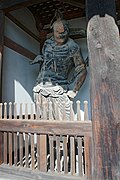 Ungyō Niō at the Central Gate of Hōryū-ji
 -
 Agyō Niō at the Central Gate of Hōryū-ji


Sikhism
[edit]Ik Onkar (Punjabi: ਇੱਕ ਓਅੰਕਾਰ; iconically represented as ੴ) are the first words of the Mul Mantar, which is the opening verse of the Guru Granth Sahib, the Sikh scripture.[127] Combining the numeral one ("Ik") and "Onkar", Ik Onkar literally means "one Om ";[128][L] these words are a statement that there is "one God",[129] understood to refer to the "absolute monotheistic unity of God"[127] and implying "singularity in spite of the seeming multiplicity of existence".[130][M]
According to Pashaura Singh, Onkar is used frequently as invocation in Sikh scripture; it is the foundational word (shabad), the seed of Sikh scripture, and the basis of the "whole creation of time and space".[131]
Ik Onkar is a significant name of God in the Guru Granth Sahib and Gurbani, states Kohli, and occurs as "Aum" in the Upanishads and where it is understood as the abstract representation of three worlds (Trailokya) of creation.[132][N] According to Wazir Singh, Onkar is a "variation of Om (Aum) of the ancient Indian scriptures (with a change in its orthography), implying the unifying seed-force that evolves as the universe".[133] Guru Nanak wrote a poem entitled Onkar in which, states Doniger, he "attributed the origin and sense of speech to the Divinity, who is thus the Om-maker".[127]
— Ramakali Dakkhani, Adi Granth 929-930, Translated by Pashaura Singh[131]
"Onkar" is the primordial sound/word. It is the soundless word (anahat naad or anahad naad). It is both the source as well as manifestation of the source. "Onkar" pervades the entire creation. The soundless sound is present everywhere and inside everything including us. In Sikhism, the Guru Granth Sahib is manifested form of this "Onkar". Hence, the Guru Granth Sahib is called "Shabad Guru". Shabad (word) is Guru and Guru itself is the Primordial Sound "Onkar" (God).[citation needed]
Thelema
[edit]For both symbolic and numerological reasons, Aleister Crowley adapted aum into a Thelemic magical formula, AUMGN, adding a silent 'g' (as in the word 'gnosis') and a nasal 'n' to the m to form the compound letter 'MGN'; the 'g' makes explicit the silence previously only implied by the terminal 'm' while the 'n' indicates nasal vocalisation connoting the breath of life and together they connote knowledge and generation. Together these letters, MGN, have a numerological value of 93, a number with polysemic significance in Thelema. Om appears in this extended form throughout Crowley's magical and philosophical writings, notably appearing in the Gnostic Mass. Crowley discusses its symbolism briefly in section F of Liber Samekh and in detail in chapter 7 of Magick (Book 4).[134][135][136][137]
Modern reception
[edit]The Brahmic script Om-ligature has become widely recognized in Western counterculture since the 1960s, mostly in its standard Devanagari form (ॐ), but the Tibetan Om (ༀ) has also gained limited currency in popular culture.[138]
In meditation
[edit]Meditating and chanting of Om can be done by first concentrating on a picture of Om and then effortlessly mentally chanting the mantra. Meditating and mental chanting have been said[by whom?] to improve the physiological state of the person by increasing alertness and sensory sensitivity.[139][unreliable source?]
See also
[edit].svg)
Notes
[edit]- ^ As used in the Stele of Sulaiman, dated to 1348.
- ^ Used for example in Urdu and Sindhi, although speakers of these languages may also use Brahmic representation such as Devanagari.
- ^ As used in the Stele of Sulaiman, dated to 1348.
- ^ Praṇava Upaniṣad in Gopatha Brāhmaṇa 1.1.26 and Uṇādisūtra 1.141/1.142
- ^ see Pāṇini, Aṣṭādhyāyī 6.1.95
- ^ see Māṇḍūkya Upaniṣad 8-12, composed in Classical Sanskrit, which describes Om as having three mātras corresponding to the three letters a-u-m
- ^ in the early 19th-century manuscript above Om is written अउ३म् with "अउ" as ligature as in ॐ without chandrabindu
- ^ later called Shiva
- ^ this is a reference to the three major Vedic fire rituals
- ^ this is a reference to the three major Vedas
- ^ this is a reference to the three worlds of the Vedas
- ^ Sanskrit original, quote: द्वे वाव ब्रह्मणो रूपे मूर्तं चामूर्तं च । अथ यन्मूर्तं तदसत्यम् यदमूर्तं तत्सत्यम् तद्ब्रह्म तज्ज्योतिः यज्ज्योतिः स आदित्यः स वा एष ओमित्येतदात्माभवत्[75]
- ^ Hume translates this as "imperishable Aksara", Max Muller translates it as "indestructible Brahman"; see: Max Muller, The Upanishads, Part 2, Mundaka Upanishad, Oxford University Press, page 36 and Robert Hume, "Thirteen Principal Upanishads" [1], page 367
- ^ The Sanskrit word used is Vyadh, which means both "penetrate" and "know"; Robert Hume uses penetrate, but mentions the second meaning; see: Robert Hume, Mundaka Upanishad, Thirteen Principal Upanishads, Oxford University Press, page 372 with footnote 1
- ^ Quote: "While Ek literally means One, Onkar is the equivalent of the Hindu "Om" (Aum), the one syllable sound representing the holy trinity of Brahma, Vishnu and Shiva - the God in His entirety."[128]
- ^ Quote: "the 'a,' 'u,' and 'm' of aum have also been explained as signifying the three principles of creation, sustenance and annihilation. ... aumkār in relation to existence implies plurality, ... but its substitute Ik Onkar definitely implies singularity in spite of the seeming multiplicity of existence. ..."[130]
- ^ Quote: "Ik Aumkara is a significant name in Guru Granth Sahib and appears in the very beginning of Mul Mantra. It occurs as Aum in the Upanishads and in Gurbani, the Onam Akshara (the letter Aum) has been considered as the abstract of three worlds (p. 930). According to Brihadaranyaka Upanishad "Aum" connotes both the transcendent and immanent Brahman."[132]
References
[edit]- ^ a b c Jones, Constance; Ryan, James D. (2006). Encyclopedia of Hinduism. Infobase Publishing. pp. 319–20. ISBN 978-0-8160-7564-5.
- ^ a b Beck, Guy L. (2012). Sonic liturgy: ritual and music in Hindu tradition. Columbia: University of South Carolina Press. p. 25. ISBN 978-1-61117-108-2. OCLC 824698506.
- ^ a b c d Wilke, Annette; Moebus, Oliver (2011). Sound and Communication: An Aesthetic Cultural History of Sanskrit Hinduism. Berlin: De Gruyter. p. 435. ISBN 978-3110181593.
- ^ a b James Lochtefeld (2002), "Om", The Illustrated Encyclopedia of Hinduism, Vol. 2: N-Z, Rosen Publishing. ISBN 978-0823931804, page 482
- ^ a b Holdrege, Barbara A. (1996). Veda and Torah: Transcending the Textuality of Scripture. SUNY Press. p. 57. ISBN 978-0-7914-1640-2.
- ^ "Om". Merriam-Webster (2013), Pronounced: \ˈōm\
- ^ a b David Leeming (2005), The Oxford Companion to World Mythology, Oxford University Press, ISBN 978-0195156690, page 54
- ^ a b Hajime Nakamura, A History of Early Vedānta Philosophy, Part 2, Motilal Banarsidass, ISBN 978-8120819634, page 318
- ^ a b c d e f g h Annette Wilke and Oliver Moebus (2011), Sound and Communication: An Aesthetic Cultural History of Sanskrit Hinduism, De Gruyter, ISBN 978-3110181593, pages 435–456
- ^ a b c Gerety, Moore; McKean, Finnian (20 May 2015). This Whole World Is OM: Song, Soteriology, and the Emergence of the Sacred Syllable (Thesis). Harvard University, Graduate School of Arts & Sciences. p. 33. ISSN 1746-7527.
- ^ a b Kudelska, Marta (1 January 2019). Why Is There I Rather Than It?. Peter Lang D. p. 244. doi:10.3726/b17932. ISBN 978-3-631-84429-8.
- ^ "Kathopanishad- Verse 15 - kathopanishad-1-2-15-sarve vedā - in Sanskrit with English Transliteration, Meaning and Commentary by Adi Shankaracharya (Sankara Bhashya)".
- ^ a b David White (2011), Yoga in Practice, Princeton University Press, ISBN 978-0691140865, pp. 104–111
- ^ a b Alexander Studholme (2012), The Origins of Om Manipadme Hum: A Study of the Karandavyuha Sutra, State University of New York Press, ISBN 978-0791453902, pages 1–4
- ^ T. A. Gopinatha Rao (1993), Elements of Hindu Iconography, Volume 2, Motilal Banarsidass, ISBN 978-8120808775, p. 248
- ^ Sehdev Kumar (2001), A Thousand Petalled Lotus: Jain Temples of Rajasthan, ISBN 978-8170173489, p. 5
- ^ Jan Gonda (1963), The Indian Mantra, Oriens, Vol. 16, pp. 244–297
- ^ a b Julius Lipner (2010), Hindus: Their Religious Beliefs and Practices, Routledge, ISBN 978-0415456760, pp. 66–67
- ^ Misra, Nityanand (25 July 2018). The Om Mala: Meanings of the Mystic Sound. Bloomsbury Publishing. pp. 104–. ISBN 978-93-87471-85-6.
- ^ "OM". Sanskrit English Dictionary, University of Köln, Germany
- ^ James Lochtefeld (2002), Pranava, The Illustrated Encyclopedia of Hinduism, Vol. 2: N-Z, Rosen Publishing. ISBN 978-0823931804, page 522
- ^ Paul Deussen, Sixty Upanishads of the Veda, Volume 1, Motilal Banarsidass, ISBN 978-8120814684, pages 74-75, 347, 364, 667
- ^ Diana Eck (2013), India: A Sacred Geography, Random House, ISBN 978-0385531924, page 245
- ^ R Mehta (2007), The Call of the Upanishads, Motilal Barnarsidass, ISBN 978-8120807495, page 67
- ^ Omkara, Sanskrit-English Dictionary, University of Koeln, Germany
- ^ CK Chapple, W Sargeant (2009), The Bhagavad Gita, Twenty-fifth–Anniversary Edition, State University of New York Press, ISBN 978-1438428420, page 435
- ^ Max Muller, Chandogya Upanishad, The Upanishads, Part I, Oxford University Press, page 12 with footnote 1
- ^ a b c Parpola, Asko (1981). "On the Primary Meaning and Etymology of the Sacred Syllable ōm". Studia Orientalia Electronica. 50: 195–214. ISSN 2323-5209.
- ^ Parpola, Asko (2015). The Roots of Hinduism : the Early Aryans and the Indus Civilization. New York. ISBN 9780190226909.
{{cite book}}: CS1 maint: location missing publisher (link) - ^ Aitareya Brahmana 5.32, Rig Veda, pages 139-140 (Sanskrit); for English translation: See Arthur Berriedale Keith (1920). The Aitareya and Kauṣītaki Brāhmaṇas of the Rigveda. Harvard University Press. p. 256.
- ^ Max Muller, Chandogya Upanishad, Oxford University Press, pages 1-21
- ^ a b Paul Deussen, Sixty Upanishads of the Veda, Volume 1, Motilal Banarsidass, ISBN 978-8120814684, pages 67-85, 227, 284, 308, 318, 361-366, 468, 600-601, 667, 772
- ^ Paul Deussen, Sixty Upanishads of the Veda, Volume 1, Motilal Banarsidass, ISBN 978-8120814684, page 207
- ^ John Grimes (1995), Ganapati: The Song of Self, State University of New York Press, ISBN 978-0791424391, pages 78-80 and 201 footnote 34
- ^ "Aitareya &Taittiriya Upanishads with Shankara Bhashya - English".
- ^ a b Whitney, William Dwight (1950). Sanskrit Grammar: Including both the Classical Language, and the older Dialects, of Veda and Brahmana. Cambridge, Massachusetts: Harvard University Press. pp. 12, 27–28.
- ^ Osho (2012). The Book of Secrets, unpaginated. Osho International Foundation. ISBN 9780880507707.
- ^ Mehta, Kiran K. (2008). Milk, Honey and Grapes, p.14. Puja Publications, Atlanta. ISBN 9781438209159.
- ^ Misra, Nityanand (2018). The Om Mala, unpaginated. Bloomsbury Publishing. ISBN 9789387471856.
- ^ Vālmīki; trans. Mitra, Vihārilāla (1891). The Yoga-vásishtha-mahárámáyana of Válmiki, Volume 1, p.61. Bonnerjee and Company. [ISBN unspecified].
- ^ Kobayashi, Masato (2006). "Pāṇini's Phonological Rules and Vedic: Aṣṭādhyāyī 8.2*" (PDF). Journal of Indological Studies. 18: 16.
- ^ Joseph Campbell (1949), The Hero with a Thousand Faces, 108f.
- ^ https://unicodeplus.com/U+095 0 Unicode Character "ॐ" (U+0950)
- ^ Deb, Harit Krishna (1921). "The Svastika and the Oṁkāra". Journal of the Royal Asiatic Society of Bengal. 17 (3): 231–247.
- ^ "Research Items: The Swastika, Gammadion, Fylfot". Nature. 110 (2758): 365. September 1922. doi:10.1038/110365a0. ISSN 0028-0836. S2CID 4114094. The Swastika, p. PA365, at Google Books
- ^ Roy, Ankita (2011). Rediscovering the Brahmi Script (PDF). Bombay: Industrial Design Center, IDC, IIT. Archived from the original (PDF) on 3 October 2015. See the section, "Ancient Symbols".
- ^ Kak, SC (1990). "Indus and Brahmi: Further Connections". Cryptologia. 14 (2): 169–183. doi:10.1080/0161-119091864878.
- ^ Parker, Henry (1909). Ancient Ceylon. p. 428.
- ^ Parker, Henry (1909). Ancient Ceylon. p. 490.
- ^ Deborah Wong (2001), Sounding the Center: History and Aesthetics in Thai Buddhist Performance, University of Chicago Press, ISBN 978-0226905853, page 292
- ^ James Minahan (2009), The Complete Guide to National Symbols and Emblems, ISBN 978-0313344961, pages 28-29
- ^ "ឱម: ប្រភពនៃរូបសញ្ញាឱម". Archived from the original on 10 November 2021. Retrieved 17 August 2020.
- ^ "ឱម : អំណាចឱមនៅក្នុងសាសនា". Archived from the original on 10 November 2021. Retrieved 17 August 2020.
- ^ "Om". 10 November 2020.
- ^ Ellwood, Robert S.; Alles, Gregory D. (2007). The Encyclopedia of World Religions. Infobase Publishing. pp. 327–328. ISBN 9781438110387.
- ^ Beck, Guy L. (1995). Sonic Theology: Hinduism and Sacred Sound. Motilal Banarsidass. pp. 42–48. ISBN 9788120812611.
- ^ Monier Monier-Williams (1893), Indian Wisdom, Luzac & Co., London, page 17
- ^ a b Max Muller, Chandogya Upanishad, The Upanishads, Part I, Oxford University Press, pages 1–3 with footnotes
- ^ a b c Paul Deussen, Sixty Upanishads of the Veda, Volume 1, Motilal Banarsidass, ISBN 978-8120814684, pages 68-70
- ^ a b Patrick Olivelle (2014), The Early Upanishads, Oxford University Press, ISBN 978-0195124354, page 171-185
- ^ Paul Deussen, Sixty Upanishads of the Veda, Volume 1, Motilal Banarsidass, ISBN 978-8120814684, pages 70–71 with footnotes
- ^ a b Max Muller, Chandogya Upanishad, The Upanishads, Part I, Oxford University Press, pages 4–6 with footnotes
- ^ a b Robert Hume, Chandogya Upanishad, The Thirteen Principal Upanishads, Oxford University Press, pages 178-180
- ^ Max Muller, Chandogya Upanishad, The Upanishads, Part I, Oxford University Press, pages 4–19 with footnotes
- ^ Max Muller, Chandogya Upanishad, The Upanishads, Part I, Oxford University Press, page 28 with footnote 1
- ^ Max Muller, Chandogya Upanishad, The Upanishads, Part I, Oxford University Press, page 35
- ^ Paul Deussen, Sixty Upanishads of the Veda, Volume 1, Motilal Banarsidass, ISBN 978-8120814684, pages 269-273
- ^ Max Muller (1962), Katha Upanishad, in The Upanishads – Part II, Dover Publications, ISBN 978-0486209937, page 8
- ^ a b Paul Deussen, Sixty Upanishads of the Veda, Volume 1, Motilal Banarsidass, ISBN 978-8120814684, pages 284-286
- ^ a b c Muller, Max (ed.). The Upanishads: Maitrayana-Brahmana Upanishad. Vol. 2. Oxford University Press. pp. 307–308.
- ^ Maitri Upanishad – Sanskrit Text with English Translation[permanent dead link] EB Cowell (Translator), Cambridge University, Bibliotheca Indica, page 258-260
- ^ Max Muller, The Upanishads, Part 2, Maitrayana-Brahmana Upanishad, Oxford University Press, pages 306-307 verse 6.3
- ^ Deussen, Paul, ed. (1980). Sixty Upanishads of the Veda. Vol. 1. Motilal Banarsidass. p. 347. ISBN 978-8120814684.
- ^ Cowell, E.B. (ed.). Maitri Upanishad: Sanskrit Text with English Translation. Bibliotheca Indica. Translated by Cowell, E.B. Cambridge University Press. p. 258.
- ^ (in Sanskrit) – via Wikisource.
- ^ Paul Deussen (Translator), Sixty Upanishads of the Veda, Vol 2, Motilal Banarsidass (2010 Reprint), ISBN 978-8120814691, pages 580-581
- ^ Eduard Roer, Mundaka Upanishad Bibliotheca Indica, Vol. XV, No. 41 and 50, Asiatic Society of Bengal, page 144
- ^ Robert Hume, Mundaka Upanishad, Thirteen Principal Upanishads, Oxford University Press, pages 372-373
- ^ Charles Johnston, The Mukhya Upanishads: Books of Hidden Wisdom, (1920–1931), The Mukhya Upanishads, Kshetra Books, ISBN 978-1495946530 (Reprinted in 2014), Archive of Mundaka Upanishad, pages 310-311 from Theosophical Quarterly journal
- ^ Mundaka Upanishad, in Upanishads and Sri Sankara's commentary – Volume 1: The Isa Kena and Mundaka, SS Sastri (Translator), University of Toronto Archives, page 144 with section in 138-152
- ^ a b c d e f Paul Deussen, Sixty Upanishads of the Veda, Volume 2, Motilal Banarsidass, ISBN 978-8120814691, pages 605-637
- ^ a b c d e f g Hume, Robert Ernest (1921), The Thirteen Principal Upanishads, Oxford University Press, pp. 391–393
- ^ Charles Johnston, The Measures of the Eternal – Mandukya Upanishad Theosophical Quarterly, October, 1923, pages 158-162
- ^ Paul Deussen, Sixty Upanishads of the Veda, Volume 1, Motilal Banarsidass, ISBN 978-8120814684, pages 308
- ^ Max Muller, Shvetashvatara Upanishad, The Upanishads, Part II, Oxford University Press, page 237
- ^ Hume, Robert (1921). "Shvetashvatara Upanishad 1.14 – 1.16". The Thirteen Principal Upanishads. Oxford University Press. pp. 396–397 with footnotes.
- ^ Grimes, John A. (1995). Ganapati: Song of the Self. State University of New York Press. pp. 77–78. ISBN 978-0-7914-2439-1.
- ^ Alter, Stephen (2004). Elephas Maximus: a portrait of the Indian Elephant. New Delhi: Penguin Books. p. 95. ISBN 978-0143031741.
- ^ Grimes (1995), pp. 23–24.
- ^ Saraswati (1987), p. 127, In Chinmayananda's numbering system, this is upamantra 8.
- ^ Gerety, Finnian M. M. (1 February 2021). "Between Sound and Silence in Early Yoga: Meditation on " Om " at Death". History of Religions. 60 (3): 217–218. doi:10.1086/711944. ISSN 0018-2710. S2CID 233429885.
- ^ "Valmiki Ramayana - Yuddha Kanda - Sarga 117". valmikiramayan.pcriot.com.
- ^ a b Fowler, Jeaneane D. (2012). The Bhagavad Gita: A Text and Commentary for Students. Sussex Academic Press. p. 164. ISBN 978-1845193461.
- ^ Mukundananda (2014). "Bhagavad Gita, The Song of God: Commentary by Swami Mukundananda". Jagadguru Kripaluji Yog.
- ^ a b Fowler, Jeaneane D. (2012). The Bhagavad Gita: A Text and Commentary for Students. Sussex Academic Press. p. 271. ISBN 978-1845193461.
- ^ Muller, Max, ed. (26 October 2001). The Bhagavadgita with the Sanatsujatiya and the Anugita. Translated by Telang, K.T. Routledge. p. 120. ISBN 978-0700715473.
- ^ The Vishnu-Dharma Vidya [Chapter CCXXI]. 16 April 2015.
- ^ Esnoul, A.M. (2005). "Oṃ". Encyclopedia of Religion (2nd ed.). USA: Macmillan Reference. pp. 6820–6821. ISBN 9780028659978.
- ^ "14, King Purūravā Enchanted by Urvaśī". Bhāgavata Purāṇa, Canto 9. Bhaktivedanta Book Trust International, Inc.
- ^ Young, Katherine K. "Theology Does Help Women's Liberation". In Rosen, Steven J. (ed.). Vaiṣṇavī: Women and the Worship of Krishna. Motilal Banarsidass. pp. 242–243.
- ^ Beck, Guy (1995). Sonic Theology: Hinduism and Sacred Sound. Motilal Banarsidass. p. 154. ISBN 978-8120812611.
- ^ Rocher, Ludo (1986). The Purāṇas. Wiesbaden: O. Harrassowitz. ISBN 978-3447025225.
- ^ "Adi Parashakti - The Divine Mother". TemplePurohit - Your Spiritual Destination Bhakti, Shraddha Aur Ashirwad. 1 August 2018. Retrieved 26 May 2021.
- ^ Swami Narayanananda (1960). The Primal Power in Man: The Kundalini Shakti. Health Research Books. ISBN 9780787306311.
{{cite book}}: ISBN / Date incompatibility (help) - ^ a b Patanjali (1912). The Yogasutras of Patanjali. Translated by Johnston, Charles. New York, C. Johnston. p. 15.
- ^ "Indian Century - OM". www.indiancentury.com.
- ^ Kaviraja, Krishnadasa (1967). "20, the Goal of Vedānta Study". Teachings of Lord Caitanya. Translated by A. C. Bhaktivedanta Swami Prabhupada. Bhaktivedanta Book Trust International, Inc.
- ^ Chattopadhyaya, Sudhakar (1990) [1978]. Reflections on the Tantras. Motilal Banarasidasa. p. 43.
- ^ a b Von Glasenapp (1999), pp. 410–411.
- ^ Malaiya, Yashwant K., "Om – significance in Jainism", Languages and Scripts of India, Colorado State University
- ^ "Namokar Mantra". Digambarjainonline.com. Retrieved 4 June 2014.
- ^ Samuel, Geoffrey (2005). Tantric Revisionings: New Understandings of Tibetan Buddhism and Indian Religion. Motilal Banarsidass. ISBN 9788120827523.
- ^ "Vajrayana Buddhism Origins, Vajrayana Buddhism History, Vajrayana Buddhism Beliefs". www.patheos.com. Retrieved 4 August 2017.
- ^ ""Om" - the Symbol of the Absolute". Retrieved 13 October 2015.
- ^ Olsen, Carl (2014). The Different Paths of Buddhism: A Narrative-Historical Introduction. Rutgers University Press. p. 215. ISBN 978-0-8135-3778-8.
- ^ Getty, Alice (1988). The Gods of Northern Buddhism: Their History and Iconography. Dover Publications. pp. 29, 191–192. ISBN 978-0-486-25575-0.
- ^ Gyatso, Tenzin. "On the meaning of: OM MANI PADME HUM - The jewel is in the lotus or praise to the jewel in the lotus". Internet Sacred Text Archive. Retrieved 17 April 2017.
- ^ C. Alexander Simpkins; Annellen M. Simpkins (2009). Meditation for Therapists and Their Clients. W.W. Norton. pp. 159–160. ISBN 978-0-393-70565-2.
- ^ C. Alexander Simpkins; Annellen M. Simpkins (2009). Meditation for Therapists and Their Clients. W.W. Norton. p. 158. ISBN 978-0-393-70565-2.
- ^ a b Snodgrass, Adrian (2007). The Symbolism of the Stupa, Motilal Banarsidass. Motilal Banarsidass Publishers. p. 303. ISBN 978-8120807815.
- ^ a b Baroni, Helen J. (2002). The Illustrated Encyclopedia of Zen Buddhism. Rosen Publishing. p. 240. ISBN 978-0-8239-2240-6.
- ^ a b c ""A un" (阿吽)". Japanese Architecture and Art Net Users System. 2001. Retrieved 14 April 2011.
- ^ Daijirin Japanese dictionary, 2008, Monokakido Co., Ltd.
- ^ "Komainu and Niô" (PDF). Dentsdelion Antiques Tokyo Newsletter. 11 (3). 2011.
- ^ Ball, Katherine (2004). Animal Motifs in Asian Art. Dover Publishers. pp. 59–60. ISBN 978-0-486-43338-7.
- ^ Arthur, Chris (2009). Irish Elegies. Palgrave Macmillan. p. 21. ISBN 978-0-230-61534-2.
- ^ a b c Doniger, Wendy (1999). Merriam-Webster's encyclopedia of world religions. Merriam-Webster. p. 500. ISBN 978-0-87779-044-0. Retrieved 23 September 2015.
- ^ a b Gulati, Mahinder (2008). Comparative Religious And Philosophies: Anthropomorphlsm And Divinity. Atlantic. pp. 284–285. ISBN 978-8126909025.
- ^ Singh, Khushwant (2002). "The Sikhs". In Kitagawa, Joseph Mitsuo (ed.). The religious traditions of Asia: religion, history, and culture. London: RoutledgeCurzon. p. 114. ISBN 0-7007-1762-5.
- ^ a b Singh, Wazir (1969). Aspects of Guru Nanak's philosophy. Lahore Book Shop. p. 20. Retrieved 17 September 2015.
- ^ a b Singh, Pashaura (2014). "Gurmat: The Teachings of the Gurus". In Singh, Pashaura; Fenech, Louis E. (eds.). The Oxford Handbook of Sikh Studies. Oxford University Press. p. 227. ISBN 978-0199699308.
- ^ a b Kohli, S.S. (1993). The Sikh and Sikhism. Atlantic. p. 35. ISBN 81-71563368.
- ^ Singh, Wazir (1969). "Guru Nanak's philosophy". Journal of Religious Studies. 1 (1): 56.
- ^ Crowley, Aleister. Liber Samekh. Internet Sacred Text Archive. Retrieved 27 May 2021.
- ^ Crowley, Aleister. Magick in Theory and Practice - Chapter 7. Internet Sacred Text Archive. Retrieved 27 May 2021.
- ^ Crowley, Aleister (1997). Magick : Liber ABA, book four, parts I–IV (Second revised ed.). San Francisco, CA. ISBN 9780877289197.
{{cite book}}: CS1 maint: location missing publisher (link) - ^ Crowley, Aleister (2016). Liber XV : Ecclesiae Gnosticae Catholicae Canon Missae. Gothenburg. ISBN 9788393928453.
{{cite book}}: CS1 maint: location missing publisher (link) - ^ Messerle, Ulrich. "Graphics of the Sacred Symbol OM". Archived from the original on 31 December 2017. Retrieved 14 January 2019.
Bibliography
[edit]- Kumar, S.; Nagendra, H.R.; Manjunath, N.K.; Naveen, K.V.; Telles, S. (2010). "Meditation on OM: Relevance from ancient texts and contemporary science". International Journal of Yoga. 3 (1): 2–5. doi:10.4103/0973-6131.66771. PMC 2952121. PMID 20948894.
- Saraswati, Chinmayananda (1987). Glory of Ganesha. Bombay: Central Chinmaya Mission Trust. ISBN 978-8175973589.
- Von Glasenapp, Helmuth (1999). Der Jainismus: Eine Indische Erlosungsreligion [Jainism: An Indian Religion of Salvation] (in German). Shridhar B. Shrotri (trans.). Delhi: Motilal Banarsidass. ISBN 81-208-1376-6.
Further reading
[edit]- Francke, A. H. (1915). "The Meaning of the "Om-mani-padme-hum" Formula". The Journal of the Royal Asiatic Society of Great Britain and Ireland. 47 (3): 397–404. doi:10.1017/S0035869X00048425. JSTOR 25189337. S2CID 170755544.
- Gurjar, A. A.; Ladhake, S. A.; Thakare, A. P. (2009). "Analysis of Acoustic of "OM " Chant to Study It's [sic] Effect on Nervous System". International Journal of Computer Science and Network Security. 9 (1): 363–367. CiteSeerX 10.1.1.186.8652.
- Kumar, Uttam; Guleria, Anupam; Khetrapal, Chunni Lal (2015). "Neuro-cognitive aspects of "OM" sound/syllable perception: A functional neuroimaging study". Cognition and Emotion. 29 (3): 432–441. doi:10.1080/02699931.2014.917609. PMID 24845107. S2CID 20292351.
- Stein, Joel (4 August 2003). "Just say Om" (PDF). Time Magazine.
- Telles, S.; Nagarathna, R.; Nagendra, H. R. (1995). "Autonomic changes during "OM" meditation" (PDF). Indian Journal of Physiology and Pharmacology. 39 (4): 418–420. ISSN 0019-5499. PMID 8582759.
- Vivekanda. – via Wikisource.
| Philosophy |
|  | |||||||||||||||||
|---|---|---|---|---|---|---|---|---|---|---|---|---|---|---|---|---|---|---|---|
| Texts |
| ||||||||||||||||||
| Deities |
| ||||||||||||||||||
| Practices |
| ||||||||||||||||||
| Related | |||||||||||||||||||


| Gods | |||||
|---|---|---|---|---|---|
| Philosophy | |||||
| Branches |
| ||||
| Practices | |||||
| Literature | |||||
| Symbols | |||||
| Ascetics | |||||
| Scholars | |||||
| Community |
| ||||
| Jainism in |
| ||||
| Jainism and | |||||
| Dynasties and empires | |||||
| Related | |||||
| Lists | |||||
| Navboxes | |||||


