


Community hub
Recent from talks
Contribute something
Nothing was collected or created yet.
Ken (unit)
View on Wikipedia

| Ken | |
|---|---|
| Unit system | Japanese units |
| Unit of | length |
| Symbol | 間 |
| Conversions | |
| 1 間 in ... | ... is equal to ... |
| Japanese units | 6 尺 |
| SI units | 1.818 m |
| imperial/US units | 5.965 ft or 71.58 in |

The ken (Japanese: 間) is a traditional Japanese unit of length, equal to six shaku ('Japanese feet'). The exact value has varied over time and location but has generally been a little shorter than 2 meters (6 ft 7 in).[1][2] It is now standardized as 1.82 m.[3]
Although mostly supplanted by the metric system, this unit is a common measurement in Japanese architecture, where it is used as a proportion for the intervals between the pillars of traditional-style buildings. In this context, it is commonly translated as "bay". The length also appears in other contexts, such as the standard length of the bō staff in Japanese martial arts and the standard dimensions of the tatami mats. As these are used to cover the floors of most Japanese houses, floor surfaces are still commonly measured not in square meters but in "tatami" which are equivalent to half of a square ken.
Word
[edit]
Among English loanwords of Japanese origin, both ken and ma are derived from readings of the same character 間.
This kanji graphically combines 門 "door" and 日 "sun". The earlier variant character 閒 was written with 月 "moon" rather than "sun", depicting "A 門 door through the crevice of which the 月 moonshine peeps in".[4]
The diverse Japanese pronunciations of 間 include on'yomi Sino-Chinese readings (from jian 間 or 间 "room; between; gap; interval") of kan "interval; space; between; among; discord; favorable opportunity" or ken "six feet"; and kun'yomi native Japanese readings of ai "interval; between; medium; crossbred", aida or awai "space; interval; gap; between; among; midway; on the way; distance; time; period; relationship", or ma "space; room; interval; pause; rest (in music); time; a while; leisure; luck; timing; harmony".[5]
History
[edit]
The ken is based on the Chinese jian. It uses the same Chinese character as the Korean kan.
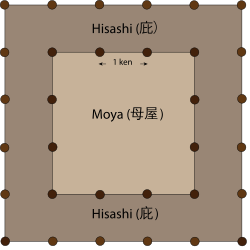
A building's proportions were (and, to a certain extent, still are) measured in ken, as for example in the case of Enryaku-ji's Konponchū-dō (Main Hall), which measures 11×6 bays (37.60 m × 23.92 m), of which 11×4 are dedicated to the worshipers. Inside buildings, available space was often divided in squares measuring one ken across, and each square was then called a ma (間), the term written with the same Chinese character as ken.[1] Traditional buildings usually measure an odd number of bays, for example 3×3 or 5×5. A type of temple's gate called rōmon can have dimensions going from 5×2 bays to the more common 3×2 bays down to even 1×1 bay.[6] The Zen butsuden in the illustration measures 5×5 ken across externally because its 3×3 ken core (moya) is surrounded by a 1-ken aisle called hisashi.
The value of a ken could change from building to building, but was usually kept constant within the same structure. There can however be exceptions. Kasuga Taisha's tiny honden's dimensions, for example, are 1×1 in ken, but 1.9×2.6 in meters.[1] In the case of Izumo Taisha's honden, a ken is 6.32 m (20.7 ft), well above its standard value.[7]
The distance between pillars was standardized very early and started being used as a unit of measurement. Land area in particular was measured using the ken as a basis. The unit was born out of the necessity to measure land surface to calculate taxes. At the time of Toyotomi Hideyoshi (16th century), the ken was about 1.97 m (6.5 ft), but around 1650 the Tokugawa shogunate reduced it to 1.818 m (5.96 ft) specifically to increase taxes. After the Edo period, the ken started to be called kyōma (京間).[1][2]
References
[edit]Citations
[edit]- ^ a b c d JAANUS
- ^ a b Iwanami Kōjien
- ^ Magazine, Wallpaper* (May 22, 2021). "Modern Japanese houses inspiring minimalism and avant-garde living". Wallpaper*.
- ^ Bernhard Karlgren, Analytic Dictionary of Chinese and Sino-Japanese, Paul Geunthner, 1923, p. 130.
- ^ John H. Haig, The New Nelson Japanese-English Character Dictionary, Tuttle, 1997, p. 1132.
- ^ Fujita Masaya, Koga Shūsaku, ed. (April 10, 1990). Nihon Kenchiku-shi (in Japanese) (September 30, 2008 ed.). Shōwa-dō. p. 79. ISBN 4-8122-9805-9.
- ^ JAANUS, Taisha-zukuri. Accessed on December 1, 2009.
Bibliography
[edit]- Japanese Art Net User System (JAANUS) Dictionary of Japanese Architectural and Art Historical Terminology, articles Kasuga-zukuri, Ken and Kondō. Accessed on May 6, 2009
- Iwanami Kōjien (広辞苑) Japanese dictionary, 6th Edition (2008), DVD version
Elements of Japanese architecture | ||||||||||
|---|---|---|---|---|---|---|---|---|---|---|
| Styles |
| |||||||||
| Types of building |
| |||||||||
| Roof styles | ||||||||||
| Structural and spatial | ||||||||||
| ||||||||||
| Rooms | ||||||||||
| Furnishings | ||||||||||
| Partitions | ||||||||||
| Outdoor objects | ||||||||||
| Measurements | ||||||||||
| Organizations | ||||||||||
| Related topics |
| |||||||||

Ken (unit)
View on GrokipediaDefinition and Terminology
Precise Definition and Variations
The ken (間) is a traditional Japanese unit of length equivalent to six shaku (the Japanese foot), with the standardized shaku defined as exactly 10/33 meters under the 1891 Weights and Measures Act, yielding one ken as precisely 60/33 meters or 20/11 meters (approximately 1.81818 meters).[6][7] This module derives from the interval between wooden columns in post-and-beam construction, serving as a fundamental spatial measure in traditional buildings.[1] Prior to national standardization in the late 19th century, the ken's length exhibited regional and temporal variations, often determined by local timber dimensions or carpentry practices rather than a fixed metric, with recorded values ranging slightly shorter or longer than the modern equivalent depending on the era.[3] For instance, pre-Edo period measurements could differ by up to several centimeters due to inconsistent shaku calibrations across domains.[8] These discrepancies highlight the ken's origins as a pragmatic, body-proportional unit akin to a fathom, adapted empirically for architectural utility rather than abstract uniformity.[6] In contemporary contexts, the ken retains its 1.818-meter value for heritage restoration and modular design, though practical applications may invoke slight adjustments for material tolerances in replicating historical structures.[1] No significant modern variants exist outside specialized recreations, as metric adoption has supplanted it for official use since 1921.[3]Etymology and Linguistic Context
The term ken (間) for the traditional Japanese unit of length originates from the Sino-Japanese (on'yomi) reading of the kanji 間, which fundamentally denotes an interval, gap, or space between objects.[9] This kanji is an ideogrammatic compound (会意形声文字) combining 門 (mon, gate) and 月 (tsuki, moon), evoking the image of moonlight penetrating the space within or through a gateway, thereby symbolizing division or enclosure of area.[10] The character's adoption into Japanese from Chinese script dates to at least the 5th century CE, with its core semantic role in expressing spatial or temporal separation persisting across compounds like 時間 (jikan, time) or 空間 (kūkan, space).[10] In architectural and linguistic usage, ken specifically contextualizes 間 as the modular bay or interval between the centers of two adjacent pillars (柱間, hashira-ma) in post-and-beam construction, a system central to Japanese building traditions since the Asuka period (538–710 CE).[11] This measurement-derived term functions as a counter suffix in compounds such as ikken (一間, one bay) or niken (二間, two bays), quantifying structural modules rather than absolute distance, and extends metaphorically to room divisions in vernacular language (e.g., 居間, ima, living room as an "interval of dwelling").[11] The native kun'yomi readings ma (space, pause) or aida (gap, duration) of the same kanji underscore a broader cultural emphasis on relational voids over fixed entities, influencing aesthetic concepts like ma in design, though the unit ken prioritizes the standardized on'yomi for technical precision.[9]Historical Evolution
Ancient and Pre-Standardized Origins
The ken, denoting the interval between two structural pillars in wooden architecture, traces its origins to the Asuka period (538–710 CE), when Japanese builders adopted modular construction techniques from continental Asia alongside Buddhism. This practical unit prioritized functional spans for post-and-beam frameworks over fixed metrics, allowing flexibility in temple and palace designs influenced by Chinese and Korean models. Early examples appear in 7th-century structures like Hōryū-ji, where bay spacing formed the basis for proportional planning, though precise lengths varied with local materials and craftsmanship.[12] Formalization occurred with the Taihō Code of 701 CE, which integrated the shakkanhō system—derived from Tang dynasty standards—establishing the ken nominally as six shaku, a foot-like unit. However, pre-standardized applications in the Nara (710–794 CE) and Heian (794–1185 CE) periods exhibited inconsistencies; records indicate the ken sometimes equated to 6 shaku plus 3 to 5 sun (where 1 sun ≈ 3 cm), reflecting regional shaku variations from 29.6 cm to 30.8 cm. These discrepancies arose from empirical adjustments for seismic resilience and aesthetic harmony rather than uniform enforcement, as evidenced in temple reconstructions and edicts.[13][14] In ancient temple architecture, such as Tōdai-ji's Kondō hall (completed 752 CE), the ken module dictated room widths, roof projections, and overall massing, ensuring structural stability through repeated bays. This approach, rooted in causal principles of load distribution in timber framing, persisted without rigid standardization until later feudal regulations, underscoring the unit's evolution from adaptive craft practice to codified measure.[15][16]Standardization in the Edo Period
During the Edo period (1603–1868), under the Tokugawa shogunate, the ken—traditionally the interval between structural columns in architecture—experienced increased standardization to support centralized administration, land taxation, and modular construction practices. Prior to this era, the ken lacked a fixed relation to the base unit shaku (approximately 30.3 cm), often equating to 6 shaku plus variable additions like 3–5 sun (1 sun ≈ 3.03 cm), leading to regional discrepancies that complicated governance and trade.[13] The shogunate addressed this variability through regulatory reforms, enforcing uniformity in measurements for official purposes, including urban planning in Edo (modern Tokyo) and domainal infrastructure.[17] A pivotal change occurred around 1650, when the ken was officially redefined as exactly 6 shaku, yielding 181.8 cm, a deliberate reduction from prior lengths to inflate tax yields on land and buildings without nominal rate hikes—effectively shrinking assessed areas under the same modular units.[11] This adjustment aligned with broader metrological controls, such as the 1669 standardization of the volume unit shō, reflecting the regime's emphasis on quantifiable fiscal precision amid rapid urbanization and castle reconstructions post-Sekigahara (1600).[18] Architectural treatises and carpentry guilds adopted this ken module rigorously, basing room dimensions, tatami mat layouts (typically 1 ken by 0.5 ken), and building bays on it, which streamlined mass production of timber frames during the era's population boom and merchant class expansion.[17] Enforcement occurred via han (domainal) edicts and shogunal oversight, with hereditary officials inspecting compliance in construction projects, from samurai residences to merchant warehouses, fostering a national consistency despite lingering local shaku variants like kanejaku (shorter) and kujirajaku (longer).[19] By the mid-18th century, this system underpinned standardized town grids and temple expansions, such as those in Kyoto and Edo, minimizing disputes over property extents and enabling efficient resource allocation in a resource-constrained archipelago.[13] However, full metrical uniformity awaited Meiji reforms, as Edo-era standards prioritized practical utility over absolute precision, with ken lengths fluctuating slightly by craft or locale until late in the period.[11]Transition During the Meiji Restoration and Metric Adoption
During the Meiji Restoration, which began in 1868, the Japanese government initiated reforms to centralize and standardize traditional measurement systems, including the shakkanhō framework encompassing the ken, to support industrialization, international trade, and administrative uniformity amid regional variations in unit lengths.[20] Japan acceded to the International Metre Convention in 1885, aligning national standards with emerging global metric prototypes held in Paris.[20] The pivotal Weights and Measures Act of 1891 legally defined the shaku at precisely 10/33 meter (approximately 30.3 centimeters), thereby fixing the ken—equivalent to six shaku—at 60/33 meter (approximately 1.818 meters), based on brass standards calibrated against metric references.[21][22] This reform preserved the hierarchical structure of traditional units (sun, shaku, ken, jō, chō) while anchoring them to metric precision, enabling compatibility with Western engineering practices without immediate wholesale replacement.[21] The push toward full metric adoption accelerated post-Meiji, culminating in the Revised Weights and Measures Law promulgated on April 12, 1921, and effective from July 1, 1924, which established the metric system as the official standard and prohibited traditional units for most commercial and governmental purposes.[23] Nonetheless, exemptions persisted for customary applications, allowing the metric-defined ken to remain integral to fields like architecture, where it dictated pillar spacing, room modules, and tatami mat dimensions (typically one ken by half ken).[1][3] This hybrid approach reflected pragmatic adaptation: while metric units dominated scientific, manufacturing, and export sectors by the early 20th century, the ken's endurance stemmed from its embedded role in cultural and constructive norms, resisting complete obsolescence even as Japan's economy globalized.[1] Traditional units, now metric-equivalent, thus transitioned from variable feudal standards to legally codified relics, coexisting with SI units in niche domains.[21]Practical Applications
Role in Traditional Japanese Architecture
The ken served as the primary modular unit in traditional Japanese wooden architecture, representing the standard distance between the centers of adjacent pillars, which constituted the building's structural skeleton. Equal to six shaku (approximately 1.818 meters in standardized measurements), this interval enabled proportional design, scalability, and rhythmic repetition across structures from vernacular houses to monumental temples.[16][12] The modular approach, centered on the ken, organized both interior spaces and exterior forms, with column heights often matching one ken and inter-column spacings of three or 3.5 ken, divided into panels for infill walls and screens.[12] In temple construction, the ken dictated bay layouts for main halls (kondō), as exemplified in the Tōshōdaiji kondō (8th century), where the façade measures seven ken (about 12.7 meters, narrowing at ends) and the hipped roof spans four ken front to back.[24] This system extended to larger complexes like Tōdai-ji's Daibutsuden (rebuilt 1709, original 752 CE), supported by 84 pillars spaced in ken bays to accommodate the colossal Buddha statue, ensuring seismic resilience through flexible post-and-beam framing.[25] During the Kamakura period (1185–1333 CE), temple planning explicitly employed ken proportions for halls, building on earlier Asuka and Nara-era precedents in sites like Hōryū-ji (founded 607 CE).[15] For castles and urban layouts, the ken formed the basis of grid planning in castle towns, subdividing sites for fortifications and residences, as in Edo-period developments where building alignments followed ken increments for defensive and aesthetic coherence.[26] Integration with area units like the tsubo (one square ken) further standardized room sizes via tatami mats, fostering prefabricated elements and harmonious spatial hierarchies in both elite and common structures.[17] This modular rigor, rooted in carpentry traditions, prioritized functional adaptability over rigid geometry, allowing variations like the inner core (moya) and surrounding veranda (hisashi) to expand in ken multiples.[27]Integration with Other Length and Area Units
In the traditional Japanese shakkanhō system of measurement, the ken functions as an intermediate modular length unit, equivalent to six shaku, which itself subdivides into ten sun and further into bu for finer granularity in carpentry and layout.[18][28] This hierarchical integration enables scalable design, where larger spans like building widths are denoted in whole ken while detailing employs shaku fractions, ensuring proportional consistency across structures without reliance on metric intermediaries.[3] For area quantification, the ken directly defines the tsubo, the primary unit for flooring and land appraisal, as one square ken—or equivalently, thirty-six square shaku—reflecting its origin in the spatial module of a standard room bay.[28][18] The tsubo aligns with practical flooring by encompassing the area of two jō (tatami mat units), promoting efficient tessellation in residential and temple interiors where dimensions are multiples of the ken grid.[29]| Length/Area Unit | Relation to Ken |
|---|---|
| Shaku (length) | 1 ken = 6 shaku[18] |
| Tsubo (area) | 1 tsubo = 1 ken² = 36 shaku²[28] |
Conversions and Contemporary Status
Metric and International Equivalents
The standardized ken (間), as defined in the shakkan-hō system following Japan's metric alignment in the early 20th century, measures exactly 20/11 meters, or approximately 1.818 meters.[1][21] This equates to 6 shaku, with each shaku fixed at 10/33 meters (0.303 meters).[30] In international imperial units, 1 ken corresponds to approximately 5.964 feet, 71.57 inches, or 1.988 yards.[21][7] These conversions derive from the metric base, reflecting the unit's role in precise architectural and spatial planning where exact modular spacing remains relevant despite predominant metric use in contemporary Japan.[3]Persistence in Modern Japan
Despite Japan's adoption of the metric system via the Revised Weights and Measures Law effective July 1, 1924, the ken—standardized at 1.818 meters—persists as a modular reference in architectural design and construction, particularly for residential and traditional-style structures.[23][1] This unit, originally denoting column spacing intervals, continues to inform proportional layouts that prioritize spatial harmony and adaptability in wooden framing, even as metric dimensions govern official blueprints and regulations.[17] Contemporary examples illustrate its practical application. The 10 Ken House, completed in 2012 by Coordinate House NOGAMI in Tokyo, composes its form from ten interconnected ken modules, treating the structure as an aggregation of modular elements that evoke historical construction while accommodating modern living needs.[31] Similarly, Yuji Tanabe Architects employed the ken in the Pettanco House (2022), basing the two-story layout on a single ken grid for precise spatial divisions in a live-work space blending traditional aesthetics with contemporary functionality.[32] A prior project by the same firm in 2019 scaled to 4 ken by 6 ken, demonstrating the unit's scalability for site-specific adaptations using modern tools and materials.[33] In broader practice, carpenters and designers retain the ken for aligning components like beams and panels, facilitating compatibility with empirical joinery methods refined over centuries for earthquake resistance, though metric conversions are mandatory for legal compliance under the Building Standards Act of 1950. This dual usage—ken for conceptual planning and metric for execution—preserves causal continuity in design logic, evident in the prevalence of ken-proportioned tatami rooms (each roughly 1 ken by 0.5 ken) in real estate listings as of 2023, where they denote floor area intuitively for cultural familiarity.[1] Such persistence counters full metric homogenization, rooted in the unit's proven utility for proportional efficiency rather than regulatory override.References
- https://www.[researchgate](/page/ResearchGate).net/figure/The-Ken-as-a-measurement-unit-used-in-a-typical-Japanese-house-Source-D-K-Ching_fig2_26503576