
Wikipedia
Yang Luchan
View on Wikipedia | This article is written like a story. (December 2008) |
Key Information


| Yang Luchan | |||||||||
|---|---|---|---|---|---|---|---|---|---|
| Traditional Chinese | 楊露禪 | ||||||||
| Simplified Chinese | 杨露禅 | ||||||||
| |||||||||
| Yang Fukui | |||||||||
| Traditional Chinese | 楊福魁 | ||||||||
| Simplified Chinese | 杨福魁 | ||||||||
| |||||||||
| Yang Wudi | |||||||||
| Traditional Chinese | 楊無敵 | ||||||||
| Literal meaning | Yang the Invincible | ||||||||
| |||||||||
| Part of a series on |
| Chinese martial arts (Wushu) |
|---|
 |
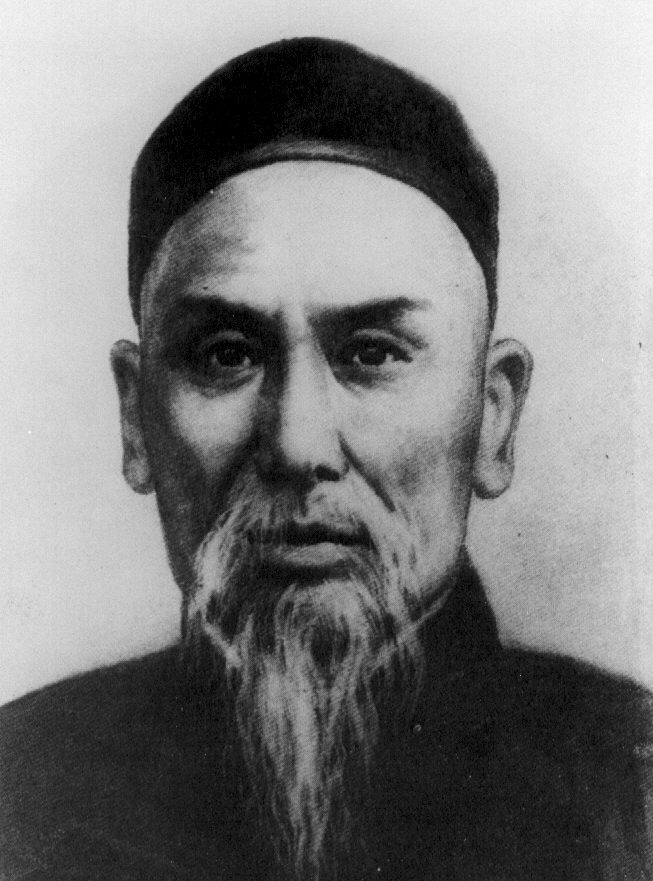
Yang Luchan (Chinese: 杨露禅; pinyin: Yáng Lùchán; Wade–Giles: Yang Lu-ch'an), also known as Yang Fukui (1799–1872), was an influential Chinese practitioner and teacher of the internal style tai chi martial art. He is known as the founder of Yang-style tai chi, the most popular and widely practised tai chi style in the world today.[1][2]
History
[edit]Yang Luchan's family was a poor farming/worker class from Hebei Province, Guangping Prefecture, Yongnian County. Yang would follow his father in planting the fields and, as a teenager, held temporary jobs. One period of temporary work was spent doing odd jobs at the Taihetang Chinese pharmacy located in the west part of Yongnian City, opened by Chen Dehu of the Chen Village in Huaiqing Prefecture, Wen County, Henan. As a child, Yang liked martial arts and studied Changquan, gaining a certain level of skill.
One day Yang reportedly witnessed one of the partners of the pharmacy utilizing a style of martial art that he had never before seen to easily subdue a group of would-be thieves. Because of this, Yang requested to study with the pharmacy's owner, Chen Dehu. Chen referred Yang to the Chen Village to seek out his own teacher—the 14th generation of the Chen Family, Chen Changxing.[1][2]
One night, he was awakened by the sounds of "Hen" (哼) and "Ha" (哈) in the distance. He got up and traced the sound to an old building. Peeking through the broken wall, he saw his master Chen Changxing teaching the techniques of grasp, control, and emitting jin in coordination with the sounds "Hen" and "Ha." He was amazed by the techniques and from that time on, unknown to master Chen, he continued to watch this secret practice session every night. He would then return to his room to ponder and study. Because of this, his martial ability advanced rapidly. One day, Chen ordered him to spar with the other disciples. To his surprise, none of the other students could defeat him. Chen realized that Yang had great potential and after that taught him the secrets sincerely.[3][4][better source needed]
After mastering the martial art, Yang was given permission by his teacher to go to Beijing and teach his own students, who would include Wu Yuxiang and his brothers, who were Imperial Chinese officials in the Imperial Chinese bureaucracy.[2] In 1850, Yang was paid by wealthy residents to teach tai chi to them. Among this group was Yang's best known non-family student, Wu Quanyou.[5] This was the beginning of the spread of tai chi from the family art of a small village in central China to an international phenomenon.[6] Due to his influence and the number of teachers he trained, including his own descendants, Yang is directly acknowledged by 4 of the 5 tai chi families as having transmitted the art to them.[1][2][6]
The Legend of Yang Wudi
[edit]After emerging from Chenjiagou, Yang became famous for never losing a match and never seriously injuring his opponents. Having refined his martial skill to an extremely high level, Yang Luchan came to be known as Yang Wudi (Chinese: 楊無敵; lit. 'Yang the Invincible'). In time, many legends sprang up around Yang's martial prowess. These legends would serve to inform various biographical books and movies. Though not independently verifiable, several noteworthy episodes are worth mentioning to illustrate the Yang Wudi character:
- The House of Prince Duan, one of the royal families in the capital, employed a large number of boxing masters and wrestlers—some of which were anxious to have a trial of strength with Yang Luchan. Yang typically declined their challenges. One day, a famous boxing master of high prestige insisted on competing with Yang to see who was the stronger. The boxer suggested that they sit on two chairs and pit their right fists against each other. Yang Luchan had no choice but to agree. Shortly after the contest began, Duan's boxing master started to sweat all over and his chair creaked as if it were going to fall apart; Yang however looked as composed and serene as ever. Finally rising, Yang gently commented to the onlookers: "The Master's skill is indeed superb, only his chair is not as firmly made as mine." The other master was so moved by Yang's modesty that he never failed to praise his exemplary conduct and unmatched martial skill.[7]
- Once while fishing at a lake, two other martial artists hoped to push Yang in the water and ruin his reputation. Yang, sensing the attacker's intention, arched his chest, rounded his back, and executed the High Pat on Horse technique. As his back arched and head bowed, the two attackers were bounced into the water simultaneously. He then said to them that he would be easy on them today; but if they were on the ground, he would have punished them more severely. The two attackers quickly swam away.[citation needed]
- In Beijing, a rich man called Chang heard of Yang's great skills and invited him to demonstrate his art. When Yang arrived, Chang thought little of his ability due to his small build—Yang simply did not "look" like a boxer. Yang was served a very simple dinner. Yang Luchan continued to behave like an honoured guest, despite his host's thoughts. Chang later questioned if Yang's tai chi, being so soft, could actually be used to defeat people. Given that he invited Yang on the basis of his reputation as a great fighter, this question was a veiled insult. Yang replied that there were only three kinds of people he could not defeat: men of brass, men of iron and men of wood. Chang invited out his best bodyguard, Liu, to test Yang's skill. Liu entered aggressively and attacked Yang. Yang, employing only a simple yielding technique, threw Liu across the yard. Chang was very impressed and immediately ordered a banquet to be prepared for Yang.[8][better source needed]
Origin of the name "taijiquan"
[edit]In Chinese, tai chi is now known as taijiquan (literally "taiji boxing"). But when Yang Luchan first taught in Yongnian County, his art was referred to as Mianquan (綿拳 Cotton Fist) or Huaquan (化拳 Neutralising Fist). Whilst teaching at the Imperial Court, Yang met many challenges, some friendly some not. But he invariably won and in so doing he gained a great reputation. Many who frequented the imperial households would come to view his matches. At one such gathering in which Yang had won against several reputable opponents, the scholar Weng Tonghe was present. Inspired by the way Yang moved and executed his techniques, Weng felt that Yang's movements and techniques expressed the physical manifestation of the philosophy of taiji. Weng wrote for him a matching verse:[9]
Hands Holding taiji shakes the whole world, a chest containing ultimate skill defeats a gathering of heroes.
Thereafter, Yang family history holds that taiji began to be used in reference to the martial art, although it is not until the turn of the 20th century that there is firm written evidence for the term "taijiquan".[10][11][12][13]
Legacy
[edit]Yang Luchan passed his art to:
- His second son, but oldest son to live to maturity, Yang Banhou (1837–1890), was also retained as a martial arts instructor by the Chinese Imperial family.[1] Yang Banhou became the highest paid teacher of Wu Quanyou even though Yang Luchan was Wu's first tai chi teacher.[2][6]
- His third son Yang Jianhou (1839–1917), who passed it to his sons, Yang Shaohou (1862–1930) and Yang Chengfu (1883–1936).[1][2][6]
- Wu Yuxiang (1813–1880) who also developed his own Wu-style, which eventually, after three generations, led to the development of Sun-style tai chi.[2][6]
Yang Luchan served as the protagonist in the wuxia novel Tou Quan by Gong Baiyu, published in 1940 in Tianjin.
Tai chi lineage tree with Yang-style focus
[edit]References
[edit]- ^ a b c d e Wile, Douglas (1983). Tai Chi Touchstones: Yang Family Secret Transmissions. Sweet Ch'i Press. ISBN 978-0-912059-01-3.
- ^ a b c d e f g Wile, Douglas (1995). Lost T'ai-chi Classics from the Late Ch'ing Dynasty (Chinese Philosophy and Culture). State University of New York Press. ISBN 978-0-7914-2654-8.
- ^ "History of Yang Style Taijiquan (Tai Chi Chuan)". 15 February 2019.
- ^ T'ai Chi Ch'uan - Classical Yang style by Yang Jwing-Ming June 2010 ISBN 978-1-59439-200-9
- ^ Wu, Kung-tsao (2006) [1980]. Wu Family T'ai Chi Ch'uan (吳家太極拳). Chien-ch’uan T’ai-chi Ch’uan Association. ISBN 0-9780499-0-X.
- ^ a b c d e Yip, Y. L. (Autumn 1998). "A Perspective on the Development of Taijiquan – Qi: The Journal of Traditional Eastern Health and Fitness Vol. 8 No. 3". Qi: The Journal of Traditional Eastern Health & Fitness. Insight Graphics Publishers. ISSN 1056-4004.
- ^ Gu Liuxin, The Evolution of the Yang School of Taijiquan
- ^ "Historical Series Notes". Itcca.it. Retrieved 2015-07-09.
- ^ Peter Lim Tien Tek, The Development Of Yang Style Taijiquan
- ^ Davis 2004.
- ^ Yang Banhou 1875
- ^ Wile 1996, pp. 57–89, 135–153.
- ^ Li Jianqing, p. 37-38
Bibliography
[edit]- Davis, Barbara (2004). Taijiquan Classics: An Annotated Translation. North Atlantic Books. ISBN 978-1-55643-431-0.
- Yang, Banhou (楊班侯, 1875*), 太極法說 (Explaining Taiji Principles), available online in Chinese and English translation at Scribd and also included in Chinese and English translation in Wile, Douglas (1996), Lost T'ai-chi Classics from the Late Ch'ing Dynasty, State University of New York Press, ISBN 0-7914-2653-X (*Scholars estimate the publication date to be between 1875 and 1910, and believe the author(s) to be Yang Banhou and/or his disciples)
- Wile, Douglas (1996). Lost T'a-Chi Classics from the Late Ch'ing Dynasty. State University of New York Press. ISBN 0-7914-2653-X.
- Li, Jianqing, Editor in Chief (李剑青, 主編, 2006), 永年太极拳志 (Yongnian Taijiquan Gazetteer), 人民体育出版社出版 (People's Sports Publishing House), ISBN 7-5009-3044-5.
External links
[edit]| International | |
|---|---|
| National | |

Grokipedia
Yang Luchan
View on GrokipediaEarly Life
Birth and Family Background
Yang Luchan, originally named Yang Fujui (楊福魁), was born around 1799 in Nanguan Village, Yongnian County, Hebei Province, China. He came from a humble peasant family of modest means, typical of rural farming communities in the region during the late Qing Dynasty.[2][4] Historical records indicate that Yang's family belonged to the lower socioeconomic strata, with his early years marked by poverty and involvement in agricultural labor alongside his father. This background of hardship influenced his initial foray into manual work, including employment in grain transportation for wealthier households, before his exposure to martial arts.[2] Accounts vary on the exact details of his familial status, with some later narratives depicting his origins as either a bondservant or from a more prosperous trader background.[2]Initial Employment and Martial Arts Exposure
Yang Luchan was born circa 1799 in the Nanguan district of Yongnian County, Hebei Province, into a modest peasant family. From an early age, he displayed a keen interest in martial arts, studying external styles such as Changquan (Long Fist) and achieving a basic level of proficiency through self-practice and local instruction. This childhood fascination laid the foundation for his lifelong dedication to the discipline, though specific details of his initial training remain sparse in historical records.[2] Traditional narratives describe Yang's initial employment as a laborer in Yongnian, possibly at a grain store or as a general manservant in a local household. One prominent account places him working near or at the Taihetang Pharmacy, which was owned by Chen Dehu—a merchant from Chenjiagou Village in Henan Province and a practitioner of the Chen family's martial arts under master Chen Changxing. While employed in this capacity, Yang reportedly witnessed Chen Dehu demonstrate superior martial skill by effortlessly subduing a disruptive customer, an event that sparked his desire to learn the sophisticated techniques on display. Impressed by this exposure to what would become taijiquan, Yang approached Chen Dehu for guidance, leading to his eventual recommendation and journey to Chen Village for formal apprenticeship.[2][5] Alternative historical interpretations suggest Yang may have entered service directly as a bondservant to the Chen family in their village, where his exposure to taijiquan occurred through clandestine observation of clan training sessions. These variations highlight the legendary nature of early accounts, with the earliest documented reference—Li Yiyu's 1881 preface—simply noting that Yang, motivated by his admiration for martial arts, traveled to Chen Village to study under Chen Changxing for approximately ten years, without detailing prior employment or specific inciting incidents. Later retellings, such as those by Tang Hao in the 1930s, emphasize the bondservant role to explain his prolonged stay and access to secretive teachings. Despite these discrepancies, all accounts agree that Yang's early occupational circumstances in Yongnian provided the pivotal bridge to his transformative encounter with taijiquan.[2]Learning Taijiquan
Journey to Chen Village
Yang Luchan, born in 1799 in the Nanguan district of Yongnian County, Hebei Province, grew up in a region known for its rich martial arts traditions during the late Qing dynasty. As a young man, he developed an interest in boxing arts, studying basic Shaolin techniques locally before seeking more advanced training. His admiration for the renowned Chen family martial arts, particularly after hearing accounts of their prowess, motivated him to undertake the journey southward to Chenjiagou (Chen Village) in Wen County, Henan Province, in the early 1820s.[2] The exact circumstances of Luchan's initial arrival in Chen Village remain somewhat obscured by oral traditions and later accounts, but historical narratives indicate he traveled as an outsider seeking apprenticeship in a clan-exclusive art. Lacking direct familial ties to the Chen lineage, which guarded their taijiquan teachings closely, Luchan initially gained entry by offering his services as a bondservant or laborer. According to early 20th-century historian Tang Hao and other sources, Luchan was employed by Chen Dehu, a wealthy relative of the Chen family who operated the herbal shop Taihetang in the village and had scholarly connections. This arrangement, common in Qing-era social structures for outsiders pursuing specialized skills, enabled Luchan to observe practices covertly while performing menial tasks such as grinding herbs.[2][6] Upon arrival, Luchan faced challenges as a non-family member, including skepticism and unequal treatment from Chen practitioners. He reportedly endured harsh labor and subtle discrimination, yet persisted in his studies by watching training sessions from afar, often at night through courtyard walls. His determination impressed Chen Changxing (1771–1853), the 14th-generation head of the Chen family and a master of their lao jia (old frame) taijiquan, who eventually accepted him as a formal disciple after Luchan demonstrated his foundational martial skills in a confrontation with village youths. This pivotal acceptance marked the beginning of his structured apprenticeship, lasting approximately 10 to 18 years according to varying historical accounts, from the late 1820s into the 1830s or early 1840s.[2][4] During this period in Chen Village, Luchan immersed himself in the demanding regimen of Chen-style taijiquan, which emphasized explosive fajin (emitting power) and integrated silk-reeling movements with internal cultivation principles. He trained rigorously under Chen Changxing's guidance, absorbing not only the forms but also the underlying theories of yielding and borrowing force, adapted from earlier Chen innovations. Accounts from disciple Li Yiyu, writing in 1881, highlight Luchan's diligence and quick aptitude, noting how his outsider perspective allowed him to refine the art's subtleties over years of dedicated practice. By the late 1830s or early 1840s, having mastered the system, Luchan began preparing to return to Hebei, though some traditions suggest he made additional visits to deepen his knowledge.[2]Apprenticeship with Chen Changxing
As an outsider from Yongnian County, Yang worked as a servant in Chen Dehu's household at the Taihetang herbal shop, performing menial tasks such as grinding herbs and tending the grounds, which provided him proximity to the Chen family's martial arts practice. Chen Dehu, recognizing the value of martial training and connected to the Chen lineage, invited his relative Chen Changxing, the 14th-generation head of the Chen family and a renowned taijiquan master, to teach at his residence, allowing Yang incidental exposure to the art.[6][2] Initially excluded from formal instruction due to the Chen family's tradition of restricting their secretive Laojia (Old Frame) taijiquan to blood relatives, Yang began learning covertly by observing Chen Changxing's evening training sessions from outside the practice hall. He practiced alone at night, mimicking the forms, including explosive techniques involving "Hen" and "Ha" vocalizations for emitting jin (internal power), as well as grappling methods like grasping and controlling. His diligence paid off when, during a sparring incident, Yang inadvertently demonstrated superior skill by defeating one of Chen Changxing's formal disciples, leading to his discovery and formal acceptance as a disciple despite his outsider status. Chen Changxing, impressed by Yang's talent, hard work, and rapid progress, broke family protocol by imparting the complete Chen-style curriculum, including the advanced Pao Chui (Cannon Fist) form and secret fajin applications.[4][7] Historical accounts vary on the exact duration of Yang's apprenticeship, with some sources like Li Yiyu (1881) indicating about 10 years of intensive training starting in the 1830s, while others suggest up to 18 years of formal study following his acceptance. This immersion equipped Yang with the foundational principles of silk-reeling energy (chan si jin) and whole-body coordination, which he later adapted into his own style, though he was initially forbidden by the Chen family from teaching their exact forms to outsiders. By the end of his time in Chen Village around the early 1840s, Yang had transformed from a humble servant into a formidable martial artist, setting the stage for his departure to Beijing around 1850.[2][8][6]Development of Yang-Style Taijiquan
Adaptations to Chen Style
Yang Luchan, having apprenticed under Chen Changxing in Chenjiagou for approximately ten years, acquired a deep understanding of the Chen family's old frame Taijiquan, which combined slow, coiling movements with explosive fajin emissions. Upon returning to his native Hebei province and later establishing himself in Beijing, he began modifying this rigorous style to suit a broader audience, particularly the physically less conditioned Manchu bannermen and imperial officials.[1] These changes transformed the art into what is recognized as the foundational Yang style, emphasizing accessibility and internal cultivation over the Chen style's martial vigor, with smoother, larger, and softer movements.[4] The resulting style retained core principles like peng, lu, ji, and an (ward off, roll back, press, and push) but expressed them through gentler forms, broadening Taijiquan's appeal beyond familial martial transmission. This evolution marked a pivotal shift, influencing subsequent generations and contributing to Taijiquan's enduring popularity as a health-oriented discipline. These modifications were driven by practical necessities in the Qing imperial court, where Yang taught from the 1850s onward, adapting the art to foster health, longevity, and subtle self-defense amid the sedentary lifestyles of his patrons.[1]Origin of the Name "Taijiquan"
The name "Taijiquan," translating to "Supreme Ultimate Fist," draws from the ancient Chinese philosophical concept of taiji (supreme ultimate), a foundational idea in the I Ching (Book of Changes) describing the dynamic interplay of yin and yang as the origin of the universe. This term was first applied to the martial art practiced by Yang Luchan in the mid-19th century, during the late Qing dynasty, as his style gained prominence in Beijing. Prior to this, the art taught in Chen Village—from which Yang learned—was known by alternative names reflecting its fluid, extended movements rather than a specific philosophical label.[4] The adoption of "Taijiquan" for Yang's adapted style is closely tied to the compilation of the Taijiquan Classics, a collection of theoretical texts that codified the art's principles. Scholars note that the name's emergence aligned with the Yang family's efforts to distinguish their gentler, more accessible version of the Chen art from its origins, emphasizing internal cultivation over overt combat, though the precise inventor remains unknown. Note that aspects of the transmission, including Wu Yuxiang's learning (a student of Yang Luchan, possibly also from Chen Qingping), are subject to historical debate. By the 1880s, "Taijiquan" had become the standard term within the lineage.[1] This naming formalized Yang-style Taijiquan as a distinct system, blending martial technique with Daoist cosmology and paving the way for its widespread dissemination.[2]Career in Beijing
Teaching the Imperial Family
Upon arriving in Beijing in the 1850s, Yang Luchan was employed by the Qing imperial court as a martial arts instructor, initially through connections at a shop supplying the palace. He was hired to teach Taijiquan to Prince Duan (Duan Wang), a close relative of the emperor, and to members of the elite Manchu Imperial Guard Brigade stationed in the Forbidden City. This position elevated his status and allowed him to disseminate his adapted style among the Manchu nobility and security forces during a period of Qing dynasty decline.[6][9] Historical accounts indicate that Yang served as a tutor to the Manchu garrison, focusing on combat applications of Taijiquan to enhance the guards' skills. Among his notable students were Wan Chun, who specialized in push hands techniques; Ling Shan, expert in forms and applications; and Quan You, who emphasized weapons training integrated with the style. These teachings were documented in early 20th-century martial arts texts, reflecting Yang's role in adapting his art for imperial service without official Qing records confirming the details. Legends persist that Yang's employment followed a challenge match with imperial guards, leading to an imperial decree for him to instruct the royal family, though such stories lack primary verification and may stem from later oral traditions. His instruction to the imperial household, spanning over two decades, contributed to Taijiquan's recognition as both a martial and health practice within elite circles, influencing its transmission through Manchu and Han practitioners alike.Reputation as Yang Wudi
Yang Luchan, upon arriving in Beijing in the 1850s, quickly established a formidable reputation in martial arts circles through demonstrations of his Taijiquan skills, earning him the nickname Yang Wudi (楊無敵), or "Yang the Invincible." This moniker reflected his perceived undefeated record in challenge matches and public competitions, where he reportedly never lost and avoided seriously injuring opponents, showcasing the internal power and yielding techniques of his adapted style. According to accounts from the Yang family lineage, his prowess stemmed from over a decade of rigorous training under Chen Changxing, enabling him to prevail against diverse martial artists without relying on brute force.[10] A pivotal event in solidifying this reputation occurred at the Duanwangfu (Prince Duan's mansion) in Beijing, where Yang Luchan competed against notable fighters and demonstrated exceptional agility and technique. Observers, including the imperial tutor Weng Tonghe, were particularly impressed; a dedicatory couplet praising Yang's art is attributed to Weng Tonghe—"Presenting Tai Chi to the universe with shock and awe, his unique skill crushes heroes"—though its authenticity has been disputed by scholars.[2][11] This endorsement from a high-ranking Qing official helped elevate Yang's status among the elite, leading to his invitation to teach the imperial bodyguards. The International Yang Family Tai Chi Chuan Association records this competition as the origin of his "Invincible" title, highlighting how his performances blended martial efficacy with philosophical depth. Further contributing to the legend, Yang Luchan is said to have defeated experts from across the country in a major Beijing competition, further cementing his invincibility within Taijiquan and broader wushu communities. Historical narratives from the Yang Martial Arts Association emphasize that these victories were not aggressive conquests but demonstrations of superior song (relaxation) and ting (listening) skills, aligning with Taijiquan's principles of overcoming hardness with softness. While primary contemporary records are scarce, these accounts, preserved through family oral traditions and early 20th-century compilations, underscore how Yang's reputation transformed him from a provincial practitioner into a national icon of internal martial arts.[12]Family and Lineage
Immediate Family
Yang Luchan married upon returning briefly to his hometown of Yongnian around 1825, though historical records do not preserve the name of his wife. He had three sons, the eldest of whom died as a young adult and did not significantly contribute to the Taijiquan lineage. The eldest was Yang Fenghou (also known as Yang Qi, c. 1835–1861), who died from opium addiction or in a conflict, leaving a son named Yang Zhaolin who later studied Taijiquan independently.[4][13][2] Yang Luchan's second son, Yang Yu (also known as Yang Banhou, 1837–1892), became a renowned martial artist known for his small-frame style and service as an instructor to the imperial guards.[4][6] He had one son, Yang Zhaopeng, who continued aspects of the family art.[4] The third son, Yang Jian (also known as Yang Jianhou, c. 1839–1917 or 1842–1917), was the primary lineage holder after his father's death, teaching a medium-frame version of Yang-style Taijiquan to a wide array of students, including members of the imperial family.[4][14] He fathered three sons: Yang Zhaoyuan (who died young), Yang Zhaoxiong (Yang Shaohou, 1862–1930), and Yang Zhaoqing (Yang Chengfu, 1883–1936), who further propagated the style.[4] No daughters are documented in reliable historical sources.Tai Chi Lineage Tree
The lineage of Yang-style Taijiquan traces its origins from the Chen family style, with Yang Luchan (1799–1872) as the pivotal figure who adapted and popularized it after studying under Chen Changxing in the early 19th century. This adaptation softened the vigorous Chen movements into a more accessible form emphasizing internal energy (qi) cultivation, relaxed postures, and fluid sequences, which became the foundation for subsequent generations. The Yang family maintained direct transmission through Luchan's sons and grandsons, leading to distinct sub-styles such as the "small frame" (emphasizing compact, explosive techniques) and "large frame" (focusing on expansive, slow movements). Beyond the family, the lineage branched through notable students, influencing other Tai Chi variants like Wu-style.[4][15] The following represents the primary Yang-style lineage tree, highlighting key generational transmissions within the family and major disciples. It is structured hierarchically to show father-son relationships and significant teaching lines, based on documented historical accounts.- Chen Changxing (c. 1771–1853)
Teacher of Yang Luchan; 14th-generation Chen family practitioner who transmitted the "old frame" Chen style, incorporating both lao jia (old frame) and pao chui (cannon fist) forms.[4]- Yang Luchan (1799–1872)
Founder of Yang-style; synthesized Chen techniques into a gentler, upright variant after secretive study in Chen Village; taught imperial guards in Beijing, earning the nickname "Yang the Invincible" (Yang Wudi). His form emphasized silk-reeling energy (chan si jin) and martial applications while promoting health benefits.[4][16]- Yang Banhou (Yang Yu, 1837–1892)
Eldest surviving son; developed the "small frame" (xiaojia) variant with lower stances, faster transitions, and combative focus; taught elite students, including imperial bodyguards, but often modified forms to preserve secrecy. His lineage contributed to compact, agile sub-branches.[4][15][17]- Wu Quanyou (1834–1902)
Disciple of Yang Banhou; integrated Yang principles with his Hao-style background, leading to the founding of Wu-style Taijiquan through his son Wu Jianquan; this branch emphasized smaller circles and forward-leaning postures.[4] - Other disciples: Included Zhao Peng and figures like Wang Jiao-Yu, who preserved the "true system" in non-family lines, influencing later schools such as those under Kuo Lien-Ying.[18]
- Wu Quanyou (1834–1902)
- Yang Jianhou (Yang Jian, 1839–1917)
Second surviving son; refined the "standard frame" (zhongjia) with balanced stances and moderate speed; taught both family members and external students, bridging small and large frame developments. His teachings emphasized precision and internal power.[4][16]- Yang Shaohou (Yang Zhao Xiong, 1862–1930)
Eldest son of Jianhou; advanced the small frame with explosive fajin (emitting power) and low, agile postures; known for rigorous, martial-oriented teaching; his line includes Yang Zhensheng and contributed to competitive and performance styles.[4][15][19] - Yang Chengfu (Yang Zhao Qing, 1883–1936)
Youngest son of Jianhou; popularized the "large frame" (dajia) through public demonstrations and writings, simplifying forms for broader health practice while retaining core principles; authored influential texts like Yang Style Taijiquan (1934); his 108-form became the global standard.[4][16]- Direct descendants:
- Yang Zhenming (1910–1986)
Eldest son; focused on traditional transmission in Hong Kong. - Yang Zhenji (b. 1928)
Second son; established schools in China and the U.S., emphasizing classical forms and push-hands. - Yang Zhenduo (1926–2020)
Third son; co-founded International Yang Family Tai Chi Association; promoted global standardization of the 108-form. - Yang Zhenguo (b. 1928)
Fourth son; taught in Canada, preserving family arts (living as of 2025).[16][15][20]
- Yang Zhenming (1910–1986)
- Notable disciples:
- Fu Zhongwen (1911–1994), nephew and student; transmitted to international audiences, including his son Fu Shenyuan and grandson James Fu; emphasized health and martial integration.
- Dong Yingjie (1891–1960); developed a softer, artistic variant.
- Chen Weiming (1881–1955); authored early instructional books.
- Zheng Manqing (1902–1975); created a 37-form abbreviation, spreading Yang-style in the West with a more upright, condensed approach.[15][4]
- Direct descendants:
- Yang Shaohou (Yang Zhao Xiong, 1862–1930)
- Yang Banhou (Yang Yu, 1837–1892)
- Yang Luchan (1799–1872)