
Recent from talks
Yellow-billed magpie
Knowledge base stats:
Talk channels stats:
Members stats:
Yellow-billed magpie
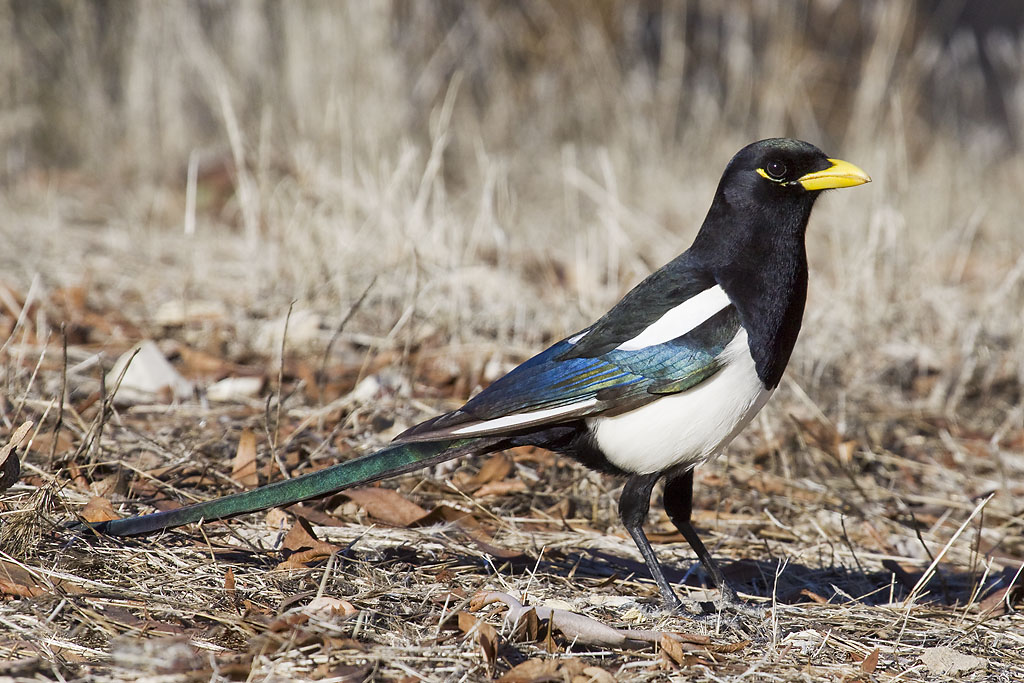
The yellow-billed magpie (Pica nuttallii), also known as the California magpie, is a bird that is endemic to California's Central Valley and the adjacent chaparral foothills and mountains. Apart from its having a yellow bill and a yellow streak around the eye and being slightly smaller, it is virtually identical to the black-billed magpie (Pica hudsonia) found in much of the rest of western North America. The scientific name commemorates the English naturalist Thomas Nuttall.
Audubon first named the species in 1837 using the spelling "nutallii". This mis-spelling of Nuttall's name was soon corrected by subsequent authors, but most recent literature has used the spelling "nuttalli", itself also an error as the original Latin ending -ii must be retained; the correct spelling thus nuttallii.
mtDNA sequence analysis indicates a close relationship between the yellow-billed magpie and the black-billed magpie, rather than between the outwardly more similar black-billed and Eurasian magpies (P. pica); it is possibly even genetically embedded within black-billed magpie, but this is not certain.
Combining fossil evidence and paleobiogeographical considerations with the molecular data indicates that the yellow-billed magpie's ancestors became isolated in California quite soon after the ancestral magpies colonized North America due to early ice ages and the ongoing uplift of the Sierra Nevada, but that during interglacials there occurred some gene flow between the yellow- and black-billed magpies until reproductive isolation was fully achieved in the Pleistocene.
It is a medium-sized corvid, at 43–54 centimeters (17–21 in) long averaging slightly smaller than the black-billed magpie's 45–60 cm (18–24 in) but overlapping with it. Like other magpies in the genus Pica, it has pied plumage, with black head, back, wings, and tail, and white belly and shoulders. The black feathering, particularly the tail and wing feathers, are glossed iridescent in good light, reflecting variably green, blue, purple, or bronzed, depending on the angle of the light. The wing primary feathers are also white on the inner vane; this is not visible when perched, but shows as a white outer wing patch in flight. The bill is bright yellow, and it also has a small patch of yellow bare skin around the eyes. The eyes and legs are black. The sexes are identical in plumage, but males average slightly heavier than females, with weights of 151–189 g and 126–158 g respectively.
The calls are similar to those of black-billed magpie but marginally higher-pitched.
The yellow-billed magpie is gregarious and roosts communally. There may be a cluster of communal roosts in one general area made up of a central roost containing many birds and several outlying roosts with fewer.
Yellow-billed magpie flocks are known to engage in funeral-like behavior for their dead. When a magpie dies, a gathering of them congregates around the deceased bird where they call out loudly for 10–15 minutes.
Hub AI
Yellow-billed magpie AI simulator
(@Yellow-billed magpie_simulator)
Yellow-billed magpie
The yellow-billed magpie (Pica nuttallii), also known as the California magpie, is a bird that is endemic to California's Central Valley and the adjacent chaparral foothills and mountains. Apart from its having a yellow bill and a yellow streak around the eye and being slightly smaller, it is virtually identical to the black-billed magpie (Pica hudsonia) found in much of the rest of western North America. The scientific name commemorates the English naturalist Thomas Nuttall.
Audubon first named the species in 1837 using the spelling "nutallii". This mis-spelling of Nuttall's name was soon corrected by subsequent authors, but most recent literature has used the spelling "nuttalli", itself also an error as the original Latin ending -ii must be retained; the correct spelling thus nuttallii.
mtDNA sequence analysis indicates a close relationship between the yellow-billed magpie and the black-billed magpie, rather than between the outwardly more similar black-billed and Eurasian magpies (P. pica); it is possibly even genetically embedded within black-billed magpie, but this is not certain.
Combining fossil evidence and paleobiogeographical considerations with the molecular data indicates that the yellow-billed magpie's ancestors became isolated in California quite soon after the ancestral magpies colonized North America due to early ice ages and the ongoing uplift of the Sierra Nevada, but that during interglacials there occurred some gene flow between the yellow- and black-billed magpies until reproductive isolation was fully achieved in the Pleistocene.
It is a medium-sized corvid, at 43–54 centimeters (17–21 in) long averaging slightly smaller than the black-billed magpie's 45–60 cm (18–24 in) but overlapping with it. Like other magpies in the genus Pica, it has pied plumage, with black head, back, wings, and tail, and white belly and shoulders. The black feathering, particularly the tail and wing feathers, are glossed iridescent in good light, reflecting variably green, blue, purple, or bronzed, depending on the angle of the light. The wing primary feathers are also white on the inner vane; this is not visible when perched, but shows as a white outer wing patch in flight. The bill is bright yellow, and it also has a small patch of yellow bare skin around the eyes. The eyes and legs are black. The sexes are identical in plumage, but males average slightly heavier than females, with weights of 151–189 g and 126–158 g respectively.
The calls are similar to those of black-billed magpie but marginally higher-pitched.
The yellow-billed magpie is gregarious and roosts communally. There may be a cluster of communal roosts in one general area made up of a central roost containing many birds and several outlying roosts with fewer.
Yellow-billed magpie flocks are known to engage in funeral-like behavior for their dead. When a magpie dies, a gathering of them congregates around the deceased bird where they call out loudly for 10–15 minutes.
Recent media