Hubbry Logo
Yivli Minaret MosqueYivli Minaret MosqueMain
Open search
Yivli Minaret Mosque
Community hub
Yivli Minaret Mosque
logo
8 pages, 0 posts
0 subscribers
Be the first to start a discussion here.
Yivli Minaret Mosque
from Wikipedia

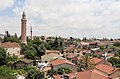
Yivli Minaret Mosque (Turkish: Yivli Minare Camii) is a historic mosque located in Kaleiçi, the old town center of Antalya, Turkey. Situated along Cumhuriyet Street near Kalekapısı Square, it is one of the city’s most important landmarks. Its fluted brick minaret, adorned with traces of blue tilework, has become a widely recognized symbol of Antalya.[1]

Key Information

History

[edit]

The origins of the Yivli Minaret Mosque date back to the early 13th century. Following the Seljuk conquest of Antalya in 1226, a mosque was constructed on the site of a ruined Byzantine church around 1230. This early structure reflected the Seljuk approach of integrating earlier architectural elements into new Islamic buildings. The minaret, which gives the mosque its name, was likely commissioned during the reign of Alaaddin Keykubad I (1220–1237), a ruler known for his extensive architectural patronage across Anatolia.[2]

The original mosque was either destroyed or fell into disrepair during the 14th century. In 1373, it was rebuilt by Mehmet Bey, a member of the Hamidids dynasty.[3] The new design introduced a prayer hall covered with six domes, supported by columns incorporating ancient capitals. Over time, the mosque served various functions, including housing the Antalya Museum for a period in the 20th century. Restoration efforts were carried out in 1953 and 1961, with further extensive work completed between 2007 and 2010. During the latest restoration, historic water channels were uncovered beneath the structure, now visible through a glass floor section.

Architecture

[edit]

The mosque has a rectangular plan and reflects early examples of multi-domed religious architecture in Anatolia. Its prayer hall is covered with six domes arranged in two rows, supported by twelve columns topped with reused capitals, likely from Roman or Byzantine-era buildings.[4] The walls are constructed of finely cut stone, and the interior features minimal decoration, consistent with early Seljuk aesthetic principles.

The most distinctive element of the complex is its 38-meter-high minaret, composed of red brick and rising from a massive square stone base.[5] The shaft is divided into eight fluted sections and was originally covered with turquoise and dark blue tiles, fragments of which are still visible today.

Yivli Minaret is frequently compared to other fluted minarets in Turkey, such as those of the Burmalı Minaret in Amasya, Karahasan Mosque in Tire, and Gedik Ahmet Pasha Mosque in Afyonkarahisar.[1] Despite similarities, Yivli Minaret distinguishes itself through its height, design, and historical significance. Today, it continues to serve as an active place of worship and remains a defining feature of Antalya’s skyline.

[edit]

References

[edit]
[edit]
Revisions and contributorsEdit on WikipediaRead on Wikipedia
from Grokipedia
The Yivli Minaret Mosque (Yivli Minare Camii), located in the historic Kaleiçi district of , , is a prominent 13th-century Seljuk architectural complex centered around its iconic fluted , which stands as a symbol of the city's Islamic heritage. Constructed in 1230 CE during the reign of Alaeddin Keykubad I (r. 1219–1237), the —reaching approximately 38 meters in height—is the oldest surviving element of the ensemble, built primarily of red brick in a hexagonal bond pattern with a cut-stone base and remnants of turquoise tilework, featuring eight shallow semi-circular flutes divided by muqarnas-supported balconies. The structure originated from the conversion of a Byzantine into a by the Seljuks following their conquest of in 1216, marking it as one of the earliest examples of in the region. The mosque complex, which expanded over time to include adjacent structures such as the Zincirli Madrasa, Mehmet Bey Imareti, and Nigâr Hanîm Mosque, exemplifies Seljuk innovations in Anatolian , blending Persian influences with local Byzantine elements through its intricate and geometric designs. The prayer hall was reconstructed with six domes in the , and during the Ottoman period, the site underwent further restorations and modifications, preserving its role as a central amid Antalya's urban evolution. Today, the Yivli Minaret Mosque serves as a key cultural landmark, attracting visitors for its historical significance and contributing to Antalya's identity as a bridge between ancient Roman, Byzantine, Seljuk, and Ottoman legacies.

History

Origins and Construction

The Seljuk conquest of Antalya occurred in 1207 under Sultan Ghiyath al-Din Kaykhusraw I, marking a pivotal shift in the region's control from Byzantine and Venetian influences to Anatolian Seljuk rule. This victory secured a vital Mediterranean port, facilitating trade and military expansion for the . Following this , the Yivli Minaret Mosque was constructed around 1230 during the reign of Alaeddin Keykubad I (r. 1219–1237), his son and successor, as the first major Islamic structure in . The site was selected atop the ruins of a Byzantine church, incorporating elements of the preexisting structure to symbolize the transition from Christian to Islamic dominance. An inscription on the explicitly attributes its construction to Alaeddin Keykubad I's , underscoring direct Seljuk imperial support without evidence of contemporaneous modifications. The mosque's establishment played a key role in asserting Seljuk presence in the newly acquired territory, serving as a focal point for religious and communal life in the district—the historic walled core of . By anchoring in the urban landscape, it contributed to the district's development as a center of Seljuk administration, trade, and cultural integration, transforming into a prominent hub within the sultanate. The fluted , a hallmark of early Seljuk design, exemplifies this architectural assertion.

Reconstructions and Alterations

In 1373, following damage to the original structure, the prayer hall of the Yivli Minaret Mosque was rebuilt by Mehmet Bey (also known as Zincirkiran Mehmed Bey) of the Hamidids dynasty, transforming it into a six-domed layout supported by columns topped with ancient capitals reused from earlier Byzantine and Roman sites. This reconstruction marked a significant evolution from the foundational Seljuk design, emphasizing multi-dome Anatolian architecture while integrating salvaged classical elements for structural and aesthetic enhancement. During the Ottoman period, the mosque complex underwent further alterations that reflected the empire's administrative and cultural priorities, including the establishment of a Mevlevi lodge in the by Antalya governor Tekeli Mehmed Pasha within an existing Seljuk structure to the north. Expansions to the surrounding complex also incorporated Ottoman influences, such as the addition of the of Nigâr Hanim, wife of Sultan (r. 1481–1512), situated between the mosque and the lodge, which extended the site's role as a multifunctional religious and commemorative space. These changes, while preserving the core prayer hall from the 1373 rebuild, adapted the ensemble to Ottoman dervish traditions and imperial patronage without major overhauls to the primary worship area. In the 19th and early 20th centuries, the mosque's usage shifted amid Turkey's transition to a secular republic, with the structure converted into part of the around 1934, where the prayer hall served archaeological and ethnographic displays until . This repurposing highlighted the building's historical layers but interrupted its religious function, aligning with broader national policies on heritage preservation. Following the museum's relocation in , the mosque transitioned back to active religious use in the post-1920s era, reclaiming its role as a while retaining interpretive elements from its secular interlude.

Architecture

Minaret

The minaret of the Yivli Minaret Mosque stands at a height of 38 meters and was constructed in the early 13th century, between 1220 and 1237, during the reign of Seljuk Sultan Alaeddin Keykubad I. Renowned for its fluted (yivli) design, the structure features eight semi-circular ribs crafted from red baked bricks, forming a distinctive grooved shaft that tapers upward. It rises from a sturdy square base of cut stone, measuring 6.5 meters in height and 5.5 meters per side, while the brick body originally incorporated alternating rows of dark blue and tiles for decoration, with only traces of these vibrant elements surviving today. This design embodies a seminal Seljuk architectural , merging Persian influences—particularly the techniques inspired by monuments like Gonbad-e Qabus—with local Anatolian traditions of stone , symbolizing the cultural synthesis of the Anatolian Seljuk era. The minaret's construction employed baked bricks laid with in layers of 2–5 cm, a method that enhanced bonding and flexibility; the fluted form and widened base further bolster its resistance to seismic forces prevalent in the region, as demonstrated by finite element analyses showing minimal tensile stress under loads.

Prayer Hall and Interior

The prayer hall of the Yivli Minaret Mosque features a rectangular layout oriented east-west, divided into six square sections covered by six domes. These domes are supported by 12 columns of varying thicknesses, many incorporating reused Roman with Corinthian and Doric capitals from the Byzantine era. The structure employs double archways and triangular transition zones (known as Turkish triangles) to connect the domes to the supporting elements and exterior walls. The hall's mihrab consists of a semicircular niche on the southern wall, positioned at an approximate 30-degree angle and dating to the Hamidid reconstruction of 1373 under Zincirkiran Mehmed Bey. The , also from the Hamidid period, complements the as part of the 14th-century rebuilding. Interior decorations are relatively minimal but include surviving fragments of glazed tiles and plaster work, reflecting geometric patterns and influences from the Seljuk and later Ottoman eras uncovered during restorations. Natural lighting enters the prayer hall through barred windows on the east, north, and south facades, illuminating the space for congregational . The domed and arched design enhances acoustics, allowing the call to prayer and recitations to resonate effectively throughout the hall. The attaches to the northwest corner of this hall, integrating the overall complex.

Surrounding Complex

Madrasa and Seminary

The within the Yivli Minaret Mosque complex was constructed in 1239 by Seljuk Atabeg Ataman, also referred to as Atabey Armağan, during the reign of Sultan Gıyaseddin Keyhüsrev II. It is situated to the northwest of the main mosque, contributing to the integrated Seljuk-era religious and educational landscape of the site. Designed as an , the structure primarily served for , accommodating students in the study of , , and related , in line with the educational mission of Seljuk madrasas. Architecturally, it adopted a classic Seljuk plan featuring a central enclosed by vaulted iwans on multiple sides, providing spaces for teaching and communal activities. Excavations in 2024 uncovered student cells and additional graves, providing insights into the 's daily life and practices. Today, as of 2025, the remains largely in ruins, with much of the original building lost to time and urban development, but has undergone significant excavations and restoration, completed in November 2025, revealing these features and making the site open to visitors with improved landscaping. Surviving remnants include a prominent portal, known as the crown gate, adorned with decoration, along with partial foundations and one , which were uncovered and partially restored during excavations in the early . As a key component of the mosque's surrounding , the played a vital role in the complex's function as a hub for scholarly and spiritual pursuits, reinforcing the mosque's centrality in Seljuk Antalya's cultural and intellectual life.

Other Associated Structures

The Yivli Minaret Mosque forms part of a larger , or religious complex, that incorporates utility and boundary elements dating primarily to the Seljuk period and later Ottoman additions. Among these are the Mevlevi lodge, located to the northwest of the main , which served as a center for Sufi education and practices akin to a ; it was formally founded in the by Tekeli Pasa but likely built on earlier Seljuk foundations; today, it operates as the Antalya Mevlevi Lodge Museum, showcasing Sufi artifacts and history. Two notable tombs are integrated into the complex: a large octagonal dedicated to Zincirkiran Mehmed Bey, the 14th-century patron of the mosque's reconstruction, positioned near the dervish lodge, and a smaller for Nigar Hanim, consort of Sultan , situated between the mosque and the lodge. These structures, constructed from cut stone, provided funerary facilities for key figures associated with the site's development. Excavations and restorations conducted between 2007 and 2010 revealed ancient water channels beneath the mosque, likely part of the complex's hydraulic system for communal use, including possible ablution purposes; these channels, visible today through a floor panel, facilitated cooling in summer and heating in winter via an underground network. The original enclosure of the complex was defined by robust walls and gates tied to Antalya's historic , with the nearby Gate serving as a primary access point to the upper town area encompassing the mosque; these defensive elements, dating to the 13th century, enclosed the religious and utility features for security and communal organization. Byzantine , including reused column capitals and hewn stones from earlier church structures, were incorporated into the complex's walls and supporting elements, exemplifying Seljuk practices of material reuse that blended pre-Islamic heritage with .

Significance and Legacy

Cultural and Historical Importance

The Yivli Minaret Mosque exemplifies the architectural fusion of Seljuk and Byzantine traditions, serving as a landmark in Anatolian Islamic history through its incorporation of pre-existing Byzantine church elements into a new Islamic structure following the Seljuk conquest. Built on the ruins of a Byzantine church, the mosque's design reflects the Seljuks' practice of adapting local materials and motifs, such as stone bases and tilework, to create a synthesis that bridged Christian and Islamic aesthetics in 13th-century Anatolia. This blend not only facilitated the Islamization of the region but also established a model for cultural integration in post-conquest urban landscapes. As Antalya's oldest surviving mosque, the Yivli Minaret holds profound symbolic status, representing the city's transition to Seljuk rule and its enduring Islamic heritage. Its iconic fluted , a distinctive feature, has become a enduring emblem of regional identity, underscoring the mosque's role in preserving historical continuity amid successive empires. Furthermore, the site was added to UNESCO's Tentative List of World Heritage Sites in 2016, recognizing its outstanding universal value as a testament to early Anatolian Turkish architecture. The mosque's influence extended to later in the region, where the Seljuk tradition of fluted minarets and integrated complexes inspired subsequent designs, as seen in Ottoman-era additions to the site itself. Historically, it is tied to key events such as the Seljuk conquest of in 1207, commissioned under Alaeddin Keykubad I to commemorate the victory and assert Islamic presence in the former Byzantine stronghold. This event marked a pivotal shift in the city's demographic and cultural fabric, with the mosque functioning as a commemorative monument to Seljuk expansion along the Mediterranean coast.

Modern Usage and Restoration

The Yivli Minaret Mosque has undergone several key restorations in the to preserve its structural integrity and historical features. In 1953 and 1961, the received repairs from the General Directorate of and Museums, addressing wear from centuries of exposure. The spire was renewed in 1973 by the Directorate General of Foundations. These efforts built upon earlier reconstructions, ensuring the structure's stability amid ongoing urban influences. A major restoration of the prayer hall occurred between 2007 and 2010, led by the Directorate General of Foundations, which included seismic upgrades and the excavation of ancient water channels beneath the floor. This work incorporated a transparent section in the flooring to display the discovered channels, enhancing educational value without compromising functionality. The project faced delays due to these archaeological finds, highlighting the balance between preservation and revelation of subsurface history. In 2020, excavations during restoration work unearthed 40 graves near the madrasah gate, providing further insight into the site's historical layers. Restoration and landscaping of the complex were completed in October 2025, with three additional graves uncovered, underscoring ongoing efforts to protect and reveal its archaeological significance. Today, the mosque serves as an active place of worship, hosting daily prayers and Friday congregations for the local community in Antalya's Kaleiçi district. Visitors are permitted outside prayer times, with guidelines emphasizing modest dress to respect its religious role. As a prominent landmark, it integrates into Kaleiçi's tourism landscape, drawing local and international visitors who appreciate its role as a city symbol featured in promotional materials. Conservation initiatives continue to address challenges from urban development pressures in the historic center, including resident displacement and increased building density driven by tourism growth. Registered as under Turkish Law No. 2863, the site benefits from state monitoring and protection to mitigate these threats while sustaining its dual religious and touristic functions.

References

Add your contribution
Related Hubs
User Avatar
No comments yet.