Hubbry Logo
Yuan KewenYuan KewenMain
Open search
Yuan Kewen
Community hub
Yuan Kewen
logo
8 pages, 0 posts
0 subscribers
Be the first to start a discussion here.
Yuan Kewen
Yuan Kewen
from Wikipedia
Yuan Kewen
Yuan Kewen

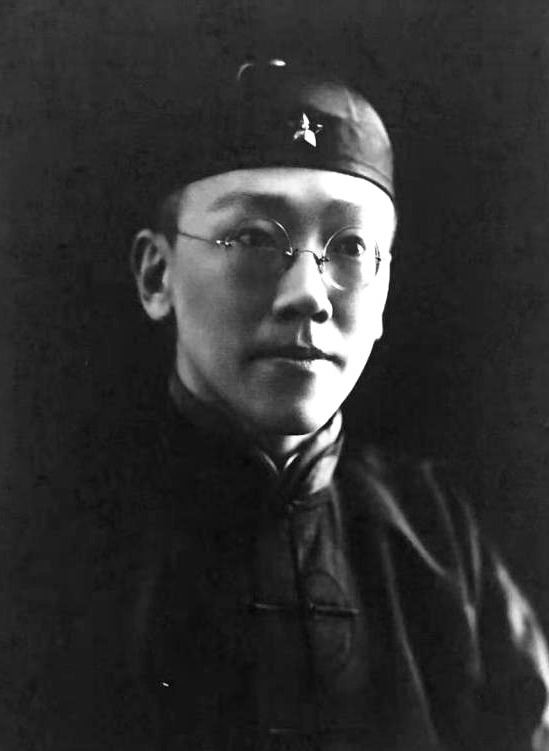
Yuan Kewen (Chinese: 袁克文; 16 July 1890 – 22 March 1931) was a Chinese scholar and calligrapher. Yuan's courtesy name was Baocen (豹岑). Yuan is also known by the sobriquet Hanyun (寒云).

Early life

[edit]

Yuan was born in 1890 in Hanseong (Seoul), Korea. His father was Yuan Shikai, a Chinese official who later became President of China (and briefly Emperor) in the 1910s. Yuan's Korean mother was Lady Gim (金氏), his father's third Korean concubine born in Hanseong, Korea. Yuan's elder brother was Prince Yuan Keding. Zhang Boju was Yuan Kewen's cousin and close friend.[1][additional citation(s) needed]

Career

[edit]

Yuan was an expert of Chinese traditional literature and a master of calligraphy and Chinese ink painting. He excelled in poetry and lyrics and was obsessed in collecting fine arts and antiques. He was against his father's revival of the monarchy and also lived a promiscuous life, which irritated his father. Yuan fled to the foreign concession of Shanghai and joined a gang of thugs. He recruited many disciples in Shanghai and Tianjin.

Personal life

[edit]

Yuan married Liu Meizhen (刘梅真). In addition to his wife, Yuan had five concubines, Qing Yunlou, Xiao Taohong, Tang Zhijun, Yu Peiwen, and Yaxian. Yuan also had numerous mistresses.

Yuan had four sons and three daughters, and all of them were scholars. Yuan's third son, Luke Chia-Liu Yuan (袁家騮, Yuan Jialiu), was a renowned high-energy physicist.

In 1931, Yuan died of a sudden illness[1] in Tianjin.

He is also known for research on the paper tiger game and he wrote《雀谱》.[2]

See also

[edit]

References

[edit]
Revisions and contributorsEdit on WikipediaRead on Wikipedia
from Grokipedia

Yuan Kewen (1889–1931), courtesy name and Hanyun, was a Chinese scholar, poet, and , recognized as the second son of , the first president of the Republic of . Born to 's Korean concubine Ms. Jin in and later adopted by his father's favored Chinese concubine Ms. Shen, Kewen pursued cultural endeavors amid his family's political prominence, authoring poetry collections such as Huanshang sicheng and Xinbing miyuan, and sustaining himself through writing articles and selling works. His artistic output included contributions to periodicals like Banyue and participation in theatrical performances, while he actively preserved family memories via photographs, paintings, and objects during the Republican era's upheavals. Notably, Kewen facilitated the 1916 sale of ancient Zhaoling stone horses— artifacts—to the art dealer C. T. Loo, reflecting his engagement with historical relics amid financial and familial pressures. Perceived by some as opposing his father's short-lived monarchical bid, which spared him certain postwar reprisals, Kewen's life encapsulated the intersection of elite Republican dissipation and cultural nostalgia, culminating in the 1928 fire that destroyed his Huanshang estate.

Early Life and Family Background

Birth and Parentage

Yuan Kewen was born in 1890 in Hanseong (present-day Seoul), Korea, while his father, Yuan Shikai, served as the Qing dynasty's Imperial Resident in the Korean court. His mother was a Korean woman surnamed Kim (金氏), who held the status of Yuan Shikai's third concubine; historical accounts describe her as originating from a prominent Korean family. As the second son of —a military commander and statesman who rose to prominence in the late Qing era—Yuan Kewen followed his elder brother, (born 1878). This parentage positioned him within a politically influential household amid the Qing empire's expanding influence in Korea prior to the .

Childhood in a Political Household

Yuan Kewen was born in 1890 in , Korea, during his father Yuan Shikai's tenure as Qing commissioner and resident-general there, to the fourth concubine, Lady Jin, a Korean woman whom Kewen later described as from a prominent background. Due to Lady Jin's relatively low status in the household—likely acquired as a purchased —and the childlessness of Yuan Shikai's first concubine, Shen Shi, Kewen was adopted by Shen Shi shortly after birth, a common practice in elite Qing to ensure lineage continuity. As the second of Yuan Shikai's 17 sons in a sprawling polygamous household comprising one principal wife (Lady Yu) and nine concubines from diverse regions including and Korea, Kewen grew up amid strict patriarchal discipline enforced by his father, who ruled the family as absolute authority. The household, which produced 32 children overall, relocated frequently following Yuan Shikai's military and administrative postings, shifting from Korea to urban centers like after the Sino-Japanese War of 1894–1895, exposing young Kewen to the instabilities of late Qing politics and his father's rising influence in the and reformist circles. Kewen's early education occurred within the family compound, blending traditional Confucian with modern subjects such as English and , reflecting Yuan Shikai's pragmatic approach to preparing heirs for a changing amid Western encroachments and internal upheavals. This environment immersed him in political discourse from childhood, as Yuan Shikai hosted officials, negotiated with foreign powers in Korea, and navigated court intrigues upon returning to , fostering Kewen's later familiarity with power dynamics despite the family's emphasis on scholarly pursuits over direct military involvement for sons like him.

Education and Scholarly Formation

Formal Training

Yuan Kewen underwent a rigorous traditional Confucian education typical of elite families in late Qing , emphasizing classical texts and literary composition from early childhood. Beginning at age six, he learned to recognize and write ; by seven, he studied the Confucian along with historical annals; at ten, he demonstrated proficiency in essay writing; and by fifteen, he composed poetry competently. This home-based tutelage, facilitated by his father's status as a high-ranking official, prepared him for scholarly pursuits rather than the system, which he bypassed through hereditary privilege. In calligraphy, his formal training involved apprenticeship under prominent Tianjin-based masters Yan Xiu, a leading educator and calligrapher known for his orthodox styles, and Fang Dishan, a versatile scholar excelling in , , and couplets. These mentors imparted technical precision and stylistic depth, enabling Kewen to master scripts like the Yan style while integrating personal flair, though his instruction focused more on artistic refinement than institutional enrollment. No records indicate attendance at modern academies or foreign studies, distinguishing his path from siblings like , who pursued overseas military training.

Mastery of Traditional Arts

Yuan Kewen developed expertise in classical Chinese poetry, particularly the ci (lyric) form, drawing from Song dynasty traditions while incorporating personal themes of melancholy and introspection. His verses often reflected erudition in Confucian classics and Tang-Song literary models, with works like those inscribed in his calligraphic pieces showcasing rhythmic precision and emotional depth. In calligraphy, Yuan demonstrated versatility across scripts including seal, clerical, regular, and running styles, characterized by structural rigor and fluid execution that built upon Qing dynasty碑学 (stele studies) influences. His running-regular script innovated on predecessors by emphasizing书写性 (writability) and personal expressiveness, as seen in hanging scrolls on patterned paper dated to the late 1910s and 1920s. Examples include a 1927 couplet in eight characters that fetched high auction values, underscoring recognition of his technical mastery among contemporaries and collectors. Yuan's ink painting complemented his calligraphic practice, often featuring minimalist landscapes or integrated poetic inscriptions on paper scrolls, aligning with literati traditions of wenrenhua (scholar-amateur ). Auction records of works from 1910–1930, such as dedicated scrolls with seals, confirm his proficiency in brush techniques and composition, though fewer paintings survive compared to calligraphic outputs.

Artistic Achievements

Poetry and Literary Works

Yuan Kewen demonstrated proficiency in classical Chinese poetry, particularly in shi (regulated verse) and ci (lyric) forms, where he blended personal introspection with subtle political commentary. His works often evoked melancholy and nostalgia, using natural imagery—such as autumnal winds, fleeting clouds, and precarious heights—to symbolize transience and the risks of ambition, themes informed by his family's turbulent political legacy. These poems, frequently inscribed in elegant calligraphy, served as vehicles for affective remembrance amid Republican China's upheavals. A prominent example is his 1915 shi poem "Ganyu" (Sense of Encounter), composed as an indirect plea to his father, , against pursuing emperorship. Employing double-layered metaphors, it depicts an unstable autumnal landscape mirroring national peril: "Donning thin cotton barely holding against the chill, the weather turns gloomy without clear skies or rain. Southern-returning geese obscure the lone moon, western gales darken the nine citadels." The concluding warns, "I deeply lament how higher places bring more storms and rains; do not climb to the topmost jade pavilion," alluding to the dangers of elevated power without overt . This piece exemplifies Kewen's skill in veiled critique, preserving his literary reputation while navigating familial tensions. Kewen's oeuvre includes numerous surviving fragments, often tied to specific locales or events, such as garden excursions or reflections on ancestral estates, totaling over 200 documented compositions in literary anthologies. His ci lyrics similarly emphasized emotional depth, with sensuous evocations of loss and fleeting beauty, though less politically charged than his shi. These writings, while not compiled into a formal personal anthology during his lifetime, circulated among contemporaries and later scholars, highlighting his role as a literatus amid personal dissipation.

Calligraphy and Ink Painting

Yuan Kewen demonstrated proficiency in traditional , particularly in the running script (xing shu) style, which he employed in and couplets inscribed with . His calligraphic works often featured fluid, expressive strokes combined with personal seals and dedications, as seen in a 107.3 x 48 cm dated to his active period, where he inscribed verses alongside his signature. These pieces reflect a scholarly integration of literary composition and brushwork, drawing from classical traditions while incorporating contemporary themes from his milieu. Auction records indicate consistent attribution and market interest in such works, with examples sold featuring on or gold-flecked substrates measuring up to 130 cm in length. In ink , Yuan produced using monochromatic ink washes on , adhering to wenrenhua (literati ) conventions that emphasized personal expression over realism. A documented example is a mounted approximately 109 x 32 cm, executed in sparse brushwork typical of the , highlighting misty terrains and scholarly retreats. His , like his , were often paired with poetic inscriptions, underscoring his multifaceted engagement with ; however, scholarly assessments have noted that while technically competent, their acclaim derived partly from his familial prominence rather than surpassing elite contemporaries in innovation or depth. Surviving pieces remain in private collections and appear in transactions, affirming their preservation within Chinese circles.

Scholarly Contributions to Games and Antiques

Yuan Kewen distinguished himself as a collector and scholar of antiques, with particular emphasis on , ancient bronzes (), rare books, and related artifacts. Influenced by his tutor Fang Dishan during the late Guangxu reign (1875–1908), he developed an early fascination with ancient coins, initiating systematic acquisition and examination around 1916 after his father's death. His approach involved rigorous authentication, tracing , and assessing cultural value, resulting in a comprehensive collection that encompassed the so-called "four treasures of the " in Chinese numismatics—exceptional specimens valued for their rarity and historical insight. In bibliophilia, Yuan amassed over 100 woodblock-printed editions, a feat underscoring his access to elite networks and discernment amid the era's scarcity of such items, which had been fragmented and prized by page since the Ming period. Among these was a Song edition of the Xuanzong Ji (Collection of Fish Xuanji), later preserved in the Library. His broader antique pursuits extended to paintings, stamps, and inscriptions, often acquired through auctions and dealers, reflecting a holistic engagement with . Yuan's scholarly output included anecdotal compilations such as Xin Bing Miyuan and Huanshi Sichen, which embedded original data on antique cataloging, provenance disputes, and historical anecdotes, aiding later researchers despite occasional interpretive variances critiqued by contemporaries. These works prioritized empirical verification over conjecture, preserving ephemeral details of artifact circulation in the late Qing and early Republican transition. No dedicated treatises on traditional games like weiqi or xiangqi are recorded, though his cultural milieu encompassed such pursuits as extensions of scholarly leisure.

Political Engagement

Involvement in Yuan Shikai's Affairs

Yuan Kewen, born in 1890 as the second son of , maintained close proximity to his father's administration during 's tenure as provisional president (1912–1913) and official president (1913–1916), owing to familial favoritism that distinguished him among his siblings. This access allowed informal participation in discussions on state matters, though no records indicate formal appointments or administrative roles for him in the government. His elder brother, , actively pushed monarchical agendas, highlighting a contrast in their orientations, with Kewen's scholarly inclinations—encompassing , , and antiques—limiting his practical engagement to personal counsel rather than policy execution. Despite this intimacy, Yuan Shikai reportedly viewed Kewen skeptically as more dilettante than strategist, prioritizing military and bureaucratic loyalists for core decisions amid the fragile republic's challenges, including suppressing provincial rebellions and negotiating foreign loans. Kewen's documented writings, such as memoirs reflecting on his father's career, later preserved insights into these affairs but did not stem from operational involvement. This peripheral role aligned with his broader disinterest in partisan politics, focusing instead on cultural pursuits amid the Beiyang government's authoritarian consolidation.

Opposition to Imperial Restoration

Yuan Kewen openly opposed his father Yuan Shikai's push for imperial restoration during the preparations led by the Monarchy Promotion Society (Chóu'ān Huì) in mid-1915. While his elder brother actively advocated for the and fabricated support through initiatives like a edition of the Shun Tian Times, Kewen rejected the scheme, viewing it as a perilous deviation from republican principles. His was rooted in a preference for scholarly pursuits over political ambition, and he counseled against the move in private discussions, emphasizing the risks of alienating public sentiment and military leaders. Kewen expressed his opposition through , composing works that subtly critiqued the imperial aspirations. In the poem Gǎn Yù (感遇), he warned of the dangers at the pinnacle of power with lines such as "On the highest ridges, winds and storms rage fiercely; avoid ascending to the uppermost chambers of the jade palace," interpreted as a for the instability of the amid mounting nationwide resistance. This literary resistance contrasted sharply with the efforts of imperial supporters and circulated among circles, reinforcing anti-monarchy sentiments. His stance provoked Yuan Shikai's ire, leading to familial estrangement; reports indicate the elder Yuan contemplated bypassing Keding in succession plans due to incompetence but ultimately sidelined Kewen for perceived disloyalty, expelling him from the household. Despite lacking formal political influence, Kewen's principled rejection—amid broader provincial rebellions and international condemnation—aligned with the forces that compelled Yuan Shikai's on March 22, 1916, after a mere 83 days as . Kewen's opposition earned posthumous admiration for prioritizing intellectual integrity over familial loyalty.

Personal Life and Controversies

Relationships and Extravagant Lifestyle

Yuan Kewen married Liu Meizhen as his principal wife, with whom he had children, though specific details on their union remain sparse in contemporary accounts. Beyond this , he maintained multiple concubines, including figures from the world such as Qing Yunlou, Xiao Taohong, Tang Zhijun, Yu Peiwen, and Yaxian, reflecting the polygamous norms of Republican-era households influenced by late imperial traditions. His relationships extended widely into Beijing's districts, where he cultivated liaisons marked by poetic reciprocity and mutual respect rather than mere transaction; contemporaries noted his refusal to demean partners and his practice of composing verses during encounters, earning him a reputation as a modern "Liu Yong" among literati and circles. Kewen's extravagance manifested in unchecked expenditures on luxuries, entertainments, and , often leveraging his familial prestige to sustain a of opulent gatherings, acquisitions, and support for dependents. After Yuan Shikai's death on June 6, 1916, which precipitated the family's financial decline amid political turmoil, Kewen inherited a considerable portion of the estate—estimated in the millions of taels—but dissipated it through habitual prodigality, including funding associates from the and networks without emphasis on thrift or . This pattern, dubbed his "excessive spending of gold" by observers, underscored a disregard for fiscal restraint, prioritizing aesthetic and social indulgences over long-term stability, even as the Yuan clan's influence waned post-monarchy attempt.

Criticisms of Dissolute Behavior

Yuan Kewen was widely criticized for his severe , which spanned about 14 years and dominated his daily routine. He reportedly smoked from morning to night, often reclining on an opium couch even during visits from guests or while editing manuscripts, prioritizing the habit over social obligations or work. The financial toll was substantial; at a time when a stone of cost around 10 yuan, his daily consumption exceeded 20 yuan, reflecting a level of indulgence that strained resources amid broader economic constraints in early Republican . His father, , openly expressed dismay at Kewen's dissolute tendencies, reportedly describing him as a "fake literati" ensnared by and female companionship, unfit for serious responsibilities despite his artistic talents. This paternal disapproval stemmed from Kewen's failure to align with familial expectations of discipline and utility, exacerbated by overindulgence fostered in part by his adoptive mother's spoiling. Contemporaries echoed these views, portraying Kewen as a quintessential whose habits—encompassing , , heavy drinking, and patronage of brothels—undermined his scholarly potential and contributed to personal decline. Kewen's relationships further fueled criticism, as he maintained a principal , Liu Meizhen, alongside at least five named concubines—Qingyunlou, Xiaotaohong, Tang Zhijun, Yu Peiwen, and Yaxian—and numerous mistresses, totaling over a dozen women in his household. Despite this arrangement, he continued frequenting pleasure houses, embodying a bohemian extravagance that contemporaries saw as emblematic of moral laxity and fiscal irresponsibility. Such behavior, while common among elite males of the era, drew particular scorn for Kewen due to his privileged background and the contrast with his intellectual pursuits, leading to perceptions of wasted inheritance and self-inflicted ruin following Yuan Shikai's death in 1916.

Death and Legacy

Final Years and Demise

Following the death of his father on June 6, 1916, Yuan Kewen inherited a portion of the family estate but rapidly depleted his resources through extravagant spending on opera performances, courtesans, and antiquities collecting. By the late , he had relocated primarily to , where he sustained himself through associations with the (Qing Bang), leveraging his literary reputation and charitable acts toward the impoverished and performers to maintain influence among underworld figures and the . In his final years, Yuan Kewen's health deteriorated amid ongoing indulgences, culminating in a contraction of in early 1931. He succumbed to the disease on March 22, 1931, at the age of 41, leaving behind personal assets valued at only 20 Chinese yuan—insufficient even for basic arrangements. Despite his penury, Yuan Kewen's passing drew widespread from unexpected quarters; the , along with over a thousand courtesans and performers he had patronized, mobilized to fund and organize an elaborate procession in , attended by approximately 4,000 people and featuring lavish rites that surpassed the scale of his father's interment in ostentation. This event underscored his enduring appeal among Tianjin’s underclass and circles, where his generosity and cultural had fostered transcending his family's fallen status.

Posthumous Reputation and Influence

Yuan Kewen's posthumous reputation centers on his artistic and scholarly talents, overshadowing his personal failings of extravagance and opium addiction. Regarded as a bridge in the evolution of stele-influenced from the late Qing to the Republican era, his works demonstrate proficiency across five scripts, with particular innovation in running and regular scripts that incorporated bold structures inspired by masters like Huang Tingjian. His calligraphy pieces frequently appear in auctions, affirming ongoing appreciation among collectors and scholars for their structural rigor and fluidity. The scale of his 1931 funeral procession, involving over 4,000 attendees from affiliates, literati, and courtesans—many of whom volunteered despite his impoverished death leaving only 20 yuan in assets—reflected widespread respect earned through generosity and cross-class associations, reportedly exceeding the attendance at Yuan Shikai's rites. This event highlighted his enduring appeal among figures and entertainers, whom he patronized lavishly during life. In broader cultural legacy, Yuan Kewen embodies nostalgic remnants of elite Republican memory, with surviving poems, photographs, and artifacts serving as affective loci for literati confronting social-political upheaval. His systematic collections and studies of ancient coins and antiques influenced subsequent Republican-era connoisseurship, emphasizing precise cataloging amid cultural fragmentation. These elements position him as a symptomatic figure of transitional rather than a transformative influencer, his sustained more by personal anecdotes than institutional .

References

Add your contribution
Related Hubs
User Avatar
No comments yet.