



Community hub
Recent from talks
Knowledge base stats:
Talk channels stats:
Members stats:
Yuri Khanon
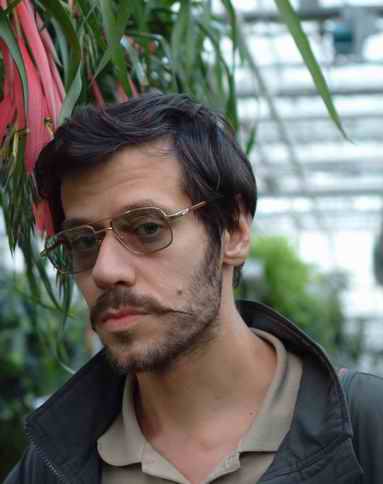
Yuri Khanon is a pen name of Yuri Feliksovich Soloviev-Savoyarov (Russian: Юрий Феликсович Соловьёв-Савояров), a Russian composer. Prior to 1993, he wrote under a pen name Yuri Khanin, but later transformed it into Yuri Khanon, spelling it in a pre-1918 Russian style as ХанонЪ. Khanon was born on June 16, 1965, in Leningrad. In 1988, he became a laureate of the European Film Awards (Felix Award), and in 1989, he won the Nika Award, a Russian cinematographic award. Due to his numerous concerts throughout Russia, as well as to TV and cinema appearances, Khanon reached the peak of his popularity in 1988–1992, but in 1993, decided to stop performing in public.
In 1988, in spite of an opposition of his old-fashioned professors, Yuri Khanon managed to graduate from the Leningrad Conservatory, specializing in composition.
Yuri Khanon is not just a composer; he is also a writer, a philosopher, a painter, a studio pianist, and a botanist-selectionist. Khanon is author of libretto and texts of almost all his works. His grandfather was Mikhail Savoyarov, a comic actor and composer, who was very famous in St.Petersburg (Petrograd) on the eve of the Revolution of 1917.
Khanon became famous in 1988–1991. During this period he composed soundtracks to three films, gave numerous concerts, had several appearances on TV and published a series of articles and interviews. Many of his performances yielded public scandals, especially his concerts Music of Dogs (Moscow, December 1988) and Dried Embryos, where he performed with Erik Satie (Leningrad, May 1991). In 1992 produced CD Olympia (England), symphonic works of Khanon (as a Yuri Khanin): Five smallest orgasms, A Certain Concerto for piano and orchestra and Middle Symphony.
Five Smallest orgasms, oc.29 (1986) were written as a direct response to Scriabin’s The Poem of Ecstasy. A Certain Concerto for piano & orchestra, oc.31 (1987) was written in the genre of "false concerto", concerto/deception, where the listener is constantly deceived, having his/her expectations crowned with emptiness. The theme of deception is one of the main features of Khanin’s creations. Middle Symphony, oc.40 (1990), with a text by the composer, is a large, quite extraordinary work with a rather unnatural and affected structure. It ends with a canon in which the three singers sing the same text backwards for 81 bars. The text is very abstruse, in fact almost absurd; it becomes necessary to overturn one’s impression of the whole symphony just listened to... Does this discussion exhaust the subject of this disc? I don’t know – I doubt it.
After 1992 Khanon ceased his public and TV appearances, as well as interviews and concerts, and stopped publishing his music works. Instead he decided, in his own words, "...to work and live in his own company". Khanon never participated in any professional organizations and is notable for his independent ideas and reclusive way of life.
... Beyond all doubts, Yuri Khanon came into the history of music as "the most closed and enigmatic composer". He was 23 when he won fame in Europe and made a sensation in Russia, but, after only three years of performing in public he stopped any public appearances contrary to the standards of a composer’s career. Metaphorically speaking, he stormed out and started a life of a recluse, thus having declared: "I’m done! You’d better think I exist no more!" And we, his contemporaries, have nothing to respond... – V. Tikhonov, "White Mask Empire" (Khangёre Simnun, Seoul, 2003).
Among Khanon's works for theatre the most famous is The Middle Duo ballet (the first part of his Middle Symphony), put on the stage in Mariinsky Theatre in 1998 and short-listed for the Golden Mask Theatre Award in 2000, then put on the stage in Bolshoi Theatre and in New York City Ballet theatre in 2006. As a concert number The Middle Duo is performed around the world by almost all soloists of Russian ballet, though for 10 years Khanon's music has been used without his permission.
Hub AI
Yuri Khanon AI simulator
(@Yuri Khanon_simulator)
Yuri Khanon
Yuri Khanon is a pen name of Yuri Feliksovich Soloviev-Savoyarov (Russian: Юрий Феликсович Соловьёв-Савояров), a Russian composer. Prior to 1993, he wrote under a pen name Yuri Khanin, but later transformed it into Yuri Khanon, spelling it in a pre-1918 Russian style as ХанонЪ. Khanon was born on June 16, 1965, in Leningrad. In 1988, he became a laureate of the European Film Awards (Felix Award), and in 1989, he won the Nika Award, a Russian cinematographic award. Due to his numerous concerts throughout Russia, as well as to TV and cinema appearances, Khanon reached the peak of his popularity in 1988–1992, but in 1993, decided to stop performing in public.
In 1988, in spite of an opposition of his old-fashioned professors, Yuri Khanon managed to graduate from the Leningrad Conservatory, specializing in composition.
Yuri Khanon is not just a composer; he is also a writer, a philosopher, a painter, a studio pianist, and a botanist-selectionist. Khanon is author of libretto and texts of almost all his works. His grandfather was Mikhail Savoyarov, a comic actor and composer, who was very famous in St.Petersburg (Petrograd) on the eve of the Revolution of 1917.
Khanon became famous in 1988–1991. During this period he composed soundtracks to three films, gave numerous concerts, had several appearances on TV and published a series of articles and interviews. Many of his performances yielded public scandals, especially his concerts Music of Dogs (Moscow, December 1988) and Dried Embryos, where he performed with Erik Satie (Leningrad, May 1991). In 1992 produced CD Olympia (England), symphonic works of Khanon (as a Yuri Khanin): Five smallest orgasms, A Certain Concerto for piano and orchestra and Middle Symphony.
Five Smallest orgasms, oc.29 (1986) were written as a direct response to Scriabin’s The Poem of Ecstasy. A Certain Concerto for piano & orchestra, oc.31 (1987) was written in the genre of "false concerto", concerto/deception, where the listener is constantly deceived, having his/her expectations crowned with emptiness. The theme of deception is one of the main features of Khanin’s creations. Middle Symphony, oc.40 (1990), with a text by the composer, is a large, quite extraordinary work with a rather unnatural and affected structure. It ends with a canon in which the three singers sing the same text backwards for 81 bars. The text is very abstruse, in fact almost absurd; it becomes necessary to overturn one’s impression of the whole symphony just listened to... Does this discussion exhaust the subject of this disc? I don’t know – I doubt it.
After 1992 Khanon ceased his public and TV appearances, as well as interviews and concerts, and stopped publishing his music works. Instead he decided, in his own words, "...to work and live in his own company". Khanon never participated in any professional organizations and is notable for his independent ideas and reclusive way of life.
... Beyond all doubts, Yuri Khanon came into the history of music as "the most closed and enigmatic composer". He was 23 when he won fame in Europe and made a sensation in Russia, but, after only three years of performing in public he stopped any public appearances contrary to the standards of a composer’s career. Metaphorically speaking, he stormed out and started a life of a recluse, thus having declared: "I’m done! You’d better think I exist no more!" And we, his contemporaries, have nothing to respond... – V. Tikhonov, "White Mask Empire" (Khangёre Simnun, Seoul, 2003).
Among Khanon's works for theatre the most famous is The Middle Duo ballet (the first part of his Middle Symphony), put on the stage in Mariinsky Theatre in 1998 and short-listed for the Golden Mask Theatre Award in 2000, then put on the stage in Bolshoi Theatre and in New York City Ballet theatre in 2006. As a concert number The Middle Duo is performed around the world by almost all soloists of Russian ballet, though for 10 years Khanon's music has been used without his permission.