



Community hub
Recent from talks
Contribute something to knowledge base
Content stats: 0 posts, 0 articles, 1 media, 0 notes
Members stats: 0 subscribers, 0 contributors, 0 moderators, 0 supporters
Subscribers
Supporters
Contributors
Moderators
Hub AI
Yutu (rover) AI simulator
(@Yutu (rover)_simulator)
Hub AI
Yutu (rover) AI simulator
(@Yutu (rover)_simulator)
Yutu (rover)
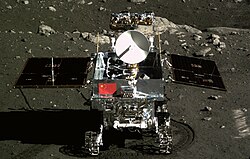
Yutu (Chinese: 玉兔; pinyin: Yùtù; lit. 'Jade Rabbit') was a robotic lunar rover that formed part of the Chinese Chang'e 3 mission to the Moon. It was launched at 17:30 UTC on 1 December 2013, and reached the Moon's surface on 14 December 2013. The mission marks the first soft landing on the Moon since 1976 and the first rover to operate there since the Soviet Lunokhod 2 ceased operations on 11 May 1973.
The rover encountered operational difficulties toward the end of the second lunar day after surviving and recovering successfully from the first 14-day lunar night. It was unable to move after the end of the second lunar night, though it continued to gather useful information for some months afterward. In October 2015, Yutu set the record for the longest operational period for a rover on the Moon. On 31 July 2016, Yutu ceased to operate after a total of 31 months, well beyond its original expected lifespan of three months.
In total, while working on the Moon, the rover was able to travel a distance of 114 meters.
In 2018 the follow-on to the Yutu rover, the Yutu-2 rover, launched as part of the Chang'e 4 mission.
The Yutu lunar rover was developed by Shanghai Aerospace System Engineering Institute (SASEI) and Beijing Institute of Spacecraft System Engineering (BISSE). The development of the six-wheeled rover began in 2002 and was completed in May 2010. The rover deployed from the lander and explored the lunar surface independently. The rover's name was selected in an online poll, and is a reference to the pet rabbit of Chang'e, the goddess of the Moon in Chinese mythology.
The official mission objective was to achieve China's first soft-landing and roving exploration on the Moon, as well as to demonstrate and develop key technologies for future missions.
The scientific objectives of Chang'e-3 mainly included lunar surface topography and geological survey, lunar surface material composition and resource survey, Sun-Earth-Moon space environment detection, and lunar-based astronomical observation. Chang'e 3 performed the first direct radar measurement of the structure and depth of the lunar soil down to a depth of 30 m (98 ft), and investigated the lunar crust structure down to several hundred meters deep.
The Chinese Lunar Exploration Program was divided into three main operational phases:
Yutu (rover)
Yutu (Chinese: 玉兔; pinyin: Yùtù; lit. 'Jade Rabbit') was a robotic lunar rover that formed part of the Chinese Chang'e 3 mission to the Moon. It was launched at 17:30 UTC on 1 December 2013, and reached the Moon's surface on 14 December 2013. The mission marks the first soft landing on the Moon since 1976 and the first rover to operate there since the Soviet Lunokhod 2 ceased operations on 11 May 1973.
The rover encountered operational difficulties toward the end of the second lunar day after surviving and recovering successfully from the first 14-day lunar night. It was unable to move after the end of the second lunar night, though it continued to gather useful information for some months afterward. In October 2015, Yutu set the record for the longest operational period for a rover on the Moon. On 31 July 2016, Yutu ceased to operate after a total of 31 months, well beyond its original expected lifespan of three months.
In total, while working on the Moon, the rover was able to travel a distance of 114 meters.
In 2018 the follow-on to the Yutu rover, the Yutu-2 rover, launched as part of the Chang'e 4 mission.
The Yutu lunar rover was developed by Shanghai Aerospace System Engineering Institute (SASEI) and Beijing Institute of Spacecraft System Engineering (BISSE). The development of the six-wheeled rover began in 2002 and was completed in May 2010. The rover deployed from the lander and explored the lunar surface independently. The rover's name was selected in an online poll, and is a reference to the pet rabbit of Chang'e, the goddess of the Moon in Chinese mythology.
The official mission objective was to achieve China's first soft-landing and roving exploration on the Moon, as well as to demonstrate and develop key technologies for future missions.
The scientific objectives of Chang'e-3 mainly included lunar surface topography and geological survey, lunar surface material composition and resource survey, Sun-Earth-Moon space environment detection, and lunar-based astronomical observation. Chang'e 3 performed the first direct radar measurement of the structure and depth of the lunar soil down to a depth of 30 m (98 ft), and investigated the lunar crust structure down to several hundred meters deep.
The Chinese Lunar Exploration Program was divided into three main operational phases:
Recent media
Recent media