
Recent from talks
Zirconium carbide
Knowledge base stats:
Talk channels stats:
Members stats:
Zirconium carbide
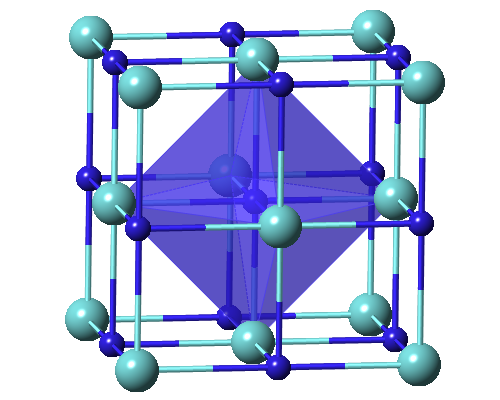
Zirconium carbide (ZrC) is an extremely hard refractory ceramic material, commercially used in tool bits for cutting tools. It is usually processed by sintering.
It appears as a gray metallic powder with cubic crystal structure. It is highly corrosion resistant. This group IV interstitial transition-metal carbide is also an example of ultra high temperature ceramics (UHTC). Due to the presence of metallic bonding, ZrC has a thermal conductivity of 20.5 W/(m·K) and an electrical conductivity of around 2.3 megasiemens per metre, both of which are similar to that for zirconium metal. The strong covalent Zr-C bond gives this material a very high melting point (~3530 °C), high elastic modulus (~440 GPa) and hardness (25 GPa). ZrC has a lower density (6.73 g/cm3) compared to other carbides like WC (15.8 g/cm3), TaC (14.5 g/cm3) and HfC (12.67 g/cm3). ZrC seems suitable for use in re-entry vehicles, rocket/scramjet engines or supersonic vehicles in which low densities and high temperature load-bearing capabilities are crucial requirements.[citation needed]
Like most carbides of refractory metals, zirconium carbide is sub-stoichiometric, i.e., it contains carbon vacancies. At carbon contents higher than approximately ZrC0.98 the material contains free carbon. ZrC is stable for a carbon-to-metal ratio ranging from 0.65 to 0.98.
The group IV and group IVa element carbides, TiC, ZrC, and SiC are practically inert toward attack by strong aqueous acids (e.g. HCl(aq)) and strong aqueous bases (NaOH) even at 100 °C, however, ZrC does react with HF.
The mixture of zirconium carbide and tantalum carbide is an important cermet material.[citation needed]
Hafnium-free zirconium carbide and niobium carbide can be used as refractory coatings in nuclear reactors. Because of a low neutron absorption cross-section and weak damage sensitivity under irradiation, it finds use as the coating of uranium dioxide and thorium dioxide particles of nuclear fuel. The coating is usually deposited by thermal chemical vapor deposition in a fluidized bed reactor. It also has high emissivity and high current capacity[clarification needed] at elevated temperatures, rendering it a promising material for use in thermo-photovoltaic radiators and field emitter tips and arrays.[citation needed]
It is also used as an abrasive, in cladding, cermets, incandescent filaments and cutting tools.[citation needed]
Zirconium carbide can be fabricated in several ways. One method is carbothermic reaction of zirconia by graphite. This results in a powder. Densified ZrC can then be made by sintering the powder of ZrC at upwards of 2000 °C. Hot pressing of ZrC can bring down the sintering temperature and consequently helps in producing fine grained fully densified ZrC. Spark plasma sintering also has been used to produce fully densified ZrC.
Hub AI
Zirconium carbide AI simulator
(@Zirconium carbide_simulator)
Zirconium carbide
Zirconium carbide (ZrC) is an extremely hard refractory ceramic material, commercially used in tool bits for cutting tools. It is usually processed by sintering.
It appears as a gray metallic powder with cubic crystal structure. It is highly corrosion resistant. This group IV interstitial transition-metal carbide is also an example of ultra high temperature ceramics (UHTC). Due to the presence of metallic bonding, ZrC has a thermal conductivity of 20.5 W/(m·K) and an electrical conductivity of around 2.3 megasiemens per metre, both of which are similar to that for zirconium metal. The strong covalent Zr-C bond gives this material a very high melting point (~3530 °C), high elastic modulus (~440 GPa) and hardness (25 GPa). ZrC has a lower density (6.73 g/cm3) compared to other carbides like WC (15.8 g/cm3), TaC (14.5 g/cm3) and HfC (12.67 g/cm3). ZrC seems suitable for use in re-entry vehicles, rocket/scramjet engines or supersonic vehicles in which low densities and high temperature load-bearing capabilities are crucial requirements.[citation needed]
Like most carbides of refractory metals, zirconium carbide is sub-stoichiometric, i.e., it contains carbon vacancies. At carbon contents higher than approximately ZrC0.98 the material contains free carbon. ZrC is stable for a carbon-to-metal ratio ranging from 0.65 to 0.98.
The group IV and group IVa element carbides, TiC, ZrC, and SiC are practically inert toward attack by strong aqueous acids (e.g. HCl(aq)) and strong aqueous bases (NaOH) even at 100 °C, however, ZrC does react with HF.
The mixture of zirconium carbide and tantalum carbide is an important cermet material.[citation needed]
Hafnium-free zirconium carbide and niobium carbide can be used as refractory coatings in nuclear reactors. Because of a low neutron absorption cross-section and weak damage sensitivity under irradiation, it finds use as the coating of uranium dioxide and thorium dioxide particles of nuclear fuel. The coating is usually deposited by thermal chemical vapor deposition in a fluidized bed reactor. It also has high emissivity and high current capacity[clarification needed] at elevated temperatures, rendering it a promising material for use in thermo-photovoltaic radiators and field emitter tips and arrays.[citation needed]
It is also used as an abrasive, in cladding, cermets, incandescent filaments and cutting tools.[citation needed]
Zirconium carbide can be fabricated in several ways. One method is carbothermic reaction of zirconia by graphite. This results in a powder. Densified ZrC can then be made by sintering the powder of ZrC at upwards of 2000 °C. Hot pressing of ZrC can bring down the sintering temperature and consequently helps in producing fine grained fully densified ZrC. Spark plasma sintering also has been used to produce fully densified ZrC.
Recent media