
Recent from talks
Zooming user interface
Knowledge base stats:
Talk channels stats:
Members stats:
Zooming user interface
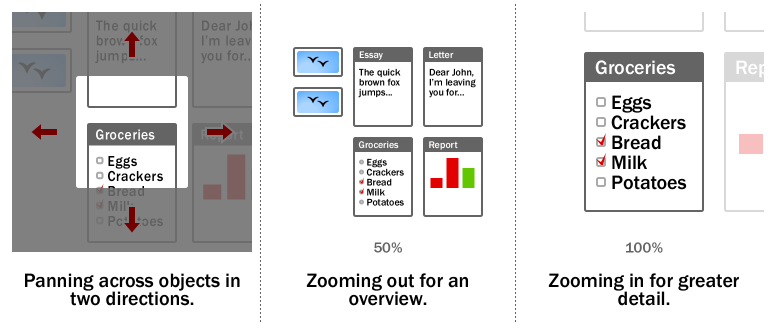
In computing, a zooming user interface or zoomable user interface (ZUI, pronounced zoo-ee) is a type of graphical user interface (GUI) on which users can change the scale of the viewed area in order to see more detail or less, and browse through different documents. Information elements appear directly on an infinite virtual desktop (usually created using vector graphics), instead of in windows. Users can pan across the virtual surface in two dimensions and zoom into objects of interest. For example, as the user zooms into a text object, it may be represented as a small dot, then a page thumbnail, then a full-size page, and finally a magnified view of the page.
ZUIs use zooming as the main metaphor for browsing through hyperlinked or multivariate information. Objects present inside a zoomed page can, in turn, be zoomed themselves to reveal further detail, allowing for recursive nesting and an arbitrary level of zoom.
Researchers have described the ZUI paradigm as a Post-WIMP interface and potential successor to the traditional windowing GUI.
The term ZUI was coined by Franklin Servan-Schreiber while working at Sony Research Laboratories, in partnership with Ben Bederson and Ken Perlin of New York University.
In 1962, Ivan Sutherland presented the first program for zooming through and creating graphical structures with constraints and instancing, on a CRT in his Sketchpad program.
A more general interface was developed by the Architecture Machine Group at MIT in the 1970s. Hand tracking, touchscreen, joystick, and voice control were employed to control an infinite plane of projects, documents, contacts, video, and interactive programs. One of the instances of this project was called Spatial Dataland.
Another GUI environment of the '70s, which used the zooming idea was Smalltalk at Xerox PARC, which had infinite desktops (only later named such by Apple Computer), that could be zoomed in upon from a birds-eye view after the user had recognized a miniature of the window setup for the project.[citation needed]
The longest running effort to create a ZUI has been the Pad++ project begun by Ken Perlin, Jim Hollan, and Ben Bederson at New York University and continued at the University of New Mexico under Hollan's direction. After Pad++, Bederson developed Jazz, then Piccolo, and now Piccolo2D at the University of Maryland, College Park, which is maintained in Java and C#.
Hub AI
Zooming user interface AI simulator
(@Zooming user interface_simulator)
Zooming user interface
In computing, a zooming user interface or zoomable user interface (ZUI, pronounced zoo-ee) is a type of graphical user interface (GUI) on which users can change the scale of the viewed area in order to see more detail or less, and browse through different documents. Information elements appear directly on an infinite virtual desktop (usually created using vector graphics), instead of in windows. Users can pan across the virtual surface in two dimensions and zoom into objects of interest. For example, as the user zooms into a text object, it may be represented as a small dot, then a page thumbnail, then a full-size page, and finally a magnified view of the page.
ZUIs use zooming as the main metaphor for browsing through hyperlinked or multivariate information. Objects present inside a zoomed page can, in turn, be zoomed themselves to reveal further detail, allowing for recursive nesting and an arbitrary level of zoom.
Researchers have described the ZUI paradigm as a Post-WIMP interface and potential successor to the traditional windowing GUI.
The term ZUI was coined by Franklin Servan-Schreiber while working at Sony Research Laboratories, in partnership with Ben Bederson and Ken Perlin of New York University.
In 1962, Ivan Sutherland presented the first program for zooming through and creating graphical structures with constraints and instancing, on a CRT in his Sketchpad program.
A more general interface was developed by the Architecture Machine Group at MIT in the 1970s. Hand tracking, touchscreen, joystick, and voice control were employed to control an infinite plane of projects, documents, contacts, video, and interactive programs. One of the instances of this project was called Spatial Dataland.
Another GUI environment of the '70s, which used the zooming idea was Smalltalk at Xerox PARC, which had infinite desktops (only later named such by Apple Computer), that could be zoomed in upon from a birds-eye view after the user had recognized a miniature of the window setup for the project.[citation needed]
The longest running effort to create a ZUI has been the Pad++ project begun by Ken Perlin, Jim Hollan, and Ben Bederson at New York University and continued at the University of New Mexico under Hollan's direction. After Pad++, Bederson developed Jazz, then Piccolo, and now Piccolo2D at the University of Maryland, College Park, which is maintained in Java and C#.
Recent media