


Community hub
Recent from talks
Contribute something
Nothing was collected or created yet.
Sho (letter)
View on Wikipedia
 | ||||||||||||||||||||||||||||||||||||||||||||||||
| Greek alphabet | ||||||||||||||||||||||||||||||||||||||||||||||||
|---|---|---|---|---|---|---|---|---|---|---|---|---|---|---|---|---|---|---|---|---|---|---|---|---|---|---|---|---|---|---|---|---|---|---|---|---|---|---|---|---|---|---|---|---|---|---|---|---|
|
||||||||||||||||||||||||||||||||||||||||||||||||
| History | ||||||||||||||||||||||||||||||||||||||||||||||||
|
||||||||||||||||||||||||||||||||||||||||||||||||
| Diacritics and other symbols | ||||||||||||||||||||||||||||||||||||||||||||||||
| Related topics | ||||||||||||||||||||||||||||||||||||||||||||||||

The letter Ϸ ϸ, sometimes called sho or san, was a letter added to the Greek alphabet in order to write the Bactrian language.[1][2] It was similar in appearance to the Anglo-Saxon and Icelandic letter thorn (þ), which has typically been used to represent it in modern print, although they are historically unrelated. It probably represented a sound similar to English "sh" ([ʃ]). Its conventional transliteration in Latin is ⟨š⟩.[3]


Its original name and position in the Bactrian alphabet, if it had any, are unknown. Some authors have called it "san", on the basis of the hypothesis that it was a survival or reintroduction of the archaic Greek letter San.[4] This letter Ϸ closely resembles, perhaps coincidentally, the letter ⟨𐊮⟩ of the Greek-based Carian alphabet which may have also stood for [ʃ]. The name "sho" was coined for the letter for purposes of modern computer encoding in 2002, on the basis of analogy with "rho" (ρ), the letter with which it seems to be graphically related.[1] Ϸ was added to Unicode in version 4.0 (2003), in an uppercase and lowercase character designed for modern typography.
| Appearance | Code points | Name |
|---|---|---|
| Ϸ | U+03F7 | GREEK CAPITAL LETTER SHO |
| ϸ | U+03F8 | GREEK SMALL LETTER SHO |
References
[edit]- ^ a b c Everson, M. and Sims-Williams, N. (2002) “Proposal to add two Greek letters for Bactrian to the UCS”,ISO/IEC JTC1/SC2/WG2 N2411.
- ^ History of Civilizations of Central Asia. UNESCO. 2006. p. 121. ISBN 978-9231032110.
- ^ Skjærvø, P. O. (2009). "Bactrian". In Brown, Keith; Ogilvie, Sarah (eds.). Concise encyclopedia of languages of the world. Oxford: Elsevier. p. 115. ISBN 9780080877754.
- ^ Tarn, William Woodthorpe (1961). The Greeks in Bactria and India. Cambridge: Cambridge University Press. p. 508. ISBN 9781108009416.
{{cite book}}: ISBN / Date incompatibility (help)
- Themistocleous, Charalambos; Katsoyannou, Marianna; Armosti, Spyros; Christodoulou, Kyriaci (7–11 August 2012). Cypriot Greek Lexicography: A Reverse Dictionary of Cypriot Greek (PDF). 15th European Association for Lexicography (EURALEX) Conference. Oslo, Norway. Archived from the original (PDF) on 6 August 2016. Retrieved 12 February 2013.
 | This article about an alphabet or related topic is a stub. You can help Wikipedia by expanding it. |
Sho (letter)
View on GrokipediaOverview
Etymology and nomenclature
The name "Sho" for the additional letter in the Bactrian script, representing the /ʃ/ sound, was coined in 2002 by Nicholas Sims-Williams and Michael Everson during the Unicode encoding proposal, by analogy with the Greek letter rho (ρ) to reflect its phonetic value in words like "Kanishka."[1] This modern nomenclature established a consistent English term in digital and scholarly contexts, drawing from the Bactrian pronunciation of the sibilant /ʃ/ as heard in the language's Iranian heritage. Prior to this, no native or traditional name for the letter is attested in surviving Bactrian texts, which instead reflect its functional role in adapting the Greek alphabet for an Eastern Iranian language spoken in ancient Bactria.[1] In early 20th-century epigraphic studies following the decipherment of longer Bactrian inscriptions, the letter was occasionally termed "san" by some scholars, based on a hypothesis linking its form to the archaic Greek letter san (Ϻ), an obsolete character with a numeric value of 900.[1] However, this connection is now regarded as untenable, as the Bactrian letter's glyph and position differ significantly from san, and no evidence supports a direct derivation; the two are distinct innovations for unrelated scripts.[1] For convenience in pre-digital transliterations, some researchers employed the Latin thorn (Þ) to approximate its shape and sound, though this practice underscores the letter's unique status outside standard Greek epigraphy.[1] The letter's first historical attestation appears in Bactrian inscriptions from the 1st century AD, during the Kushan period, including the monumental texts at Surkh Kotal in northern Afghanistan, which were excavated and deciphered in the 1950s by W. B. Henning.[1] In modern linguistics, naming conventions prioritize its phonetic designation as "š" (IPA /ʃ/), emphasizing its role in overcoming the Greek alphabet's limitations for rendering Iranian sibilants, as noted in comprehensive studies of the language's orthography.[3] This approach aligns with broader conventions in Iranian philology, where script adaptations are analyzed through their sound values rather than imposed classical Greek labels.Physical description
The uppercase form of the Sho letter, denoted as Ϸ, resembles half of the Greek letter phi (Φ), featuring a semi-circular bowl on the right with a vertical stroke, creating a distinctive profile suitable for monumental inscriptions. This design is evident in early epigraphic examples, such as the Dasht-e Nawur inscription, where the letter appears as a robust, half-phi-like shape with straight lines and a prominent rightward extension.[1] The lowercase form, ϸ, serves as a cursive variant primarily found in manuscripts and papyri, often manifesting as a looped shape with a descending tail and a curved bowl on the right, resembling a simplified phi or rho, allowing for fluid connections in continuous writing. In documents like the Bactrian manumission deed (I 6 23001), this form exhibits a tall ascender and long descender, with the loop providing balance in slanted scripts.[1] Epigraphic styles of Sho reveal notable variations across media from the 2nd to 8th centuries AD, with angular, block-like renditions in rock inscriptions—such as those at Surkh Kotal—contrasting against the more fluid, cursive iterations on coins and papyri, where the vertical stroke may curve slightly for aesthetic flow. These differences reflect adaptations to carving tools and writing surfaces, yet maintain the core structure of bowl, vertical, and descender.[1]Historical development
Origins in the Bactrian adaptation of Greek script
Following the conquests of Alexander the Great in 323 BCE, the region of Bactria in Central Asia underwent significant Hellenization, leading to the adoption of the Greek script for administrative and monumental purposes. This adaptation persisted even after the decline of direct Greek rule in the 2nd century BCE, as successive powers, including the Greco-Bactrian kingdom and later the Kushan Empire, continued to employ the Greek alphabet to record local languages. Bactrian, an Eastern Iranian language spoken in the area, required modifications to the Greek script to accommodate its phonological features, marking the script's evolution into what is known as the Greco-Bactrian or Bactrian alphabet.[1] A primary motivation for these changes was the need to represent sounds absent in standard Greek phonology, particularly the voiceless postalveolar fricative /ʃ/, which is characteristic of Bactrian among Eastern Iranian languages. To denote this sound, scribes introduced a new letter called Sho (Ϸ in majuscule, ϸ in minuscule), resembling a modified form of the Greek phi (Φ) or rho (Ρ) with a distinctive descender and ascender, often compared to the Old Norse thorn (þ). This innovation addressed a gap in the Greek alphabet, which lacked a dedicated symbol for /ʃ/, and Sho first appears in Kushan-era inscriptions dating to around the 1st century CE, such as those at Surkh Kotal.[4][1][5] Beyond the addition of Sho, the Bactrian alphabet underwent further streamlining to fit the language's phonemic inventory. Letters like xi (Ξ) and psi (Ψ), which represent the consonant clusters /ks/ and /ps/ in Greek, were omitted entirely, as these sequences do not occur in Bactrian. Additionally, upsilon (Υ), originally denoting the vowel /y/ or /u/ in Greek, was repurposed to represent the aspirate /h/, helping to resolve ambiguities in rendering Bactrian's sound system with only minimal alterations to the core Greek framework. These modifications reflect a pragmatic adaptation driven by linguistic necessity during the early Kushan period, when the script served as a tool for asserting local identity within a Hellenized administrative tradition.[2][4][5]Usage in the Kushan and Hephthalite periods
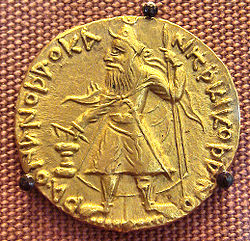
The letter Sho played a significant role in the Bactrian script during the Kushan Empire (1st–3rd centuries AD), appearing prominently in monumental inscriptions that documented royal decrees and dynastic claims. A key example is the Rabatak inscription, dated to approximately 127 AD and erected by King Kanishka I near Surkh Kotal in modern Afghanistan, where Sho is employed in terms such as "Kuṣāṇa" to denote the imperial lineage and in phrases affirming the king's authority over conquered territories. This inscription, comprising 23 lines on a limestone block, exemplifies Sho's integration into formal epigraphy for conveying the /ʃ/ sound essential to Bactrian nomenclature and proclamations.[6][7] Sho also featured in numismatic inscriptions of the Kushan period, adorning gold and copper coins to inscribe rulers' titles and epithets in Bactrian, such as "ΒΑΣΙΛΕΩΣ ΒΑΣΙΛΕΩΝ ΚΟϷΑΝΟΥ" on issues of Kanishka, highlighting the letter's utility in abbreviating ethnic and regal identifiers across the empire's vast economic network.[6] Under the subsequent Hephthalite Empire (5th–6th centuries AD), Sho continued in practical applications within administrative and religious contexts, including legal deeds, economic records, and Buddhist manuscripts from regions encompassing present-day northern Afghanistan and northwestern Pakistan. These texts, often on perishable materials like leather and wood, reflect Sho's persistence in everyday governance and devotional literature amid the Hephthalites' rule over former Kushan domains.[8] Following the Umayyad conquests of the mid-7th century, which introduced Arabic administration to the region, the use of Sho and the Bactrian script gradually waned, supplanted by Islamic-era writing systems. The latest attested instances appear in 9th-century inscriptions from the Tochi Valley in northwestern Pakistan, marking the script's final phase before obsolescence. The entire surviving corpus of Bactrian texts, spanning these periods, comprises approximately 150 documents, primarily administrative and epigraphic artifacts preserved through archaeological finds.[7]Phonology and orthography
Phonetic value
The letter Sho (Ϸ, ϸ) primarily represents the voiceless postalveolar fricative /ʃ/ in the Bactrian language, a sound akin to the "sh" in English "ship".[7][9] This phoneme, characteristic of Eastern Iranian languages, was absent from Classical Greek phonology, prompting the adaptation of the Greek script with Sho to accurately transcribe Bactrian speech.[7] In Bactrian, /ʃ/ typically occurs in initial and medial positions, reflecting the language's phonological inventory where it fills a gap not covered by existing Greek letters like sigma (/s/) or chi (/x/).[9] Examples of Sho's usage appear in key Bactrian inscriptions, such as the Rabatak inscription of Kanishka, where it denotes /ʃ/ in words like šau ("king"), spelled as Ϸαυ, emphasizing royal titles and authority. Similarly, aša ("truth" or "order"), a core concept in Iranian linguistics derived from Avestan aša-, employs Sho medially to represent /ʃ/, underscoring its role in philosophical and religious terminology. Another instance is found in personal names like Dathsho-marego ("eunuch of the gift"), where Sho captures the /ʃ/ sound in compound formations.[7] In Bactrian phonology, /ʃ/ contrasts phonemically with /s/ (rendered by sigma, Σ/σ) and /x/ (rendered by chi, Χ/χ), ensuring distinct articulation in words that might otherwise overlap in Iranian etymologies; for example, /ʃ/ preserves Old Iranian *š while /s/ handles sibilants from other sources, and /x/ denotes the velar fricative.[7][9] This separation highlights Sho's linguistic significance in adapting the script to Bactrian's Eastern Iranian features, where /ʃ/ could shift to /h/ in specific environments (e.g., after back vowels) but retained its primary fricative value in core vocabulary.[9]Position in the Bactrian alphabet
The Bactrian alphabet consists of 23 letters, comprising 22 letters derived from the standard Greek alphabet (excluding xi and psi, which were unused due to the absence of /ks/ and /ps/ sounds in Bactrian) plus the additional letter Sho (Ϸ, ϸ) introduced to represent the /ʃ/ phoneme.[1][2] No historical abecedary survives to confirm the exact sequence of letters in the Bactrian alphabet, leaving the position of Sho unattested in primary sources. However, in contemporary scholarly representations (e.g., Sims-Williams) and digital encoding standards, Sho is typically placed after omega (Ω, ω), sometimes following the numeric value of 800.[1] The orthographic conventions of the Bactrian script mirror those of Greek, with text written from left to right in a continuous flow. Sho functions uniformly to denote /ʃ/ across all positional contexts—initial, medial, and final—eliminating the need for digraphs or contextual variants in spelling.[4][1] Unlike certain Greek letters that doubled as numerals in the acrophonic system, Sho was not assigned a numerical value in Bactrian usage. The numeral system adhered to the classical Greek model, employing the initial letters from alpha to theta for units 1 through 9, and extending through the sequence without incorporating the added Sho.[1][2]Forms and encoding
Graphical variants
The letter Sho exhibits notable graphical variations across different media and historical contexts in Bactrian script, reflecting adaptations to material constraints and scribal practices. In epigraphic contexts, particularly monumental inscriptions, Sho is typically rendered in a tall, angular uppercase form (Ϸ), characterized by a pronounced horizontal crossbar, a circular bowl on the right, and a long vertical descender extending below the baseline, as seen in the Kanishka inscription at Surkh Kotal and the Dasht-e Nawur petroglyphs from the 1st-2nd centuries CE.[7] On coinage, the form is more compact and simplified to accommodate limited space, evident in Kushan issues where the letter integrates into legends.[7] In manuscript traditions, the lowercase variant (ϸ) predominates in a cursive style suited to quicker writing on perishable surfaces like birch bark, papyri, and ostraca, evolving from the 2nd century CE onward with fluid strokes, as documented in 4th-6th century administrative and Buddhist texts from northern Afghanistan.[7] This cursive form frequently incorporates ligatures with adjacent letters for efficiency, particularly in the denser scripts of legal documents and religious manuscripts from sites like the Tochi Valley.Unicode and digital representation
The uppercase form of the Sho letter is assigned the Unicode code point U+03F7 (GREEK CAPITAL LETTER SHO, Ϸ), while the lowercase form is U+03F8 (GREEK SMALL LETTER SHO, ϸ); both reside in the Greek and Coptic block (U+0370–U+03FF).[10] These code points were introduced in Unicode version 4.0, released in April 2003, to support archaic Greek letters used in historical scripts like Bactrian. Font support for Sho was initially limited after its addition to Unicode, as many early fonts lacked glyphs for these rare archaic characters, often leading to substitutions like Latin thorn in digital editions of Bactrian inscriptions prior to widespread adoption.[7] Contemporary fonts have improved this coverage significantly; for instance, Noto Sans Greek includes full glyphs for both uppercase and lowercase Sho, enabling accurate rendering in modern applications and web browsers. These characters are now utilized in scholarly digital editions of Bactrian texts, such as the TITUS project's Corpus of Bactrian Texts, which employs Unicode encoding for precise transcription and display. Inputting Sho typically relies on standard Unicode methods rather than dedicated keys in basic layouts, though it integrates with extended polytonic Greek keyboard configurations on operating systems like Windows and macOS via character maps or input tools. In Windows, for example, the uppercase Sho can be entered by holding Alt and typing 03F7 on the numeric keypad (using the Unicode hexadecimal input method).[11] On Linux, Ctrl+Shift+U followed by 03F7 achieves the same for uppercase. For web and HTML contexts, the entities Ϸ (hexadecimal) or Ϸ (decimal) render the uppercase Sho, with ϸ or ϸ for lowercase.[12]Related representations
Other letters for [ʃ] in Greek-derived scripts
In the Coptic script, a direct descendant of the Greek alphabet adapted for writing the late stage of the Egyptian language, the voiceless postalveolar fricative /ʃ/ is represented by the dedicated letter shai, appearing as Ϣ (majuscule) and ϣ (minuscule). This letter, derived from Demotic Egyptian influences, was necessary to express a sound absent in Greek phonology, and it is consistently used across major Coptic dialects like Sahidic and Bohairic for words such as ϣⲁⲓ (shai, meaning "small"). Although some early or dialectal variations might approximate /ʃ/ with digraphs like σι in transitional phases, the standard orthography relies on shai without exception.[13] The Gothic alphabet, devised in the 4th century CE by Ulfilas for translating the Bible into the Gothic language and heavily modeled on Greek uncial forms with runic admixtures, lacks a specific letter for /ʃ/, reflecting the absence of this phoneme in Gothic phonology. Sibilant sounds are instead covered by the letter based on Greek sigma (𐍃) for /s/ and zeta-derived 𐍀 for /z/, with any potential /ʃ/ in rare loanwords likely rendered via adaptations likeDistinction from similar archaic Greek letters
The Bactrian letter sho (Ϸ, ϸ), introduced around the 1st century AD to represent the phoneme /ʃ/ in the adapted Greek script used for the Bactrian language, must be distinguished from earlier archaic Greek letters like san (Ϻ, ϻ) due to differences in form, function, and chronology. San, attested in Greek inscriptions from before the [4th century BC](/page/4th century BC), primarily denoted /s/ in certain dialects such as those of Crete and Corinth, and later served as the numeral for 900; its shape resembles a sideways sigma (Σ) or an M-like form without a hooked descender. In contrast, sho features a distinct hooked or thorn-like structure, often depicted as a rho (Ρ) with a prominent downward stroke, tailored specifically for the sibilant /ʃ/ absent in standard Greek.[1][15] Similarly, sho differs from sampi (ϡ, Ͳ), another obsolete letter from Ionian Greek alphabets, which represented a sibilant sound (possibly /ss/ or /ts/) or functioned as the numeral 900, typically rendered with three vertical strokes or a lunate form with a central bar. Sho lacks this triple-stroke configuration and instead employs a single, curved ascender and descender, reflecting its independent development for Bactrian phonology rather than continuity from Ionian epigraphy.[1][16] Sho has no direct lineage from san or sampi; it was invented as an addition to the Greek alphabet during the Kushan period to accommodate Bactrian needs, with occasional early scholarly speculation linking it to san for its potential numeric value of 900 unverified by any extant texts. Modern epigraphists, building on decipherments like that of the Surkh Kotal inscription, have corrected prior ambiguities, affirming sho's unique role in Central Asian Greek-derived scripts.[1]References
- https://en.wikibooks.org/wiki/Gothic/1/Alphabet