


Community hub
Recent from talks
Contribute something
Nothing was collected or created yet.
.218 Bee
View on Wikipedia | This article needs additional citations for verification. (January 2013) |
| .218 Bee | ||||||||||||||||||||
|---|---|---|---|---|---|---|---|---|---|---|---|---|---|---|---|---|---|---|---|---|
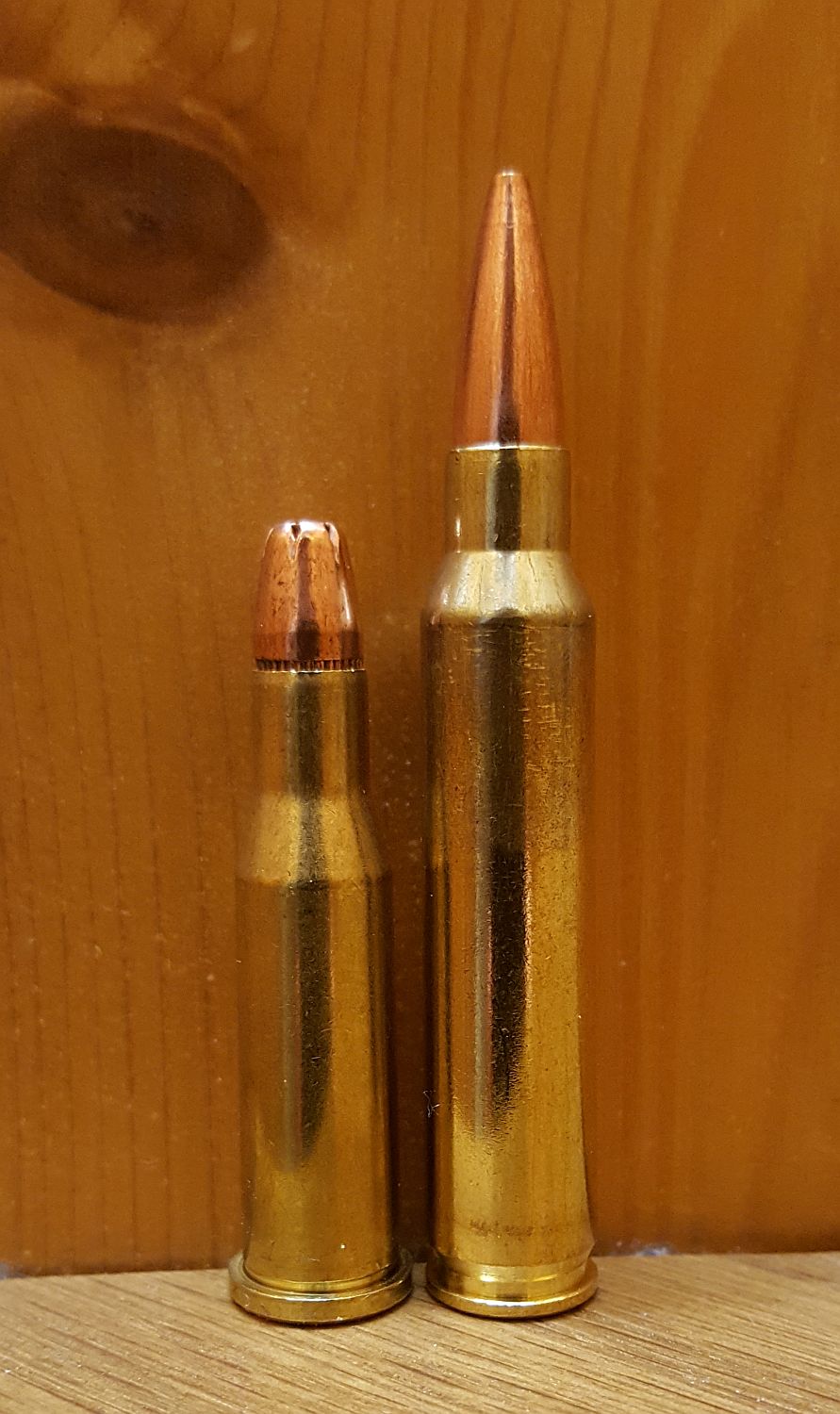
 Left, compared to .223 Remington | ||||||||||||||||||||
| Type | Rifle | |||||||||||||||||||
| Place of origin | US | |||||||||||||||||||
| Production history | ||||||||||||||||||||
| Designer | Winchester | |||||||||||||||||||
| Designed | 1937 | |||||||||||||||||||
| Manufacturer | Winchester | |||||||||||||||||||
| Produced | 1937–present | |||||||||||||||||||
| Variants | .218 Mashburn Bee[1] | |||||||||||||||||||
| Specifications | ||||||||||||||||||||
| Parent case | .32-20 Winchester | |||||||||||||||||||
| Case type | Rimmed, bottleneck | |||||||||||||||||||
| Bullet diameter | .224 in (5.7 mm) | |||||||||||||||||||
| Neck diameter | .242 in (6.1 mm) | |||||||||||||||||||
| Shoulder diameter | .329 in (8.4 mm) | |||||||||||||||||||
| Base diameter | .349 in (8.9 mm) | |||||||||||||||||||
| Rim diameter | .408 in (10.4 mm) | |||||||||||||||||||
| Rim thickness | .065 in (1.7 mm) | |||||||||||||||||||
| Case length | 1.345 in (34.2 mm) | |||||||||||||||||||
| Primer type | Small rifle | |||||||||||||||||||
| Maximum CUP | 40,000[2] CUP | |||||||||||||||||||
| Ballistic performance | ||||||||||||||||||||
| ||||||||||||||||||||
| Source: Hodgdon [3] | ||||||||||||||||||||
The .218 Bee / 5.7x34mmR is a .22 caliber centerfire rifle cartridge designed for varmint hunting by Winchester in 1937. The cartridge was originally chambered in the Winchester Model 65 lever-action rifles, which may have ultimately led to its lack of popularity. The cartridge is named for the bore diameter of the barrel in which the cartridge is chambered rather than the usual practice in the United States of having the cartridge's nomenclature reflect in some way the bullet diameter.
History
[edit]The .218 Bee cartridge was designed by Winchester for use in their Model 65 lever-action rifles. Winchester designed the cartridge by necking down the .25-20 Winchester cartridge to accept a .224 diameter bullet. Just as the .32-20 can be considered to be the parent cartridge of the .25-20, it can also be considered the parent cartridge to the .218 Bee. The cartridge was introduced as a commercial cartridge by Winchester in 1937 in their Model 65 lever action rifle, which was also chambered for the .25-20 and .32-20 Winchester cartridges. However, while the .25-20 and the .32-20 Model 65 rifles have 22-inch (560 mm) barrels, the rifles chambered for the Bee have 24-inch (610 mm) barrels.
Despite showing some early promise, the cartridge never really caught on, even though it was later chambered by Winchester in their new bolt-action Model 43 rifle and by Sako in their L-46 rifle. There was some question about the accuracy of the .218 Bee as compared to the .222,[4] but that was likely due to the difference of inherent accuracy between the bolt-action rifles commonly chambered for the .222 and the lever-action rifles commonly chambered for the .218 Bee. Although not in common use, it is still a very effective cartridge in its class, for small to medium varmints out to about 200 yards (180 m). Production ammunition and rifles are still available from a few manufacturers.
Performance
[edit]In terms of relative performance, the .218 Bee falls between the smaller .22 Hornet, and the larger .222 Remington and the more popular .223 Remington.
See also
[edit]Notes
[edit]- ^ Landis, Charles S. Twenty-Two Caliber Varmint Rifles (1947) Small Arms Technical Publishing Company p.60
- ^ Saami pressures. (n.d.). Retrieved May 3, 2023, from https://leverguns.com/articles/saami_pressures.htm
- ^ "Hodgdon Online Reloading Data". Archived from the original on 2007-11-11. Retrieved 2007-08-02.
- ^ Association, National Rifle. "An Official Journal Of The NRA | Head to Head: .22 Hornet vs. .218 Bee". An Official Journal Of The NRA. Retrieved 2025-10-14.
References
[edit]- The .218 Bee by Chuck Hawks
- Contender Varminting - .218 Bee at Rocky's Reloading Room
.218 Bee
View on GrokipediaHistory
Development
In the mid-1930s, Winchester engineers conceived the .218 Bee to overcome the limitations of the .22 Hornet, particularly its insufficient muzzle velocity for effective varmint hunting at extended ranges beyond 200 yards.[5] The .22 Hornet, introduced by Winchester in 1930, had gained popularity for small game but was constrained by modest powder capacity and performance in lever-action rifles, prompting the need for a more capable .22-caliber alternative.[1] The primary goal was to develop a higher-velocity cartridge using affordable, existing rimmed cases, making it accessible to budget-conscious shooters amid the economic hardships of the Great Depression.[2] By selecting the .25-20 Winchester as the parent case—a rimmed, bottlenecked design already in production—engineers aimed to minimize manufacturing costs while optimizing for lever-action platforms like the Winchester Model 65.[5] This choice positioned the .218 Bee in direct competition with the .22 Hornet, but with enhancements tailored for reliable feeding and function in tubular-magazine rifles.[2] A pivotal design decision involved necking down the .25-20 Winchester case to accept .224-inch bullets.[6] This modification enhanced velocity potential without requiring entirely new tooling, aligning with Depression-era efficiency.[1] Initial prototyping and testing focused on achieving muzzle velocities exceeding 2,800 fps with 45- to 46-grain bullets while maintaining safe pressures below 45,000 psi.[2] These efforts confirmed the cartridge's superiority over the .22 Hornet in ballistic flatness and energy retention for varmint applications, paving the way for its commercial viability.[5]Introduction and Adoption
The .218 Bee was introduced by Winchester in 1938 as a centerfire rifle cartridge chambered in the Model 65 lever-action rifle, an updated version of the Model 92 with a 24-inch barrel, aimed at revitalizing sales of the platform.[1] Marketed as a "varmint powerhouse," it was positioned as superior to the earlier .22 Hornet, offering higher velocity for improved performance on small pests while maintaining low recoil suitable for lightweight rifles and economical hunting.[1] The initial factory load consisted of a 46-grain hollowpoint bullet propelled to 2,860 feet per second from the 24-inch barrel, specifically tailored for varmint and small game applications.[2] Early adoption centered among hunters in the U.S. Midwest and Western regions, where it gained favor for controlling prairie dogs and ground squirrels due to its flat trajectory and minimal pelt damage on fur-bearing species.[7] Sales peaked in the late 1930s as Winchester integrated the cartridge into its lineup, including limited offerings in bolt-action rifles like the Model 43 starting in 1944, though its primary association with lever-actions limited broader appeal among varmint shooters who preferred more accurate single-shot and bolt-action designs.[2] International interest remained minimal, with the cartridge seeing scant production or use outside North America.[8] Post-World War II, the .218 Bee's popularity declined sharply due to widespread ammunition shortages affecting commercial cartridges and a growing preference for military surplus rifles chambered in the more readily available .22 Hornet.[9] The introduction of the more powerful .222 Remington in 1950 further eroded its market share, as that cartridge offered superior ballistics in modern bolt-action platforms and quickly became a varmint hunting standard.[1] By the mid-20th century, Winchester's sporadic production runs could not sustain demand, leading to the .218 Bee's niche status among reloaders and collectors.[2]Design
Parent Cartridge and Modifications
The .218 Bee cartridge was developed from the .25-20 Winchester, a rimmed, straight-walled cartridge introduced in 1895 for use in revolvers and lever-action rifles, and itself derived by necking down the .32-20 Winchester case to .257-inch bullet diameter.[1][2] The primary modifications involved necking down the .25-20 case mouth from .257 inches to .224 inches to accept .22-caliber bullets, while forming a bottleneck shape by introducing a shoulder positioned forward by approximately 0.150 inches relative to the parent case. This adjustment increased the usable case capacity to about 14.2 grains of water, compared to roughly 10-12 grains in the unmodified .25-20, allowing for greater powder charges of 10-14 grains in typical loads versus around 5-8 grains in the original.[1][10] The resulting design is a rimmed, bottlenecked case with a 15-degree shoulder angle, which promotes reliable feeding and extraction in lever-action rifles equipped with tubular magazines. These changes optimized the cartridge for higher operating pressures, with a SAAMI maximum average of 40,000 CUP (equivalent to approximately 46,000 psi), exceeding the capabilities of the lower-pressure .25-20 while maintaining compatibility with its rim dimensions.[11]Specifications
The .218 Bee is a rimmed, centerfire rifle cartridge with the following key physical dimensions: bullet diameter of 0.224 inches (5.69 mm), neck diameter of 0.242 inches (6.15 mm), shoulder diameter of 0.329 inches (8.36 mm), base diameter of 0.349 inches (8.86 mm), and rim diameter of 0.408 inches (10.36 mm).[4] The case measures 1.345 inches (34.16 mm) in length, with a maximum overall cartridge length of 1.700 inches (43.18 mm).[4] It employs a small rifle primer type and has a case capacity of approximately 14.2 grains of water (varies 14-18 grains by manufacturer).[1][12] Rifles chambered for the .218 Bee typically feature a recommended rifling twist rate of 1:16 inches, optimized for bullets weighing 35 to 50 grains.[4] The SAAMI-established maximum average operating pressure is 46,000 psi (40,000 CUP), with headspace at the rim (rim thickness 0.065 inches).[4]| Dimension | Imperial (inches) | Metric (mm) |
|---|---|---|
| Bullet Diameter | 0.224 | 5.69 |
| Neck Diameter | 0.242 | 6.15 |
| Shoulder Diameter | 0.329 | 8.36 |
| Base Diameter | 0.349 | 8.86 |
| Rim Diameter | 0.408 | 10.36 |
| Case Length | 1.345 | 34.16 |
| Overall Length (max) | 1.700 | 43.18 |
| Rim Thickness (headspace) | 0.065 | 1.65 |