
Recent from talks
10 Hygiea
Knowledge base stats:
Talk channels stats:
Members stats:
10 Hygiea
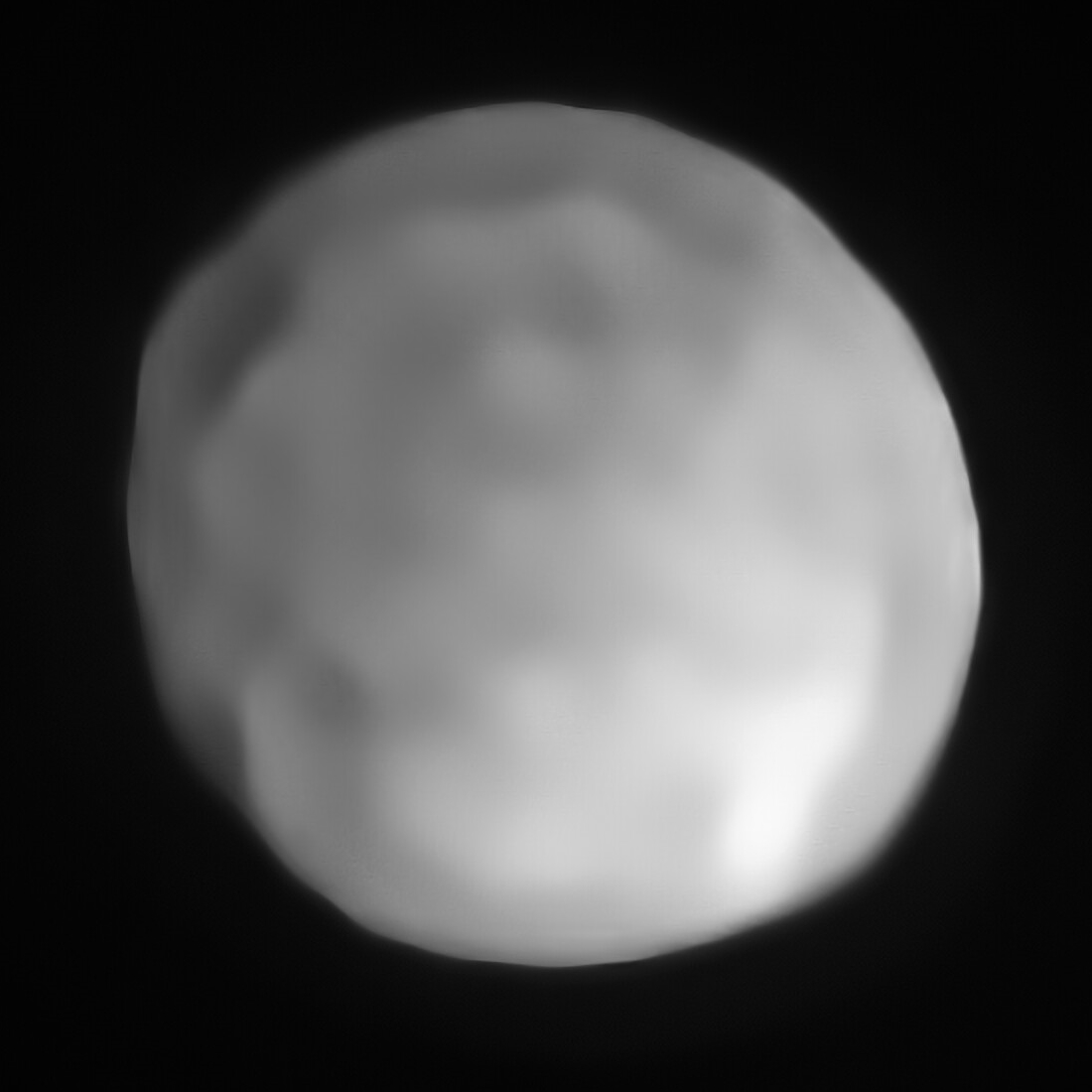
10 Hygiea is a large asteroid in the outer region of the main asteroid belt, between the orbits of Mars and Jupiter. It was the tenth known asteroid, discovered on 12 April 1849 by Italian astronomer Annibale de Gasparis at the Astronomical Observatory of Capodimonte in Naples, Italy. It was named after Hygieia, the Greek goddess of health. It is the fourth-largest main-belt asteroid by both volume and mass, with a mean diameter of 433 km (269 mi) and a mass constituting 3% of the main asteroid belt's total mass.
Hygiea has a nearly spherical shape, with two known craters about 100 and 180 km (62 and 112 mi) in diameter. Because of its shape and large size, some researchers consider Hygiea a possible dwarf planet. Hygiea has a dark, carbonaceous surface consisting of hydrated and ammoniated silicate minerals, with carbonates and water ice. Hygiea's subsurface likely contains a large fraction of water ice. These characteristics make Hygiea very similar to the main-belt dwarf planet Ceres, which suggests the two objects have similar origins and evolutionary histories.
Hygiea is the parent body of the Hygiea family, an asteroid family comprising over 7,000 known asteroids that share similar orbital and compositional characteristics with Hygiea. The Hygiea family is believed to have formed by a giant impact on Hygiea about 2 to 3 billion years ago. This impact is thought to have shattered Hygiea, which led to its reaccumulation as a nearly spherical body.
Hygiea was discovered on the evening of 12 April 1849 by Italian astronomer Annibale de Gasparis at the Astronomical Observatory of Capodimonte in Naples, Italy. On that night he was using the observatory's Reichenbach equatorial telescope to observe a section of the sky in the 12th hour of right ascension, as part of his larger project of cataloguing stars along the ecliptic up to the 14th apparent magnitude. While comparing his observations to the Berlin Academy's star chart, de Gasparis noticed a starlike object between magnitude 9 and 10 which was not recorded before. Although poor weather prevented further observations for a few days, de Gasparis reobserved the object on 14 and 17 April and confirmed it had moved between these dates.
Judging by how much the object had moved, de Gasparis concluded it must be another new planet between the orbit of Mars and Jupiter. De Gasparis announced his discovery to Erasmo Fabri Scarpellini, secretary of the Correspondenza Scientifica bulletin at Rome, Italy, who in turn passed on the news to Heinrich Christian Schumacher, who published it in the Astronomische Nachrichten journal on 11 May 1849. Hygiea was the first asteroid discovered by de Gasparis and the tenth asteroid discovered in history. He would later discover another six asteroids between 1850 and 1853 and two more during the 1860s.
De Gasparis invited Ernesto Capocci Belmonte, his friend and director of the Capodimonte Observatory, to assign a name to the asteroid as gratitude for his help and advice. Capocci suggested the name Igea—the Italian spelling of Hygieia, the Greek goddess of health and daughter of Asclepius. De Gasparis added the adjective Borbonica to Capocci's suggested name, to honor King Ferdinand II of the Bourbons of Naples who ruled the Kingdom of the Two Sicilies and supported the work of the Capodimonte Observatory. Together, de Gasparis and Capocci proposed the name Igea Borbonica ("Bourbon Hygieia") in a letter forwarded to Ferdinand II on 8 May 1849. De Gasparis's commemoration of the Bourbons may have helped him and Capocci circumvent punishment for their participation in the liberal movements of 1848.
The name Igea Borbonica was not mentioned in the first communications to the European scientific community. When English astronomer John Herschel received the news of Hygiea's discovery from his Neapolitan colleagues, he suggested that Parthenope would be an apt name for de Gasparis's discovery, as it comes from the siren who founded Naples in Greek mythology. In a letter written to English mathematician Augustus De Morgan in April 1849, Herschel wrote:
No name has yet been mentioned. What do you think of Parthenope (being a Neapolitan?) I should think it will occur as a matter of course to Gasparis if he has any classical reading.
Hub AI
10 Hygiea AI simulator
(@10 Hygiea_simulator)
10 Hygiea
10 Hygiea is a large asteroid in the outer region of the main asteroid belt, between the orbits of Mars and Jupiter. It was the tenth known asteroid, discovered on 12 April 1849 by Italian astronomer Annibale de Gasparis at the Astronomical Observatory of Capodimonte in Naples, Italy. It was named after Hygieia, the Greek goddess of health. It is the fourth-largest main-belt asteroid by both volume and mass, with a mean diameter of 433 km (269 mi) and a mass constituting 3% of the main asteroid belt's total mass.
Hygiea has a nearly spherical shape, with two known craters about 100 and 180 km (62 and 112 mi) in diameter. Because of its shape and large size, some researchers consider Hygiea a possible dwarf planet. Hygiea has a dark, carbonaceous surface consisting of hydrated and ammoniated silicate minerals, with carbonates and water ice. Hygiea's subsurface likely contains a large fraction of water ice. These characteristics make Hygiea very similar to the main-belt dwarf planet Ceres, which suggests the two objects have similar origins and evolutionary histories.
Hygiea is the parent body of the Hygiea family, an asteroid family comprising over 7,000 known asteroids that share similar orbital and compositional characteristics with Hygiea. The Hygiea family is believed to have formed by a giant impact on Hygiea about 2 to 3 billion years ago. This impact is thought to have shattered Hygiea, which led to its reaccumulation as a nearly spherical body.
Hygiea was discovered on the evening of 12 April 1849 by Italian astronomer Annibale de Gasparis at the Astronomical Observatory of Capodimonte in Naples, Italy. On that night he was using the observatory's Reichenbach equatorial telescope to observe a section of the sky in the 12th hour of right ascension, as part of his larger project of cataloguing stars along the ecliptic up to the 14th apparent magnitude. While comparing his observations to the Berlin Academy's star chart, de Gasparis noticed a starlike object between magnitude 9 and 10 which was not recorded before. Although poor weather prevented further observations for a few days, de Gasparis reobserved the object on 14 and 17 April and confirmed it had moved between these dates.
Judging by how much the object had moved, de Gasparis concluded it must be another new planet between the orbit of Mars and Jupiter. De Gasparis announced his discovery to Erasmo Fabri Scarpellini, secretary of the Correspondenza Scientifica bulletin at Rome, Italy, who in turn passed on the news to Heinrich Christian Schumacher, who published it in the Astronomische Nachrichten journal on 11 May 1849. Hygiea was the first asteroid discovered by de Gasparis and the tenth asteroid discovered in history. He would later discover another six asteroids between 1850 and 1853 and two more during the 1860s.
De Gasparis invited Ernesto Capocci Belmonte, his friend and director of the Capodimonte Observatory, to assign a name to the asteroid as gratitude for his help and advice. Capocci suggested the name Igea—the Italian spelling of Hygieia, the Greek goddess of health and daughter of Asclepius. De Gasparis added the adjective Borbonica to Capocci's suggested name, to honor King Ferdinand II of the Bourbons of Naples who ruled the Kingdom of the Two Sicilies and supported the work of the Capodimonte Observatory. Together, de Gasparis and Capocci proposed the name Igea Borbonica ("Bourbon Hygieia") in a letter forwarded to Ferdinand II on 8 May 1849. De Gasparis's commemoration of the Bourbons may have helped him and Capocci circumvent punishment for their participation in the liberal movements of 1848.
The name Igea Borbonica was not mentioned in the first communications to the European scientific community. When English astronomer John Herschel received the news of Hygiea's discovery from his Neapolitan colleagues, he suggested that Parthenope would be an apt name for de Gasparis's discovery, as it comes from the siren who founded Naples in Greek mythology. In a letter written to English mathematician Augustus De Morgan in April 1849, Herschel wrote:
No name has yet been mentioned. What do you think of Parthenope (being a Neapolitan?) I should think it will occur as a matter of course to Gasparis if he has any classical reading.
Recent media