


Community hub
Recent from talks
Contribute something
Nothing was collected or created yet.
12AU7
View on Wikipedia| 12AU7 | |
|---|---|
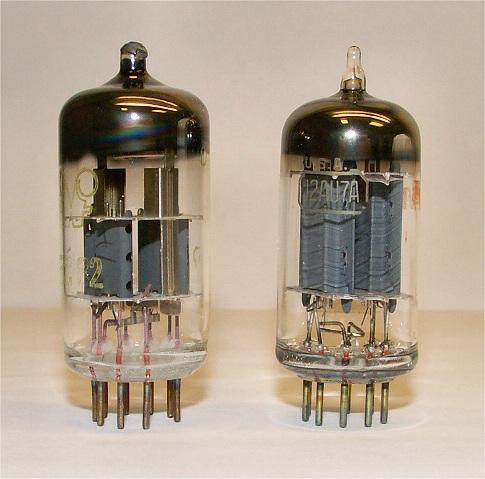
 RFT "thin-plate" ECC82 variant (left), RCA 12AU7A variant (right) | |
| Classification | Dual Triode |
| Service | Audio amplifiers and TV receivers |
| Height | 2+5⁄8 in (67 mm) |
| Diameter | 7⁄8 in (22 mm) |
| Cathode | |
| Cathode type | Coated Unipotential |
| Heater voltage | Series / Parallel 12.6 / 6.3 V |
| Heater current | Series / Parallel 150 / 300 mA |
| Anode | |
| Max dissipation Watts | 2.75 W per section |
| Max voltage | 300 V |
| Max current | 20 mA (maximum) |
| Socket connections | |
 | |
| References | |
| http://www.thetubestore.com/lib/thetubestore/eh-12au7eh.pdf | |
The 12AU7 and its variants are miniature nine-pin (B9A base) medium-gain dual-triode vacuum tubes. It belongs to a large family of dual-triode vacuum tubes which share the same pinout (RETMA 9A). 12AU7 is also known in Europe under its Mullard–Philips tube designation ECC82.[1] There are many equivalent tubes with different names, some identical, some designed for ruggedness, long life, or other characteristics; examples are the US military 5814A and the European special-quality ECC802 and E82CC.
The tube is popular in hi-fi vacuum tube audio as a low-noise line amplifier, driver (especially for tone stacks), and phase-inverter in vacuum tube push–pull amplifier circuits. It was widely used, in special-quality versions such as 5814A, in pre-semiconductor digital computer circuitry. Use of special-quality versions outside of the purpose they were designed for may not be optimal; for example, a version for digital computers may be designed for long life without cathode poisoning when mostly switched to low-current mode in switching applications, but with little attention to parameters of interest only for linear applications such as linearity of transfer characteristic, matching between the two sections, microphony, etc.
This tube is essentially two 6C4/EC90s in the same envelope. However, this latter type is officially described in manufacturer's data as "a special quality R.F. power amplifier or oscillator for frequencies up to 150 MHz".[2] The 12AU7, on the other hand, is described as an "A.F. double triode".[3] Data sheets suggest an upper frequency limit of 30 kHz for the 12AU7/ECC82 and it is not described as a "special quality" device. [4] This contrasts with the 6AB4/EC92 and 12AT7/ECC81 which are both R.F. devices operating up to VHF.
Double triodes of the 12AU7 family have a center-tapped filament for use in either 6.3V 300mA or 12.6V 150mA heater circuits.
It was also widely used in television applications, mostly as line timebase oscillator, frame timebase oscillator, in some cases as gated automatic gain control, synchronisation separator, limiter, or, in some later colour sets, as relay tube, to turn off high voltage tube driver in case one of line failure or frame failure, to protect the picture tube, in the case of television where high voltage was generated separate from the line timebase.
As of 2012[update] the 12AU7 continued to be manufactured in Russia, Slovakia (JJ Electronic), and China.

See also
[edit]References
[edit]- ^ "www.thetubestore.com - 12AU7 / ECC82 Tube Types". www.thetubestore.com.
- ^ Tung-sol Data sheet for 6C4/EC90 dated December 1968
- ^ Tung-sol Data sheet for 12AU7/ECC82 dated August 1950
- ^ Brimar application report VAD/513.4 for 12AU7/ECC82 dated January 1952 gives a gain of -1 to -2 dB at 30 kHz
External links
[edit]- 12AU7 datasheet from the RCA RC-29 Receiving Tubes Manual (NJ7P Tube Database)
- Several tube datasheets
- Reviews of 12au7 tubes.
- [1] (JJ Electronic ECC82 Datasheet)
12AU7
View on GrokipediaIntroduction
Overview
The 12AU7 is a miniature nine-pin (B9A base) medium-gain dual-triode vacuum tube, designed as a general-purpose medium-mu twin triode for use in electronic circuits.[8] It features two independent triode sections within a single envelope, enabling applications such as voltage amplification, phase inversion, and signal processing in audio, radio, and television equipment.[8] The tube operates with a center-tapped heater rated for 6.3 V or 12.6 V, making it suitable for series heater strings in multi-tube circuits.[3] Developed by RCA and introduced in 1946, the 12AU7 marked an early adoption of the noval base design, replacing larger octal-based dual triodes like the 6SN7 in compact applications.[3] Its medium amplification factor of approximately 17 provides balanced performance for tasks requiring moderate gain without excessive distortion.[8] The 12AU7 belongs to RCA's 12A_7 series of miniature dual triodes, which includes variants like the high-mu 12AX7 and the medium-high-mu 12AT7, offering a range of gain options for preamplifier and driver stages in amplification systems.[3]Nomenclature and Designations
The 12AU7 designation follows the RETMA (Radio Electronics Television Manufacturers Association, formerly RMA) numbering system established for American vacuum tubes in the mid-20th century to standardize identification based on key electrical and physical characteristics. In this system, the leading numerals "12" denote a heater voltage of 12.6 volts when connected in series or 6.3 volts in parallel via the center-tapped filament, enabling compatibility with both AC and DC receiver circuits.[1][9] The letters "AU" form a sequential type code in the RETMA system for this medium-mu (amplification factor of approximately 17) twin triode. The trailing numeral "7" refers to the nine-pin miniature (noval) base, a compact B9A socket type that became standard for post-World War II receiving tubes to reduce size and improve manufacturability.[10][4] Internationally, the tube is designated as ECC82.[1] Prior to standardization, early prototypes of the 12AU7 were developed under RCA's internal designation A4498, an all-glass dual triode initiated on November 27, 1945, and completed by April 3, 1946, as a compact replacement for octal-based types like the 6SN7 and 12SN7. The commercial name 12AU7 was officially registered with the RMA on April 17, 1946, marking its introduction as the first production tube with the noval base, with full production scaling to 10,000 units per month by September 1946. It appeared in consumer catalogs, such as Allied Radio's January 1947 edition, solidifying the RETMA code as the primary identifier.[3] For military and industrial applications, the 12AU7 received Joint Army-Navy (JAN) specifications post-introduction, with equivalents like the JAN-5814 (a balanced-section variant for computers) and JAN-6189 (ruggedized for high-vibration environments) adopted starting in 1947 when the tube was added to the Preferred List of Army-Navy Electron Tubes on January 28. These JAN designations ensured compliance with military standards for reliability, while retaining electrical equivalence to the commercial 12AU7; no earlier VT-series (Vacuum Tube) codes from World War II apply, as the tube postdates that era. An industrial variant, the 5963, was later specified for computer use, reflecting adaptations within the same nomenclature framework.[3][11]History
Development and Introduction
The 12AU7 vacuum tube was developed by the Radio Corporation of America (RCA) in the mid-1940s, specifically as part of the postwar transition from larger metal and glass-enclosed tubes to compact, all-glass miniature designs.[3] Development began on November 27, 1945, under RCA's internal project code A4498, with the commercial type designation reserved on April 17, 1946, and completion achieved by April 3, 1946, following intensive engineering efforts by RCA's tube division to adapt dual-triode technology for smaller form factors.[3] No specific individual inventors are credited in historical records, but the work stemmed from RCA's broader team advancements in vacuum tube miniaturization, building on earlier 7-pin miniature tubes introduced in 1939 for portable battery-operated radios.[3][4] Key motivations for the 12AU7's creation included the need for miniaturization to support emerging portable radios and televisions, as well as reduced power consumption to enable AC/DC operation in consumer electronics following World War II.[3] The tube featured a noval B9A 9-pin base, introduced by RCA in mid-1945, which eliminated bulky octal connectors and allowed for more compact circuit designs, aligning with the industry's production of over 50 million miniature tubes by 1945.[3] As a medium-mu dual triode, it served as a direct successor to the larger octal-based 6SN7, offering similar amplification characteristics but in a smaller envelope with a center-tapped heater compatible with both 6.3 V and 12.6 V supplies for flexible power arrangements.[12][3] The 12AU7 was introduced commercially in 1946, with RCA announcing its development in October of that year and beginning large-scale shipments in January 1947.[13] By August 1946, 300 production samples were prepared, targeting an initial output of 10,000 units per month starting in September to meet postwar demand.[3] Official registration with the Radio Manufacturers Association (RMA) occurred on October 18, 1946, prior to a formal press release on October 8, 1946, by which time the tube appeared in catalogs like Allied Radio's, marking its entry into widespread use as a versatile preamplifier component.[3][2][14]Manufacturers and Production
The 12AU7 vacuum tube was primarily manufactured in the United States by major electronics firms including RCA, General Electric (GE), Sylvania, and Tung-Sol during its peak production years from the late 1940s through the 1970s.[3][4] RCA led the initial development and production starting in 1946, with GE joining as a second source in 1947 to support applications in television and industrial equipment.[3] Sylvania and Tung-Sol followed suit, producing significant volumes often rebranded for various applications, with RCA, GE, and Sylvania accounting for the majority of U.S. output regardless of labeling.[4][15] Internationally, production expanded to Europe and Japan beginning in the 1950s. In Europe, Philips and its subsidiary Mullard manufactured the electrically equivalent ECC82 variant, with Mullard producing high-quality units in Britain during the 1950s and 1960s.[15][16] Japanese firms such as Toshiba, Hitachi, and Matsushita (later Panasonic) entered production around the same period, creating durable versions noted for their build quality in consumer and professional audio gear.[1][17][18] Production of the 12AU7 reached its height in the 1950s and 1960s, driven by the postwar boom in consumer electronics like televisions and audio amplifiers, with initial U.S. output planned at 10,000 units per month by late 1946 and estimated sales growing to 80,000 units in the second year of availability.[3] Demand declined sharply in the 1970s as transistors and solid-state technology supplanted vacuum tubes in most applications, leading to the cessation of large-scale manufacturing by U.S. and European producers.[19][20] Today, new old stock (NOS) 12AU7 tubes remain widely available from surplus inventories of these original manufacturers, including RCA black-plate versions and Mullard ECC82s, as well as modern variants like Hewlett Packard short black plate NEC (Made in Japan), supporting ongoing use in audiophile and vintage equipment restoration.[21][15][22]Design and Construction
Physical Structure
The 12AU7 vacuum tube features a compact cylindrical form factor with a glass envelope that measures approximately 1.75 inches (44.5 mm) in height and 0.75 inches (19 mm) in diameter.[1] This miniature design facilitates integration into space-constrained electronics like audio amplifiers and receivers. The envelope is constructed from borosilicate glass, valued for its thermal stability, mechanical strength, and ability to withstand operational heat without deformation.[23] At the base of the tube is a B9A (noval) miniature nine-pin connector, a standard for post-World War II miniature tubes, enabling reliable electrical connections in socketed applications.[1] The base is typically molded from black or white plastic for insulation and durability, fitted with metal pins—often nickel-plated for corrosion resistance and conductivity.[4] Weighing around 0.5 ounces (14 grams), the 12AU7 is lightweight, which aids in easy installation but necessitates attention to mounting in vibration-prone settings such as mobile radios or high-output audio systems.[24] To mitigate microphonic effects from external vibrations, it is recommended to use isolated sockets, rubber dampers, or shock mounts that absorb mechanical stress and prevent resonance within the glass envelope.[25]Internal Components
The 12AU7 vacuum tube features a dual triode structure, incorporating two independent medium-mu triode sections within a single envelope, each with its own cathode, grid, and plate, while sharing a common indirectly heated filament.[26] The heater consists of a coiled tungsten wire, typically insulated with a high-purity alumina coating to prevent shorting and ensure efficient indirect heating of the cathodes at temperatures around 1100–1200°C.[27] The cathodes employ an oxide coating, primarily composed of barium and strontium carbonates applied to a nickel base, enabling thermionic electron emission for amplification. The grids are constructed from fine tungsten wire wound around supporting frames to control electron flow between the cathode and plate.[28] The plates, or anodes, are formed from nickel or nickel-plated steel, providing a semi-cylindrical or box-like structure to collect electrons while dissipating heat effectively in miniature designs.[29] The internal assembly utilizes an all-glass sealed envelope with rigid metal leads extending directly to the 9-pin miniature base pins, ensuring mechanical stability and vacuum integrity. A getter, often a metallic flash or ring, is incorporated to absorb residual gases and maintain the high vacuum necessary for reliable operation.[30] Later variants, such as the 12AU7-A, incorporate enhanced construction techniques, including rigid mica spacers and optimized electrode mounting, to achieve a low-microphonic design that minimizes vibration-induced noise in sensitive audio applications.[10]Technical Specifications
Electrical Characteristics
The 12AU7 is a medium-mu twin triode vacuum tube, featuring an amplification factor (μ) of 17 to 20 per triode section, which provides moderate voltage gain suitable for various amplifier stages.[31] Under typical class A amplifier operating conditions per triode—plate voltage of 250 V, grid bias of -2 V—the tube exhibits a plate current of 10.5 mA and transconductance (g_m) of 2.2 mA/V, with plate resistance (r_p) approximately 7.7 kΩ.[31] These parameters ensure balanced performance in low-distortion applications, as the plate characteristic curves demonstrate relatively linear operation across a range of grid biases, making the tube well-suited for audio frequency amplification.[10] The heater is rated for operation at 12.6 V AC or DC with a current of 0.15 A in series configuration (across pins 4 and 5, pin 9 unconnected), or alternatively at 6.3 V with 0.3 A in parallel configuration (across pins 4-9 and 9-5), allowing flexibility in power supply design.[4] Maximum ratings include a plate-to-cathode voltage of 300 V, grid-to-cathode voltage of -50 V (DC), plate dissipation of 2.75 W per triode (5.5 W total for both), and cathode current of 20 mA average (60 mA peak).[10] Exceeding these limits can lead to reduced tube life or failure, as specified in manufacturer guidelines.[32] In circuit analysis, the approximate voltage gain (A_v) for a common-cathode triode stage is calculated as: where μ is the amplification factor, R_L is the load resistance, and r_p is the plate resistance (approximately 7.7 kΩ under typical conditions).[31] This formula highlights the tube's efficiency in resistive-loaded configurations, with gain scaling based on load selection while maintaining low noise figures below 5 dB in audio applications.[4]Pin Configuration
The 12AU7 vacuum tube employs a nine-pin miniature construction (B9A noval base), with pins arranged in a circular pattern and numbered 1 through 9 in a clockwise direction when viewed from the bottom of the tube, starting adjacent to the indexing keyway or notch between pins 8 and 1.[10] This pinout configuration supports the dual-triode structure, where each triode section has dedicated connections for plate, grid, and cathode, along with shared heater terminals and a heater center tap.[33] The specific functions of each pin are as follows:| Pin | Function |
|---|---|
| 1 | Plate (anode) of triode 1 |
| 2 | Grid of triode 1 |
| 3 | Cathode of triode 1 |
| 4 | Heater (one terminal) |
| 5 | Heater (other terminal) |
| 6 | Grid of triode 2 |
| 7 | Cathode of triode 2 |
| 8 | Plate (anode) of triode 2 |
| 9 | Heater center tap |
Applications
Audio Amplifiers
The 12AU7 dual triode vacuum tube plays a key role in audio amplifiers, particularly as a phase inverter or splitter in push-pull output stages, where it provides balanced drive signals to the power tubes for improved linearity and reduced even-order harmonic distortion. This configuration leverages the tube's medium-mu characteristics and symmetrical design to split the input signal into out-of-phase components, ensuring efficient power transfer in Class AB or B amplifier circuits.[34][35] In hi-fi applications, the 12AU7 is favored for preamplifiers and phono stages due to its low-noise operation and cleaner sound profile compared to higher-gain tubes like the 12AX7, making it suitable for line-level signal handling where minimal coloration is desired. Its amplification factor of 17 allows for moderate voltage gain without introducing excessive distortion, supporting transparent audio reproduction in systems emphasizing fidelity.[36][37] Within guitar amplification, the 12AU7 can be used effectively as a driver stage in modified Fender and Marshall designs, delivering a clean, articulate tone by providing sufficient current drive while avoiding premature overdrive; this lower gain factor of 17 complements overdrive pedals by preserving headroom and preventing preamp saturation until higher signal levels are reached. In modern boutique amplifiers, the tube enhances tonal clarity and dynamic response in low-wattage setups.[38][37]Radio and Television Receivers
The 12AU7 vacuum tube served as a key component in intermediate frequency (IF) and detection stages of AM and FM radio receivers during the 1940s through 1960s, particularly in post-war designs where its dual-triode configuration enabled efficient signal processing. In AM radios, it functioned as a second detector and audio driver, converting modulated IF signals to audio while providing low-distortion amplification suitable for battery or AC/DC operation. For FM reception, the tube acted as a driver between the IF amplifier and ratio detector, enhancing limiter performance and quadrature detection in superheterodyne circuits.[39][4] In RCA Victor radio-phonograph combinations introduced after 1946, the 12AU7 amplified signals post-IF for both AM (540-1600 kHz) and FM (88-108 MHz) bands, supporting 5-6 watts of undistorted output. Its medium-mu characteristics, with an amplification factor of 17, allowed multi-stage configurations without overload, maintaining stability across varying input levels in consumer receivers. Additionally, the tube's 12.6 V heater option facilitated series-string operation in rugged AC/DC sets, where direct line connection demanded reliable filament performance under fluctuating voltages.[39][36][4] Within black-and-white television receivers of the era, the 12AU7 excelled in video amplification and synchronization circuits, amplifying high-frequency video signals while separating horizontal and vertical sync pulses for stable picture reproduction. As a first and second video amplifier, it boosted RF-detected video to drive kinescopes, with typical plate voltages around 110-166 V yielding 96 V peak-to-peak output at maximum contrast. In sync separator stages, one triode section clipped video to isolate sync components, while the other amplified them for oscillator control, ensuring lock-in during weak signals.[39][40] RCA Victor television models post-1946, including the 9T240 (KCS28 chassis) and 9TC245 (KCS34 chassis), employed the 12AU7 for dual video amplification to support 10-12 inch screens on 10BP4 and 12LP4 tubes, with cathode bias around -5 to -12 V for linear response. Philco TV chassis, such as those in 1950s consolette models, utilized the 12AU7 as the first video amplifier, where reversed pin connections in early production (pins 4/5 and 9) were corrected to optimize signal path integrity. Its medium gain prevented saturation in cascaded video stages, and inherent ruggedness—evident in low microphony and tolerance for 250 V plate operation—suited the high-reliability demands of AC/DC television sets.[39][41][10]Other Applications
The 12AU7 has been employed in various other electronic circuits, including oscillators and multivibrators for generating and shaping signals in instrumentation and timing applications. Its dual triode structure supports balanced operation in these roles, providing stability and low distortion. Additionally, rugged variants like the 5814 (a military equivalent of the 12AU7) were used in early computer systems during the 1950s for logic and amplification functions, valued for their reliability in high-vibration environments and tight manufacturing tolerances.[4]Variants and Equivalents
Domestic Variants
The 12AU7 represents the original domestic variant of the miniature medium-mu twin triode vacuum tube, registered by the Radio Electronics Television Manufacturers Association (RETMA) on October 18, 1946, and primarily developed by RCA for use in radio receivers, television sets, and audio amplifiers.[2] This version employs a standard filament warm-up profile, with a center-tapped heater operating at 6.3 volts (300 mA) in parallel or 12.6 volts (150 mA) in series, supporting parallel-series filament string configurations in consumer electronics of the era.[10] In the 1950s, the 12AU7A emerged as an upgraded domestic variant, incorporating a controlled cathode warm-up to enhance compatibility with series-string filament circuits common in AC/DC receiver designs, thereby improving filament current tolerance and reducing startup inconsistencies.[10] Additionally, the 12AU7A features construction modifications that result in a lower microphonic output compared to the original 12AU7, minimizing mechanical noise susceptibility in sensitive audio applications.[10] Electrically, the 12AU7A maintains equivalent maximum ratings and characteristics to the 12AU7, including a maximum plate voltage of 300 volts per section and amplification factor of 17.[10] The 5814 is a military-grade equivalent to the 12AU7A, offering enhanced ruggedness and reliability for use in vibration-prone environments such as military communications and instrumentation.[42] It shares the same electrical parameters but features reinforced construction for improved shock and vibration resistance.[42] The 5963, a low-noise variant, is designed for precision applications requiring minimal microphonics, such as high-fidelity audio preamplifiers and test equipment.[43] It matches the standard 12AU7 specifications with improved stability and reduced hum. The 6189, also known as the 12AU7WA, is a ruggedized industrial variant designed for demanding U.S. military and high-vibration environments, such as airborne equipment and mobile communications systems.[44] Introduced as a special-quality tube, it shares the core electrical parameters of the 12AU7 family but includes reinforced internal structures, including a more robust cathode and glass envelope, to ensure operational reliability under shock and vibration exceeding standard consumer tubes.[45] This variant was qualified for critical applications where dependability is paramount, with typical uses in phase inverters and oscillators in military hardware.[44]International Equivalents
The ECC82 serves as the primary European equivalent to the 12AU7, developed under the Mullard-Philips naming convention for use in low-frequency voltage amplification applications. It is electrically identical to the 12AU7, featuring an amplification factor (mu) of 17, a maximum plate voltage of 300 V, and a heater rating of 6.3 V at 300 mA or 12.6 V at 150 mA.[46] British military designations include the CV4003 and CV491, both special-quality versions of the ECC82/12AU7 designed for enhanced reliability in demanding environments. These tubes incorporate rugged construction for improved vibration resistance and extended operational life, often rated at over 10,000 hours compared to the standard 5,000 hours of commercial variants. They maintain the same pinout and electrical parameters as the 12AU7, including a transconductance of 1.7–2.2 mA/V and plate dissipation of 2.75 W per triode, making them direct drop-in replacements.[47][48] In Eastern Europe, the B329 designation, produced by manufacturers like Tesla in Czechoslovakia, functions as a direct pin-compatible substitute for the 12AU7 with minor variations in plate material for cost efficiency and local production standards.[49] These tubes exhibit similar performance characteristics, such as an amplification factor of 17 and heater current of 300 mA at 6.3 V, though some versions feature slightly different getter designs affecting vacuum stability. Japanese production in the 1960s included high-quality versions of the 12AU7 by manufacturers like Toshiba, noted for superior build quality and low microphonics in phase inverters and drivers for hi-fi equipment.[50]| Equivalent | Origin | Key Features |
|---|---|---|
| ECC82 | Europe (Mullard/Philips) | Identical electricals; mu=17; max plate 300 V. |
| CV4003/CV491 | UK (Military) | Ruggedized; 10,000+ hour life; vibration-resistant. |
| B329 | Czechoslovakia (Tesla) | Pin-compatible; minor plate differences; industrial focus. |
| 12AU7 (Toshiba) | Japan | High build quality; low microphonics for audio. |
Comparisons
With 12AX7
The 12AU7 is a medium-gain dual triode with an amplification factor (mu) typically ranging from 17 to 20, in contrast to the high-gain 12AX7, which has a mu of 100.[51][52] This significant difference positions the 12AU7 for use in driver stages where moderate amplification is needed, while the 12AX7 is preferred for preamplifier gain stages requiring high voltage amplification.[51][52] The 12AU7 demonstrates lower distortion and superior linearity compared to the 12AX7, making it better suited for applications demanding clean signal reproduction.[36] In addition, the 12AU7 has a higher plate resistance of approximately 7.7 kΩ versus the 12AX7's 62.5 kΩ, which affects circuit loading and bandwidth but contributes to its cleaner performance in low-distortion roles.[51][52] Direct substitution of a 12AU7 in place of a 12AX7 is feasible in many circuits due to their shared 9-pin miniature base and similar heater requirements, but it reduces overall gain by a factor of about 5, potentially underperforming in high-mu designs optimized for the 12AX7's characteristics.[36][51]| Parameter | 12AU7 Typical | 12AX7 Typical |
|---|---|---|
| Amplification Factor (μ) | 17–20 | 100 |
| Transconductance (gm, micromhos) | 2200 | 1600 |
| Plate Resistance (rp, kΩ) | 7.7 | 62.5 |
With 12AT7
The 12AU7 and 12AT7 are both miniature dual-triode vacuum tubes sharing the same 9-pin base and heater requirements, allowing for potential interchangeability in certain circuits, though their differing electrical parameters lead to distinct roles in amplification. The 12AU7 has an amplification factor (μ) of 17 to 20, considerably lower than the 12AT7's μ of 60, positioning the 12AU7 for low-level buffering applications where minimal gain is desired, while the 12AT7 excels in intermediate amplification stages requiring higher voltage gain.[35][54] In terms of current handling, the 12AU7 supports a higher plate dissipation of 2.75 W per triode compared to the 12AT7's 2.5 W per triode, enabling the 12AU7 to manage greater power levels in driver or output-related tasks without excessive heat buildup.[35][54] This difference contributes to overlapping uses in audio and RF circuits, but the 12AU7's lower gain often results in reduced distortion at the expense of overall amplification. Substitution between the 12AU7 and 12AT7 is feasible in some phase splitter configurations due to their compatible pinouts, but it typically alters circuit balance owing to the threefold gain disparity, potentially requiring bias adjustments to maintain performance.[37] In audio applications, the 12AU7 substitution yields a softer sound character, attributed to its lower gain and higher current capability, which reduces harshness in signal processing.[4]| Parameter | 12AU7 | 12AT7 |
|---|---|---|
| Amplification Factor (μ) | 17–20 | 60 |
| Transconductance (g_m) | 2.2 mS | 5.5 mS |
| Plate Dissipation (per triode) | 2.75 W | 2.5 W |