Hubbry Logo
16 mm scale16 mm scaleMain
Open search
16 mm scale
Community hub
16 mm scale
logo
8 pages, 0 posts
0 subscribers
Be the first to start a discussion here.
16 mm scale
16 mm scale
from Wikipedia
16 mm scale
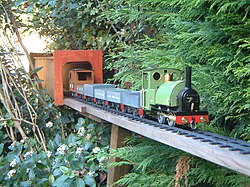
Modified Mamod live steam locomotive and train on a garden railway layout
Scale16 mm to 1 foot
Scale ratio1:19.05
Model gauge32 mm (1.26 in)
Prototype gauge2 ft (610 mm)

16 mm to 1 foot or 1:19.05 is a popular scale of model railway in the UK which represents narrow gauge prototypes.[1] The most common gauge for such railways is 32 mm (1.26 in), representing 2 ft (610 mm) gauge prototypes. This scale/gauge combination is sometimes referred to as "SM32" (terminology popularised by Peco, one of the principal manufacturers of appropriate track)[1] and is often used for model railways that run in gardens, being large enough to easily accommodate live steam models. The next most common gauge is 45 mm (1.772 in),[2] which represents the theoretical non-existent gauge 2 feet 9+34 inches (857 mm). This gauge is commonly used to portray prototypes between 2 ft 6 in (762 mm) and 3 ft (914 mm) gauge.

Overview

[edit]

There are a number of commercial manufacturers of 16 mm scale models[3] as well as many enthusiastic amateurs who build their own rolling stock. Because real 2 ft (610 mm) railways were most commonly found in the UK, many of the models are of British prototypes. European and North American narrow gauge railways are also modeled in this scale, mainly with scratch-built or kit-built models.

Although models of approximately this scale were being built as early as the 1930s, it was the founding of the Merioneth Railway Society just after the Second World War that marks the popularization of this scale.

This set the light-hearted spirit of the 16 mm fraternity, where a sense of fun and whimsy often override more serious concerns. The use of live steam as the predominant motive power of the models means absolute scale reproduction is often sacrificed to the demands of steam engineering at this scale. However the realistic sound, smell and visual effects of steam-driven locomotives makes up for loss of fidelity elsewhere. Driving a live steam locomotive, even at this small scale is very different from driving an electrically powered model.

For many years there were no commercially available parts, and everything was hand-built or kit-bashed from O scale components. In the 1968[4] Archangel emerged as the first commercial manufacturer on a large scale, followed by Merlin and Beck at the end of 1970s. All three companies produced affordable live steam locomotives in this scale. In 1981, Mamod entered the market with a cheap if somewhat crude steam loco for the UK market. Although not perfect, the low cost opened the hobby to a much wider range of people and as a result demand for other products grew. Roundhouse enjoys a large share of the market as builders of high quality live steam locomotives and suppliers of parts for home builders. A group of professional and hobbyist makers have emerged to meet this demand. Accucraft UK have built high quality live steam models of locomotives of the Talyllyn Railway, the Lynton & Barnstaple, and Welshpool & Llanfair.

Manufacturers

[edit]
Mamod 16 mm gauge live steam railway.

The Useful Links page in the 16mm Association web site has an extensive list of active traders. The list below includes traders who were significant in the hobby at one stage but are no longer active.

See also

[edit]
[edit]

References

[edit]
Revisions and contributorsEdit on WikipediaRead on Wikipedia
from Grokipedia
16 mm scale is a popular modeling scale in the field of narrow gauge railway modeling, where 16 millimeters on the model represents one foot in prototype dimensions, yielding a scale ratio of approximately 1:19. It is predominantly used to replicate two-foot gauge railways, such as those historically operated in the UK and other regions, and is often implemented on 32 mm gauge track known as SM-32. This scale is especially favored for outdoor garden layouts, where enthusiasts construct extensive networks that can accommodate both clockwork and live steam locomotives powered by real steam. The Association of 16mm Narrow Gauge Modellers, with a worldwide membership exceeding 4,000, supports the hobby through events, publications, and resources, promoting accessibility for modelers of all ages and abilities. Common prototypes include iconic lines like the Talyllyn Railway, Lynton & Barnstaple Railway, and Welshpool & Llanfair Light Railway, with models featuring detailed locomotives such as the Baldwin 2-6-2T or Bagnall 0-4-0T. While primarily associated with British and European narrow gauge, the scale has inspired global adaptations, including custom-built rolling stock and scenic elements that enhance immersive outdoor experiences.

History and Development

Origins in the UK

The 16 mm scale began to emerge in the United Kingdom during the 1950s as a practical choice for modeling 2-foot (610 mm) gauge narrow railways, drawing significant inspiration from historic Welsh prototypes such as the Festiniog Railway. While isolated experiments with similar scales dated back to the interwar period, the decade saw increased interest through publications showcasing viable models of these compact lines, often operated on garden layouts to capture the essence of industrial narrow gauge operations. Pioneering modelers played a crucial role in establishing the scale's foundations. Alan Pratt and Brian Rogers were among the earliest prominent adopters, publishing detailed articles in Model Railway News between 1959 and 1961 that described their clockwork-driven replicas of Welsh narrow gauge locomotives and stock, including electric variants and freelance designs based on existing mechanisms. Concurrently, members of the Model Railway Club's narrow gauge section, such as David Newham and Roger Marsh, constructed intricate 16 mm models inspired by the Festiniog and Talyllyn railways, using 32 mm gauge track to represent the 2-foot prototypes; Marsh, for instance, built caricatures of early Festiniog "England" class locomotives powered by 12-volt motors sourced from specialist suppliers. These individual efforts fostered a community focused on accurate representation of Britain's preserved narrow gauge heritage. Publications were instrumental in promoting 16 mm scale among enthusiasts. Model Railway News featured Newham's series on Glyn Valley Tramway carriages in the late 1950s and Pratt and Rogers' multi-part accounts, providing blueprints, construction techniques, and operational insights that encouraged replication and refinement. This media exposure helped transition the scale from niche experimentation to a recognized approach for modeling compact, scenic narrow gauge lines. By the 1960s, the availability of ready components marked a pivotal shift from exclusive scratch-building to more accessible modeling. Suppliers like Bonds of Euston Road offered coarse-scale O gauge brass rail and electric motors compatible with 16 mm proportions, enabling broader participation without advanced fabrication skills; early adopters integrated these into custom assemblies for locomotives and trackwork. This development, alongside the formation of groups like the Merioneth Railway Society in 1962—which required prospective members to produce a 16 mm model for admission—solidified the scale's UK origins as a dedicated forum for 2-foot gauge simulation.

Evolution and Standardization

The Association of 16 mm Narrow Gauge Modellers was formally incorporated in 1995 as a pivotal body dedicated to promoting and standardizing narrow gauge modeling in the 14-16 mm to the foot scales, providing a centralized resource for enthusiasts amid the hobby's growing interest in outdoor and live steam applications. This organization emerged from early UK efforts in the post-war period, uniting modellers who sought shared standards for construction, operation, and events, which helped formalize practices and foster community growth beyond informal groups. By establishing guidelines for modular layouts and compatible components, the Association played a key role in making 16 mm scale accessible for garden railways worldwide. The 1:19 scale ratio (approximately equivalent to 16 mm to the foot) ensures consistency with imperial prototype measurements of narrow gauge railways, particularly those around 2-foot gauge, and is used on 32 mm track. This ratio prevailed in core UK circles for its fidelity to historical 2-foot gauges. This standardization, supported by the Association's publications and events, reduced compatibility issues and encouraged broader participation. Advancements in live steam technology during the 1990s significantly boosted 16 mm scale's popularity, particularly in garden railways, as manufacturers introduced more reliable, user-friendly boilers and gas-fired locomotives suitable for outdoor operation. Building on 1970s revivals like Archangel Models' designs, these innovations lowered barriers to entry, enabling modellers to run realistic steam-powered trains without advanced engineering skills, and expanded the hobby's appeal internationally through imported components and shared designs. The Association's promotion of live steam events further solidified its role in the scale's evolution, attracting new members and integrating the hobby with gardening practices.

Scale Specifications

Ratio and Representation

The 16 mm scale in model railroading employs a ratio of 16 mm to 1 foot, equivalent to approximately 1:19.05, which provides a practical size for modeling narrow-gauge railways in garden or outdoor layouts while maintaining sufficient detail for visual appeal. This scale was selected to represent prototypes with track gauges around 2 feet (610 mm), allowing models to use readily available 32 mm gauge track, which scales to this prototype dimension at the 1:19.05 ratio. In 16 mm scale, real-world narrow-gauge lines are faithfully reproduced, such as the UK's Talyllyn Railway and Ffestiniog Railway, both operating at approximately 2 feet gauge, where model track at 32 mm directly corresponds to these prototypes' dimensions. Other European narrow gauge lines are also modeled, adapted to similar gauges using 32 mm or 45 mm track, enabling modelers to capture the compact, rugged aesthetics of these systems without excessive miniaturization. A common variation is SM32, denoting 16 mm scale (SM) on 32 mm gauge track, which offers flexibility for both indoor tabletop setups and larger outdoor installations by balancing portability with realistic proportions. This configuration is particularly suited to British 2-foot prototypes, though it can represent slight gauge deviations with minor adjustments.

Track Gauges and Compatibility

In 16 mm scale modeling, the primary track gauges are 32 mm (designated SM32) and 45 mm (designated SM45). The 32 mm gauge represents a prototype narrow gauge of 2 feet (610 mm), making it the most common choice for British prototypes such as those on the Ffestiniog or Talyllyn railways. In contrast, the 45 mm gauge represents prototypes of 2 feet 6 inches (762 mm) or up to 3 feet (914 mm), suitable for slightly wider narrow gauge systems like estate or industrial lines. These gauges allow flexibility in depicting historical British narrow gauge railways, with SM32 dominating garden and outdoor layouts due to its origins in adapting existing O gauge track. Compatibility with other modeling systems enhances the versatility of 16 mm scale. SM32 track shares the 32 mm gauge with O gauge (1:43.5 scale standard gauge), permitting 16 mm narrow gauge models to run on O gauge infrastructure for hybrid layouts that mix scales and prototypes. Similarly, SM45 track aligns with 1 gauge (45 mm, often 1:32 scale for standard gauge), enabling shared use with Gauge 1 systems and allowing narrow gauge 16 mm models to operate alongside larger standard gauge representations. This cross-compatibility supports creative setups, such as dual-gauge tracks in garden railways, though scale differences may affect visual harmony. The Association of 16 mm Narrow Gauge Modellers establishes standards for track construction to ensure interoperability and realism. These include recommendations for rail profiles like code 200 bullhead rail, which provides appropriate weight and appearance for outdoor use while maintaining compatibility with standardized wheels. Finer profiles, such as code 148 or adapted code 100 equivalents, are suggested for indoor or high-fidelity layouts, emphasizing clearances and sleeper spacing to mimic prototype narrow gauge practices. These guidelines promote reliable operation across member-built modules and exhibitions.

Modeling Techniques

Locomotive Construction

In 16 mm scale modeling, locomotive construction typically begins with kits assembled from resin or metal components, which provide pre-formed chassis, boilers, and bodywork for relative ease of assembly. These kits often require soldering or gluing of white metal or etched nickel silver parts, allowing modelers to achieve fine details like valve gear and cab interiors without starting from scratch. For more customized builds, scratch-building using brass sheet and rod is a traditional approach, involving fabrication of structural elements with tools like a jeweler's lathe for axles and wheels, as detailed in specialist guides from the 16mm Association. Since the 2010s, 3D printing has emerged as a popular method for producing bespoke parts such as smokebox details or custom couplings, enabling rapid prototyping with accessible desktop printers and resins compatible with the scale's 1:19 ratio. Power systems in 16 mm scale locomotives vary to suit garden or indoor layouts, with battery-electric drives being the most common for their simplicity and reliability. These systems employ DC motors powered by rechargeable nickel-metal hydride or lithium-ion batteries, often controlled via radio or trackside pickups, offering smooth operation for models up to several kilograms in weight. Live steam propulsion, exemplified by gas-fired boilers, replicates full-size narrow-gauge engines and requires careful construction of butane or propane burners integrated into the chassis for sustained runs of 20-30 minutes. Clockwork mechanisms, though less prevalent today, persist in some heritage-style models for short demonstrations, using spring-loaded drives wound by key. Safety guidelines for live steam models, mandated by organizations like the Association of 16mm Narrow Gauge Modellers, emphasize pressure vessel certification, leak testing, and operation away from flammable materials to prevent accidents. Iconic prototypes like the Kerr Stuart Wren class locomotive, a 0-4-0ST design from early 20th-century British narrow gauge, are frequently modeled in 16 mm scale for their compact size and historical appeal. Builders focus on realism by adding details such as sprung axles for better track adhesion, painted weathering effects to mimic coal dust and oil stains, and functional whistle mechanisms using compressed air reservoirs. Kits for the Wren, available from producers like Station Road Models, include etched brass for the frames and resin for the bunker, with tips from modeling forums stressing the importance of aligning the pony truck for stability on uneven garden tracks.

Rolling Stock and Scenery

In 16mm scale modeling, rolling stock encompasses a variety of non-powered vehicles tailored to narrow gauge prototypes, including open wagons for general freight, bogie coaches for passenger transport, and specialized slate trucks used in quarry operations. These types draw inspiration from historical UK lines like the Penrhyn Quarry Railway, where slate wagons featured tipping mechanisms and wooden underframes for efficient loading. Construction emphasizes lightweight materials to facilitate operation on outdoor garden layouts, with common choices including laser-cut plywood for structural frames and plasticard for detailing panels and sides. For instance, bogie coaches are often built using layered plywood sheets to replicate full-scale depth while keeping weight low, supplemented by white-metal castings for axleguards and brass components for hardware like door handles. Open wagons and slate trucks similarly employ wood or plasticard for bodies, allowing easy scratch-building or kit assembly suited to the rigors of garden use. Scenery for 16mm scale garden railways prioritizes durable, authentic elements to evoke industrial narrow gauge environments, frequently incorporating real stone for features like tunnel portals and retaining walls. Real wood is also utilized for structures such as bridges and sheds, providing natural weathering over time that enhances realism in outdoor settings. For detailed terrain, techniques like dry stone walling involve laying modeled stones without mortar, often starting with a PVA-glued base course and building upward with through-stones for stability. Weathering methods, such as dry-brushing, are essential for achieving the aged, industrial vibe of narrow gauge operations; this involves applying light layers of acrylic paints—like weathered stone and khaki over a base coat—to highlight textures on walls, wagons, and tracks without obscuring details. Additional washes in black or brown accent cracks and dirt accumulation, simulating exposure to quarry dust and rain. Layouts integrate 1:19 scale figures and accessories to populate scenes, with resin-printed models depicting workers, passengers, and quarry personnel at approximately 90mm height for adults. These are often 3D-scanned from real people for lifelike poses, complementing rolling stock and scenery in garden environments.

Manufacturers and Products

UK-Based Producers

Mamod, established in Birmingham in 1937 by Geoffrey Malins, pioneered affordable live steam garden railway sets in the UK, entering the 16mm scale market in 1979 with the SL-1 locomotive and associated rolling stock designed to represent 2-foot narrow gauge prototypes. These early offerings featured oscillating cylinder engines powered by solid fuel tablets for safety, evolving through the 1980s and 1990s with expanded ready-to-run and kit options in 32mm and 45mm gauges, including special editions that catered to British narrow gauge enthusiasts. By the 2000s, Mamod had refined its designs for greater reliability, incorporating upgrades like gas-fired burners, though production ceased in August 2024 due to the ban on hexamine fuel used in solid fuel tablets. Peco, founded in 1946 and based in Beer, Devon, has been a cornerstone of UK model railway infrastructure since the 1960s, introducing its Streamline range of flexible and sectional track suitable for 16mm scale (SM-32) modeling on wooden sleepers. From the 1970s onward, Peco expanded its 16mm offerings to include points, crossings, and accessories compatible with garden railways, emphasizing durable, realistic construction for outdoor use. The company's track systems, produced in-house, supported the growth of 16mm layouts by providing scalable components that integrated with kits from other UK producers, maintaining a focus on precision engineering into the present day. Specialist kit producers like Wrightscale, operating since 1982 from the UK, have focused on etched brass kits for British narrow gauge prototypes, including Kerr Stuart Wren and Tattoo locomotives, Bagnall 0-4-0 tanks, and Hunslet quarry tanks drawn from original works plans. Similarly, IP Engineering, based in Lincolnshire, offers etched and ply-based kits of Talyllyn Railway wagons and coaches, such as 3-plank opens and goods vans, capturing the preserved railway's heritage in 16mm scale with included scale wheels and metal fittings. These firms emphasize fine-scale accuracy for modellers building authentic representations of UK industrial railways. The evolution of UK 16mm production in the 2000s marked a shift toward advanced manufacturing, with producers adopting laser-cut plywood and CNC-machined components for enhanced precision and ease of assembly in kits. Companies like Accucraft UK integrated these methods into live steam locomotives, such as the EM Baldwin diesel and Peckett 0-4-0ST based on Somerset & Dorset prototypes, combining 3D printing with traditional etching for detailed, durable models. This transition improved accessibility for hobbyists, reducing build times while preserving the intricate detailing essential to British narrow gauge replicas.

International Suppliers

Outside the United Kingdom, European manufacturers have significantly contributed to the 16mm scale market, particularly through high-quality live steam locomotives. Regner Modellbahnen, based in Germany, specializes in detailed, gas-fired live steam models such as the Niklas and Paul series, designed for 32mm or 45mm gauge tracks and popular among narrow gauge enthusiasts for their precision engineering and European prototypes. These models emphasize realistic operation, including features like safety valves and lubricators, and are distributed internationally via specialist retailers. Accucraft, operating with a hybrid UK-US presence, serves as a key importer and distributor of 16mm scale products, including live steam locomotives from both domestic and overseas sources. Their range features adjustable-gauge models like the Talyllyn Railway No. 3 "Sir Haydn," which draw on international designs while supporting global shipping to markets in North America and beyond. This cross-border approach has broadened access to compatible rolling stock and accessories, often sourced from German and Australian collaborators. Asian suppliers have introduced innovative and affordable options to the 16mm scale scene, with Japanese firm Aster Hobby renowned for its exquisite live steam locomotives adaptable to narrow gauge setups. Models such as the Decauville 0-6-0T showcase advanced features like working valve gear, appealing to collectors seeking high-fidelity representations of international prototypes. Emerging in the 2010s, production from Chinese facilities has further democratized the hobby by offering budget-friendly ready-to-run items and kits, often customized for 16mm via online marketplaces. Globalization, accelerated by e-commerce platforms like eBay, has enabled seamless imports of these international products, fostering a vibrant secondary market for custom and second-hand 16mm scale items worldwide. This accessibility contrasts with earlier reliance on UK manufacturing, allowing hobbyists to source diverse suppliers without geographical constraints.

Communities and Resources

Associations and Clubs

The Association of 16mm Narrow Gauge Modellers, founded in 1977 as an unincorporated group before incorporating in 1995, is the primary UK-based organization supporting enthusiasts of 16mm scale narrow gauge railway modeling, with a worldwide membership exceeding 4,000. It provides key benefits including the quarterly journal 16mm Today, a members' bulletin, public liability insurance covering up to £5 million per incident for UK and European members, and access to technical advice via online resources and a dedicated forum. The association extends internationally through affiliated groups, such as its North America Group, which coordinates activities for members across the United States and Canada, fostering cross-continental collaboration in garden railway projects. Regional clubs, including the East Midlands 16mm Group and West Midlands 16mm Group, organize regular meetups at members' layouts for running trains, exchanging ideas, and hands-on demonstrations, helping to build local communities within the hobby. These organizations emphasize education and safety, particularly for newcomers, by offering guidance on constructing and operating live steam locomotives through area group sessions, boiler testing protocols, and introductory resources that stress safe practices like pressure management and liability awareness. Such initiatives ensure accessible entry into the scale while promoting responsible enjoyment of real-steam modeling in garden settings.

Events and Publications

The 16mm scale modeling community in the UK hosts several annual events that showcase layouts, live steam demonstrations, and vendor stalls dedicated to outdoor narrow gauge railways. The Midlands Garden Rail Show, held annually since the early 2000s at the Warwickshire Exhibition Centre in Leamington Spa, features exhibitors displaying 16mm scale models, with running sessions of battery and live steam locomotives on various gauges including 32mm and 45mm. Another key event is the National Garden Railway Show, organized each spring at Stoneleigh Park near Kenilworth, where attendees can view elaborate 16mm scale garden layouts and participate in interactive steaming demonstrations. Railex exhibitions, such as the Midland Railex at the Midland Railway - Butterley, incorporate 16mm scale elements through operating garden railways with live steam and electric locos on 32mm and 45mm gauges, emphasizing practical demonstrations of narrow gauge modeling. Publications form a vital resource for 16mm scale enthusiasts, offering practical guidance on construction, maintenance, and inspiration for garden layouts. Garden Rail magazine, published quarterly since 1993, focuses on outdoor modeling in scales including 16mm to the foot, with articles on locomotive builds, rolling stock reviews, and scenic techniques tailored to garden environments. Complementing this, the Association of 16mm Narrow Gauge Modellers produces 16mm Today, a quarterly color magazine providing in-depth advice on 16mm modeling projects, supplier updates, and event coverage. Key books include The Guide to 16mm Scale Modelling (revised 2020), a 120-page reference from the Association that covers foundational techniques, gauge choices, and loco powering options for beginners and experts alike. Online resources enhance community engagement through dedicated platforms for sharing knowledge and layouts. The 16mm.org.uk website hosts the Garden Railway Forum, established in 2007, where members discuss 16mm scale builds, troubleshoot issues like track laying in gardens, and post photos of personal projects. These forums, often sponsored by modeling associations, facilitate peer support without requiring physical attendance at events.

References

Add your contribution
Related Hubs
User Avatar
No comments yet.