Hubbry Logo
2N22222N2222Main
Open search
2N2222
Community hub
2N2222
logo
8 pages, 0 posts
0 subscribers
Be the first to start a discussion here.
2N2222
2N2222
from Wikipedia

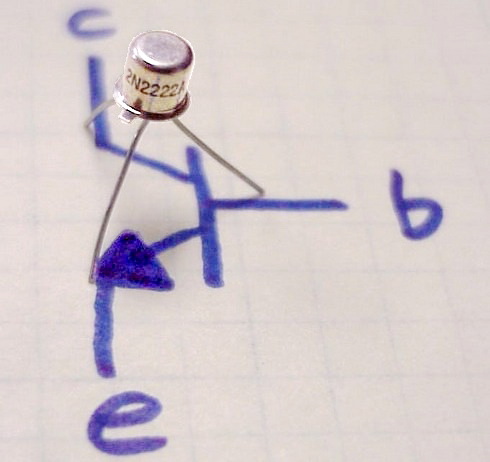
2N2222A in metal TO-18 package with the emitter, base and collector identified as E, B, and C respectively.
Cross section of 2N2222 in metal TO-18 package, showing connection wires between external pins and die.

The 2N2222 is a common NPN bipolar junction transistor (BJT) used for general purpose low-power amplifying or switching applications. It is designed for low to medium current, low power, medium voltage, and can operate at moderately high speeds. It was originally made in the TO-18 metal can as shown in the picture.

The 2N2222 is considered a very common transistor,[1][2][3] and is used as an exemplar of an NPN transistor. It is frequently used as a small-signal transistor,[4][5] and it remains a small general purpose transistor[6] of enduring popularity.[7][8][9]

The 2N2222 was part of a family of devices described by Motorola at a 1962 IRE convention.[10] Since then it has been made by many semiconductor companies, for example, Texas Instruments.[11]

Specifications

[edit]

The JEDEC registration of a device number ensures particular rated values will be met by all parts offered under that number. JEDEC registered parameters include outline dimensions, small-signal current gain, transition frequency, maximum values for voltage withstand, current rating, power dissipation and temperature rating, and others, measured under standard test conditions. Other part numbers will have different parameters. The exact specifications depend on the manufacturer, case type, and variation. Therefore, it is important to refer to the datasheet for the exact part number and manufacturer.

Manufacturer Vce Ic Ptot fT
ST Microelectronics[12]
2N2222A
40 V 600 mA 500 mW (Tamb ≤ 25 °C)
1.8 W (Tc ≤ 25 °C)
300 MHz

All variations have a beta or current gain (hfe) of at least 100 in optimal conditions. It is used in a variety of analog amplification and switching applications.

Other switching transistors

[edit]
Pinout of 2N2222 variants in plastic TO-92 package.

NPN silicon transistors with similar properties are also made in a variety of small through-hole and surface mount packages including TO-92, SOT-23, and SOT-223.

Replacements for the 2N2222 are commonly available in the cheaper TO-92 packaging, where it is known as the PN2222 or P2N2222, which has similar specifications except for the lower maximum collector current.[13] The P2N2222 has a different order of pins than the metal case 2N2222, with its emitter and collector connections switched; other plastic-case transistors also have different pinouts.

Single transistors are also available in several different surface mount packages, and a number of manufacturers market surface mount packages that incorporate several 2N2222-type transistors in one package as an array of transistors. The general specifications of the various variants are similar, with the biggest difference being the maximum allowable current and power dissipation.

The BC548 family, including the BC547A to BC550C, are lower voltage, lower current, general-purpose transistors in TO-92 packages, originating in Europe, that are often found in small-signal amplification and switching circuits of the type where the 2N2222 might otherwise be used. They are not true replacements, but comparable devices that may be substituted only in circuits where the maximum current and voltage ratings are not exceeded.

The 2N2907 is an equally popular PNP transistor complementary to the 2N2222.[14]

The 2N3904 is an NPN transistor that can only switch one-third the current of the 2N2222 but has otherwise similar characteristics. The 2N3904 exhibits its forward gain (beta) peak at a lower current than the 2N2222, and is useful in amplifier applications with reduced Ic, e.g., (gain peak at 10 mA for the 2N3904 but 150 mA for the 2N2222).

A version of the 2N2222A in a larger metal TO-39 case, the 2N2219A had a higher power dissipation rating (3 watts when attached to a heatsink that keeps the case temperature at 25 C, or 0.8 watts in free air, compared with only 1.8 watts and 0.5 watts (respectively) for the 2N2222A.[12]

Part numbers

[edit]

The 2N2222 (NPN) and 2N2907 (PNP) are complementary transistor pairs.[15] The prefix of each part number varies for each physical package type.

Transistor part numbers
BJT Thru-hole Surface-mount
TO-18 TO-92 SOT23 SOT223
NPN 2N2222 PN2222 MMBT2222 PZT2222A
PNP 2N2907 PN2907 MMBT2907 PZT2907A

See also

[edit]

References

[edit]

Further reading

[edit]
[edit]
Revisions and contributorsEdit on WikipediaRead on Wikipedia
from Grokipedia
The 2N2222 is a low-power NPN (BJT) designed for general-purpose switching and amplification in electronic circuits. It operates with a maximum collector-emitter voltage of 30 V, a collector current up to 800 mA, and a power dissipation of 500 mW at ambient temperature, making it suitable for medium-current applications. The device features a planar epitaxial construction, a DC current gain (h_FE) ranging from 35 to 300, and a transition frequency (f_T) of at least 300 MHz, enabling high-speed performance in both linear and switching modes. Originally introduced by in 1962 as part of the 2N series for military and commercial use, the 2N2222 was initially housed in a metal can package to meet reliability standards like those in the MIL-PRF-19500 specification for JAN-class devices. An improved variant, the 2N2222A, offers enhanced voltage ratings (such as 75 V collector-base) and lower saturation voltages (0.3 V at 150 mA collector current), broadening its applicability. Today, it is produced by multiple manufacturers including ON Semiconductor and , often in both metal () and plastic () packages, with operating temperatures from -55°C to +150°C. Key applications include high-speed switching for driving LEDs, relays, and loads in digital circuits; signal amplification in audio, RF, and interfaces; and general-purpose use in hobbyist projects, , and legacy military systems due to its proven reliability and cost-effectiveness. Despite its age—over 60 years—the 2N2222 remains a staple in for its balanced performance and availability as a for similar NPN transistors.

Overview

Description

The 2N2222 is a low-power NPN (BJT) designed for amplification and switching in low- to medium-current applications. It features a planar epitaxial structure housed typically in a metal can package, enabling reliable performance in general-purpose . First specified in 1962 by as a military-grade component, it has become a standard device due to its versatility and robustness. In basic operation, the 2N2222 functions as a current-controlled device where a small input current at the base-emitter regulates a much larger collector-emitter current. The forward-biased base-emitter allows majority carriers (electrons in NPN) to diffuse from the emitter to the base, while the reverse-biased base-collector collects these carriers, amplifying the signal. The supports four operating modes: forward-active for linear amplification, saturation for low-resistance switching, for blocking current, and reverse-active for specialized low-gain scenarios. Key advantages include a high DC current gain (hFE) typically ranging from 100 to 300, enabling efficient signal amplification with minimal base drive, and fast switching capabilities with a transition frequency (fT) around 250–300 MHz, supporting high-speed applications. Its proven reliability in diverse environments has made it a staple in both commercial and legacy military systems.

History

The 2N2222 originated in the early as part of the U.S. military's Joint Army-Navy (JAN) specifications under MIL-PRF-19500, aimed at providing reliable NPN switching s for defense applications. This effort sought to ensure consistent performance in harsh environments, building on earlier devices. Introduced in 1962 by at the IRE convention in New York, the 2N2222 utilized innovative ( Annular Rugged) geometry developed by engineer Jack Haenichen, marking a shift to epitaxial construction for improved speed and reliability. It replaced earlier transistors such as the 2N1304, offering superior thermal stability and higher frequency response suitable for both military and emerging commercial needs. In the late , an improved variant, the 2N2222A, was introduced with higher voltage ratings (such as 40 V collector-emitter and 75 V collector-base) and lower saturation voltages (0.3 V at 150 mA collector current), broadening its applicability. The 2N2222 series gained prominence in space programs through its radiation-hardened variants, tested for reliability in orbital environments, and proliferated in the 1970s boom for applications in radios, amplifiers, and early peripherals. Military specifications advanced in the 1980s with the introduction of higher-assurance levels like JANTX2N2222A under updated JAN standards, emphasizing extended screening for mission-critical use. As of , the 2N2222 remains in continuous production by vendors including , Central Semiconductor, and , benefiting from over six decades of that sustains its role in legacy and new designs.

Design and Construction

Semiconductor Structure

The 2N2222 is a silicon-based NPN featuring a triple-layer structure, consisting of an N-type emitter region, a P-type base region, and an N-type collector region, forming two PN junctions that enable its amplification and switching capabilities. This configuration is achieved through a planar epitaxial fabrication process on a substrate, where the layers are formed using or techniques to precisely control distribution. In terms of doping, the emitter is heavily doped to promote high injection of charge carriers into the base, while the base is lightly doped relative to the emitter to minimize recombination and achieve high , and the collector is moderately doped to support voltage handling without excessive power dissipation. These doping profiles contribute to the transistor's current gain and . The base-emitter junction exhibits forward-biased diffusion , which dominates during operation and arises from stored charge in the base, while the collector-base junction shows reverse-biased depletion due to the space-charge region, both influencing the transition (f_T) of approximately 250-300 MHz. Typical values include input (C_{ib}) up to 25 pF and output (C_{ob}) up to 8 pF at specified test conditions. The active die measures about 0.35 mm × 0.35 mm (0.12 mm²), with aluminum metallization on the top side (1.3 μm thick) for emitter and base contacts and gold-arsenide on the back (0.9 μm thick) for , subsequently encapsulated in hermetic metal (e.g., ) or plastic (e.g., ) packages for protection and handling.

Pin Configuration

The 2N2222 transistor, an NPN , features a standardized pin configuration that varies slightly by package type to facilitate proper electrical connections in circuit designs. In the standard TO-18 metal can package, the pins are arranged as follows when viewed from the bottom (leads pointing away) with the flat side facing the viewer: Pin 1 is the emitter, Pin 2 is the base, and Pin 3 is . is internally connected to the metal case, allowing for direct heat sinking through the package body in applications requiring thermal management. For the plastic package (often designated as the PN2222A variant, though functionally equivalent to the 2N2222A), the pinout is configured with the flat side facing the viewer: the left pin is the emitter, the middle pin is the base, and the right pin is . This orientation ensures consistent wiring across common through-hole mounting practices. In typical circuit implementations, the emitter pin is connected to ground or the common reference point, the base pin receives the input control signal to modulate conduction, and pin interfaces with the load, such as a or another component. For high-power operations approaching the maximum ratings, appropriate heat sinking is recommended, particularly for the package where the case serves as terminal. The schematic symbol for the 2N2222 depicts a standard NPN transistor configuration, with an arrow on the emitter lead pointing outward to indicate current flow direction from collector to emitter in the .
Package TypeView OrientationPin 1/LeftPin 2/MiddlePin 3/Right or Collector Case
TO-18 (Metal Can)Bottom (leads away), flat side facingEmitterBaseCollector (also case)
TO-92 (Plastic)Front, flat side facingEmitterBaseCollector

Electrical Characteristics

Absolute Maximum Ratings

The absolute maximum ratings for the 2N2222A transistor (common variant) represent the extreme limits of operating conditions under which the device can be expected to perform reliably without permanent damage, as specified by the manufacturer. These ratings are critical for circuit designers to ensure safe operation and prevent failure modes such as or . They are typically measured at an ambient temperature of 25°C unless otherwise noted, and values may vary slightly by manufacturer and package type, but the following are standard guarantees for the package.
ParameterSymbolValueUnitConditions/Notes
Collector-emitter voltageVCEO40VOpen base (IB=0)
Collector-base voltageVCBO75VOpen emitter (IE=0)
Emitter-base voltageVEBO6V (IC=0)
Collector currentIC600mAContinuous (800 mA peak for short durations)
Total power dissipationPD625mWAt TA=25°C, package
above 25°C-5mW/°CFor ambient temperature
Thermal resistance, junction-to-ambientθJA200°C/WFor package
Operating junction temperature rangeTJ-55 to +150°C-

Typical Performance Parameters

The 2N2222A NPN bipolar junction transistor demonstrates reliable performance in amplification and switching applications through its key electrical parameters under normal operating conditions. The DC current gain, denoted as h_{FE}, has a minimum value of 35 at a collector current I_C of 0.1 mA and collector-emitter voltage V_{CE} of 10 V, increasing to a minimum of 75 at I_C = 10 mA under the same V_{CE}. Typical h_{FE} values range from 100 to 300 across I_C from 0.1 mA to 150 mA at V_{CE} = 10 V, providing consistent gain for moderate current levels. The transition frequency f_T, a measure of the transistor's small-signal bandwidth, achieves a minimum of 300 MHz at I_C = 20 mA, V_{CE} = 20 V, and test frequency of 100 MHz, enabling high-frequency operation up to VHF ranges. In saturation mode, the collector-emitter saturation voltage V_{CE(sat)} is limited to a maximum of 0.3 V at I_C = 150 mA and base current I_B = 15 mA, minimizing power loss in switching circuits. Output admittance h_{OE}, which reflects the transistor's , has a maximum of 35 μS at I_C = 1 mA and 200 μS at I_C = 10 mA, with V_{CE} = 10 V and f = 1 kHz, corresponding to output resistances of approximately 28 kΩ and 5 kΩ, respectively, for small-signal analysis. The noise figure is low, reaching a maximum of 4 dB at I_C = 100 μA, V_{CE} = 10 V, source resistance R_S = 1 kΩ, and frequency of 1 kHz, making it suitable for low-noise audio amplification. Additionally, the temperature coefficient of h_{FE} is approximately -1%/°C, indicating a gradual decrease in gain with rising temperature as shown in manufacturer characterization graphs.
ParameterTypical ValueConditionsSource
h_{FE} (DC current gain)100–300I_C = 0.1–150 mA, V_{CE} = 10 VON Semiconductor datasheet
f_T (transition frequency)≥300 MHzI_C = 20 mA, V_{CE} = 20 V, f = 100 MHzON Semiconductor datasheet
V_{CE(sat)} (saturation voltage)≤0.3 VI_C = 150 mA, I_B = 15 mASTMicroelectronics datasheet
h_{OE} (output admittance)Max 35–200 μSI_C = 1–10 mA, V_{CE} = 10 V, f = 1 kHzON Semiconductor datasheet
Noise figure≤4 dBI_C = 100 μA, V_{CE} = 10 V, R_S = 1 kΩ, f = 1 kHzON Semiconductor datasheet

Applications

Switching Circuits

The 2N2222 transistor serves as an effective low-side switch in digital circuits, with its base driven directly by logic-level signals such as 5 V TTL outputs to control loads drawing up to 600 mA (pulsed up to 800 mA), including relays, LEDs, and small motors. In this configuration, the connects the load to ground when saturated, enabling efficient on/off operation while minimizing power dissipation in the control logic. Key to its switching performance are the characteristic times: a delay time of approximately 10 ns, of 25 ns, and of 60 ns, typically measured under conditions of VCC = 30 V, IC = 150 mA, and IB = 15 mA. These fast transitions support reliable operation in time-sensitive applications. The device's high transition frequency (fT) of 300 MHz further enables its use in generators and choppers, where switching frequencies up to 100 MHz can be achieved for RF and high-speed modulation tasks. To ensure saturation and low VCE(sat), the base drive current must satisfy IB ≥ IC / hFE_min, with hFE_min typically 100 at IC = 150 mA and VCE = 10 V. When switching inductive loads, such as relays, a circuit—often an RC network across the collector-emitter— is recommended to suppress voltage spikes and protect against transients.

Amplification Circuits

The 2N2222 is widely employed in common-emitter configurations for linear signal amplification, providing voltage gain while inverting the input signal. In this setup, the voltage gain AVA_V is approximately gmRC-g_m R_C, where gm=IC/VTg_m = I_C / V_T is the , ICI_C is the collector current, and VT=26V_T = 26 mV is the thermal voltage at 25°C. This configuration leverages the 's typical current gain hFEh_{FE} of 100 to 300 at moderate collector currents, enabling effective amplification of small signals with a collector RCR_C selected for desired gain and load matching. It is particularly suitable for audio applications, supporting bandwidths up to 20 kHz without significant distortion in low-power designs. For applications requiring higher current gain, such as interfacing with low-output sensors, a pair can be formed using two 2N2222 transistors, where the collector-emitter path of the first drives the base of the second. This arrangement multiplies the individual hFEh_{FE} values, yielding an effective gain exceeding 10,000 (based on minimum hFE=100h_{FE} = 100 per transistor), while maintaining the voltage rating but increasing the saturation voltage. The configuration enhances sensitivity for weak signal amplification but introduces higher base-emitter voltage drop, typically around 1.2 V. In radio-frequency (RF) amplification, the 2N2222 operates effectively up to the VHF band (30–300 MHz), owing to its transition frequency fTf_T of 250–300 MHz, which defines the upper limit for useful gain. It finds use in low-power oscillators and mixers, where impedance matching networks ensure maximum power transfer and minimize reflections. Stable operation in these amplification circuits relies on proper biasing techniques, such as the voltage divider method applied to the base, which provides temperature-independent quiescent point setting by drawing current through resistors much larger than the base current. Additionally, AC coupling via capacitors at input and output stages prevents DC offsets from propagating in multi-stage amplifiers, preserving signal integrity.

Variants and Packaging

Part Number Variations

The 2N2222 originated as a military-grade device under the Joint Army-Navy (JAN) specification, introduced by in 1962 for high-speed switching applications in hermetic packages. This version met the requirements of MIL-PRF-19500/255, establishing baseline performance for NPN silicon switching transistors with collector currents up to 800 mA. The 2N2222A variant emerged as a commercial upgrade, featuring enhanced voltage ratings such as VCEO up to 40 V (compared to 30 V for the original 2N2222), with DC current gain (hFE) ranging from 35 to 300—similar to the original. It also received CECC 50002-101 approval for European standards, ensuring compatibility in regulated amplification and switching circuits. Motorola's MPS2222 serves as a commercial equivalent to the 2N2222, maintaining similar electrical characteristics including a 30 V VCEO and 600 mA IC maximum, but optimized for plastic packaging to reduce costs in non-military applications. The PN2222 and PN2222A are common plastic-packaged () equivalents to the 2N2222 and 2N2222A, respectively, with matching electrical specifications including VCEO of 40 V and IC up to 800 mA, widely used in general-purpose and hobbyist applications. Within the same family, the 2N2219 and 2N2221 represent related types with similar power handling (Pd 500 mW, IC 800 mA), but the 2N2221 has a lower VCEO of 30 V compared to 40 V for the 2N2222, suiting applications with reduced voltage requirements. The 2N2219A offers VCEO of 40 V for medium-power switching. Certifications for the 2N2222 series include qualification under MIL-PRF-19500 for reliability, with RoHS compliance achieved in lead-free finishes starting in 2006 to meet environmental directives. For space and high-reliability uses, screening levels such as Class B are applied, including thermal cycling and radiation hardness assurance up to JANTXV levels.

Package Types and Dimensions

The 2N2222 transistor is available in several package types, each suited to different assembly and environmental requirements, with the metal can providing robust hermetic sealing for high-reliability applications such as and systems. The package features a cylindrical metal with a of approximately 5.08 mm and a lead of 0.41 mm, spaced at 2.54 mm center-to-center, enabling through-hole mounting while offering a junction-to-case resistance (θJC) of 83.3 °C/W for efficient heat dissipation in demanding conditions. Constructed from with glass-to-metal seals, it weighs about 0.7 g, contributing to its durability in harsh environments. For cost-sensitive, general-purpose designs, the plastic package is widely used, featuring a molded flame-retardant body with a height of 5.2 mm maximum and a lead pitch of 1.27 mm for straightforward through-hole PCB insertion. This package has a higher junction-to-ambient thermal resistance (θJA) of 200 °C/W, limiting its power handling without additional cooling, and weighs approximately 0.2 g, making it lightweight for . Surface-mount applications benefit from the SOT-23 variant (often designated MMBT2222A), which offers a compact 2.9 mm × 1.3 mm footprint ideal for dense PCB layouts in modern compact devices, with adoption growing in the 1990s alongside the rise of SMD technology. This plastic-encapsulated package supports automated assembly but requires careful thermal management due to its smaller size and higher θJA, typically around 250 °C/W.
Package TypeKey DimensionsThermal ResistanceMaterialApproximate Weight
TO-18 (Metal Can)Diameter: 5.08 mm; Lead spacing: 2.54 mmθJC: 83.3 °C/WSteel with glass seals0.7 g
TO-92 (Plastic)Height: 5.2 mm; Lead pitch: 1.27 mmθJA: 200 °C/WFlame-retardant epoxy0.2 g
SOT-23 (SMD)Footprint: 2.9 × 1.3 mmθJA: 250 °C/WPlastic<0.1 g
Mounting guidelines emphasize thermal and mechanical integrity: for power dissipation (PD) exceeding 500 mW, particularly in or SOT-23 packages, attach a heatsink to maintain junction temperatures below 150 °C, as the base PD rating assumes free-air conditions. Lead bending should incorporate a minimum radius of 0.5 mm to prevent stress cracks, with bends performed at least 1.5 mm from the package body using appropriate tooling. These practices ensure reliability, with pin layouts consistent across packages as detailed in the pin configuration section.

References

Add your contribution
Related Hubs
User Avatar
No comments yet.